Forex trading sessions divide the working week into periods associated with Sydney, Tokyo, London and New York. They help explain which financial centres are active, when their business hours overlap and how overseas events fit into an Australian trading day. They do not provide a reliable forecast of price direction.
For Australian readers, the practical challenge is the clock. London’s morning arrives in the Australian afternoon or evening, while New York’s working day runs into the night. Daylight saving changes those relationships during the year.
Australian regulatory context: ASIC prohibits the issue and distribution of binary options to retail clients in Australia. The binary options product intervention order runs until 1 October 2031. This guide explains market timing for education and market observation, not as an invitation to open an offshore binary options account.
What a Forex Trading Session Actually Means
A session is a useful description of regional business activity, not an exchange opening bell. Spot foreign exchange has no single central marketplace that switches on in Sydney and shuts down in New York. Banks, dealers and electronic venues operate across different locations.
The Australian Foreign Exchange Committee confirms that there are no set daily trading hours for the foreign exchange market. Normal activity extends from early Monday in Sydney until Friday afternoon in New York. Individual platforms can provide narrower access, maintenance breaks or different opening times.
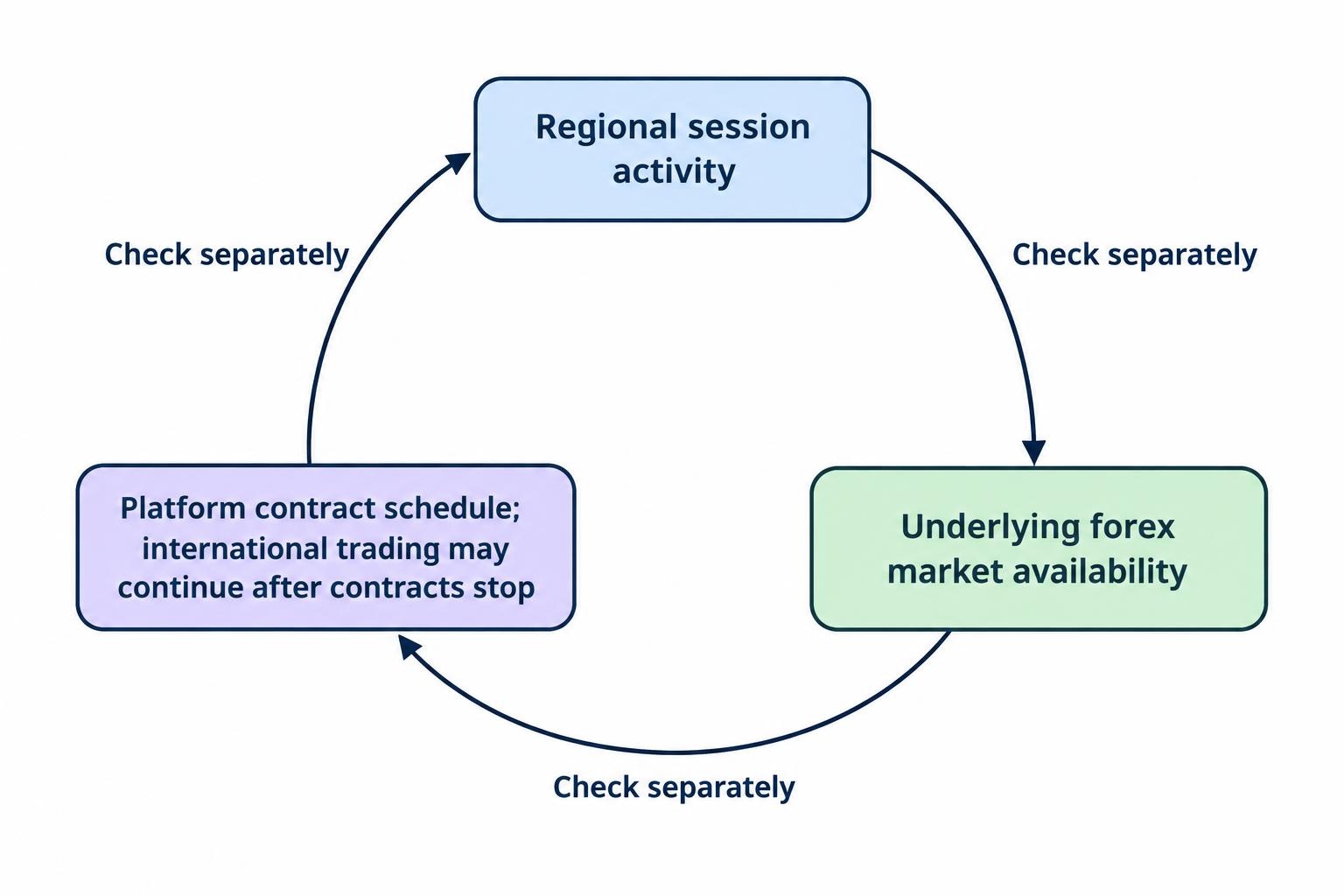
Three clocks therefore deserve separate attention: the regional session, the underlying market’s availability and the platform’s contract schedule. A currency pair can still be trading internationally after a provider stops accepting contracts on it. Equally, a moving platform chart does not prove that the normal weekday currency market is active.
Forex Session Times in UTC
Session clocks do not all use identical boundaries. For a consistent comparison, the table below uses these illustrative local business blocks: Sydney 08:00–17:00, Tokyo 09:00–18:00, London 08:00–17:00 and New York 08:00–17:00.
These are reference windows, not regulated opening hours. January and July show two clear seasonal arrangements; they should not be applied unchanged during the clock change weeks.
| Session | Assumed local hours | January, UTC | July, UTC |
|---|---|---|---|
| Sydney | 08:00–17:00 | 21:00–06:00 | 22:00–07:00 |
| Tokyo | 09:00–18:00 | 00:00–09:00 | 00:00–09:00 |
| London | 08:00–17:00 | 08:00–17:00 | 07:00–16:00 |
| New York | 08:00–17:00 | 13:00–22:00 | 12:00–21:00 |
Where the ending time is earlier than the starting time, the window crosses midnight in UTC. The Sydney session’s UTC starting date can therefore be the previous calendar day relative to its Australian date.
Use the table to compare periods, rather than to decide whether an order will be accepted. Contract availability must be checked separately.
Forex Trading Sessions in Australian Time
“Australian time” is not precise enough for a session timetable. Sydney uses AEST, UTC+10, during standard time and AEDT, UTC+11, during daylight saving. Brisbane remains on UTC+10, while Perth remains on UTC+8. Adelaide and Darwin require half-hour offsets. Tourism Australia’s time zone guide sets out these differences and which states observe daylight saving.
Using the same reference windows, the Sydney conversions are:
| Session | January, AEDT | July, AEST |
|---|---|---|
| Sydney | 08:00–17:00 | 08:00–17:00 |
| Tokyo | 11:00–20:00 | 10:00–19:00 |
| London | 19:00–04:00 | 17:00–02:00 |
| New York | 00:00–09:00 | 22:00–07:00 |
The January New York window falls on the following Sydney calendar day relative to the New York business date. A Monday morning in New York corresponds to the early hours of Tuesday in Sydney.
Notice the two-hour difference between London’s January and July opening times in Sydney. Both cities change their clocks, but in opposite seasons. Copying a timetable marked “summer hours” without checking whose summer it means is an efficient way to arrive late.
Why Daylight Saving Changes the Overlaps
London and New York do not change their clocks on the same dates. In 2026, the UK’s clock change dates are 29 March and 25 October. The UK government’s clock change schedule also lists the dates for following years.
New York follows the US schedule: daylight saving runs from 8 March to 1 November in 2026. The NIST daylight saving rules specify the second Sunday in March and first Sunday in November.
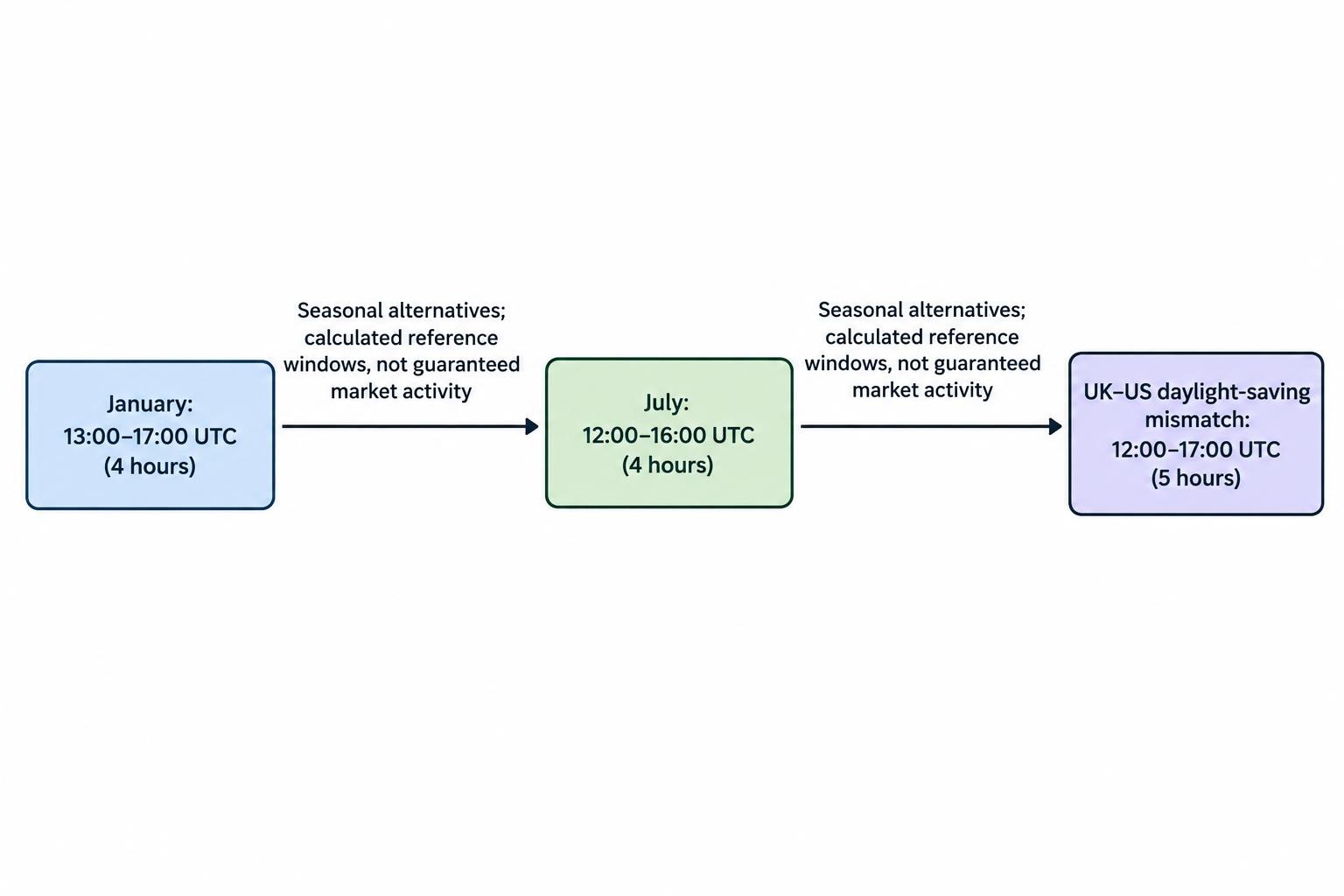
Under the session definitions used here, London and New York normally overlap for four hours: 13:00–17:00 UTC in January and 12:00–16:00 UTC in July. During their daylight saving mismatch periods, that overlap becomes five hours, from 12:00–17:00 UTC.
For Sydney, the ordinary January overlap converts to 00:00–04:00 AEDT on the following day. In July it becomes 22:00–02:00 AEST. These are calculated reference windows, not promises about market activity.
Set alerts using named city time zones where possible, rather than a permanent UTC offset. A reminder labelled “London 08:00” should follow London’s clock. A reminder fixed at “08:00 UTC” will not. Recheck calendar settings after clock changes, especially if your chart and event calendar use different time zones.
Liquidity and Volatility Are Not the Same Thing
Liquidity concerns the ability to transact without moving the price excessively. Volatility concerns how much the price changes. A busy market can offer substantial liquidity while also moving sharply; an apparently quiet market can become difficult to transact in when available quotes disappear.
Historical evidence links higher activity with greater price movement during the London and New York overlap. A 2007 RBA study of intraday currency volatility and turnover documented that pattern, alongside spikes around economic releases. It also found that high volatility can coexist with poor liquidity during market distress. Those findings describe historical relationships, not a guaranteed schedule for the next trading day.
The practical lesson is to separate participation from predictability. More transactions do not make the next price movement easier to forecast. A session label also says nothing about a binary contract’s payout, settlement feed or execution delay.
What to Observe During Each Session
Sydney: Separate Australian News from the Session Label
For an Australian dollar study, mark domestic announcements on the chart and distinguish those periods from ordinary business hours. Otherwise, a few news-driven movements can distort your impression of the entire session.
AUD/USD is a useful research subject because either currency can drive its price. Do not assume the Australian dollar matters only while Australian desks are working. The AUD/USD market guide covers the pair itself; session analysis adds the timing layer.
Tokyo: Do Not Assume Every Asian Session Behaves Alike
Tokyo provides a reference point for examining yen pairs such as USD/JPY and AUD/JPY. Record whether Japanese announcements or other scheduled events fall inside the observation window.
A quiet opening hour does not establish that the remaining session will stay quiet. Nor does one strong move establish an “Asian session trend”. Compare repeated observations before assigning a pattern to a region.
London: Watch the Handover, Not Just the Opening Minute
When studying London hours, compare the period before the reference opening with the period after it. Record whether price continues an earlier move, reverses it or stays inside the same range.
EUR/USD and GBP/USD can provide relevant subjects for European event studies. However, “London open” is not an instruction to buy a breakout. The opening time defines when to observe; it does not supply the trade direction.
New York: Keep News and Ordinary Activity Separate
For New York observations, distinguish the London overlap from the later US afternoon. Combining them into one result can conceal differences within the session.
Also separate scheduled announcement periods from ordinary minutes. If a hypothetical test succeeds only on a handful of announcement days, describe it as an event-dependent result rather than evidence that an entire session offers an advantage.
Session Timing, Economic Releases and Binary Expiry
A session window is several hours long. A binary option’s outcome can depend on a much shorter interval. Knowing that a contract expires “during London” says little about what happens between entry and settlement.
Before any paper exercise, check an economic calendar for both currencies. Record the event time in the same zone as the chart. Do not rely on the calendar’s default setting or assume it matches the platform clock.
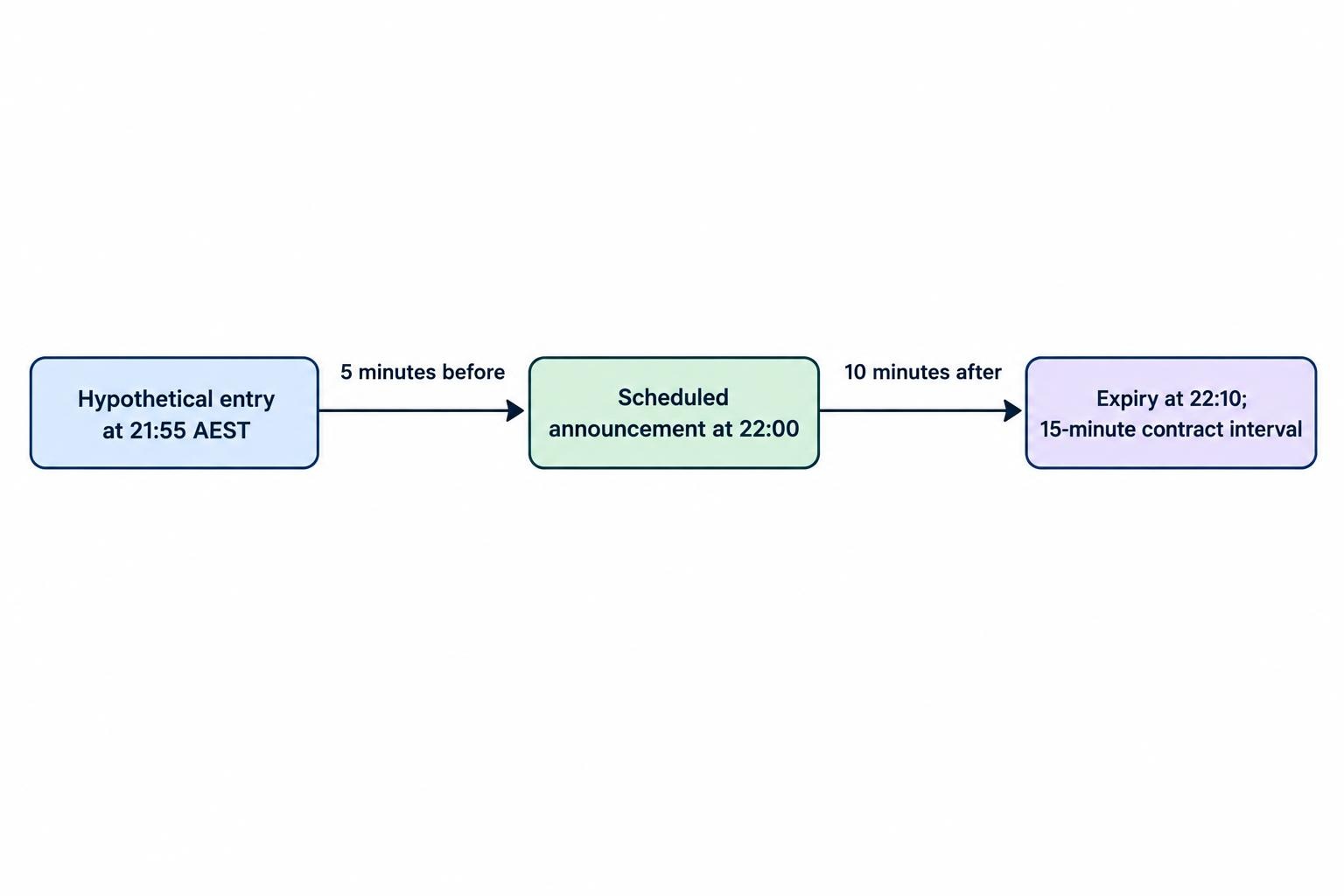
Consider a hypothetical 15-minute contract entered at 21:55 AEST and expiring at 22:10. If a scheduled announcement falls at 22:00, the observation includes five minutes before the release and ten minutes after it. Calling the result a “London session trade” hides the event that may have dominated the interval.
The opposite problem also matters. An event can cause a sharp movement before entry, followed by a reversal during the contract. Correctly identifying the announcement’s broader effect would not necessarily produce a successful short expiry outcome.
The relevant question is where settlement falls relative to the event, not just which session contains the entry. Our guide to binary options expiry times covers that contract timing distinction.
For analysis, retain the entry timestamp, expiry timestamp and event timestamp together. Screenshots without a visible time zone make later comparisons much less useful.
Weekends, Holidays and the Daily Handover
A session chart describes ordinary weekday activity. It does not establish that equivalent conditions exist over a holiday or that a platform’s weekend instrument tracks the same market as its weekday currency pair.
If a provider displays a weekend product labelled “EUR/USD OTC”, investigate its pricing and settlement rules before treating it as comparable with weekday EUR/USD. “OTC” by itself does not explain the feed: conventional spot forex also trades over the counter. The separate guide to OTC and weekend quotes addresses that distinction.
Check published maintenance arrangements around the daily handover as well. A platform break, a missing quote and a regional session ending are different events. In an observation log, record them separately rather than interpreting every interruption as a market signal.
How to Use Sessions in a Market Observation Plan
The most useful session comparison is narrow enough to repeat. Choose one currency pair, define the observation hours and keep the chart settings consistent. Comparing Tokyo on a one-minute chart with London on an hourly chart tells you very little about either session.
A practical record should include:
- The date, currency pair, session definition and time zone.
- Scheduled events affecting either currency.
- The price range over a fixed observation period.
- Any quote interruptions, feed differences or changed contract terms.
Keep news days separate from ordinary days and mark clock change weeks. Otherwise, an apparent change in session behaviour may simply reflect a shifted event time. Avoid judging a session from its most memorable chart; dramatic screenshots are good at being memorable, not representative.
Use the broader forex markets guide to connect session timing with currency pairs and market drivers. Keep each question separate: what market are you observing, what information is arriving, and what interval are you measuring?
There is no universally best forex session. The useful window is the one that fits the research question and can be observed consistently. Session timing provides context. It does not create a directional signal, guarantee a favourable payout or remove the risks of the product being studied.
This article was last updated on: October 22, 2026