Trading psychology is the way emotions, habits and beliefs influence decisions under financial uncertainty. In binary options, the practical question is not whether you feel confident. It is whether you can follow a defensible decision process without changing it because the previous contract won or lost.
For Australian readers, the legal position comes first. ASIC’s prohibition on issuing and distributing binary options to retail clients took effect on 3 May 2021 and has been extended until 1 October 2031. The ASIC announcement extending the binary options ban sets out the restriction. The examples below are educational and can be examined through paper trading; they are not a reason to fund an offshore account.
What Trading Psychology Can and Cannot Do
Good psychological habits can help you identify impulsive decisions, document uncertainty and stop when your own rules require it. They cannot turn an unprofitable contract into a profitable one, repair an unreliable price feed or make an unsuitable product appropriate.
This distinction matters because “work on your mindset” can become an explanation for every loss. Sometimes the problem is behaviour. Sometimes the method has no demonstrated advantage. Sometimes the payout does not compensate for the risk. Treating all three as a confidence problem sends the review in the wrong direction.
Psychology therefore belongs within a broader binary options risk management process, not above it. Financial exposure, contract terms, evidence and stopping rules still come first. Calmly following a bad plan is still following a bad plan.
Confidence does not change the payout maths
Consider a hypothetical contract with a A$10 stake and an 80% net profit payout. A win returns the stake plus A$8; a loss costs A$10. Across ten contracts, five wins and five losses produce a A$10 net loss, before any other costs.
Under those assumptions, with no ties or refunds, the break-even win rate is 10 ÷ 18, or about 55.56%. Feeling composed while winning half the time does not close that gap.
Keep this calculation separate from emotional self-assessment. “I followed my rules” and “the method has positive expected value” are different claims, requiring different evidence. The relationship between payout and required accuracy is covered in probability and expected value in binary options.
Recognise the Decision Pattern, Not Just the Emotion
Words such as fear, greed and discipline are broad. A more useful review identifies what happened between the feeling and the action: a stake increased, an entry condition disappeared, or a planned stopping point became negotiable.
Loss aversion and the need to get back to even
Loss aversion concerns the unequal weight people place on losses and comparable gains. The original Kahneman and Tversky prospect theory paper also describes how choices can change when outcomes are framed as gains rather than losses. It is research into decisions under risk, not a binary options profitability study.
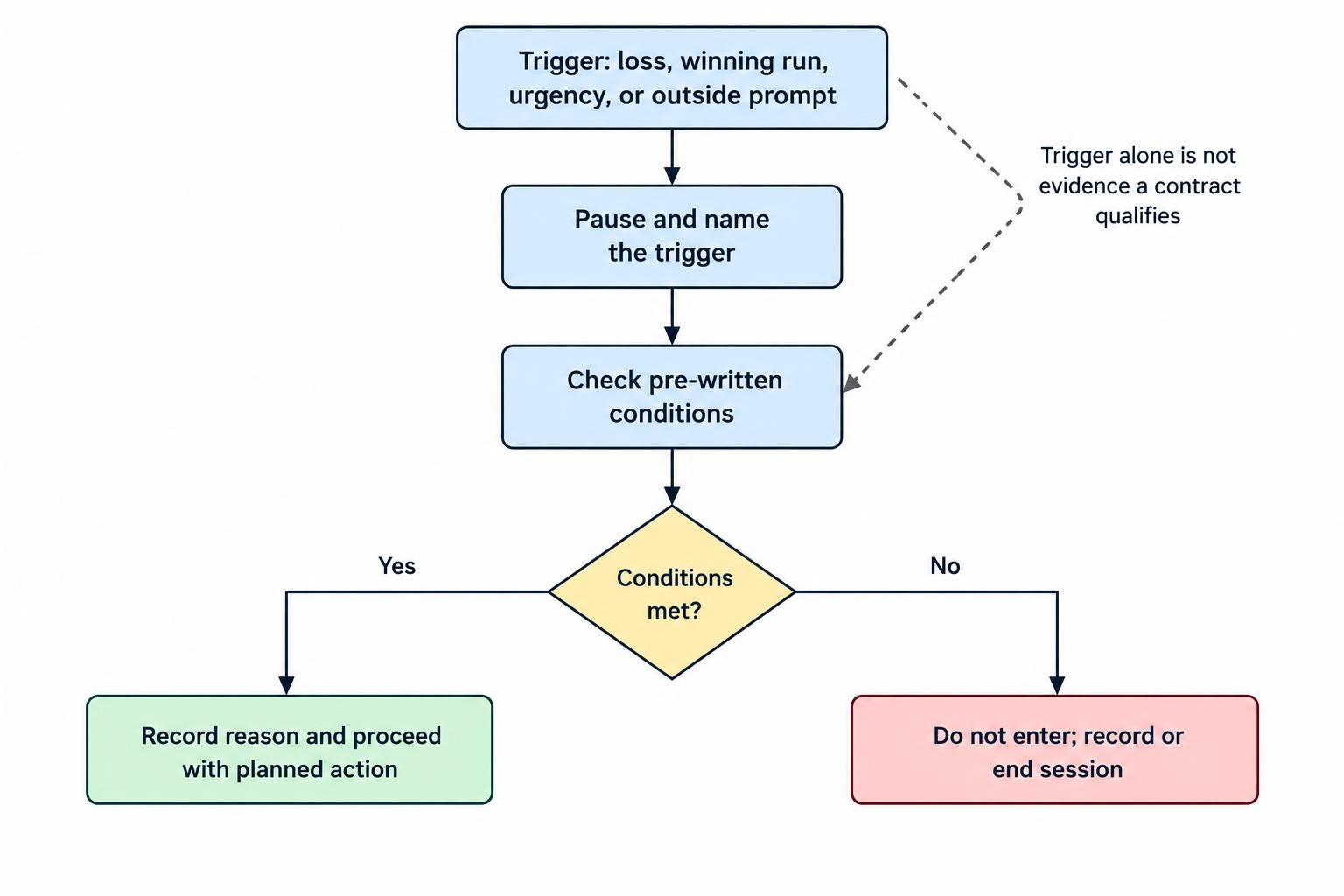
A practical warning sign is a change in the purpose of the next decision. Before a loss, the question might have been, “Does this meet my entry conditions?” Afterwards, it becomes, “What would get me back to this morning’s balance?” The second question makes an old account value the target, rather than assessing the next opportunity on its own terms.
Suppose a paper trader records three losses and increases the next simulated stake solely to recover them. Even if that contract wins, the decision process has changed. Recovery replaced the original selection rule.
Write down the recovery thought without acting on it. “I want to erase the last result” is a useful observation, not an entry signal. The separate guide to chasing trading losses examines this pattern in more detail.
Overconfidence after a winning run
A few successful predictions do not establish a reliable advantage. They also do not justify changing several parts of a plan at once.
Watch for a mismatch between the evidence collected and the freedom you give yourself. Increasing stakes, accepting weaker entries and adding unfamiliar markets after a short winning run makes it harder to identify what the original method actually achieved.
Confidence should attach to a task you can verify: recording every decision, checking the contract terms, or respecting a stopping rule. Confidence in the next outcome is a different matter. The market does not issue loyalty points for the last five predictions.
Keep any proposed change outside the active session. Record the reason, decide what evidence would support it, and review it later. A profitable afternoon is a result to examine, not automatic permission to expand exposure.
Fear of missing out and selective evidence
Fear of missing out becomes visible when urgency replaces qualification. A price moves, someone posts a winning screenshot, and a previously optional entry suddenly feels compulsory.
Use a counter-question: “If I had not seen that screenshot or price jump, would this decision still qualify?” If the answer is no, the trigger came from attention or comparison rather than the written method.
Selective evidence presents a related problem. After forming a directional view, you might keep the chart or indicator that supports it and dismiss the one that does not. Record what would invalidate the idea before checking the result. Otherwise almost any outcome can acquire a convincing explanation afterwards.
Separate Decision Quality from the Result
A winning contract can follow a poor decision. A losing contract can follow a properly executed rule. Neither statement proves that the underlying rule is profitable.
In five studies reported in Baron and Hershey’s research on outcome bias, participants evaluated decisions more favourably when their outcomes were favourable, despite having the relevant information available to the original decision maker. The experiments were not binary options tests, but they provide a useful warning for trade reviews: knowing the ending can distort the grade.
Review your actions before reviewing the balance change. A simple framework keeps those questions apart:
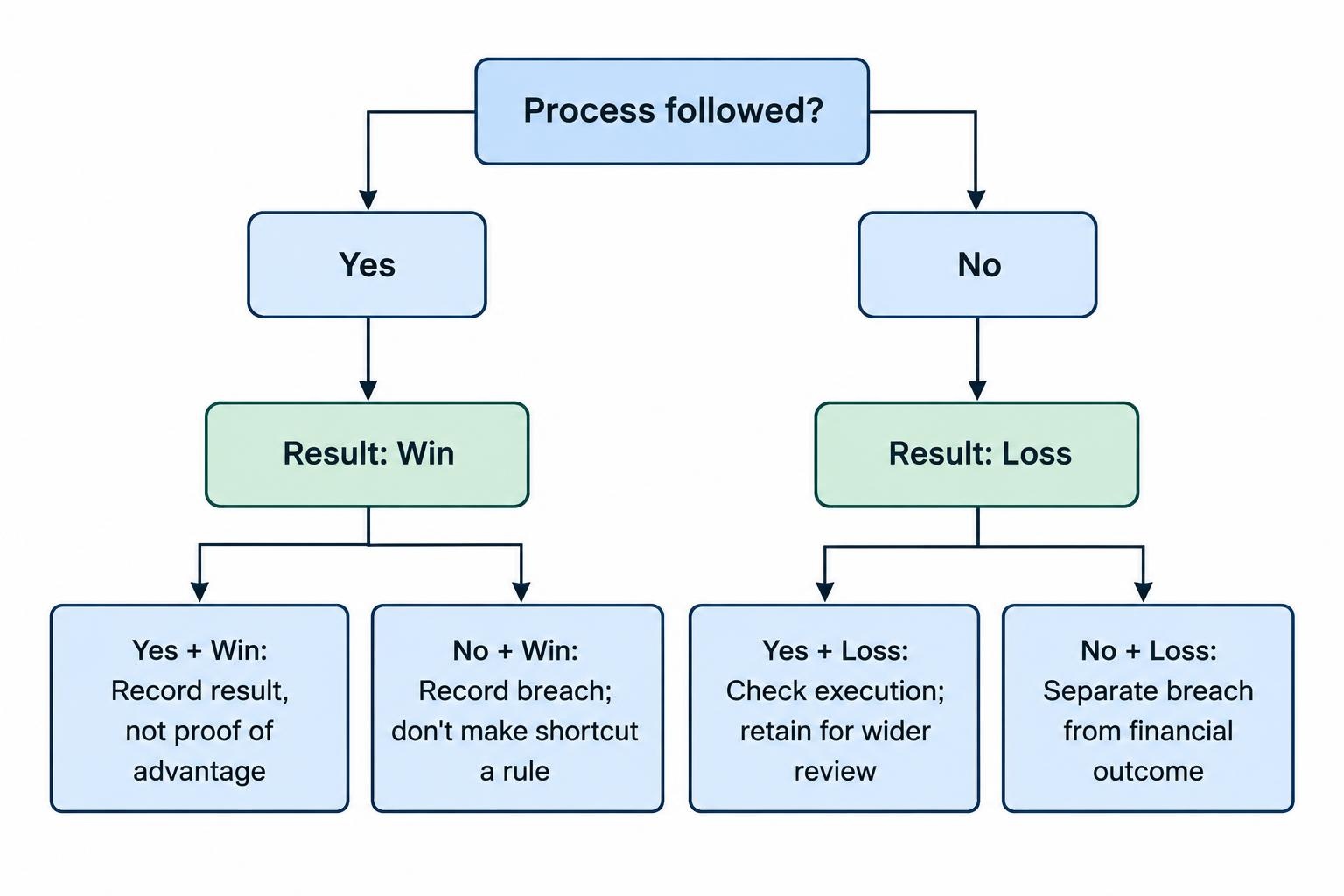
| Process followed? | Result | Review response |
|---|---|---|
| Yes | Win | Record the result without treating it as proof of an advantage. |
| Yes | Loss | Check the execution and retain the observation for the wider review. |
| No | Win | Record the rule breach; do not promote the shortcut into a new rule. |
| No | Loss | Identify the breach separately from the financial outcome. |
This is not an excuse to ignore losses. Results remain necessary for evaluating a method. The point is to avoid using one result to answer every question about selection, execution and profitability.
Reduce Prompts That Have Nothing to Do with Your Plan
Your decision environment deserves attention alongside your reactions. In an online experiment involving more than 9,000 consumers, certain app features increased trading frequency or risk taking. The FCA trading app experiment tested flashing prices, push notifications, a leaderboard, and points with a prize draw. It did not establish how every binary options interface affects every user.
The practical response is to remove unnecessary prompts where possible. Turn off promotional notifications, close performance leaderboards and keep signal chats away from the decision screen. A message arriving is not evidence that a contract qualifies.
For paper practice, separate observation from entry. Write the reason in your record before marking the hypothetical contract. If the opportunity disappears before you can describe it, let it disappear. That is preferable to inventing the reason after seeing the result.
Also define what the session is for. “Observe whether this setup appears” creates a different task from “find something to trade.” The first permits no action. The second makes inactivity look like failure.
Build a Routine That Does Not Depend on Willpower
A useful routine converts a vague intention into an observable action. “Be disciplined” is difficult to audit. “Do not record an entry unless the conditions are written first” is much clearer.
Before the session: define the boundaries
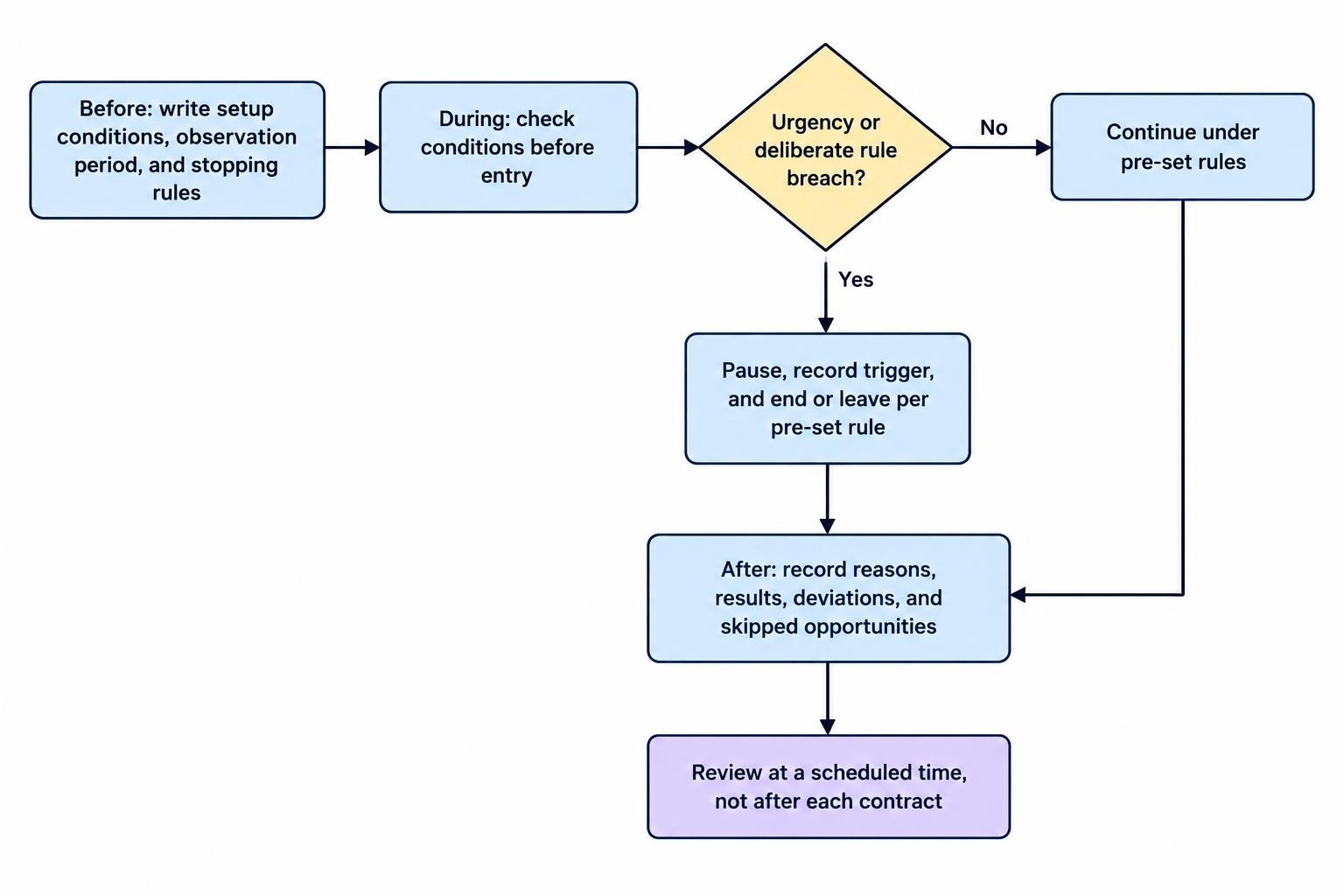
Prepare the permitted setup, observation period and stopping conditions before opening the charts. For paper trading, choose a fixed simulated balance and exposure rule rather than resetting whenever the results become uncomfortable.
Keep position exposure separate from how strongly you feel about a prediction. A plan that allows larger stakes whenever an opportunity “looks obvious” has left a large opening for discretion. The stake sizing guide covers the exposure calculation; psychology concerns whether you change that calculation under pressure.
Use a short readiness check:
- Can I state the entry conditions without looking at the latest result?
- Am I trying to recover money, relieve boredom or prove a point?
- Do I accept that this observation session may contain no qualifying entries?
- Have I written the conditions that require me to stop?
These questions are prompts, not a clinical assessment or a validated trading score. Their value is in making the decision explicit. If an answer exposes a conflict, resolve it before continuing rather than promising to behave better once the screen is moving.
During the session: treat urgency as a pause signal
Notice the language of an approaching exception: “just this once,” “the next one should recover it,” or “I cannot finish down.” None describes the contract’s merits.
When that language appears, stop adding decisions and record the trigger. Close the order screen or leave the paper exercise. Decide the pause rule beforehand, including whether the session ends after a deliberate rule breach. Otherwise the pause itself becomes another negotiation.
A break is not permission to return automatically. Check whether the original conditions still apply and whether the desire to recover or prove something remains. You do not owe the session another entry.
After the session: record actions, not character judgements
“I am terrible at this” offers little to review. “I entered twice without the required condition after reading a signal message” identifies a behaviour and its trigger.
Keep the original entry reason, the result, any deviation and the action that followed. Add a brief description of the emotional state if useful, but avoid turning the record into a long defence of the decision.
A structured trading journal should make patterns easier to inspect. Record skipped opportunities too, especially when you rejected them because they failed the rules. Otherwise the record contains actions but none of the restraint.
Review at a scheduled time rather than rewriting the method after each contract. If you change a rule, preserve its previous version and date the change. Without that record, an apparently consistent method may actually be several different methods mixed together.
Practise the Response, Not Just the Prediction
Paper trading can test whether you follow instructions without putting money at risk. Give the exercise a behavioural objective rather than a profit target.
For example, plan to observe one market for a set period and record only entries that meet a written condition. Halfway through, two hypothetical contracts lose. A third opportunity appears, but it lacks one required feature.
The exercise is not to find a clever way to recover. It is to document why the third opportunity does not qualify and leave it alone. If the price later moves in the predicted direction, keep the original assessment. A missed winner does not retroactively supply the missing condition.
Repeat the same approach after wins. Check whether a profitable result changes the simulated stake, the required evidence or the planned finishing time. Record those changes rather than hiding them inside the session total.
Do not treat success in simulation as proof that real money would produce the same behaviour. The financial consequences are different, and the differences between demo and live trading extend beyond the balance displayed. For Australian retail readers, practice is not a required stepping stone to live binary options trading.
The useful output is narrower: a record showing whether you can recognise a trigger and follow the response you chose in advance. It is also acceptable to find that repeated screen exposure makes the activity harder to leave. That finding is a reason to reconsider the exercise, not increase its intensity.
Know When the Right Response Is to Stop
Not every problem belongs in a trading journal. If the activity is affecting bills, relationships, work or your ability to stop, the next step should not be another strategy adjustment.
Repeatedly breaking a stopping rule is not solved by writing the same rule in larger letters. Stop adding money, step away from promotional groups and discuss what is happening with someone who is not selling access to trading.
Borrowing money, hiding the extent of the activity, spending more than intended and feeling driven to return to recover losses are recognised warning signs in the Queensland Government guidance on gambling harm. These signs are not a diagnosis, but they warrant attention. Australians affected by gambling harm can call 1800 858 858 for free, confidential support, available 24 hours a day, seven days a week.
Measure Better Decisions, Not Greater Confidence
Useful signs of progress include fewer undocumented decisions, fewer exceptions after losses, complete records and a greater willingness to finish without taking action. None guarantees profitability.
The aim is not to become emotionally blank. It is to prevent a feeling from quietly rewriting the rules. You can notice frustration without increasing exposure, acknowledge uncertainty without forcing a prediction, and stop without first recovering an earlier balance.
Trading psychology is most useful when it makes those choices visible. It should help you question the activity as well as your behaviour within it. Sometimes the best evidence of sound judgement is deciding not to continue.
This article was last updated on: October 22, 2026