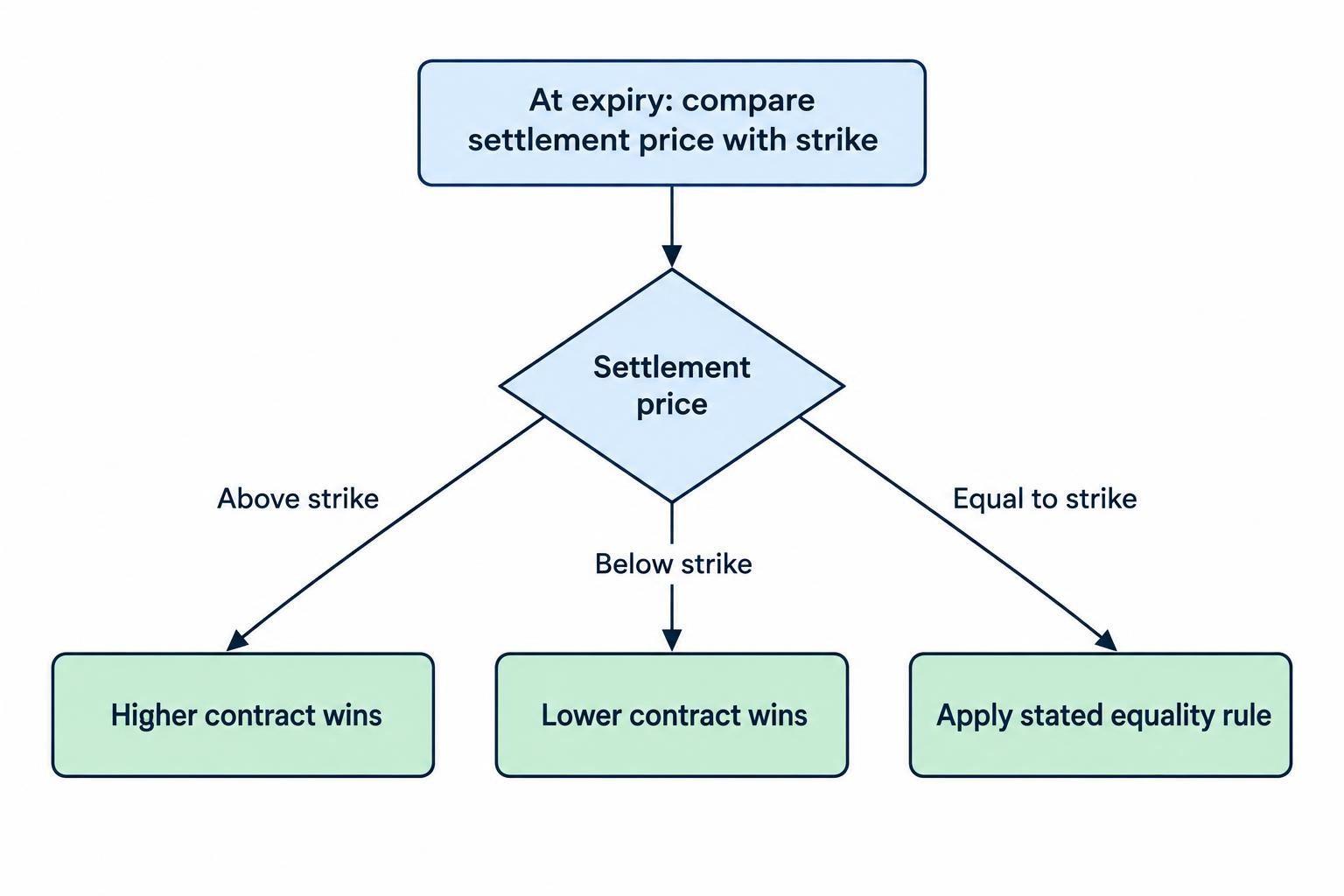
AUD/USD binary options link a fixed payout to a condition involving the Australian dollar’s value against the US dollar. In a basic higher or lower contract, the question is whether the settlement price finishes above or below an agreed strike at expiry. Forecasting the broader trend is not enough: the contract must meet its condition at the stated time.
Australian retail access is restricted. ASIC’s prohibition on issuing and distributing binary options to retail clients took effect on 3 May 2021 and has been extended until 1 October 2031. This page explains the market and contract mechanics for educational purposes, not as a route around the ASIC binary options product intervention order.
Reading the AUD/USD Quote
AUD/USD expresses how many US dollars buy one Australian dollar. A hypothetical quote of 0.6500 means A$1 is worth US$0.65. If the quote rises to 0.6520, the Australian dollar has strengthened against the US dollar. If it falls to 0.6480, it has weakened.
For a standard directional binary, a higher contract requires settlement above the strike; a lower contract requires settlement below it. Equality needs its own rule. A platform’s use of labels such as “call” and “put” does not remove the need to read that condition.
The same quotation logic applies across forex markets used for binary options, but the direction depends on the order of the currencies. Buying a higher AUD/USD contract expresses a view on AUD relative to USD, not a view that both currencies will strengthen against every other currency.
An AUD/USD Binary Options Example
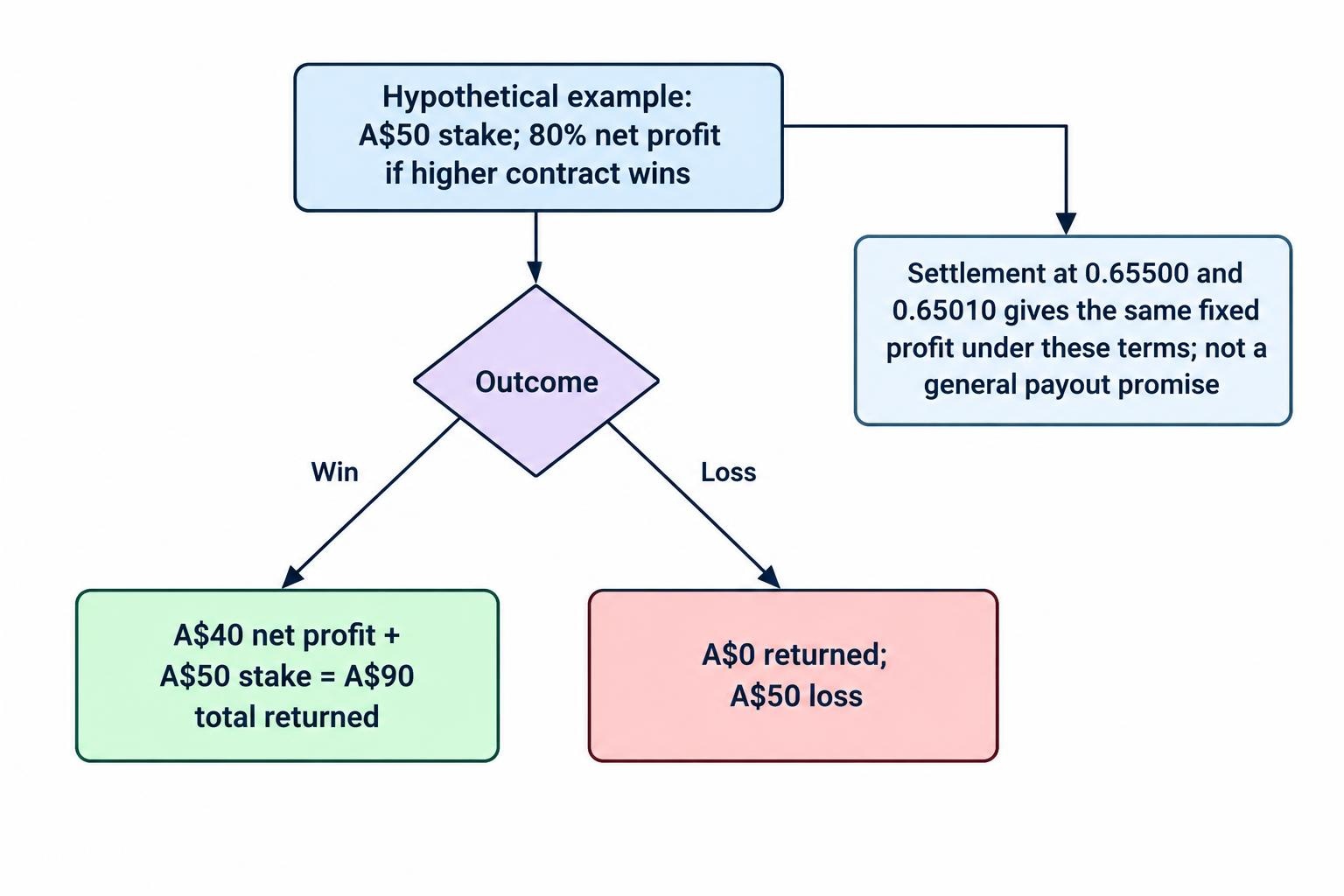
Consider a paper exercise with these hypothetical terms: an AUD/USD strike of 0.65000, expiry at 10:15 UTC, a stake of A$50 and an 80% net profit payment if the higher contract wins. Assume a losing contract returns nothing, with no fees or rebates.
| Settlement price | Contract result | Total amount returned | Net profit or loss |
|---|---|---|---|
| 0.65010 | Win | A$90 | +A$40 |
| 0.64990 | Loss | A$0 | −A$50 |
| 0.65000 | Depends on the equality rule | Contract dependent | Contract dependent |
The winning return includes the original A$50 stake plus A$40 profit. It is not A$90 profit. Also, settlement at 0.65500 would produce the same A$40 profit as settlement at 0.65010 under these fixed terms. A larger favourable currency move does not increase the payment.
The path before expiry can be misleading. AUD/USD could spend most of the contract above the strike, then finish below it and lose. Conversely, a contract could remain below the strike until its final moments and still win. For an expiry based higher or lower contract, briefly crossing the strike is not enough.
The A$50 figure describes the stake’s account currency. It does not mean the contract buys A$50 in the foreign exchange market.
The Settlement Feed Matters as Much as the Chart
AUD/USD does not have one universal spot price published by a single exchange. Foreign exchange trading takes place across venues and liquidity providers, a structure examined in the BIS research on fragmented spot currency markets. A chart used for analysis therefore needs to be distinguished from the reference used to settle a contract.
Check whether the terms use a bid, ask, midpoint, calculated index or another stated reference. Also establish whether settlement uses one observation, an average over a window or the last valid quote before expiry. Do not assume the visible candle close answers those questions.
Suppose an analysis chart shows 0.65002 while the contractual settlement reference records 0.64999 against a 0.65000 strike. The difference looks tiny, but it places the observations on opposite sides of the condition. That difference alone neither proves misconduct nor establishes that settlement was correct. The published methodology and recorded prices are what need checking.
Displayed precision also matters. A screen rounded to four decimal places may hide a difference retained in the settlement calculation. A screenshot without the instrument name, timestamp, time zone and quote basis provides an incomplete record.
What Moves AUD/USD?
Australian and US Interest Rate Expectations
AUD/USD has two sides. A forecast based entirely on Australian news can miss a change in demand for US dollars. Relative interest rates matter, but so does whether a policy development surprises the market. An unexpected rise in US rates relative to foreign rates generally supports the dollar through the exchange rate channel examined in Federal Reserve staff research on monetary policy spillovers.
For contract analysis, separate the announced decision from the expectations that existed beforehand. Consider a hypothetical RBA rate increase that was already widely anticipated. The decision alone does not establish that AUD/USD must rise after publication. The accompanying message could change the interpretation, or a simultaneous US development could outweigh it.
This is why “rates up, currency up” is an incomplete trading rule. Even a reasonable directional interpretation does not identify where AUD/USD will settle five minutes later. Policy analysis and expiry prediction are different tasks.
Commodity Prices and Risk Sentiment
Commodity export prices influence Australia’s terms of trade, while relative interest rates and investor appetite for risk also affect demand for Australian dollars. These channels form part of the RBA’s explanation of Australian dollar exchange rate drivers. They provide economic context rather than a mechanical entry signal.
A research rule such as “higher iron ore prices mean buy a higher AUD/USD contract” leaves several questions unanswered. Which commodity price series is being used? When did it update? Has the currency already reacted? What is happening to the US dollar?
Avoid treating gold as a substitute AUD/USD chart, too. A useful relationship must be tested over the relevant observation period and contract horizon. Two charts moving together yesterday is not a contract condition today.
Chinese Economic News
China matters through demand for Australian exports, commodity prices and wider financial sentiment. Historical RBA research on Chinese economic announcements examined the transmission of Chinese news into Australian financial markets, including AUD/USD.
The practical implication is to include Chinese releases in a research calendar, not to assume every strong Chinese number produces a higher Australian dollar. Different releases can point in different directions, and the response may depend on what participants expected.
Keep those distinctions in a trading record. “China news” is too broad a category for evaluating a rule. Record the release, publication time, stated expectation and observation window. Otherwise, unrelated events can become one convenient explanation after the price has moved.
Trading Sessions and Australian Time Zones
AUD/USD is not confined to Australian business hours. Weekday foreign exchange activity passes through Asia, Europe and North America, so research conducted only during Sydney office hours can miss part of the pair’s behaviour. The relevant session depends on the question being tested.
For a paper study, separate observations around Australian releases, European trading and US announcements. Do not pool them automatically. A method intended for an Australian morning data release should be evaluated in that setting rather than borrowing results from an unrelated evening session.
Time conversion deserves more attention than it usually gets. Sydney, Perth, London and New York do not share one daylight saving timetable. A saved local reminder may therefore stop matching the intended overseas event. Use the event’s stated time zone and date, then convert it for that occurrence.
The forex trading sessions guide covers session timing separately. For AUD/USD analysis, record both UTC and local time where possible. This makes comparisons easier when reviewing observations collected across seasonal clock changes.
Building an AUD/USD Economic Calendar
Australian Releases
A practical watchlist includes Australian inflation, labour market data, national accounts and RBA communications. Before collecting observations, check the publication dates rather than relying on a recurring reminder. The Australian Bureau of Statistics release calendar states that its times are in Canberra time and that release dates may change.
Distinguish the reference period from the publication date. A labour market release published this month usually describes an earlier observation period. Confusing those dates can corrupt a historical test by placing the information on a chart before it was actually available.
For each event, write down the scheduled publication time, the source of any consensus forecast and the expiry being studied. Then identify whether the contract would finish before or after publication. A contract entered ahead of a release and expiring after it is exposed to the announcement, even if its entry signal came from an otherwise orderly chart.
US Releases
On the US side, employment and inflation announcements belong on the watchlist alongside Federal Reserve decisions and communications. The Bureau of Labor Statistics release schedule lists publication times in US Eastern Time, including the Employment Situation and Consumer Price Index.
Do not reduce a release to whether its headline looks “good” or “bad”. In a hypothetical employment report, payroll growth could exceed expectations while another measure disappoints. A research record should preserve the information available at publication rather than replace it with a simplified story later.
Also separate the first response from the result at expiry. If AUD/USD initially falls, rebounds and settles above the strike, a lower contract can lose despite correctly anticipating the first move. “The market reacted as expected” and “the contract won” are not interchangeable statements.
Matching the Expiry to the Forecast
A daily view and a one minute contract answer different questions. Expecting AUD/USD to strengthen over several sessions does not establish a useful probability that it will finish above a newly set strike in 60 seconds.
Start a paper test by stating the forecast horizon. Does the rule describe the next completed candle, a reaction after an announcement or a broader directional move? Then check whether the chosen contract actually measures that forecast. Changing the expiry after seeing the result makes the exercise much less useful.
Clock based expiries need care. Entering at 14:07 for a 14:15 expiry creates eight minutes of exposure, not fifteen. A platform’s expiry label may describe the clock time rather than a duration measured from entry.
The distinction between duration and settlement time is covered in binary options expiry times. For AUD/USD, record the accepted entry time as well as the requested time. If the strike is assigned on acceptance, a delayed entry can change both the reference level and the time remaining.
Using Price Analysis Without Inventing an Edge
Support, resistance, trends and ranges can organise an AUD/USD chart. They do not establish profitability by themselves. A statement such as “price should hold support” needs a measurable definition before it can be tested.
Specify the level before the observation, what counts as a valid approach, the entry condition and the expiry. If a completed candle is required, the hypothetical entry must occur after that candle closes. Using its closing signal to claim an earlier entry introduces information that was not yet available.
For a range study, decide how the boundaries are drawn and when the range stops being valid. For a breakout study, define whether a brief crossing qualifies or whether a close beyond the boundary is required. Neither definition guarantees a useful result, but each can be evaluated honestly.
Keep event periods separate where the rule calls for it. Excluding announcements only after they produce losses is not risk control; it is editing the answer sheet.
Payouts Set the Required Success Rate
Directional accuracy is only one part of the calculation. With an 80% net profit payment on winners and a full stake loss on losers, equal sized contracts require a success rate above 55.56% to produce a positive expected result before other costs.
The calculation is 1 ÷ (1 + 0.80). Across 100 hypothetical A$50 contracts, 55 wins generate A$2,200 profit, while 45 losses cost A$2,250. The net result is a A$50 loss despite winning more often than losing.
Different payouts change that threshold. A fixed payout also should not be treated as an objective probability forecast. It is a contract term, not proof that either outcome is fairly priced. The fuller calculation is covered in probability and expected value in binary options.
Record the payout available at each hypothetical entry. Applying one attractive payment rate to every historical observation can overstate results. Where historical payouts are unavailable, label any assumed rate clearly rather than presenting the exercise as a reconstruction of tradable performance.
A Practical AUD/USD Paper Research Process
A paper study lets you examine the forecasting problem without depositing money or treating offshore access as permission to trade. Keep the question narrow enough to evaluate. “Does this defined condition improve settlement accuracy over this expiry?” is more useful than “Can I predict AUD/USD?”
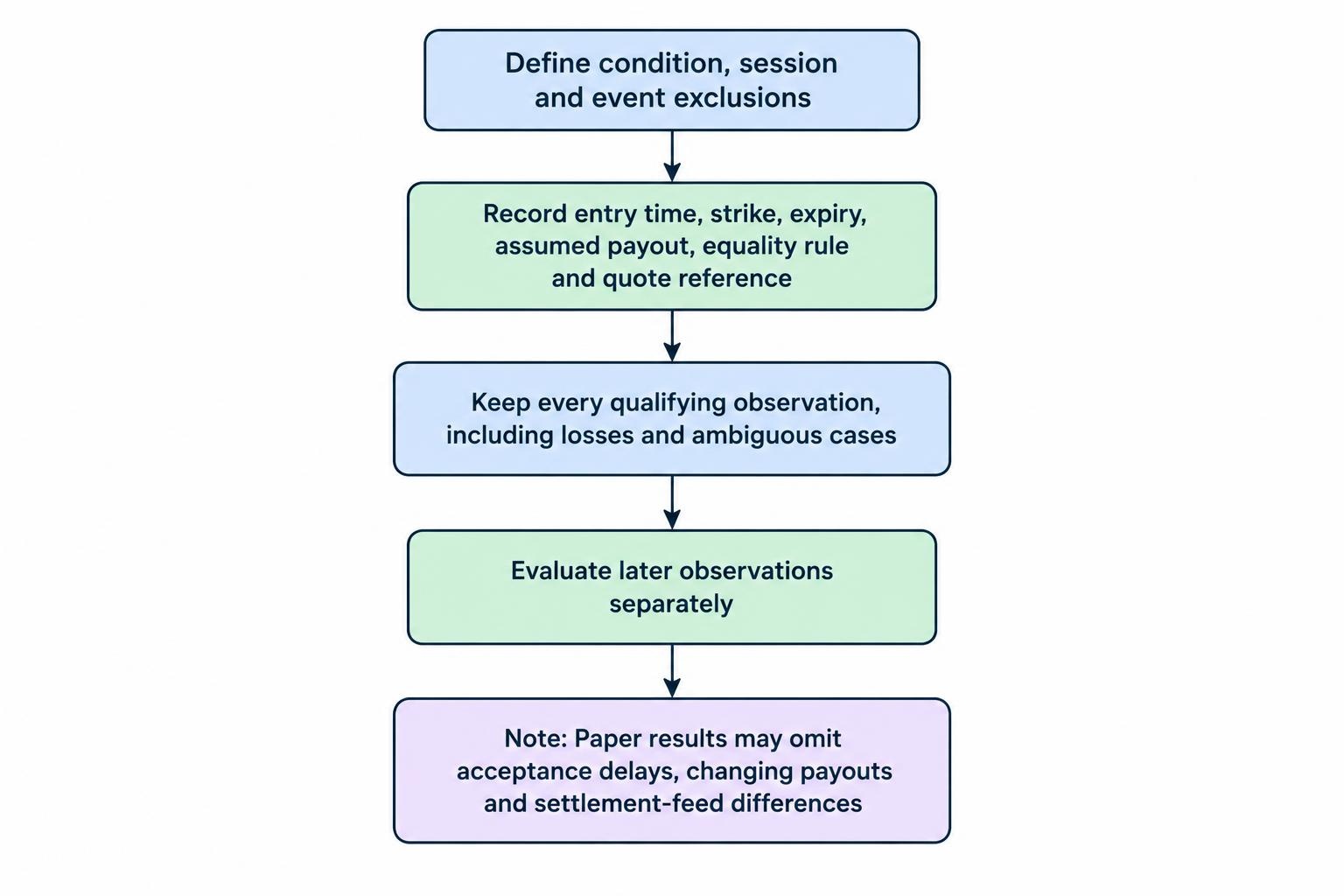
- Define the condition. State the chart setup, session and event exclusions before collecting results.
- Record the terms. Save the entry time, strike, expiry, assumed payout, equality rule and quote reference.
- Keep every qualifying observation. Include losses and ambiguous cases, not just clear examples.
- Evaluate later observations separately. Check whether the rule holds up beyond the data used to develop it.
Use a trading journal to keep market interpretation separate from contract results. Record “expected direction correct, expiry result wrong” where appropriate. That distinction can expose a mismatch between the analysis horizon and the contract rather than encourage another indicator change.
Paper results still have boundaries. They may omit acceptance delays, changing payouts or differences between an analysis feed and a contractual settlement feed. State what the exercise measures. A clean historical chart is not evidence that the same contract could have been entered on those terms.
Australian Access Comes Before Platform Selection
A familiar currency pair does not make the binary contract ordinary currency ownership. Knowing what moves the Australian dollar does not resolve the separate questions of product legality, counterparty risk or settlement terms.
An offshore platform accepting an Australian registration is not proof that it may lawfully offer the product to that person. Review binary options regulation in Australia before treating platform availability as permission. This guide does not recommend a provider or a workaround.
For AUD/USD study, keep the tasks separate: explain the likely currency move, define the exact settlement condition, then assess whether the available payout would justify the forecast probability. If any part remains unverified, a confident market story does not fill the gap.
This article was last updated on: October 22, 2026