A trading account can show a profit while the person funding it loses money. Contract payouts tell only part of the story. Funding charges, currency conversion, withdrawals and paid software can absorb the difference between a winning month and a losing one.
For Australian readers, the legal position comes first: the issue and distribution of binary options to retail clients is prohibited under ASIC’s binary options product intervention order, extended until 1 October 2031. The examples below are educational calculations, not instructions to open or fund an account.
Every fee, exchange rate and trading result used here is hypothetical. None represents a broker quotation, a typical charge or an achievable return. The purpose is to show how to calculate the total financial result without losing expenses between the trading screen and the bank statement.
What Belongs in a Total Trading Cost Calculation?
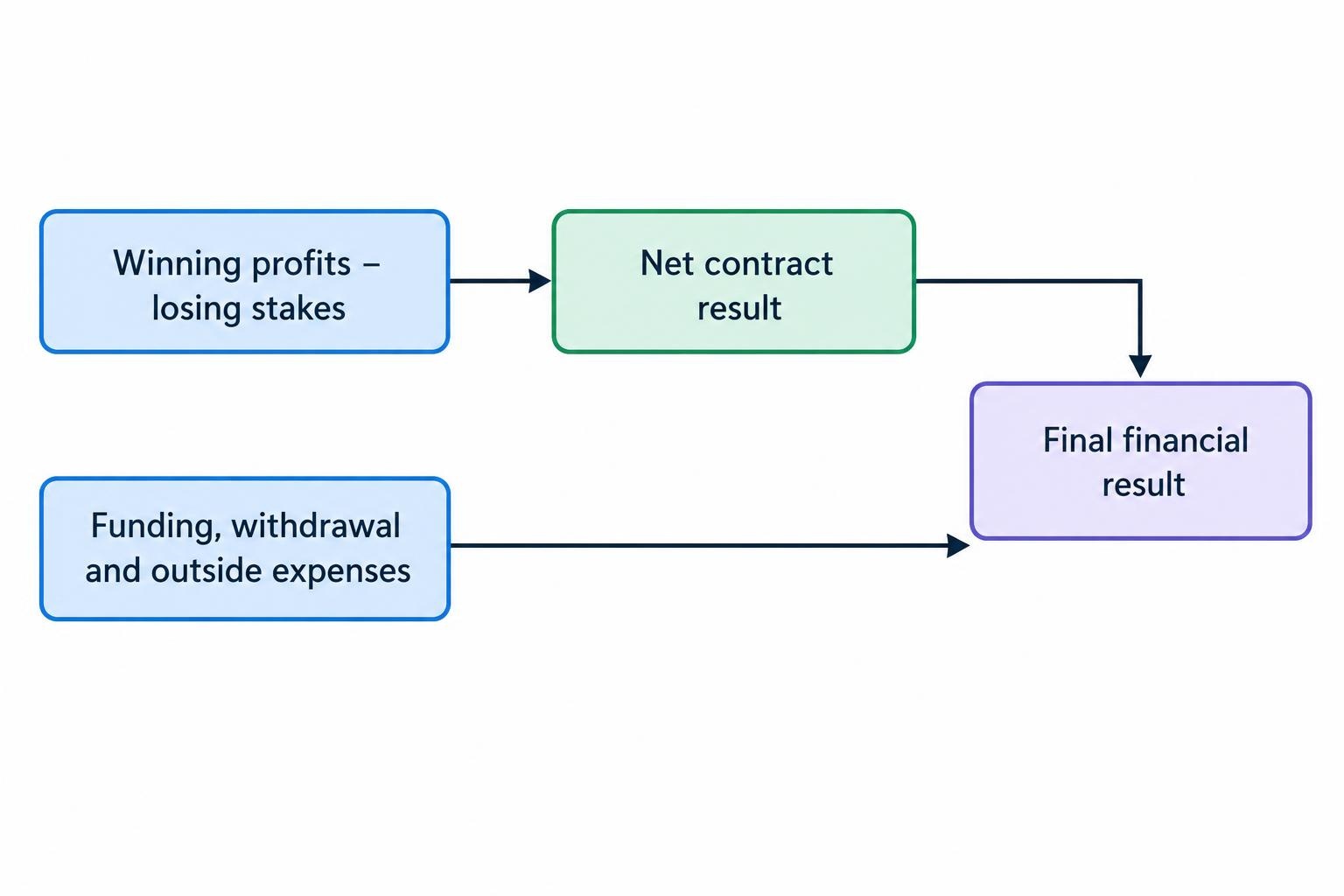
Keep three categories separate: the result from contracts, charges deducted inside the account and expenses paid outside it. Mixing them makes it easy to subtract a cost twice, or miss it entirely.
The contract result is winning profits minus losing stakes. A losing stake is a trading loss, not an additional service fee. The money committed to every contract is not automatically an expense either: a winning contract returns the stake under the assumptions used here.
Account charges might include a funding deduction or withdrawal fee. Outside expenses might include a subscription paid from a separate bank account. The broader binary options trading costs guide separates these categories; this article concentrates on putting them together.
Throughout these examples, an “80% payout” means an 80% profit on the stake when the contract wins, plus repayment of that stake. A A$20 winning contract therefore returns A$36: A$20 of principal and A$16 of profit. A losing contract loses the full A$20. There are no ties, refunds, bonuses or early closures.
This distinction matters because the amount returned is not the amount earned. Calling the entire A$36 “profit” would count the trader’s own A$20 as income from the trade. The spreadsheet would look excellent, but only because it had started congratulating itself.
Example 1: Winning More Often Than Losing Produces Just A$16
Consider 100 contracts with a A$20 stake and an 80% winning profit rate. Of those contracts, 56 win and 44 lose.
The winning contracts generate 56 × A$16 = A$896 in profit. The losing contracts cost 44 × A$20 = A$880. The net contract result is therefore A$16, before any separate expenses.
The same calculation works by comparing total stakes with total repayments. The 100 contracts involve A$2,000 of cumulative stakes. The 56 winners return A$2,016, including their returned stakes. The difference is still A$16. These are alternative calculations, not two sets of amounts to combine.
Now introduce a hypothetical A$10 withdrawal fee and A$15 software expense. The final result becomes:
A$16 − A$10 − A$15 = a A$9 loss.
The unequal winning and losing amounts create this narrow margin. A correct prediction earns A$16, while an incorrect one costs A$20. This payout asymmetry is addressed in the joint SEC and CFTC investor alert on binary options and fraud.
The 56% winning rate is simply an input in this example. It does not establish that a strategy can repeat that result. Even within the calculation, winning most of the contracts is not enough to cover A$25 of expenses.
Example 2: A US$100 Account Profit Becomes an Australian Dollar Loss
Currency conversion adds another layer because the trading account and household budget may use different currencies. To isolate the charges, this example holds the underlying exchange rate unchanged from funding to withdrawal. Any difference therefore comes from the assumed costs, not a favourable or unfavourable currency movement.
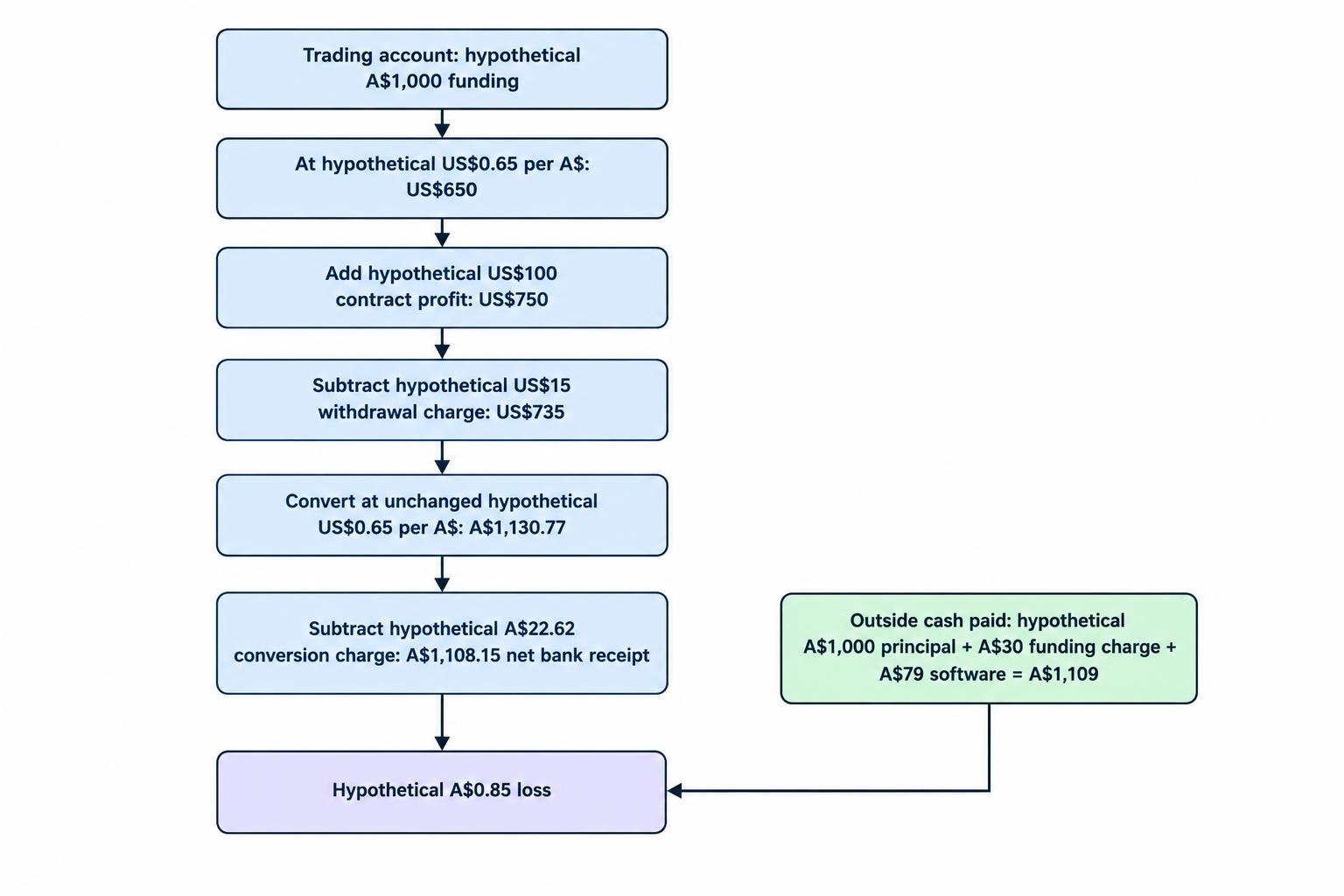
Assume A$1,000 buys US$650 at an exchange rate of US$0.65 per Australian dollar. A separate 3% funding charge adds A$30 to the bank outflow without increasing the trading balance. A software subscription costs another A$79, paid separately.
The hypothetical trading record contains 125 contracts at US$10 each. With an 80% winning profit rate, 75 wins earn US$600 and 50 losses cost US$500. The account makes US$100, taking its balance from US$650 to US$750.
| Stage | Calculation | Amount |
|---|---|---|
| Funding principal | A$1,000 × 0.65 | US$650 credited |
| Separate funding charge | A$1,000 × 3% | A$30 paid |
| Contract result | US$600 winning profits − US$500 losses | US$100 profit |
| Closing trading balance | US$650 + US$100 | US$750 |
| Withdrawal charge | US$750 − US$15 | US$735 remaining |
| Australian dollar value before conversion charge | US$735 ÷ 0.65 | A$1,130.77 |
| Hypothetical conversion charge | 2% deducted from the converted amount | A$22.62 |
| Net bank receipt | Converted amount less conversion charge | A$1,108.15 |
| Total outside cash paid | A$1,000 funding + A$30 charge + A$79 software | A$1,109 |
| Final financial result | A$1,108.15 received − A$1,109 paid | A$0.85 loss |
Calculations retain full precision until the final amounts are rounded. The account statement shows US$100 of trading profit. The bank reconciliation shows a small loss. Both figures can be mathematically correct because they measure different things.
Notice that the conversion charge applies to the remaining withdrawal amount, not just the profit. Money passing through a payment route can attract a charge regardless of whether that money represents original capital or earnings. The assumed percentage and charging basis must therefore be recorded together.
For an actual reconciliation, use the Australian dollars debited and credited, rather than replacing them with a convenient headline exchange rate. The currency conversion costs guide covers the distinction between an exchange rate margin and a separately stated fee. Do not subtract both if they describe the same charge.
An Australian dollar payment label also does not establish that a transaction has no overseas processing charge. Transactions billed in Australian dollars can still attract foreign transaction fees when processed overseas, a point covered by ASIC’s warning about foreign transaction fees on Australian dollar payments. Whether a charge applies depends on the relevant payment terms.
Example 3: A Fixed Withdrawal Fee Hits Small Amounts Harder
Suppose a hypothetical payment arrangement deducts A$10 from every withdrawal. Withdrawing A$100 leaves A$90, making the charge 10% of the requested amount. Withdrawing A$500 leaves A$490, making the same charge 2%.
Five separate A$100 withdrawals therefore produce A$450 in total receipts after A$50 of charges. One A$500 withdrawal produces A$490 after a single A$10 charge. The difference is A$40, even though the amount requested across each route is A$500.
This calculation describes the effect of a fixed fee. It is not a reason to leave money with a questionable operator, postpone action over a disputed withdrawal or deposit more to reach a threshold. A lower fee percentage does not make additional money at risk a sensible trade.
A percentage charge behaves differently. If the only fee were 2%, five A$100 withdrawals and one A$500 withdrawal would each cost A$10 in total, ignoring rounding. A minimum charge, maximum charge or combination of fixed and percentage fees would change that comparison again.
That is why a cost worksheet needs the charging rule, not just a number copied from an advertisement. The deposit and withdrawal fees guide covers these different structures. In a completed account review, the actual deductions and bank receipts settle the calculation.
Example 4: A Lower Payout Changes the Result More Than a Small Fee
Separate fees are visible. The financial effect of the payout rate is easier to overlook because it appears in the contract terms rather than as a debit on a statement.
Hold the trading record constant: 100 contracts, A$20 per contract, 58 wins and 42 losses. Compare an 80% winning profit rate with a 70% rate.
| Calculation | 80% winning profit rate | 70% winning profit rate |
|---|---|---|
| Profit per winning contract | A$16 | A$14 |
| Profit across 58 winners | A$928 | A$812 |
| Loss across 42 losers | A$840 | A$840 |
| Net contract result | A$88 profit | A$28 loss |
The payout difference changes the result by A$116. Add A$40 of identical outside expenses to both calculations and the final results become a A$48 profit and a A$68 loss respectively.
The comparison does not prove that one market, contract or operator offers better prospects. It deliberately assumes identical outcomes so that the payout effect can be measured on its own. Actual records would need to account for different contracts and results.
Nor should the A$116 difference be entered as another fee underneath the lower payout result. It is already reflected in the smaller winning profits. Subtracting it again would double count the disadvantage.
If payout rates vary across a real record, calculate each winning contract using its accepted rate. Applying the highest advertised rate to every winner would overstate income, even if the number of wins were recorded correctly.
Example 5: Subscriptions Turn a Profitable Record Into a Loss
Assume a hypothetical monthly signal subscription costs A$79 and a charting subscription costs A$21. Together, they create A$100 of monthly expenses, paid outside the trading account.
During that month, the record contains 200 contracts with A$10 stakes and an 80% winning profit rate. There are 114 wins and 86 losses, giving a 57% winning rate.
Each winner earns A$8, so the winning profits total A$912. Losing stakes total A$860. The trading account gains A$52, but the result after subscriptions is A$52 − A$100 = a A$48 loss.
Spreading the subscription cost across the completed contracts gives an accounting allocation of A$0.50 per contract. That is useful for calculating the result, but it is not a transaction charge: the subscriptions cost A$100 whether the record contains 20 contracts or 200.
This distinction matters when reviewing trading signals and software costs. A subscription must be counted in the financial result even when its invoice never appears on the trading platform.
Taking more trades would spread the same fixed expense across more contracts. It would also put more stakes at risk. Increasing activity to make a subscription look cheaper per trade does not establish that the extra contracts have positive prospects.
For a completed period, record the expense actually paid. For a forward budget, use the amount that would be payable under the relevant terms, including any renewal price. Keep those two exercises separate rather than presenting a discounted trial month as the permanent cost.
Calculate the Break-Even Rate After Expenses
For equal stakes, a constant winning profit rate and full losses on unsuccessful contracts, the fee adjusted break-even calculation is:
Break-even winning rate = [1 + costs ÷ (number of contracts × stake)] ÷ (1 + winning profit rate).
Use decimal form for the winning profit rate: 80% becomes 0.80. The costs must be additional expenses not already included in the winning and losing amounts.
Without separate expenses, an 80% winning profit rate requires a winning rate of 1 ÷ 1.80, or about 55.56%, to break even. In the subscription example, A$100 of costs across 200 A$10 contracts raises that threshold to:
[1 + 100 ÷ (200 × 10)] ÷ 1.80 = approximately 58.33%.
Because a completed record cannot contain part of a winning contract, it would need at least 117 wins from 200 contracts under these assumptions. That produces A$106 before subscriptions and A$6 afterward. With 116 wins, the result after subscriptions would still be a A$12 loss.
The calculation establishes a threshold, not the probability of reaching it. The probability and expected value guide examines that separate question. Unequal stakes, changing payouts, partial refunds or other settlement rules require a calculation that reflects those terms.
Reconcile the Account With Actual Cash Movements
For a newly funded account that has been fully closed and paid out, the simplest check is:
Final financial result = total money received back − total funding outflows − separately paid expenses.
Funding outflows should include charges paid alongside deposits. Money received back should be the net amount that actually reached the bank or other destination. Separately paid expenses cover items such as subscriptions that are absent from those funding and withdrawal figures.
For an account that remains open, add its recoverable closing value to money received back. If the measurement period begins with an existing balance, subtract the opening value too. An on-screen balance should not be treated as equivalent to cash already received.
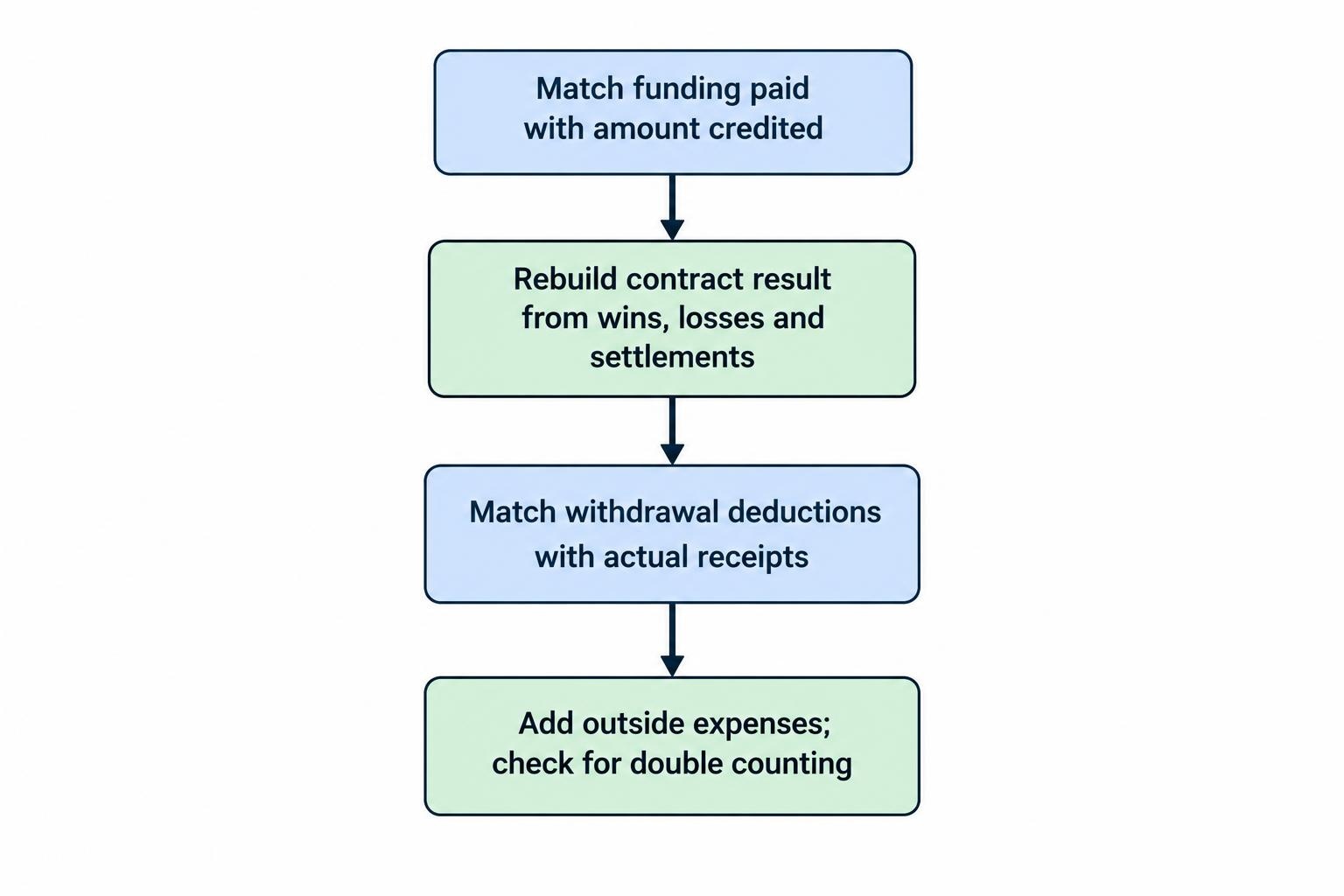
A practical reconciliation follows four steps:
- Match each funding transaction to the amount paid and the amount credited.
- Rebuild the contract result from winning profits, losing stakes and any other settlements.
- Match withdrawals to their account deductions and final receipts.
- Add outside expenses, checking that none has already been counted.
Keep the supporting statements and invoices alongside the calculation. A trading journal can connect each contract’s stake and payout with the monthly account totals, rather than relying on a screenshot of the final balance.
Compare like periods. A month containing a subscription payment but no trading activity still has that expense. A withdrawal received in a later month also needs to be identified so that a timing difference is not mistaken for missing money.
All examples here are before tax. This financial reconciliation does not determine tax treatment, establish that an expense is deductible or assume that a loss creates a refund. Those questions belong in the separate discussion of binary options tax in Australia.
Do Not Treat a Demand for More Money as an Ordinary Cost
A withdrawal calculation can assume a disclosed charge. It should not normalise a demand to send fresh money to release an existing balance.
Requests described as “tax clearance”, “validation”, “insurance” or an account release payment can be part of advance fee fraud. The SEC’s advance fee fraud warning identifies schemes in which people must supposedly pay money to receive investment proceeds, only to compound their losses through further payments.
If an operator displays a A$5,000 balance but demands another A$500 before allowing a withdrawal, the displayed A$5,000 is not a bank receipt. Do not use it to report a realised profit or assume the extra payment is a routine expense.
Pause further payments, preserve the messages and transaction records, and contact the relevant bank or payment provider about the circumstances. A reconciliation can establish how much was sent and received; it cannot make an invented account balance recoverable.
Judge the Result After the Money Comes Back
The useful figure is not the advertised payout, the winning percentage or the largest balance shown on a platform. It is the change in recoverable wealth after contract losses and all related expenses.
Start with the contract arithmetic, reconcile every deduction, then compare the result with actual cash movements. The examples show why that order matters: a positive trading result can disappear without a single additional losing contract.
This article was last updated on: October 22, 2026