Binary options settlement determines the cash result of a contract. For a high/low contract, that usually means comparing a defined settlement price with the strike price at expiry. If those prices are equal, the result depends on the contract’s equality rule. A tie does not automatically mean a refund, a loss or a winning trade.
For Australian readers, the legal position comes before the mechanics: ASIC’s prohibition on issuing and distributing binary options to retail clients took effect on 3 May 2021 and has been extended until 1 October 2031. The examples below explain contract terms, not a route around that prohibition.
What Happens When a Binary Option Settles?
Settlement applies the contract’s outcome rule and establishes the amount payable. In a cash binary option, the holder does not receive the underlying shares, currency or commodity. The contract produces a cash outcome instead.
For a price based contract, four details belong together: the strike, the expiry, the settlement reference and the comparison rule. A correct price without the correct timestamp is not enough. Neither is a timestamp without an identified price feed.
The binary option’s strike price is the comparison level recorded in the contract. It need not be the price visible when someone first opens an order ticket. Where the strike is established when an order is accepted, the accepted contract record matters more than an earlier screen display.
Suppose a contract asks whether AUD/USD will finish strictly above 0.65000. A settlement price of 0.65001 satisfies that condition. A price of 0.64999 does not. At exactly 0.65000, the price has not finished strictly above the strike. Whether that produces a zero payment or triggers a separate refund provision depends on the remaining terms.
That final distinction causes much of the confusion. A directional condition and a tie policy are related, but they are not interchangeable.
How Binary Options Ties Are Treated
A tie means the settlement price equals the strike at the precision used for the contractual comparison. It does not mean the candle looks flat, the prices appear close or the displayed profit briefly reaches zero.
Read the actual comparison language rather than relying on an “Up” or “Down” button. These conditions produce different results at equality:
| Contract condition | Does equality satisfy it? | Effect at the strike |
|---|---|---|
| Settlement price is strictly above the strike | No | The winning condition fails; check for a separate tie provision. |
| Settlement price is at or above the strike | Yes | Equality receives the winning settlement. |
| Settlement price is strictly below the strike | No | The winning condition fails; check for a separate tie provision. |
| Settlement price is at or below the strike | Yes | Equality receives the winning settlement. |
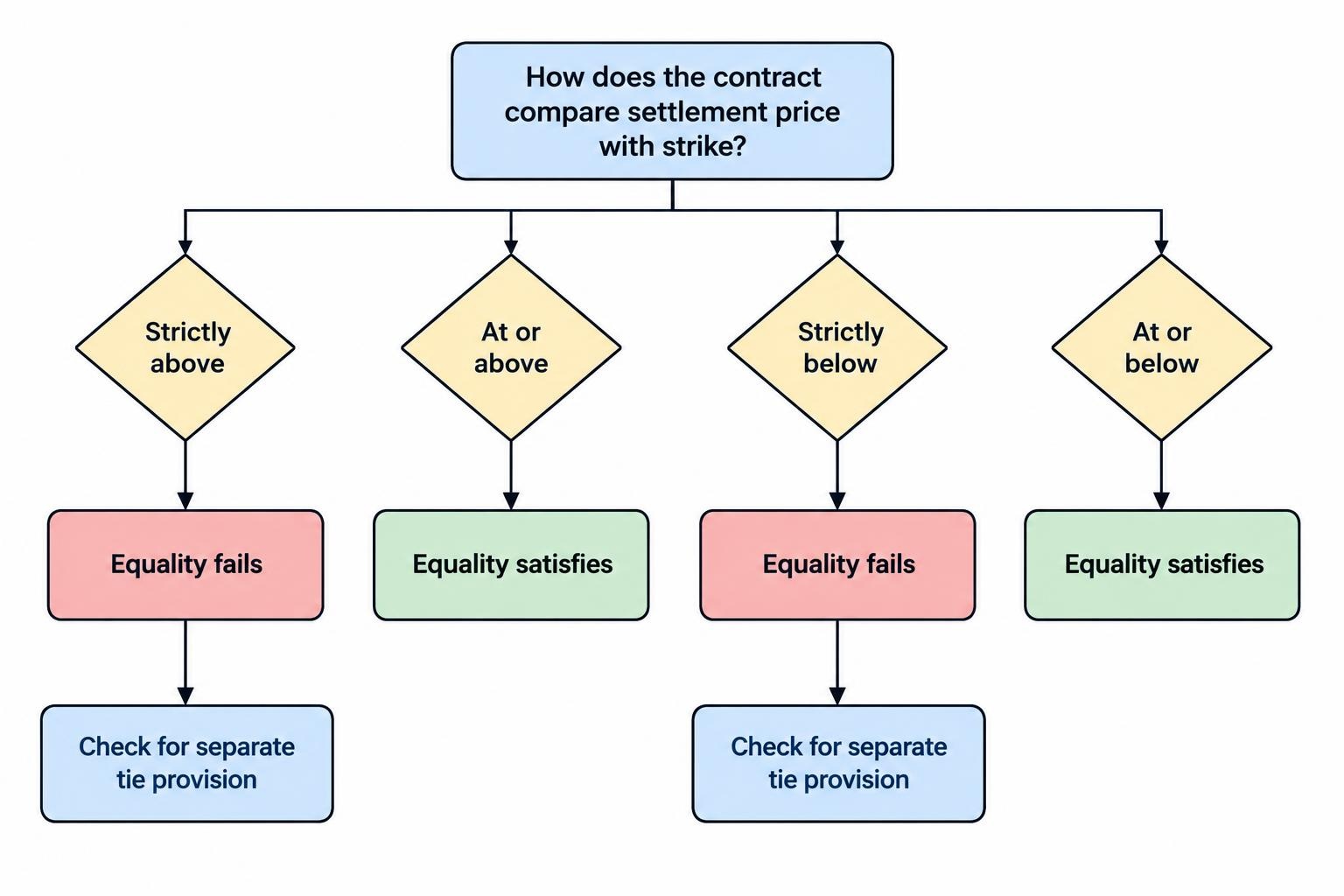
Equality can belong to one side
Published exchange rules demonstrate why there is no universal tie convention. Under CME’s Chapter 23 event contract rules, a call pays its fixed settlement amount only when the underlying futures settlement price is strictly above the strike. The corresponding put pays when that price is equal to or below the strike. Equality therefore belongs to the put, not to a refund category.
Here, a price landing exactly on the strike is not an unresolved outcome. The rule has already assigned it to one side. Calling it a “draw” would suggest something the contract does not provide.
This also explains why “binary” does not require a neutral result when the prices match. The yes/no question can include equality within either answer. The wording decides where the boundary sits.
The reverse convention also exists. Cboe’s binary index option rules, described in an SEC filing dated 15 April 2026, assign the winning settlement to a call when the index settlement value is at or above the exercise price. A put requires a value below it. These are examples of contract design, not evidence of availability to Australian retail clients.
A refund must be an express term
If a contract expressly returns the full stake at equality, the tie produces no trading profit or loss before any separate charges. Without that provision, a trader cannot assume the money comes back.
Also check what “refund” means. Returning the original cash stake is different from awarding a bonus, account credit or amount subject to further trading conditions. A label is not enough; the amount and its treatment need to be clear.
Do not assume two separately offered “above” and “below” contracts cover every possible outcome between them. If both require strict inequality and neither includes a tie refund, equality satisfies neither winning condition.
A Worked Settlement Example With a A$100 Stake
Consider a hypothetical high/low contract with a A$100 stake, a strike of 0.65000 and an 80% profit payout if AUD/USD settles strictly above the strike. Assume a losing trade returns nothing and there are no fees.
If the settlement price is 0.65001, the condition succeeds. The account receives A$180: the A$100 stake plus A$80 profit. The trading profit is A$80, not A$180. Keeping those amounts separate prevents a surprisingly common accounting muddle.
If the settlement price is 0.64999, the condition fails. The return is A$0 and the loss is A$100. Being only a small distance below the strike does not reduce that loss under the assumed fixed payout terms.
If the settlement price is exactly 0.65000, apply the equality provision. An express full stake refund would return A$100, producing a zero trading result. A strict “above, otherwise zero” rule without a refund would return nothing, producing a A$100 loss.
Changing the winning condition to “at or above” changes the equality result again: the same settlement price would now return A$180. The market price has not changed. The contract has.
These calculations use a stake plus profit model. Other binary contracts are bought for a premium and pay a fixed face amount when successful. The guide to binary options payouts separates profit percentages, gross returns and fixed settlement amounts. Do not transfer one model’s cash arithmetic to another.
Which Price Counts at Settlement?
The relevant price is the reference named in the contract, calculated using its stated method. It is not automatically the final number seen on a chart.
Check whether that reference is a bid, an ask, a midpoint, a last transaction price or a published benchmark. Also identify the underlying instrument. A cash index and an index futures contract are not interchangeable just because their names share the same index.
Published contract rules can use an official calculated value rather than an individual market tick. CME’s Chapter 23 contracts, for example, use the daily settlement price of the designated underlying futures contract. The Cboe rules discussed above distinguish reported opening and closing index settlement levels.
For a practical comparison, both records need to match on instrument, reference, time and precision. The guide to price feeds and benchmarks covers these differences in more detail. A third party chart can help investigate a result, but it does not replace the contractual reference simply because its price looks more favourable.
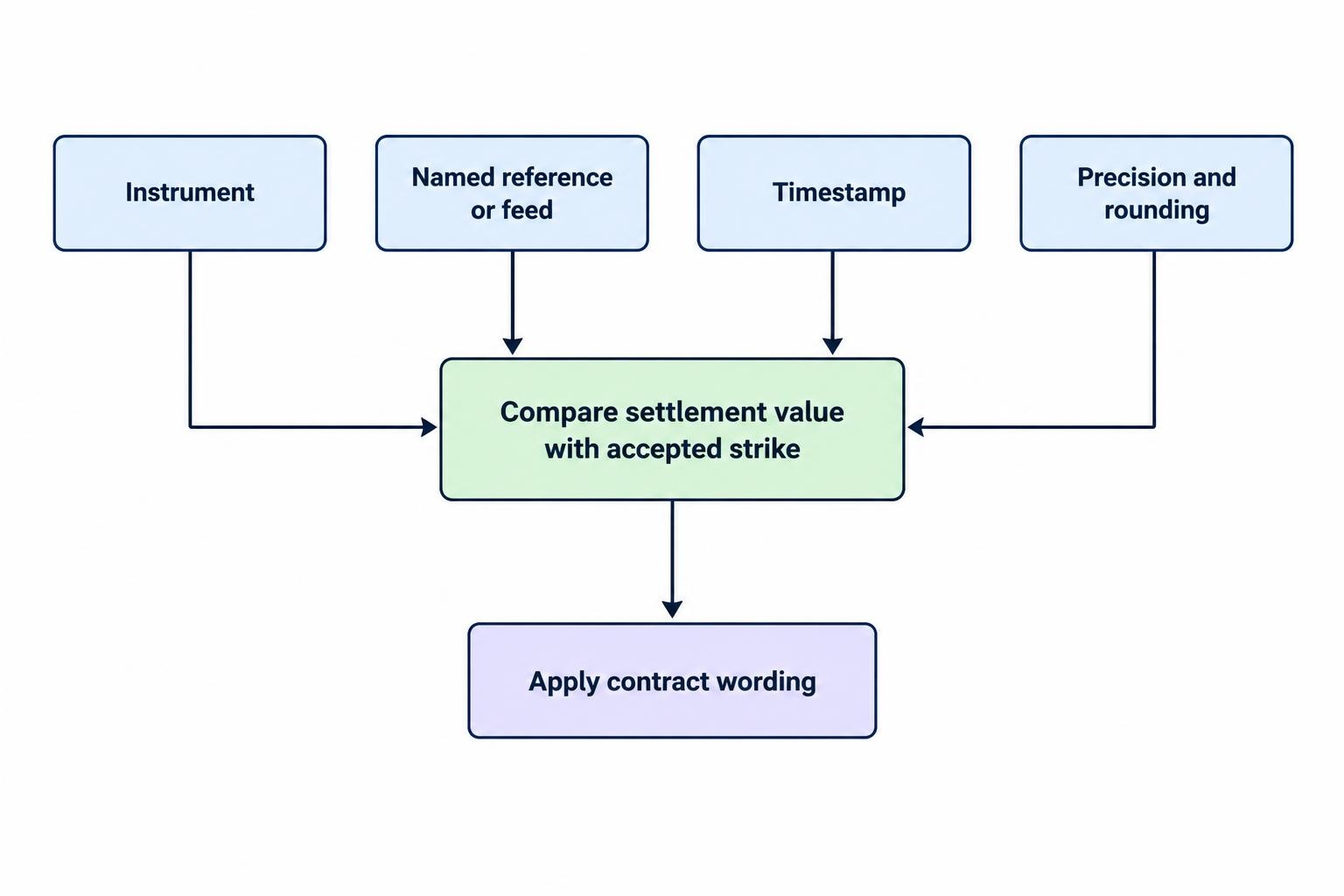
Displayed equality may not be actual equality
Consider a hypothetical system that displays five decimal places but compares prices using six:
The accepted strike is 0.650003 and the settlement price is 0.650004. Both display as 0.65000 when rounded to five decimal places. On screen, they appear equal. At the precision used in this example, the settlement price is higher.
If the contract instead requires both values to be rounded to five decimal places before comparison, those same inputs produce equality. The order of operations changes the result.
Ask whether rounding happens before the comparison or only when prices are displayed. A screenshot showing identical numbers cannot answer that question on its own. The chart looks flat, the settlement record may say otherwise.
A candle close is not automatically the settlement price
A candle summarises prices within a chart interval. To use its close as settlement evidence, establish that its interval, feed and closing method match the contract.
A one minute candle ending near expiry is not enough if the contract names a different timestamp or uses a calculated settlement value. Nor does a candle’s colour establish whether the final price was above or below the accepted strike. Its opening price may be a different comparison point altogether.
Expiry, Settlement Calculation and Account Credit
Expiry identifies when the outcome is determined under the contract. Settlement calculation applies the agreed method. Account posting records the resulting cash movement. Treat these as separate steps when reviewing a trade.
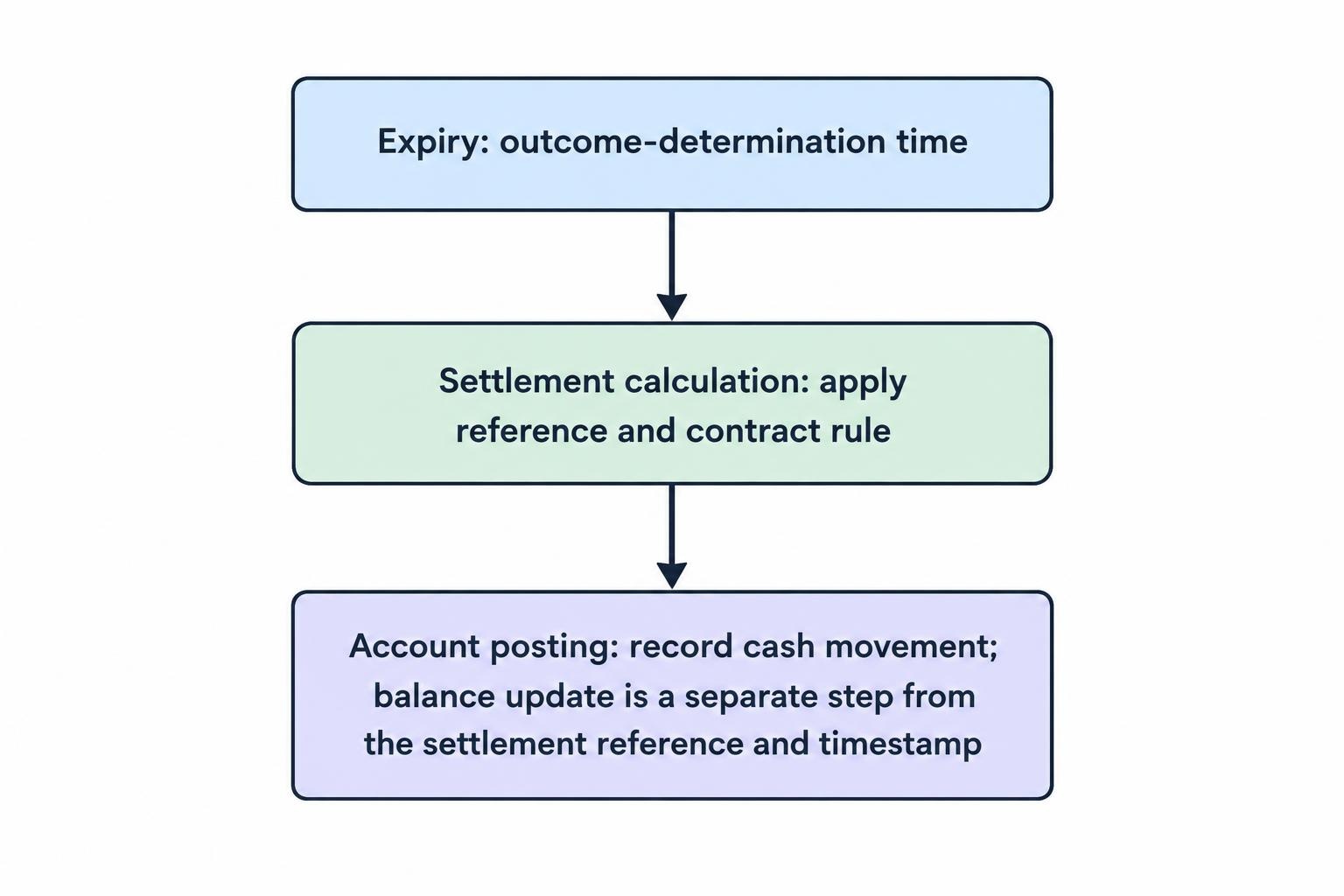
A balance update appearing after expiry does not, by itself, establish that the outcome used a later market price. The useful evidence is the settlement reference and timestamp, not the moment the account animation finishes.
Record the expiry date, time and timezone. A countdown alone is weaker evidence because it does not preserve the full contractual timestamp. The guide to binary options expiry times explains how fixed expiries and duration based contracts differ.
Where settlement depends on an individual quote, check how the terms select that quote. Do they name the last valid observation before expiry, an observation at or after expiry, or another method? Where settlement uses a calculation window, identify its start and end instead. Do not invent a “last tick” rule when the contract does not contain one.
A missing price is not a tie either. Market disruption, unavailable data and obvious pricing errors require their own contractual treatment. Check the relevant provisions rather than assuming that an interrupted feed guarantees a refund.
How to Record Ties in Performance Results
Record refunded ties separately from wins and losses. A trade can return the full stake without earning anything, so counting it as a win inflates the apparent success rate.
Suppose a hypothetical set of 100 trades contains 50 wins, 40 losses and 10 refunded ties. With a A$100 stake and A$80 profit per win, the wins earn A$4,000 and the losses cost A$4,000. The trading result is zero before charges.
The win rate is 50% across all contracts, or about 55.6% if refunded ties are excluded. Both figures need a denominator label. Neither should appear alone without the cash result.
If the same 10 equality outcomes were full losses instead, the result would be a A$1,000 loss. That is why a test using refund rules cannot fairly represent a contract that treats equality as losing.
Record the rule alongside the result when paper trading or reviewing historical data. The broader relationship between outcomes and profitability belongs in probability and expected value in binary options; the settlement task is to classify each outcome correctly before doing that arithmetic.
How to Check a Disputed Settlement
Start with the contract record rather than a general accusation about the chart. A useful review should establish what was agreed, which data were used and how those data produced the account entry.
- Preserve the accepted trade details. Keep the contract ID, direction, stake or premium, strike, acceptance time and full expiry timestamp.
- Save the applicable terms. Retain the version covering the equality rule, settlement reference, rounding and disruption procedures.
- Request the settlement inputs. Ask for the value used, its precision, its timestamp and the named reference or feed.
- Reconcile the cash entry. Separate returned stake, profit, refund and any charge rather than relying on a “won” or “lost” label.
- Describe the mismatch in writing. State which contractual provision appears inconsistent with the recorded result.
A focused question is easier to investigate than “my chart was green”. For example: “The contract requires settlement strictly above 0.65000. Please provide the settlement value and comparison precision used for contract 12345.” This asks for evidence without assuming that a rounded display proves equality.
Do not dismiss every discrepancy as harmless, either. The SEC’s warning on binary options fraud records complaints alleging software manipulation, including expiry countdowns extended until winning trades became losses. Those allegations concern changes to the trading outcome, not an ordinary delay in displaying an already determined result.
Preserve existing records and avoid depositing more money to “test” a disputed platform. Further trades do not establish what happened to the original contract.
The settlement question is precise: what price or event did the contract name, how was it measured, and where did its rules place equality? A result that cannot be reconstructed from those details has not been adequately explained.
This article was last updated on: October 22, 2026