Binary options and prediction markets can produce the same basic result: a contract pays a fixed amount if an event happens and nothing if it does not. The difference often sits in how the contract is priced, traded and settled, rather than in its yes/no outcome.
A binary option describes a payoff structure. A prediction market describes a market for trading forecasts about events. Those categories overlap, so treating them as entirely separate products can lead to poor comparisons.
For Australian retail readers, availability comes before pricing. ASIC’s binary options intervention order bans the issue and distribution of binary options to retail clients until 1 October 2031. This article compares contract mechanics; it does not recommend using offshore platforms.
Where Binary Options and Prediction Markets Overlap
A simple binary option asks whether a condition will be satisfied by expiry. That might be whether AUD/USD finishes above a stated price. The contract’s outcome determines its payment, not how far the currency moves beyond that price.
A prediction market can offer a similar contract on an economic announcement, election or other event. In a simple version, a “Yes” contract pays $1 if the stated condition is satisfied and $0 otherwise. Other designs offer multiple outcomes or partial payments, so not every prediction market contract follows that pattern. The CFTC’s explanation of event contracts covers these different structures.
The useful comparison is therefore narrower: a provider’s fixed stake binary option versus a tradable, fully paid yes/no event contract. Neither model represents every product carrying its label.
| Feature | Fixed stake binary option | Simple prediction market contract |
|---|---|---|
| Entry quote | Stake plus a stated profit percentage if successful | Purchase price per contract |
| Winning outcome | Stake returned plus the stated profit | Fixed settlement payment, such as $1 |
| Losing outcome | Entire stake lost under the assumed terms | Entire purchase cost lost |
| Pricing comparison | Convert the payout into a break even win rate | Compare purchase price with potential settlement value |
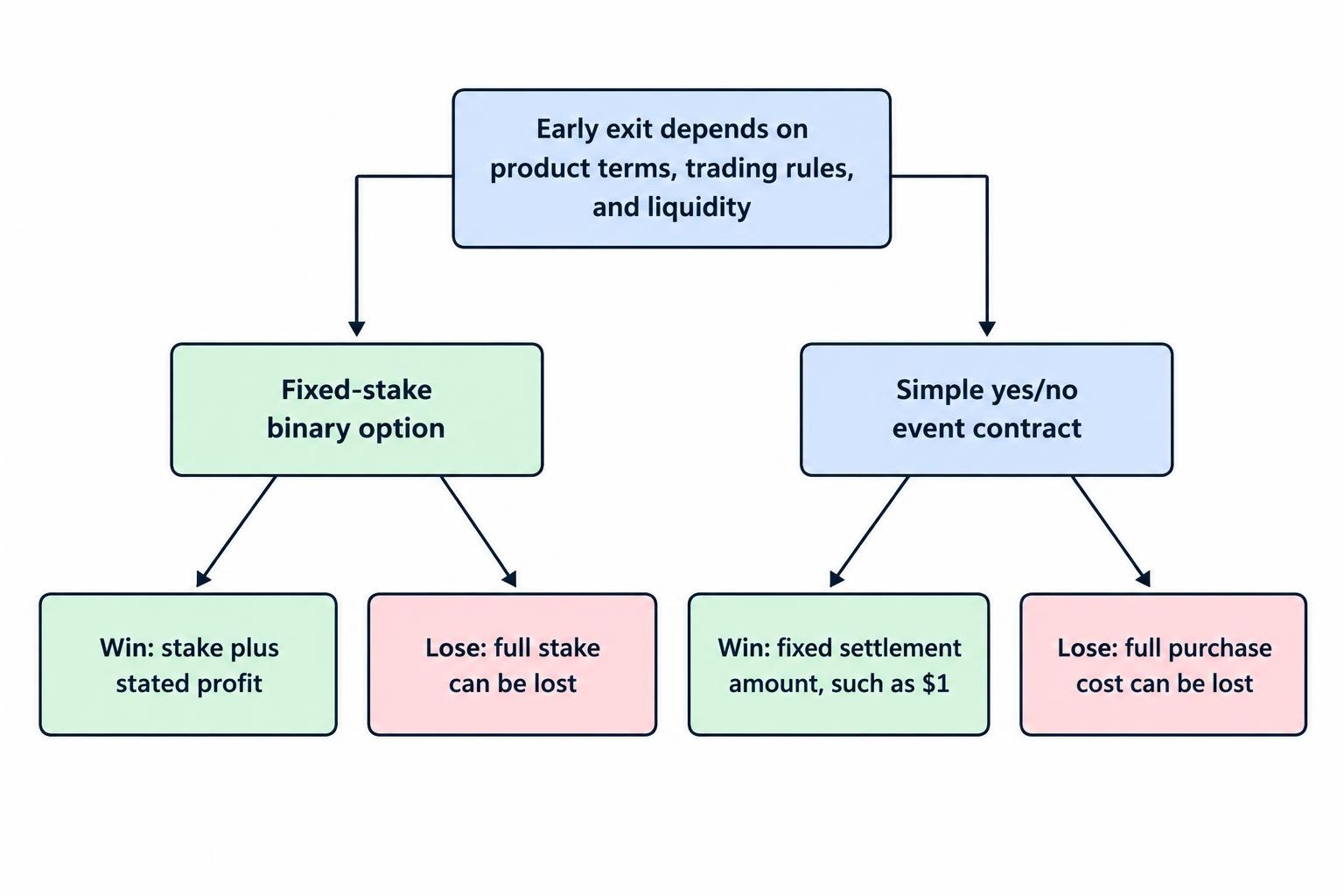
| Exit before settlement | Depends on the provider’s contract terms | Depends on trading rules and available liquidity |
These differences concern trading arrangements. They do not establish that one category is automatically safer, lawful in a particular country or more profitable.
How Payouts Compare: A Worked Example
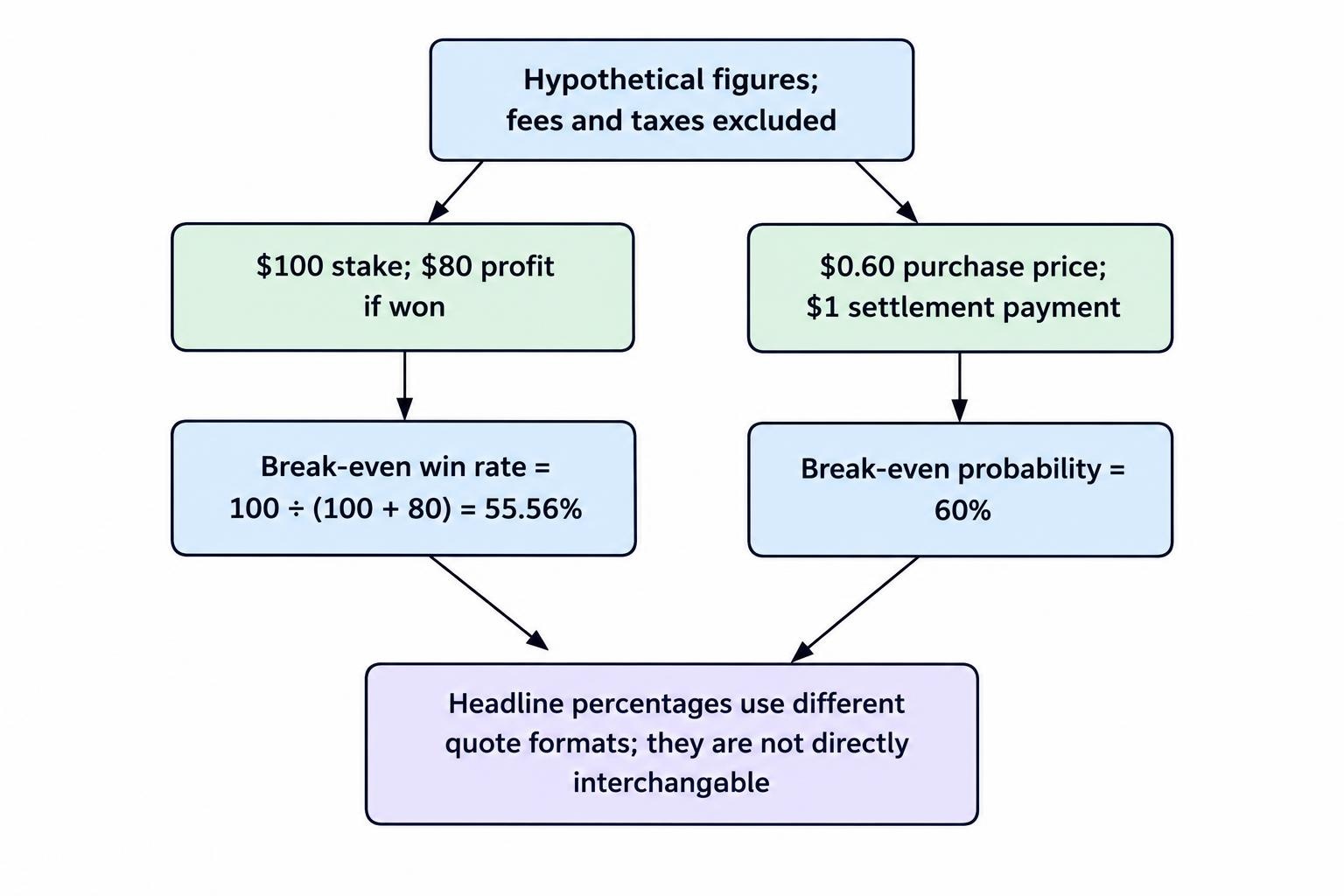
Consider two hypothetical contracts on exactly the same event, using identical settlement rules. All amounts below use the same currency, and the calculations exclude fees and taxes.
Fixed stake binary option
You stake $100. The contract offers an 80% profit if your chosen outcome wins.
A winning result returns $180: your original $100 plus $80 profit. A losing result returns nothing, producing a $100 loss. The advertised 80% is a profit percentage, not an 80% probability of success.
Because a loss costs more than a win earns, winning half the time is insufficient. Across ten contracts with five wins and five losses, the arithmetic is $400 profit from winners minus $500 lost on losers: a $100 net loss.
The break even win rate is:
$100 ÷ ($100 + $80) = 55.56%
This assumes every winning trade pays the same amount, every losing trade loses the full stake, and there are no refunds, ties or extra costs.
Prediction market contract
Now consider a “Yes” contract costing $0.60 and paying $1 if the event occurs. You buy 100 contracts for $60.
If Yes wins, settlement pays $100, giving a $40 profit. If Yes loses, the contracts pay nothing and you lose $60. The winning return on the amount paid is therefore $40 ÷ $60, or 66.67%.
Ignoring costs and the time value of money, the break even event probability is 60%. That is not directly comparable with an “80% payout” banner: one number is a contract price relative to settlement value, the other is profit relative to stake.
To put both quotes on the same basis, the binary option’s $100 cost buys a possible $180 gross return. Its cost is about 55.56 cents per dollar of possible settlement. That is the mathematical connection between the two pricing formats.
The next step is to compare those thresholds with an independently justified probability estimate, not a hunch dressed up as a percentage. The guide to probability and expected value in binary options develops that calculation further.
Does a Prediction Market Price Equal a Probability?
A $0.60 price for a contract paying $1 is often read as a 60% implied probability. That is a useful shorthand, not a measurement of the event’s true chance.
Prices can reflect traders’ beliefs, but the relationship depends on assumptions about their preferences, resources and behaviour. Research by Justin Wolfers and Eric Zitzewitz finds that prices can approximate average beliefs under a range of conditions, while still containing bias. Their working paper on interpreting prediction market prices sets out those conditions and cautions.
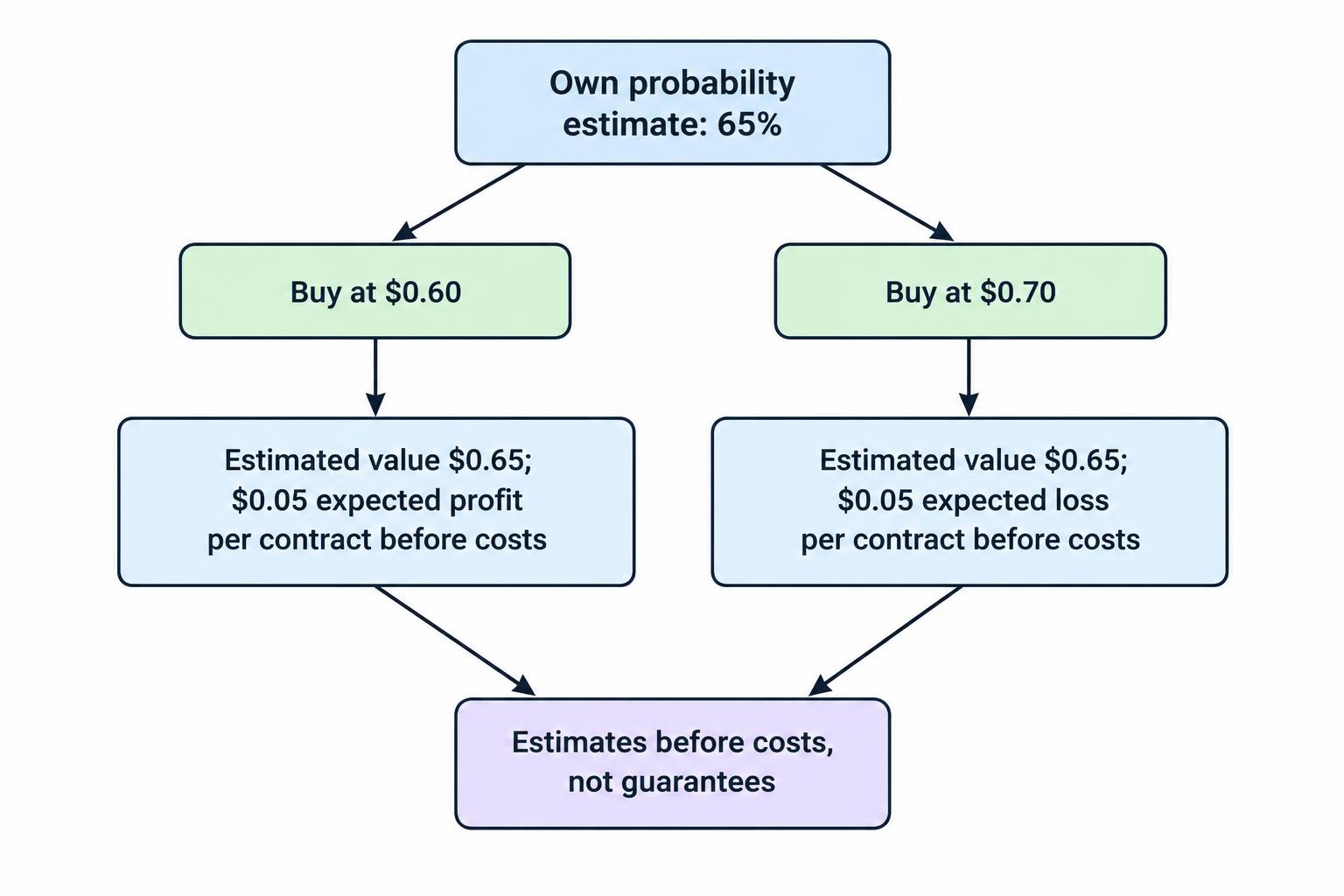
There is also a difference between a useful forecast and a profitable purchase. Suppose your own defensible estimate puts an event’s probability at 65%. Buying 100 contracts at $0.60 produces an estimated settlement value of $65 against a $60 purchase cost: $5 of expected profit before costs.
Pay $0.70 instead and the same estimate produces $5 of expected loss. You could correctly identify the more likely outcome and still pay too much for it.
Early Exit: Tradable Does Not Mean Easy to Sell
A contract can have a binary payment at settlement while changing price throughout its life. Those are separate features. An all or nothing ending does not require an all or nothing trading process.
Where secondary trading is available, selling before settlement can realise a gain or loss without waiting for the event. But the available selling price matters more than the number displayed most prominently on screen.
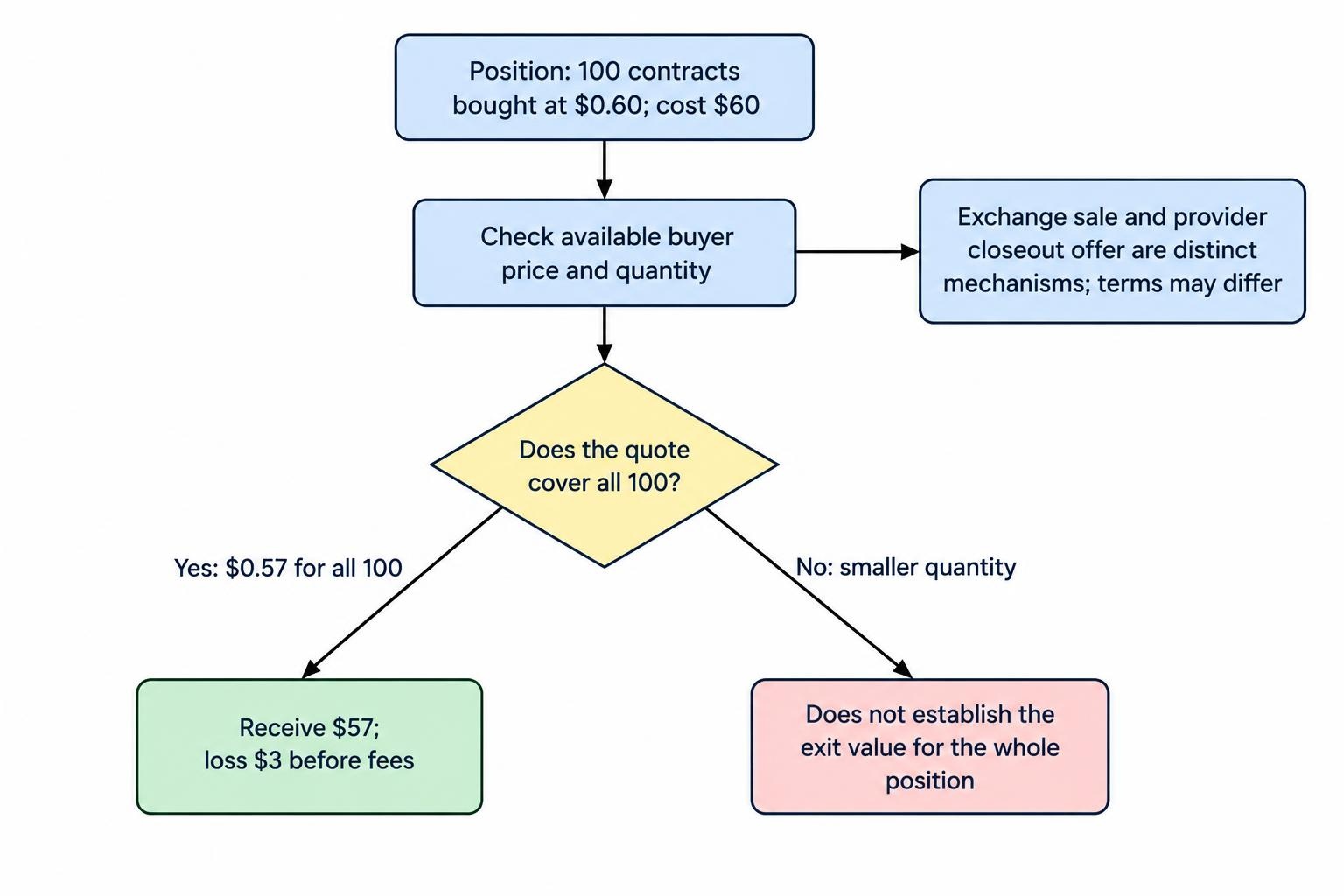
Consider a hypothetical purchase of 100 contracts at $0.60, costing $60. Later, the best available buyer offers $0.57 for all 100. Selling produces $57 and a $3 loss before fees, regardless of whether you still think the event will happen.
Check the quantity available at each price as well. A quote covering ten contracts does not establish the exit value of a position containing a thousand. An exit button is not a buyer.
For fixed stake products, do not assume an early close feature exists or uses the same pricing method as an exchange sale. The distinction between selling a position and accepting a provider’s closeout offer is covered in early close, rollover and double up.
Fees Can Reverse a Small Pricing Advantage
Compare the full amount paid with the amount actually received. A theoretical advantage can disappear once transaction charges, the gap between buying and selling prices, payment fees or currency conversion enter the calculation.
For example, buying 100 contracts at $0.60 and selling them at $0.62 creates a $2 gross gain. If the combined entry and exit charges total $2.50, the result is a $0.50 loss. These are illustrative charges, not a quoted fee schedule.
Use the same method for a fixed stake contract. Establish whether its displayed percentage means profit alone or the total amount returned, then account for any other applicable charges. Comparing promotional percentages without checking their definitions is arithmetic by advertising department.
Settlement Rules Matter More Than the Headline Question
A prediction can be broadly correct but fail the contract’s exact test. Before comparing prices, establish that both contracts really cover the same event.
Take a hypothetical question: “Will the RBA cut its cash rate before 31 December 2027?” Does a qualifying cut occur when the decision is announced or when it becomes effective? Does the contract name the cash rate target? What happens if the scheduled publication is delayed?
For a price based binary option, the equivalent questions concern the benchmark, timestamp, time zone, rounding and treatment of an exact tie. Two contracts referring to AUD/USD can produce different outcomes if their settlement rules differ.
For event markets, identify the named data source and the process for resolving missing, corrected or disputed information. The CFTC’s March 2026 prediction markets advisory addresses settlement data reliability, manipulation resistance and contract design. It also distinguishes staff guidance from new binding rules.
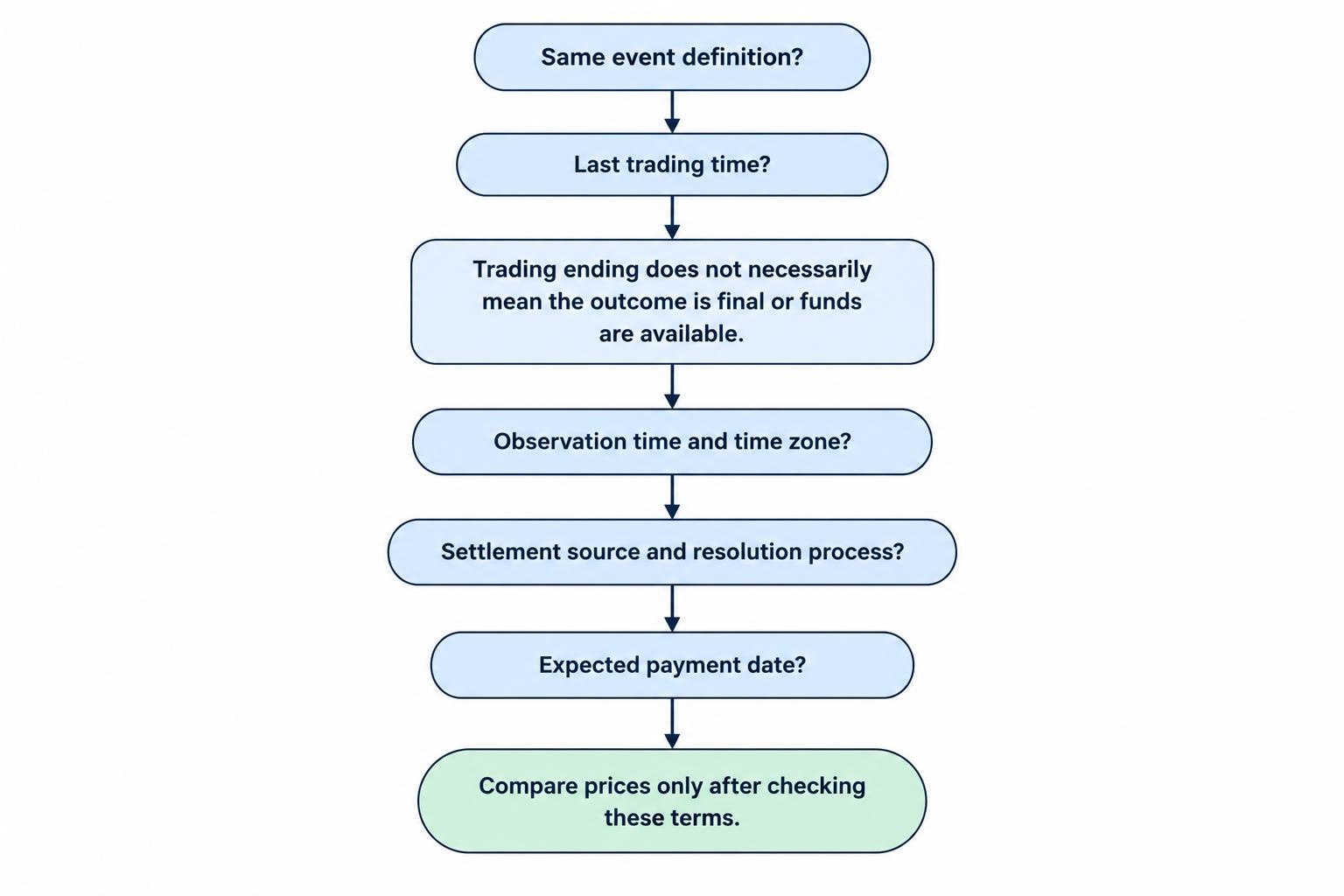
A practical comparison should record the event definition, last trading time, observation time, settlement source and expected payment date. Treat those as separate fields. “Trading has ended” does not necessarily mean “the outcome is final and the money is available”.
Counterparty and Platform Risk Remain Separate Problems
Start by asking who owes the settlement payment, who holds customer money and which entity handles a dispute. A yes/no interface answers none of those questions.
Market risk means your forecast loses. Platform risk means something goes wrong with execution, custody, account access or payment. A favourable expected value calculation cannot compensate for a provider that does not honour its obligations.
Binary options fraud complaints have included withheld withdrawals, identity theft and software manipulation. These are documented in the joint SEC and CFTC investor alert on binary options fraud. That warning should not be stretched into a claim that every binary contract is fraudulent, or that a prediction market label removes comparable concerns.
Keep the checks separate: assess the contract’s economics, verify the operator’s status, and examine the terms governing customer funds. Success on one check does not excuse failure on another.
Australian Access and Regulation
Prediction markets should not be presented to Australian readers as an automatic workaround for the binary options ban.
No prediction market operators are licensed as financial markets to operate in Australia. The Moneysmart prediction markets warning, updated on 3 August 2026, states this position and warns about the absence of important Australian financial services protections when using unlicensed offshore providers.
This does not mean every event contract has an identical legal classification. It means that calling a product a prediction, an event contract or a market does not establish permission to offer it to Australians. Nor does a foreign registration establish Australian authorisation.
Separate technical access from lawful availability. Being able to load a page, create an account or send a payment is not proof of regulatory approval. Avoid any comparison that treats those steps as sufficient due diligence.
The broader guide to binary options regulation in Australia covers the domestic position. Product classification, customer location and the provider’s actual permissions matter more than its branding.
Which Is Better for the Intended Purpose?
For studying forecasts, prediction market prices can be useful without taking a position. Record the question, price and observation time, then compare the forecast with the eventual result. There is no requirement to risk money to learn from a market.
For trading analysis, compare matching settlement conditions, maximum loss, net winning profit, break even probability and executable exit prices. A fixed stake quote can make the payoff easy to calculate; a tradable contract can make changing expectations visible. Neither feature establishes a profitable opportunity.
For long term wealth building, neither a short duration binary option nor a fully paid yes/no event contract should be treated as interchangeable with a diversified investment portfolio. Readers with that objective should start with alternatives to binary options, rather than choosing between two forms of event speculation.
The sound comparison is between contracts, costs and legal protections—not between labels. A simpler interface does not make the underlying decision simpler.
This article was last updated on: October 22, 2026