A binary options practice account lets you record simulated trades using a virtual balance rather than money at risk. Its useful purpose is to show how contract selection, expiry, payouts and account records work. A rising practice balance does not establish that a trading method is profitable, or that the platform is trustworthy.
For Australian readers, the legal position comes first. ASIC’s prohibition on issuing and distributing binary options to retail clients took effect on 3 May 2021 and has been extended until 1 October 2031. The ASIC announcement extending the binary options ban sets out that restriction. Access to a practice screen does not establish permission to offer its real-money counterpart.
What a Binary Options Practice Account Provides
A practice account maintains a notional balance and records the outcomes of simulated contracts. Depending on the simulator, it may also display charts, order confirmations, open positions and a transaction history. Check which features are actually present rather than assuming the practice environment reproduces every part of a funded account.
“Practice account” and “demo account” usually describe the same broad arrangement. The label is less useful than the account’s terms and behaviour. The separate guide to binary options demo accounts covers the basic format; this article focuses on checking whether an account produces useful learning and reviewable records.
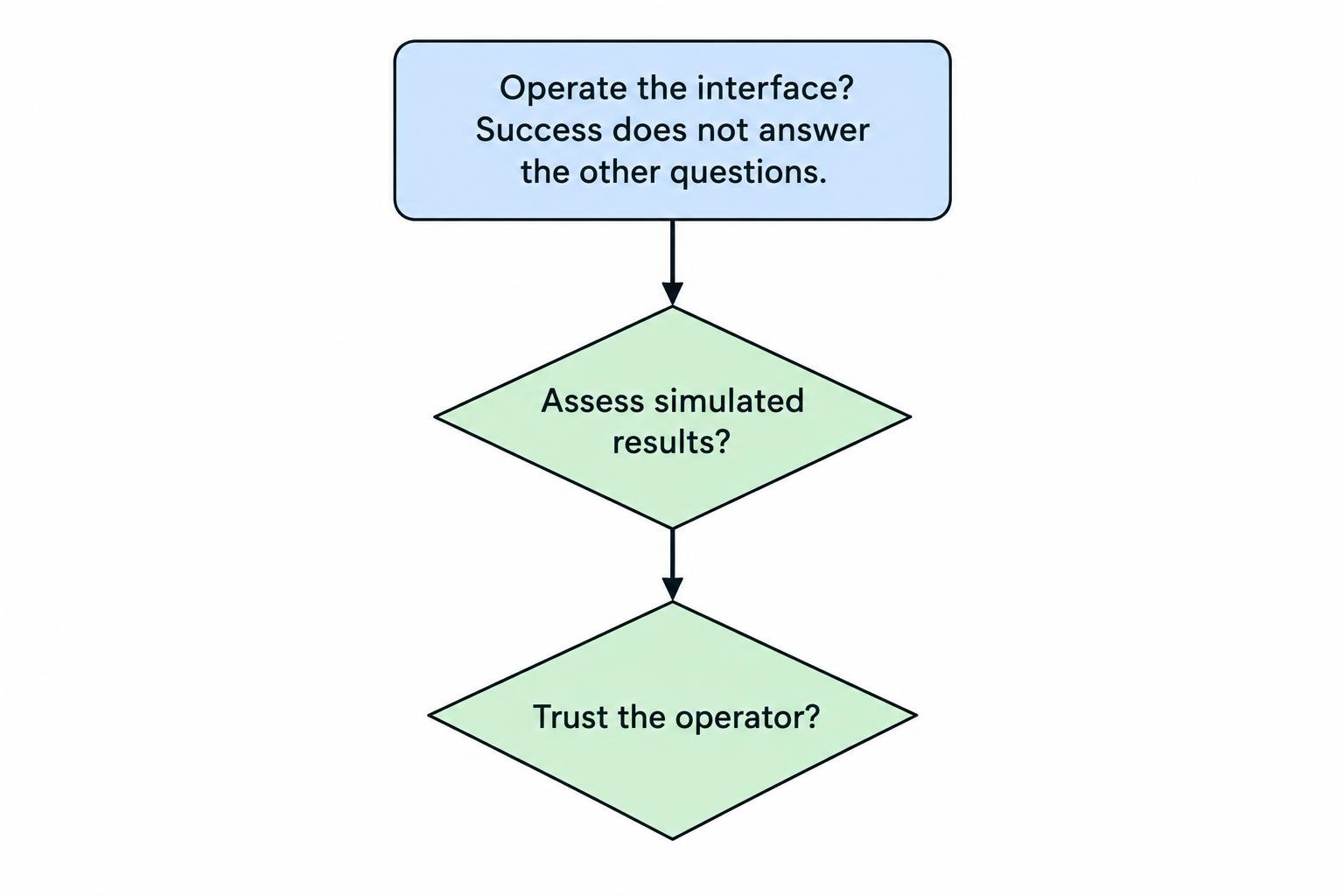
There are three separate questions to keep apart: can you operate the interface, can you assess the simulated results, and can you trust the business behind it? Success with the first question does not answer the other two.
Check the Account Before Using It
Start with the operator’s identity, access conditions and privacy terms. Establish who runs the service, what information registration requires, and whether the simulation can be used without depositing money. Do not fund an account simply to inspect a practice feature.
A polished mobile app is not evidence of regulatory approval. Availability in a recognised app store does not establish compliance, a distinction made in the CFTC warning about binary options mobile apps. Treat download numbers, ratings and screenshots as separate from checks on the operator.
The following checks help distinguish a useful simulator from an interface that produces little more than a changing balance.
| Account feature | What to check | Why it matters |
|---|---|---|
| Virtual balance | Whether it can be adjusted and whether resets remain visible | Repeated resets can hide the full practice record |
| Contract terms | Stake, strike, expiry, net winning return and tie treatment | The result cannot be assessed without knowing the contract |
| Price information | Named instrument, quote source and settlement method | A familiar market label does not identify the actual reference price |
| Transaction history | Accepted entry details, settlement values and balance changes | These allow you to reconcile individual outcomes |
| Record retention | Export options, account expiry and deletion conditions | Your evidence should remain available after the session |
Read the terms before spending hours on the interface. If the account expires, deletes earlier trades or prevents you from saving useful details, it may be unsuitable for a longer study. More chart tools will not fix missing records.
Identify What the Account Is Simulating
Check the full instrument description, not just the symbol on the chart. Ask whether the displayed price represents a named market feed, a delayed quotation, a replay or a generated series. If the account does not disclose this, record the uncertainty rather than filling the gap with an assumption.
The distinction matters when comparing prices. An AUD/USD label alone does not establish that another chart should show exactly the same value at exactly the same moment. Quote sources, timestamps and price conventions need to match before a comparison becomes useful. The guide to price feeds and settlement benchmarks covers these differences.
Use the simulation only for questions its data can answer. A replay can help you practise reading contract details. A generated price series can demonstrate payoff arithmetic. Neither should be presented as evidence that a method works on a separately sourced market price.
Set a Virtual Balance That Makes Mistakes Visible
A large starting balance can make poor decisions look harmless. For an accounting exercise, a virtual A$10 loss represents 1% of a virtual A$1,000 balance but only 0.01% of A$100,000. The dollar loss is identical; its effect on the account is not.
Choose a fixed starting balance and simulated stake for the period being reviewed. These are study settings, not a recommendation to fund an account or adopt a particular stake size. Keeping them stable makes the results easier to interpret.
Do not reset the balance after an uncomfortable session. If you need a fresh account for a different exercise, save the earlier history and label the new period separately. Otherwise, the record becomes a collection of fresh starts with the awkward bits missing.
Also separate balance growth caused by outcomes from growth caused by increasing stakes. A large simulated win after several losses does not show that the earlier decisions improved. The reset button is not a risk management system either.
Read Payouts as Net Profit, Not Just a Percentage
Before placing a simulated trade, establish what the displayed payout means. Does an “80% return” mean an A$8 profit on a successful A$10 stake, with the stake returned separately? Or does the account use another convention? Write down the cash flows rather than relying on the headline percentage.
Consider a hypothetical account with a virtual A$1,000 starting balance. Every trade risks A$10. A win earns A$8 net profit and a loss forfeits A$10. There are no fees, ties or partial refunds in this example.
After 100 trades, suppose there are 55 wins and 45 losses. The wins produce A$440 in profit, while the losses cost A$450. The account ends at A$990. Winning more often than losing has still produced a loss.
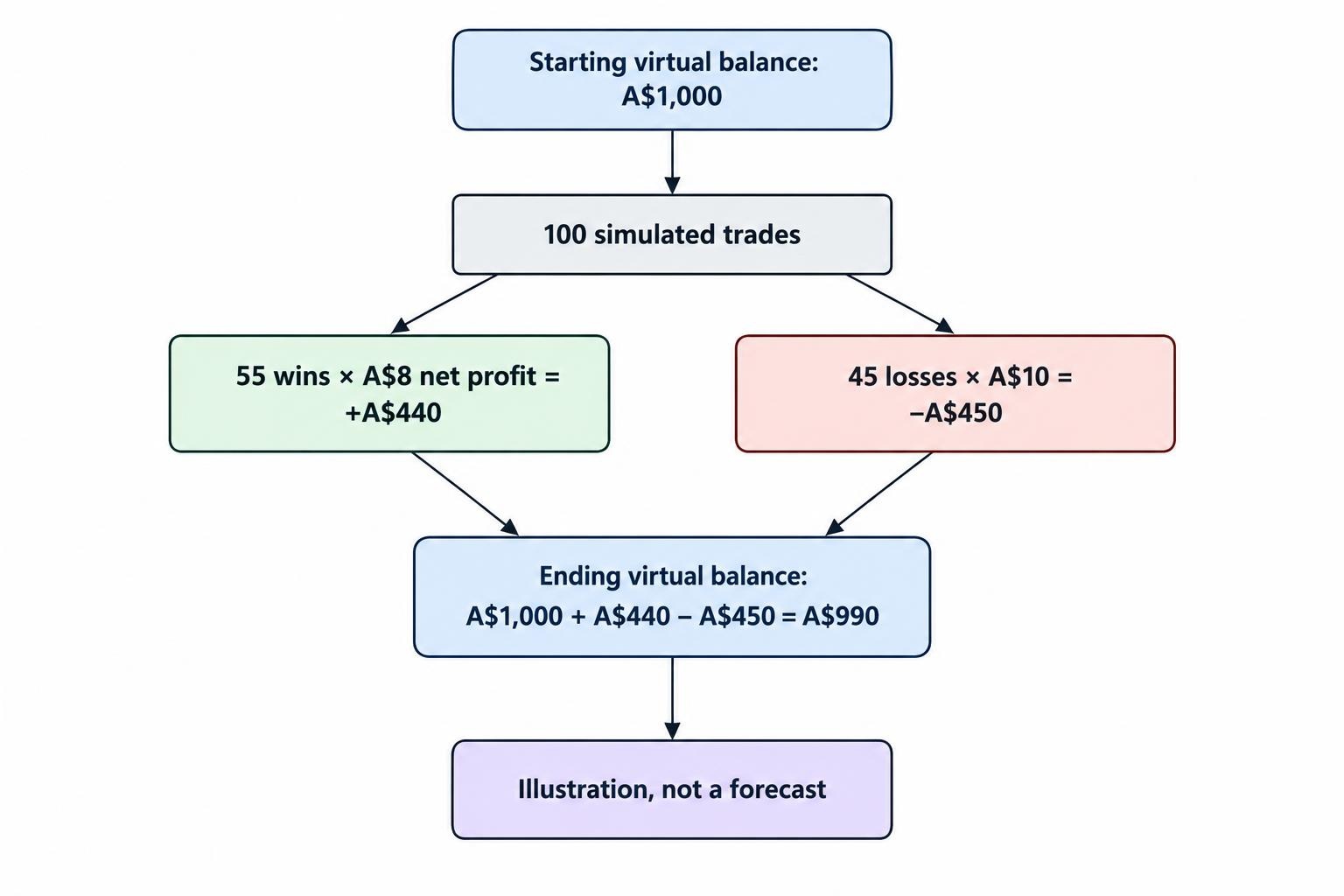
At an 80% net winning return, the break-even win rate is 1 ÷ 1.8, or about 55.56%, before other costs. If that return falls to 70%, break-even rises to about 58.82%. The same 55 wins and 45 losses would then lose A$65. These are arithmetic illustrations, not forecasts. The guide to probability and expected value in binary options develops the calculation.
For practice records, save the return offered when each simulated trade is accepted. Applying the most attractive payout seen during a session to every trade would overstate the result.
Inspect Accepted Trades and Settlement Details
The price visible when you decide to act is not enough to reconstruct a trade. Where the account provides them, record the accepted strike, acceptance time, expiry time and settlement value. Compare the confirmation with what you intended to submit.
Check whether an expiry selector represents a fixed clock time or a duration measured from acceptance. Those are different arrangements. A contract expiring at 10:35:00 is not necessarily the same as one lasting five minutes from whenever it is accepted.
Be equally careful near the strike. A chart that rounds prices to four decimal places may not display the full precision used in settlement. Read the account’s rules for equality, rounding and the reference price before deciding that a result is wrong.
If a record appears inconsistent, preserve the confirmation and relevant screenshots. Mark the result as disputed or unexplained in your review. Do not erase it, but do not invent an explanation either. An account that does not provide enough detail to investigate outcomes has failed a useful practical test.
Keep a Record That Survives the Session
The practice account’s balance is a summary, not an explanation. Keep an independent record so that a reset, account closure or missing history does not remove the evidence.
At minimum, record the instrument, direction, simulated stake, accepted strike, expiry, offered return and outcome. Add a short note stating what you intended to test and whether you followed the rule you set beforehand. A structured trading journal helps keep those fields consistent.
Separate decision quality from outcome. A trade can win despite an accidental entry or a broken rule. Another can lose despite being executed exactly as planned. Without that separation, the review rewards whatever happened to finish green.
Keep skipped opportunities and interruptions visible too. If an account freezes, a confirmation is missing or you abandon a session, note it. Removing inconvenient observations makes the account appear more dependable than your records justify.
When changing a study rule, start a clearly labelled version. Combining different entry rules, stake sizes and expiries into one win rate makes it difficult to tell what was actually assessed.
What Practice Results Cannot Establish
They cannot reproduce the consequences of losing money
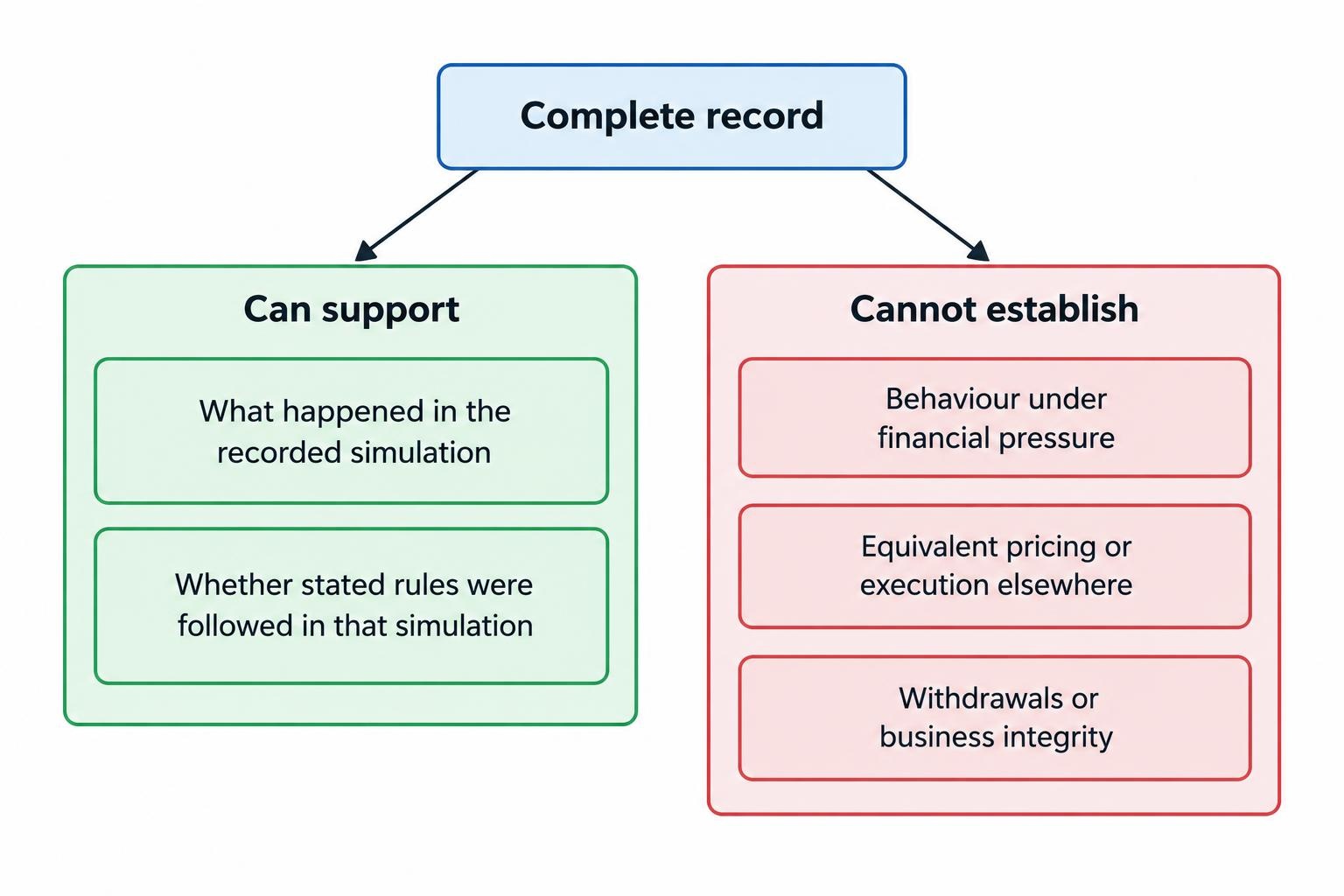
A virtual loss does not remove money needed for bills or savings. Following rules in a simulation therefore does not establish how someone would behave under financial pressure. Hypothetical records cannot fully account for financial risk or a person’s ability to continue following a method through losses, a distinction covered by the NFA notice on hypothetical performance results.
This does not make practice pointless. It changes the claim you can reasonably make. “I followed these instructions in a simulation” is supported by a complete record. “I would behave identically with money at risk” is not.
They do not prove equivalent pricing or execution
Do not assume that a practice environment and a funded account have identical acceptance rules, available contracts, payouts or settlement processes unless those details are established. Equally, do not assume every difference proves manipulation. Identify what is known and leave the rest unresolved.
ASIC’s 2017 review of binary options apps noted user comments describing profits in demo mode followed by losses in live trading. Its historical warning about unlicensed binary options apps also stressed that providers controlled their product pricing. Those observations were not a controlled experiment showing that every practice account was manipulated.
A profitable practice record cannot, by itself, verify how another account would operate. It is evidence about the simulation you used, under the conditions you recorded.
They cannot verify withdrawals or business integrity
A virtual balance does not test whether an operator will honour a withdrawal, safeguard customer information or remain solvent. Those questions sit outside the simulation. The broader comparison of demo and live binary options trading separates these account differences from basic interface practice.
Do not make a deposit to resolve that uncertainty. An educational exercise does not need to become a financial transaction to have served its purpose.
Protect Your Information During Practice
Keep the trial separate from payment activity. Do not provide card details simply to obtain virtual funds, and do not let an unsolicited account manager turn a practice session into a deposit discussion. Where registration requests personal documents, stop and establish who is requesting them and why.
Identity theft, refusal to return funds and software manipulation are among the complaints documented in the SEC investor warning on binary options fraud. Those risks are reasons to scrutinise the operator, not reasons to test it with a small payment.
Use a separate password, decline unnecessary device permissions and avoid installing software sent through private messages. Treat claims that virtual profits can be converted into withdrawable money after a payment as a reason to stop, not an account feature worth trying.
“No money at risk” should describe the simulated positions. It should not become shorthand for “nothing can go wrong.”
Judge the Account by What You Can Verify
A useful practice account leaves you with clear contract records, understandable balance changes and a better grasp of the interface. You should be able to explain why each recorded result occurred, identify any missing evidence and reproduce the account arithmetic independently.
A poor account leaves unanswered questions: undisclosed prices, unexplained settlements, missing history or pressure to deposit. Those are not problems that another hundred simulated trades will solve.
Set a narrow objective before each session and stop when you have answered it. A structured binary options practice plan can organise those objectives without treating a virtual profit target as a qualification for real-money trading.
The strongest result may be deciding that an account cannot support a reliable assessment. Practice is useful when it improves your ability to question the numbers, not when it makes the numbers look reassuring.
This article was last updated on: October 22, 2026