Share binary options are contracts whose outcome depends on a company’s share price meeting a stated condition. A typical contract asks whether the price will finish above or below a strike price at a set expiry time. The result determines a fixed payment or the loss of the stake, rather than a return that grows with the size of the share-price move.
In Australia, ASIC prohibits the issue and distribution of binary options to retail clients. The prohibition began on 3 May 2021 and extends until 1 October 2031 under ASIC’s binary options product intervention order. A contract referencing an overseas company should not be treated as an exception simply because the underlying shares trade abroad.
The examples below explain the product, not how to access it. The main distinctions are between owning shares and making a price prediction, between a company’s prospects and the contract’s deadline, and between the price displayed on a chart and the price used for settlement.
What Does a Share Binary Option Measure?
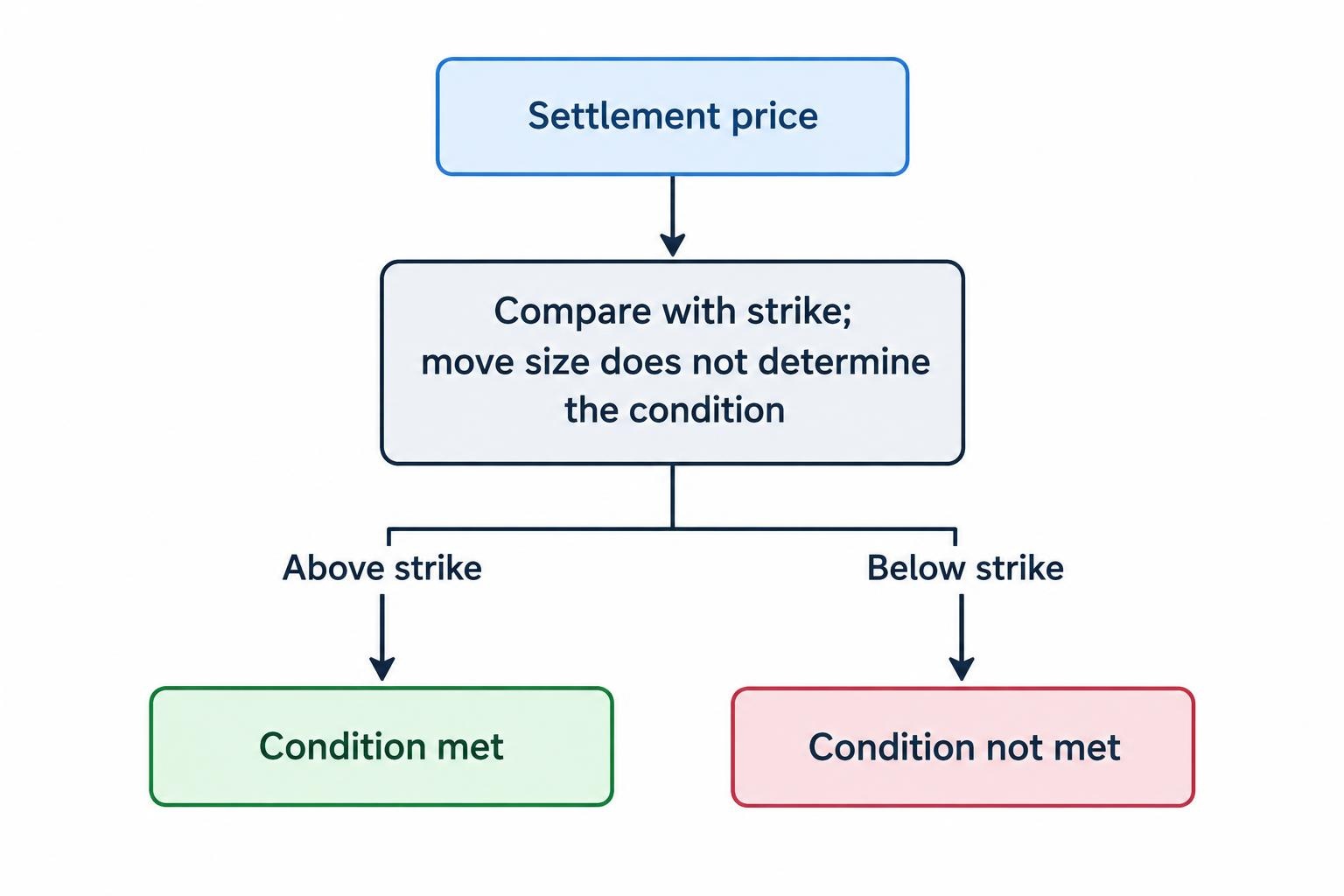
A share binary option measures whether a defined condition has been met. For a straightforward high/low contract, that condition might be: “Will this share’s settlement price be above A$50.00 at 2:30 pm?” The company’s share price supplies the reference point, but the contract has its own strike, deadline and payment terms.
The holder does not acquire shares or the right to buy or sell them. The SEC’s explanation of binary options distinguishes this automatic cash outcome from options that give the holder rights over the underlying asset.
For a fixed-payment contract held to expiry, finishing one cent above the strike can produce the same winning payment as finishing several dollars above it. Finishing one cent below can mean losing the entire stake. The size of the price movement matters only insofar as it changes whether the condition is satisfied.
Why This Is Different From Buying Shares
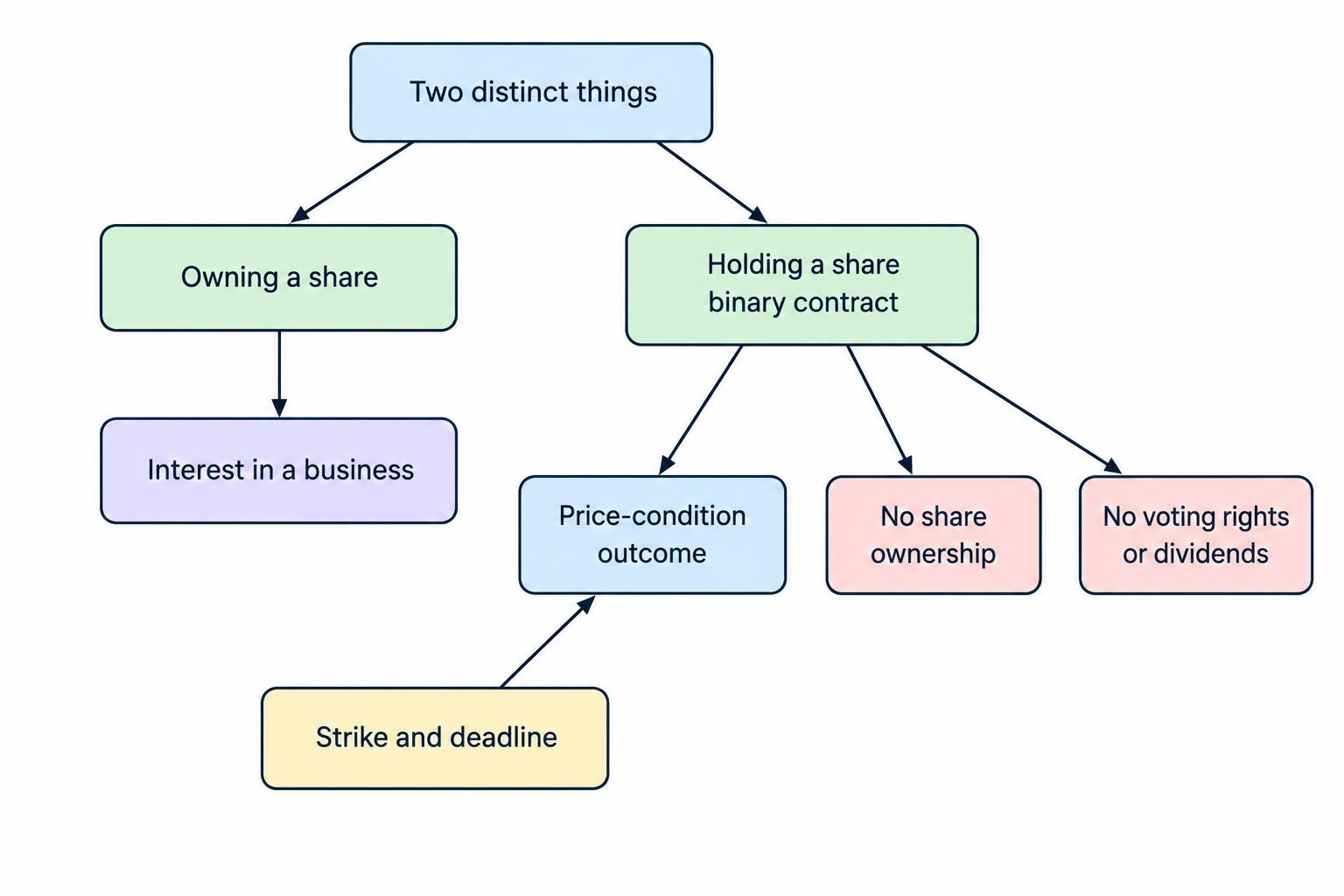
A shareholder owns an interest in a business. A share binary holder owns a contract referencing a price outcome. The binary does not itself provide voting rights, dividends or an ongoing holding in the company.
That difference changes the question being asked. “Will this business earn more over the next three years?” is not the same question as “Will its share price be above this strike in twenty minutes?” A sound assessment of the business can still produce a losing binary result if the timing is wrong.
Nor does an “up” position mean the shares must rise from yesterday’s closing price. It means the settlement condition must be met relative to the contract’s strike. A share can fall over the day yet finish above a lower strike, or rise over the day while finishing below a higher one.
A Hypothetical Share Binary Options Example
Assume a fictional Australian share has a binary contract with a strike of A$50.00. The condition is that its settlement price must be strictly above that level at 2:30 pm Sydney time.
The stake is A$100. A successful outcome returns the stake plus A$80 profit, giving a total account credit of A$180. An unsuccessful outcome loses the A$100 stake. For this example only, an exact tie refunds the stake.
| Settlement price | Contract outcome | Total returned | Net profit or loss |
|---|---|---|---|
| A$50.40 | Condition met | A$180 | +A$80 |
| A$50.01 | Condition met | A$180 | +A$80 |
| A$49.99 | Condition not met | A$0 | −A$100 |
| A$50.00 | Tie, refunded under the assumed terms | A$100 | A$0 |
These are invented contract terms, not a current offer. Tie treatment must come from the actual contract: “above” and “at or above” are different conditions.
The path before expiry also needs separating from the final result. If the share reaches A$51.00 earlier but settles at A$49.99, the illustrated high/low contract loses. Touching a price during the contract would matter only if the product’s condition expressly depended on a touch.
The Payout Sets the Break-Even Win Rate
An 80% net winning payout does not mean an 80% chance of success. It means each A$100 winning stake earns A$80, while each losing stake costs A$100.
With equal stakes, no ties and no other costs, the break-even calculation is A$100 ÷ A$180, or approximately 55.56%. Five wins and five losses would produce A$400 in profits against A$500 in losses: a net loss of A$100.
The calculation changes when payouts, stakes or refund rules change. A high win rate is not useful evidence without the payments attached to those wins and losses. The guide to probability and expected value in binary options covers that relationship without confusing a payment percentage with a forecast probability.
Australian Shares and Overseas Shares
The underlying listing determines which company announcements, trading sessions and currency conventions matter. It does not determine whether a binary provider is authorised to offer the contract to an Australian retail client.
Australian Share References
For an Australian share reference, identify the exact security and listing rather than relying on a company logo. Different securities connected with the same company need not carry the same price or rights.
The analysis should also use Sydney market time where the contract refers to the Australian session. A device clock, account clock and exchange clock can show different times without any of them being faulty.
Sector context matters too. A hypothetical miner’s price could react to commodity expectations, while a bank’s price could react to lending conditions. Neither relationship guarantees a binary outcome. The page on binary options referencing Australian shares covers the local-market details separately.
US and Other Overseas Share References
An overseas share adds another set of checks: the listing venue, local session, announcement calendar and quote currency. Do not assume a company’s ordinary shares and a depositary receipt are interchangeable price references.
The underlying quote currency is also separate from the account currency. A condition based on a US dollar share price might settle a fixed payment into an account denominated in another currency. That does not automatically reproduce the currency exposure of owning the US shares; the contract and conversion terms decide the cash result.
For the US market, the guide to binary options on US shares addresses those listing and session distinctions. A familiar company name is a starting point for identification, not proof that the contract is straightforward.
The Settlement Price Matters More Than the Chart Colour
A share does not always have one displayed price. A screen might show the last completed trade, the highest bid, the lowest offer, a midpoint or a delayed quote. Two screens can therefore disagree without either showing the same measurement incorrectly.
Consider a hypothetical bid of A$49.99, an offer of A$50.03 and a last trade of A$50.00. Against an A$50.00 strike, those figures suggest different outcomes. An offer above the strike does not establish that a contract using the last traded price has won.
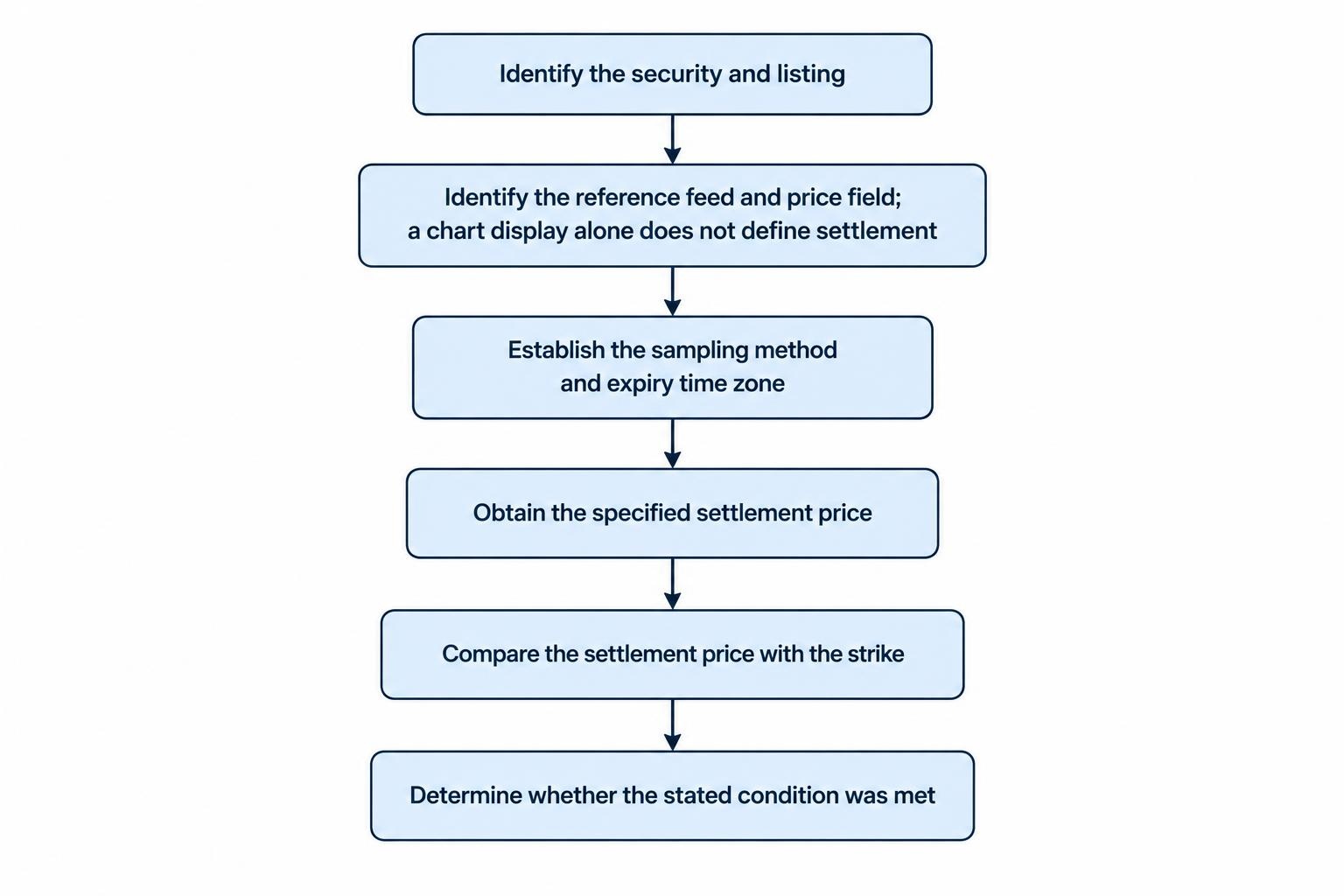
The terms should identify the reference feed, the price field and the sampling method. They should also explain what happens if no fresh trade occurs at expiry, a quote is missing, or trading in the underlying share stops.
A chart candle is a summary, not a settlement record. Its apparent closing value may use a different interval or precision from the contract. Comparing rounded chart labels can miss the decimal place that decides the result.
The broader guide to price feeds and settlement benchmarks covers these checks across markets. For shares, the practical question is whether the stated reference identifies an observable security, a usable session and a reproducible price.
Trading Hours, Auctions and Expiry Times
A contract deadline needs both a clock time and a time zone. “Expiry at 4 pm” is incomplete if it does not identify whose 4 pm.
On ASX, continuous matching ends at 4 pm Sydney time, with the closing auction occurring later. The ASX cash market trading phases distinguish continuous trading, auction preparation and the closing auction. Consequently, a 4 pm contract expiry should not automatically be treated as a contract on the official daily closing price.
An auction can also produce a price different from the last continuous trade. A contract using an auction result asks a different question from one using the last eligible trade before continuous trading ends.
For US shares, the regular session runs from 9:30 am to 4 pm Eastern Time. Extended sessions introduce other conditions: reduced trading interest, wider bid/offer spreads and prices that may differ between venues. These risks are covered in the SEC’s extended-hours trading bulletin.
Australian readers should check the calendar date as well as the hour. An overseas evening announcement may fall on the following Australian morning. Daylight-saving changes also mean a saved time conversion should not be treated as permanent.
A platform displaying a share-labelled price outside the regular session needs further explanation. Is it referencing an active extended-hours venue, a stale closing price or a separately calculated quote? The name alone does not answer that. The article on after-hours share trading examines those distinctions.
Earnings Reports and Company News
A share binary concentrates the outcome on one company’s price at a deadline. That makes the timing of company news particularly relevant.
Suppose a fictional company reports stronger sales but lowers its profit forecast. A prediction based only on the sales headline could miss the part of the announcement that changes expectations. Even an accurate reading of the announcement does not establish where the price will stand at expiry.
Separate the release time from the response period. A contract expiring before an announcement cannot capture the later reaction. One expiring immediately afterwards depends on the first price response, not necessarily the interpretation that prevails later in the session.
A useful paper exercise records the scheduled announcement, the forecast made beforehand and the exact expiry condition. Retrofitting a prediction after seeing the result proves very little, apart from how cooperative hindsight can be.
The guide to earnings reports and company news covers announcement analysis in more detail. Here, the central point is that the event schedule and contract schedule must be considered together.
Dividends, Splits and Other Corporate Actions
Corporate actions can change how a share price should be interpreted. A downward movement need not represent a fresh deterioration in the business.
Shares can fall around the ex-dividend date, when a new buyer no longer receives the declared dividend. The ASX explanation of shares and dividend dates describes that distinction. A share binary holder does not receive the company dividend simply because the contract references its shares.
This does not create an automatic winning “down” prediction. The strike, timing, other price movements and any contractual adjustments still matter. A predictable calendar event is not the same thing as a guaranteed settlement outcome.
Splits require another check. In a hypothetical two-for-one split, a holding of 100 shares becomes 200 shares, with the theoretical price per share halving before other market movements. Comparing the new quote with an unchanged old strike would distort the economic comparison.
For a binary contract, look for written terms covering adjustments, cancellation or settlement following such events. Do not assume the provider will follow the treatment used by another product or venue. The separate guide to dividends, stock splits and corporate actions covers these event types without treating every price discontinuity as a trading signal.
How to Assess a Hypothetical Share Binary
For educational analysis, begin with the contract description rather than a prediction. If the outcome cannot be reconstructed from the written terms and recorded data, a profitable-looking chart does not fix the problem.
A short review should answer five questions:
- What is the underlying? Identify the security, listing, quote currency and reference venue.
- What must happen? Record the strike, direction, expiry time, time zone and treatment of equality.
- Which price decides it? Identify the feed, price field, sampling method and missing-data rules.
- What changes the price context? Check the session, company announcements and corporate-action dates.
- What are the cash outcomes? Separate net profit from total returned, and include any stated charges.
Keep the original assumptions when reviewing the result. Changing the expiry after seeing the chart, excluding awkward ties or substituting a more favourable feed turns an analysis into a different exercise.
A paper result should also distinguish an incorrect forecast from an unclear settlement. They are separate problems. One concerns the prediction; the other concerns whether the contract can be evaluated reliably at all.
Product Risk and Provider Risk Are Separate
A clear contract can still lose money. Knowing that an individual stake can be lost in full does not make repeated stakes affordable, and a fixed winning payment does not make that payment likely.
The company whose shares appear in the contract is also not necessarily responsible for paying it. Recognising the underlying business does not establish the identity, authorisation or financial position of the contract provider.
For Australian retail readers, access restrictions remain the starting point. ASIC’s Moneysmart warning on binary options cautions that offers may be scams and advises against accepting wholesale classification simply to gain access. A working sign-up page is not evidence of lawful availability.
Share binary options should therefore be analysed as price-condition contracts, not shortcuts to share ownership. The company, strike, deadline, settlement reference and payout all need to fit the same description. Getting the company’s direction right is only one part of that assessment.
This article was last updated on: October 22, 2026