A broker’s trading name is not enough to identify who holds an account, owes a payment or answers a complaint. Useful broker research starts with the legal counterparty: the company named in the customer agreement, its registration details and the permissions that apply to that entity.
Operating status needs a separate assessment. “Website available”, “company registered”, “licence current” and “accepting customers” answer different questions. Combining them into a single “active” label hides the distinctions that matter most. The examples below use official records retrieved on 21 October 2026; they are document checks, not platform tests or a complete directory of binary options providers.
The Australian restriction comes before broker selection
ASIC’s prohibition on issuing and distributing binary options to retail clients took effect on 3 May 2021 and was extended until 1 October 2031. That restriction is the starting point for Australian retail readers, not a final box to tick after comparing platforms. A foreign registration or a familiar brand does not change the product restriction described in ASIC’s announcement extending the binary options ban.
Entity research remains useful for checking historical accounts, examining broker claims and identifying the correct business in a dispute. It should not become a search for a workaround to the retail ban.
Separate the brand, company and regulatory permission
Start with three questions: what name appears in the advertising, what company appears in the agreement, and what permission does that company actually hold? Do not accept an answer to one question as an answer to all three.
Company registration alone does not establish authorisation to provide financial services. An Australian financial services licence also does not mean ASIC endorses a company or guarantees an investment. These distinctions, including the risk of copied licence details, are covered in Moneysmart’s checks for company identity and financial services authorisation.
For a research record, treat each claimed relationship as something to establish. If a brand names several companies, identify which agreement applies to the account being examined. A group relationship should not be treated as proof that every company in that group holds the same permissions.
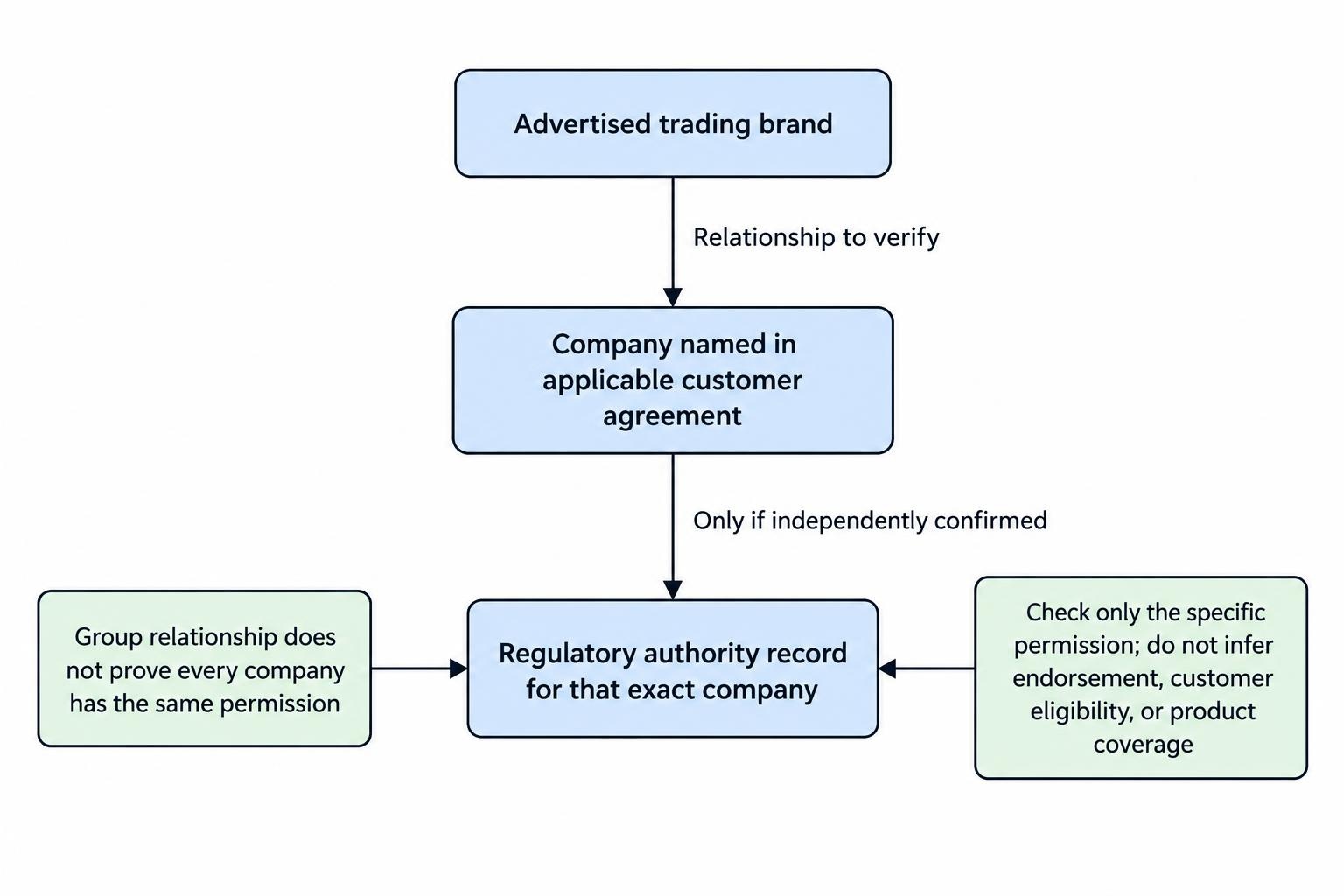
Keep payment details separate too. If a statement shows a different recipient, record that name and ask for an explanation rather than assuming it is the trading counterparty. The mismatch is a question to resolve, not automatic proof of wrongdoing.
Build an entity record that another reader can reproduce
A useful record should let someone repeat the check without relying on the researcher’s memory. Capture the exact legal name, not a shortened version, and retain the company number wherever one is available. Similar names are a reason to compare identifiers more carefully.
Use the following fields as a compact research template:
- Brand and account address: the trading name and exact website address associated with the account or offer.
- Contracting entity: the full company name, jurisdiction and registration number stated in the applicable agreement.
- Regulatory record: the authority, reference number, status and relevant permission claimed.
- Account evidence: the agreement version, account opening date and documents connecting the customer to that entity.
- Research trail: the resource checked, retrieval date, effective date and any unresolved contradiction.
Distinguish an operator’s statement from independent confirmation. “The agreement names Company A” and “the official register confirms Company A’s permission” are separate findings. If only the first is established, leave the second open.
This article concerns the resulting evidence record rather than every register search step. Use the separate guide to checking a broker’s licence for that process. In the research notes, preserve both the search term and the returned identifier so another person can check whether the match was sound.
Dated examples: what official records establish
The following examples show why a status entry needs a company or firm identifier, a jurisdiction and a date. They do not establish withdrawal performance, financial strength or permission to serve Australian retail clients.
Nadex: a trading name change is not the same as disappearance
The CFTC’s record identifies North American Derivatives Exchange, Inc., records its status as “Designated” and connects its history with HedgeStreet and Nadex. It states that the name changed to North American Derivatives Exchange in June 2009, that Foris DAX Markets acquired Nadex in March 2022, and that the market also does business under the Crypto.com name. Those connections appear in the CFTC’s designated contract market record for North American Derivatives Exchange.
The research implication is narrow: preserve the relationship between the legal entity and its historical names. Do not mark an entity “closed” just because an older trading name is less visible. Equally, do not extend that entity’s designation to every service bearing a related brand.
PocketOption: record the warning without inventing an entity mapping
The FCA’s PocketOption warning was first published on 29 September 2021 and last updated on 10 February 2026. It states that the firm is not FCA authorised and may be targeting people in the UK. The notice includes associated website addresses and contact details in the FCA warning concerning PocketOption.
A defensible entry would record the warning name, the listed identifiers, its UK scope and both publication dates. It should not turn that notice into an unsupported statement about the contracting company for every customer.
Nor should the status become “closed”. The notice supports an authorisation warning, not a finding that a website has stopped operating or that a company has entered liquidation. Those would require different evidence.
Pocket Option FX: a similar name does not establish common ownership
A separate FCA notice, published on 12 September 2023, concerns Pocket Option FX. It lists different website and contact details and states that the firm is not FCA authorised and is targeting people in the UK. The identifiers are available in the FCA warning concerning Pocket Option FX.
For this research record, the two notices do not by themselves establish common ownership or a shared contracting entity. Keep them separate unless further evidence establishes a connection.
This is a useful discipline beyond these examples. Match the actual website, company number and account documents. A resemblance between names is a lead to investigate, not a finished corporate history.
Use operating status labels that say what was checked
A single “active” or “inactive” field is too blunt. Use separate fields for corporate status, regulatory status, website availability and customer access. Then add a short evidence note explaining the result.
The following labels are a suggested reporting format, not findings about any named provider.
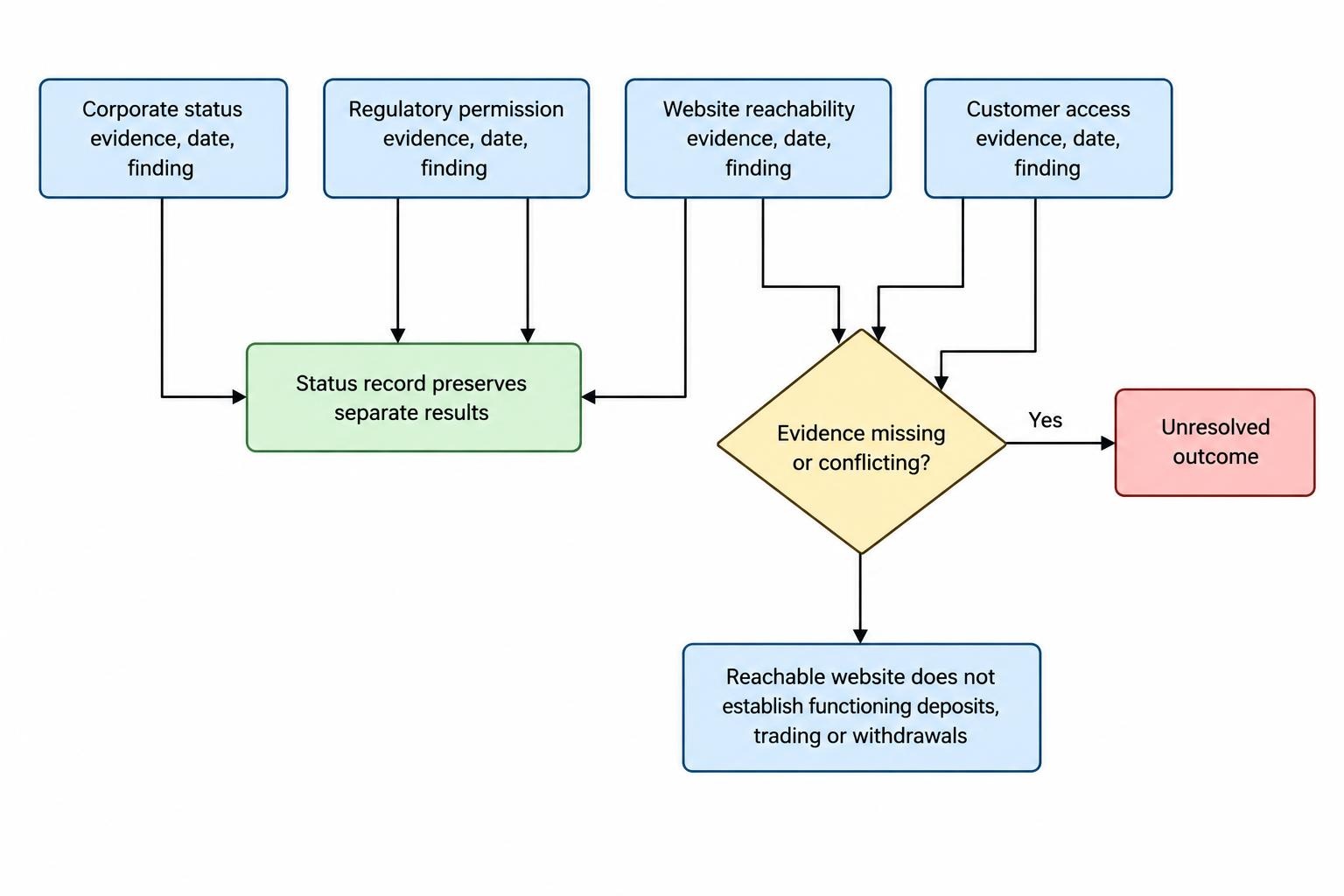
| Research label | Evidence to record | What not to infer |
|---|---|---|
| Corporate status recorded | The official company record, identifier and status date. | That financial services permission or customer repayment capacity has been established. |
| Regulatory permission confirmed | The matched entity, permission, jurisdiction and relevant date. | That every product, related company or customer location is covered. |
| Website reachable | The address checked and observation time. | That deposits, trading or withdrawals function. |
| New accounts reportedly restricted | The dated notice or account evidence supporting the restriction. | That existing accounts have closed or balances have been returned. |
| Closure or administration documented | The formal notice, affected entity and effective date. | That every related brand or company has the same status. |
| Unresolved | The missing evidence or conflicting records. | Either a favourable or adverse finding without further support. |
Do not test customer access by depositing money. Where research depends on account functions that have not been checked, state that plainly. “Not tested” is more useful than a confident label built from a homepage screenshot.
Handle rebrands and account transfers as separate events
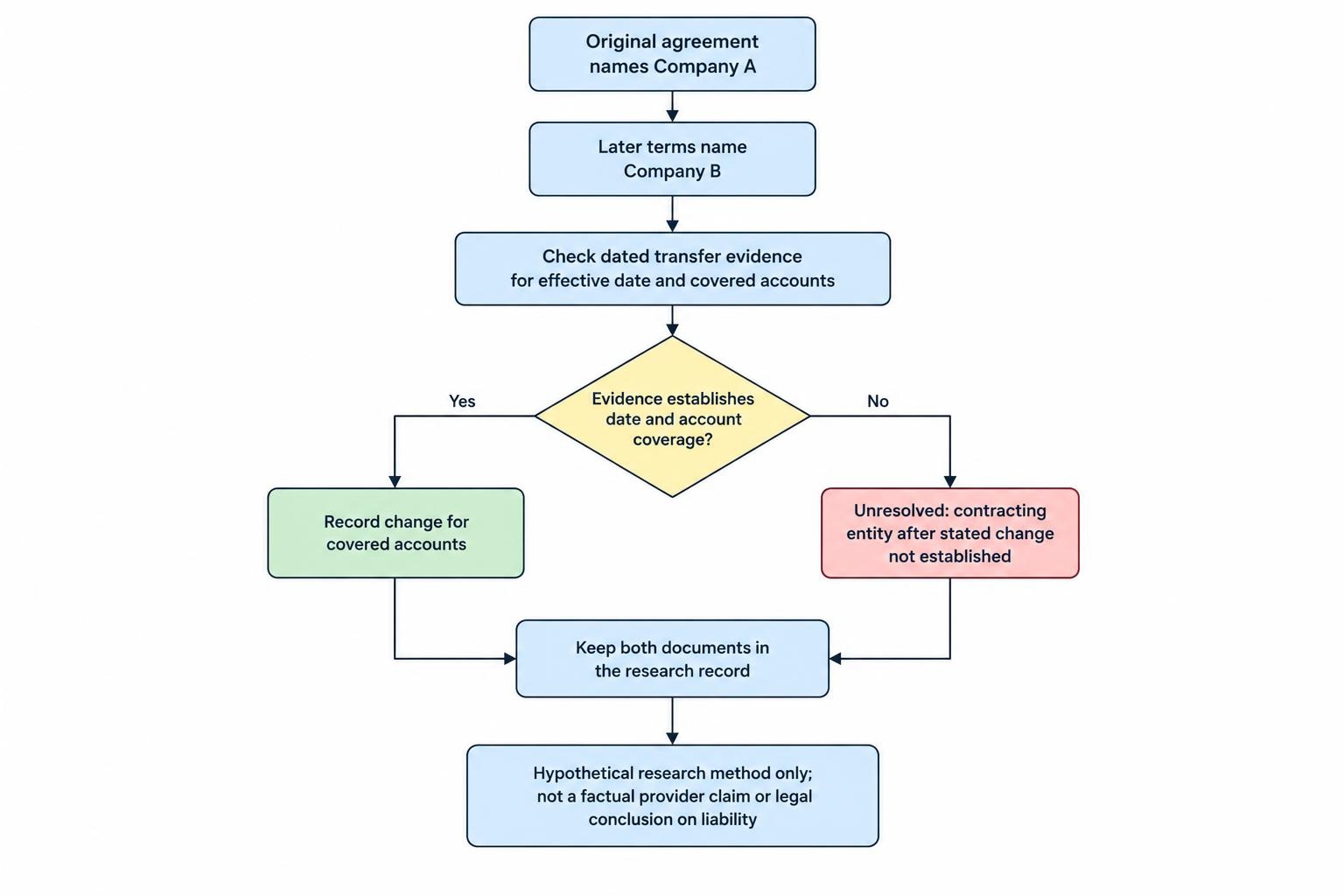
When examining a claimed rebrand, compare the legal entity and registration number before and after the change. Ask whether only the trading name changed, whether ownership changed, or whether customers were asked to contract with another company.
For a hypothetical example, suppose an account opened under Company A later displays Company B in its terms. Do not overwrite the original record. Retain both documents and look for the notice explaining when the change took effect and which accounts it covered.
Separate historical brand tracking from current permissions. A fuller brand chronology belongs in the guide to closed and renamed broker brands. An entity research record should concentrate on who was named in the agreement at each relevant point.
If the transfer evidence is missing, write “contracting entity after the stated change not established”. That wording identifies the gap without pretending to resolve questions about liability or the validity of a transfer.
Verify closure claims against formal evidence
A claim that a broker has “shut down” needs a defined meaning. Specify whether the evidence concerns a website, a trading service, a company or a regulatory permission. Avoid using those terms interchangeably.
For Australian companies, ASIC provides access to published insolvency and deregistration notices. Its guidance states that the published notices service holds notices from 1 July 2012. This is a relevant place to investigate a formal closure claim through ASIC’s insolvency and deregistration notice guidance.
Record the notice type, exact entity and event date. Do not reduce every formal notice to “closed”, or treat a notice about one company as a group wide finding.
If no matching notice is found, report the search and its scope. “No matching notice found in the resource searched” is defensible. “The company is solvent” is a much larger claim and should not be substituted for it.
Identify the complaint respondent, not just the brand
For a dispute, organise the evidence around the account agreement, payment records and communications naming the business involved. Keep the trading brand as an identifier, but do not use it as a substitute for the legal name.
AFCA considers complaints subject to its membership and jurisdiction requirements, including eligibility, time limits and other rules. A complaint needs to concern an AFCA member firm; membership alone does not settle whether a particular complaint can be considered. These conditions appear in AFCA’s requirements for complaints it can consider.
Keep the evidence note modest: identify the potential respondent, the membership finding and any unanswered eligibility question. Do not promise compensation or a successful recovery.
Where a payment recipient differs from the contracting entity, retain both names and the documents connecting them. That makes the discrepancy available for assessment without guessing which business bears responsibility.
Keep findings current without overstating certainty
Date each finding separately. The day a warning was published, the day an event took effect and the day a researcher retrieved the record may all differ. Preserve those dates rather than replacing them with a single “updated” label.
Set a fresh review when new terms name another company, a regulator changes a record, or an official notice reports a corporate event. Keep superseded evidence so the account’s history remains traceable.
Finally, separate identity verification from the broader assessment of counterparty and platform risk. Establishing a company’s identity answers who the documents name; it does not demonstrate reliable withdrawals, sound finances or suitable products.
A useful broker status record ends with clear boundaries: what was confirmed, what date it relates to and what remains unknown. If the contracting entity cannot be established, the right result is “unresolved”—not a reassuring badge.
This article was last updated on: October 22, 2026