Binary options trading tools should help you check assumptions, calculate outcomes and keep records. A useful toolkit answers practical questions: what price was observed, when did the contract expire, what payout applied, and did the result match the rules? More indicators do not necessarily mean better analysis.
For Australian readers, the legal position comes first. ASIC’s prohibition on issuing and distributing binary options to retail clients took effect on 3 May 2021 and has been extended until 1 October 2031. The ASIC announcement extending the retail binary options ban sets out that protection. Treat the tools below as resources for education, paper exercises and checking claims, not as a route around the ban.
You can organise much of this work with a spreadsheet, a chart, official calendars and a consistent review process. None of them can guarantee profitable predictions or make an unsuitable product suitable.
What belongs in a binary options toolkit?
Choose tools by the question they answer, rather than the number of features advertised. Each tool should have a clear job and a known boundary.
| Tool | Main purpose | What it cannot establish |
|---|---|---|
| Trading journal | Record decisions, contract terms and outcomes | Whether future results will repeat past results |
| Payout calculator | Calculate profit, loss and the required win rate | The probability of winning |
| Economic calendar | Identify scheduled announcements | The direction of the market response |
| Market hours tool | Check sessions, dates and time zones | Whether a platform’s quote matches its stated benchmark |
| Practice plan | Make paper exercises consistent and reviewable | How a live account would execute or handle withdrawals |
| Broker evaluation checklist | Organise checks on identity, permissions and terms | Safety based on appearance or a completed form alone |
Prefer tools that let you inspect the inputs and export the results. A colourful dashboard is less useful than a plain record you can actually check.
Use a trading journal as the central record
A journal connects the other tools. Without it, the calendar, chart and calculator become separate screens rather than a record of what happened.
For each paper observation, capture the asset, date, time zone, direction, reference price, expiry, assumed stake and quoted net payout. Add the price source and the rule used to decide the outcome. Record refunded ties, losses and wins separately; do not force every result into a simple win or loss column.
The trading journal guide covers how to structure those entries. At this stage, the priority is consistency. Two observations should be comparable without having to reconstruct what the column headings meant that day.
Keep the original entry separate from later comments. Write the reason for the observation before the outcome is known, then add a review afterwards. Otherwise, a vague idea can acquire remarkably precise reasoning once the chart has already moved.
Use screenshots to support the record, not replace it. A screenshot without a timestamp, instrument name or price source may be difficult to interpret later. Store a short explanation alongside it and keep a backup outside the charting platform.
Check payout calculators before trusting their answers
A binary options calculator should distinguish the returned stake from profit. If a hypothetical $10 contract pays 80% net profit when successful, the profit is $8 and the total amount returned is $18. An unsuccessful contract loses $10 under the assumptions used here.
For a fixed payout, full stake loss, no fees and no refunds, the calculation is:
Break-even win rate = 1 ÷ (1 + net profit rate)
Enter an 80% profit rate as 0.80. The required win rate is then approximately 55.56%. At a 75% profit rate, it rises to approximately 57.14%. These are arithmetic thresholds, not forecasts. The separate guide to probability and expected value in binary options examines what those thresholds mean.
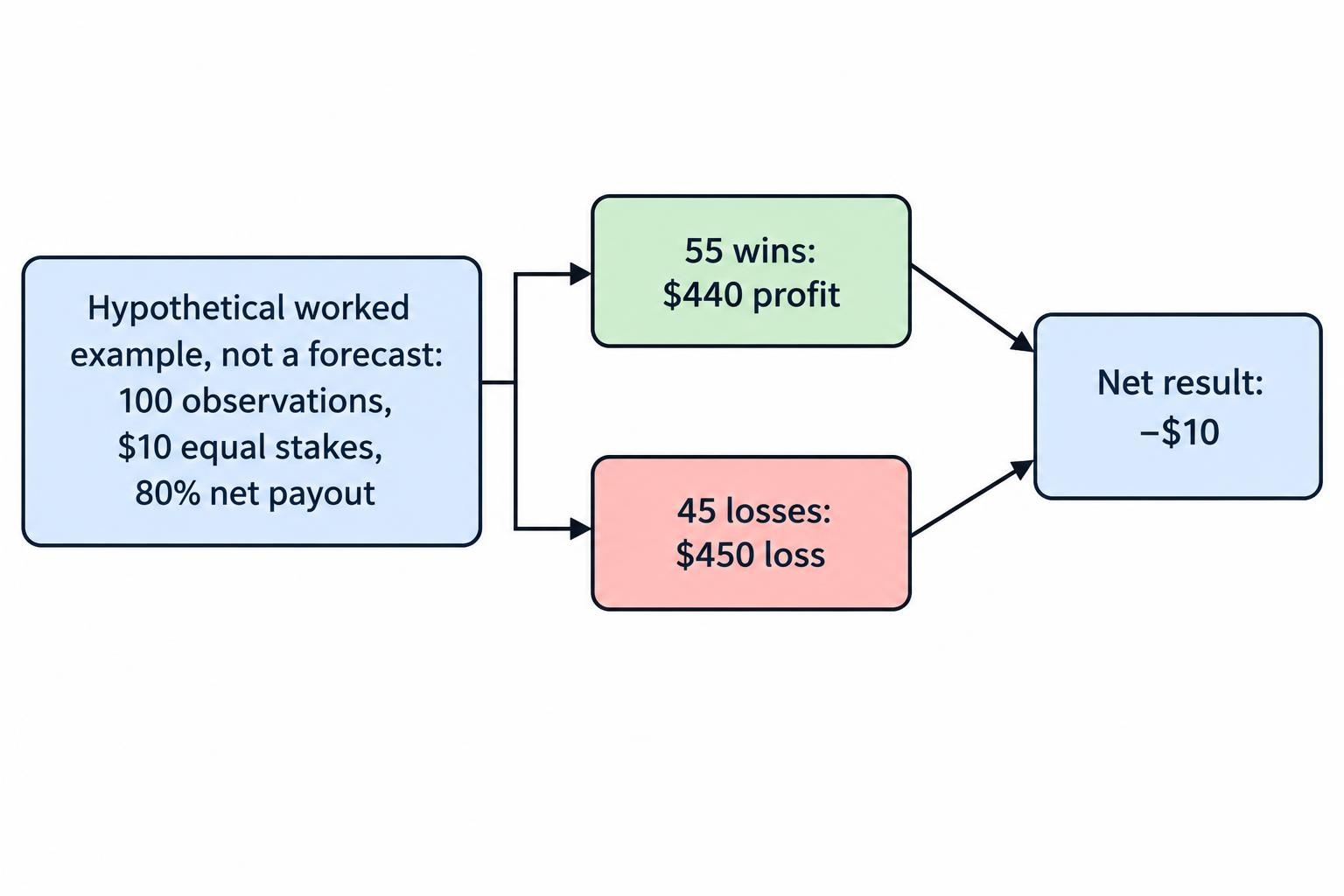
Check any calculator against a simple worked case. Across 100 hypothetical observations with equal $10 stakes and an 80% net payout, 55 wins produce $440 profit. The remaining 45 losses cost $450, leaving a $10 net loss. Winning more often than losing is not enough in that example.
Reject a calculator that hides its payout assumptions, treats an advertised maximum payout as constant, or assumes that increasing the next stake repairs previous losses. If payouts vary, record each observation’s actual assumed profit or loss rather than applying one rate to the entire sample.
A calculator can process a probability estimate, it cannot supply a trustworthy estimate simply because the output has two decimal places.
Use an economic calendar to flag events, not predict reactions
An economic calendar helps you identify scheduled announcements before reviewing a market. For an Australian dollar exercise, start with the relevant Australian releases and policy events rather than relying entirely on a platform’s coloured importance labels.
Check important entries against the institution publishing them. The RBA calendar of policy announcements and public events lists dates, times and time zones for its releases. Distinguish a policy decision from meeting minutes, a speech or a press conference; they are different events.
Save the scheduled time in your journal before beginning an observation. If you use a third party calendar, check which time zone it displays and whether its settings persist after you sign out. A correct event shown in the wrong time zone is still a bad input.
The economic calendar guide covers the fields worth checking and how to include events in a research routine. A sensible use is to label observations near announcements, then review them separately from ordinary sessions.
A calendar does not tell you whether a release will beat expectations or how prices will respond. Avoid treating an event label as a ready made directional signal.
Check market hours and clocks together
A market hours tool needs more than an “open” or “closed” badge. It should identify the market, session, date and time zone, and distinguish ordinary trading from auctions or other phases.
For Australian shares, the ASX cash market trading hours separate the opening auction, normal trading, closing auction and later phases in Sydney time. A display that compresses these into one uninterrupted session removes useful context.
Check the instrument as well as the clock. A cash index, a futures contract and an individual share are not interchangeable reference prices. An external chart is only a meaningful comparison if it represents the benchmark described in the contract terms.
Use the market hours tool guide to organise session and time zone checks. Save the UTC timestamp alongside local time where practical, and use a date aware time zone setting rather than a permanently fixed offset.
For paper exercises, record the intended expiry timestamp before observing the result. A phone countdown can help with reminders, but it is not evidence of a platform’s settlement time. If two displays disagree, investigate the instrument, timestamp and price basis before drawing a conclusion.
Build a practice plan that prevents selective recording
A practice plan gives the toolkit a repeatable purpose. Without one, it is easy to record a few attractive examples, change the rules after a loss and call the remaining results a strategy.
Define one question for each exercise. You might examine whether the outcome changes when you use the correct session time, or whether a quoted payout would have covered the losses in a recorded sample. Keep those questions separate.
A written binary options practice plan should state the observation period, entry rule, expiry rule, assumed payout and conditions for excluding an observation. Set those conditions before collecting results. Record every qualifying observation, including awkward cases and missing data.
Keep rule changes visible. If you alter the expiry or add a filter halfway through, start a new labelled batch rather than merging the results. Otherwise, the reported result no longer describes one method.
A recorded win rate also contains sampling uncertainty. Confidence intervals can express that uncertainty under stated assumptions; NIST’s methods for confidence intervals on proportions provide the statistical basis. Applying a simple binomial interval requires assumptions such as independent observations and a stable success probability, which trading observations may not satisfy.
Do not turn a favourable paper sample into a claim about live profitability. Paper records do not establish execution quality, withdrawal reliability or the validity of a provider’s prices.
Use a broker checklist as a stop gate
A broker evaluation checklist should help identify reasons to stop, not produce a reassuring score from a collection of marketing features. A polished app, responsive chat window and long list of indicators do not answer questions about legal identity or permissions.
Start with the contracting entity, not just the brand. Record the company name, claimed regulator, licence details, product permissions and intended client category. Where checks are relevant, compare claims against the regulator’s own records rather than a certificate uploaded by the business.
The broker evaluation checklist provides a structure for those questions. For an Australian retail reader, the product prohibition discussed above is a threshold issue, not a box that attractive software can outweigh.
Keep platform risk separate from analysis risk. A correct prediction is of little use if the account record or settlement process cannot be trusted. The SEC and CFTC alert on binary options fraud documents complaints involving withheld funds, identity theft and alleged software manipulation.
That does not mean every price discrepancy proves misconduct. Preserve the evidence, identify the contract’s stated rules and distinguish a documented inconsistency from an assumption about what should have happened.
When is a paid tool worth considering?
Start with the task a paid tool would improve. Perhaps manual exports take too long, historical timestamps are missing, or the journal needs better filtering. Those are testable requirements. “Better results” is not a sufficiently clear purchase specification.
Compare the tool against a basic alternative using the same input data. Check whether calculations reconcile, time zones remain correct and exported files preserve the fields you need. If the service cannot explain how it labels an outcome, its headline performance figure is difficult to audit.
Include subscriptions in the arithmetic. In a hypothetical month with $20 profit before software costs, a $30 subscription changes the result to a $10 loss. Treating software as a separate budget item does not remove its effect on the result.
Be cautious with tools that require a broker deposit, account access or remote control of your device before revealing how they work. For education, prefer arrangements that let you inspect the method without sending money to a trading account.
Make the tools work as one routine
A small, repeatable process is easier to audit than a screen full of disconnected services:
- Before an exercise: check the legal scope, instrument, session, calendar and time zone.
- Before the observation: write the rule, reference price, expiry and payout assumption into the journal.
- At the endpoint: save the observed price, timestamp, outcome and supporting evidence without rewriting the original entry.
- During review: reconcile the arithmetic, separate changed rules and investigate missing or inconsistent data.
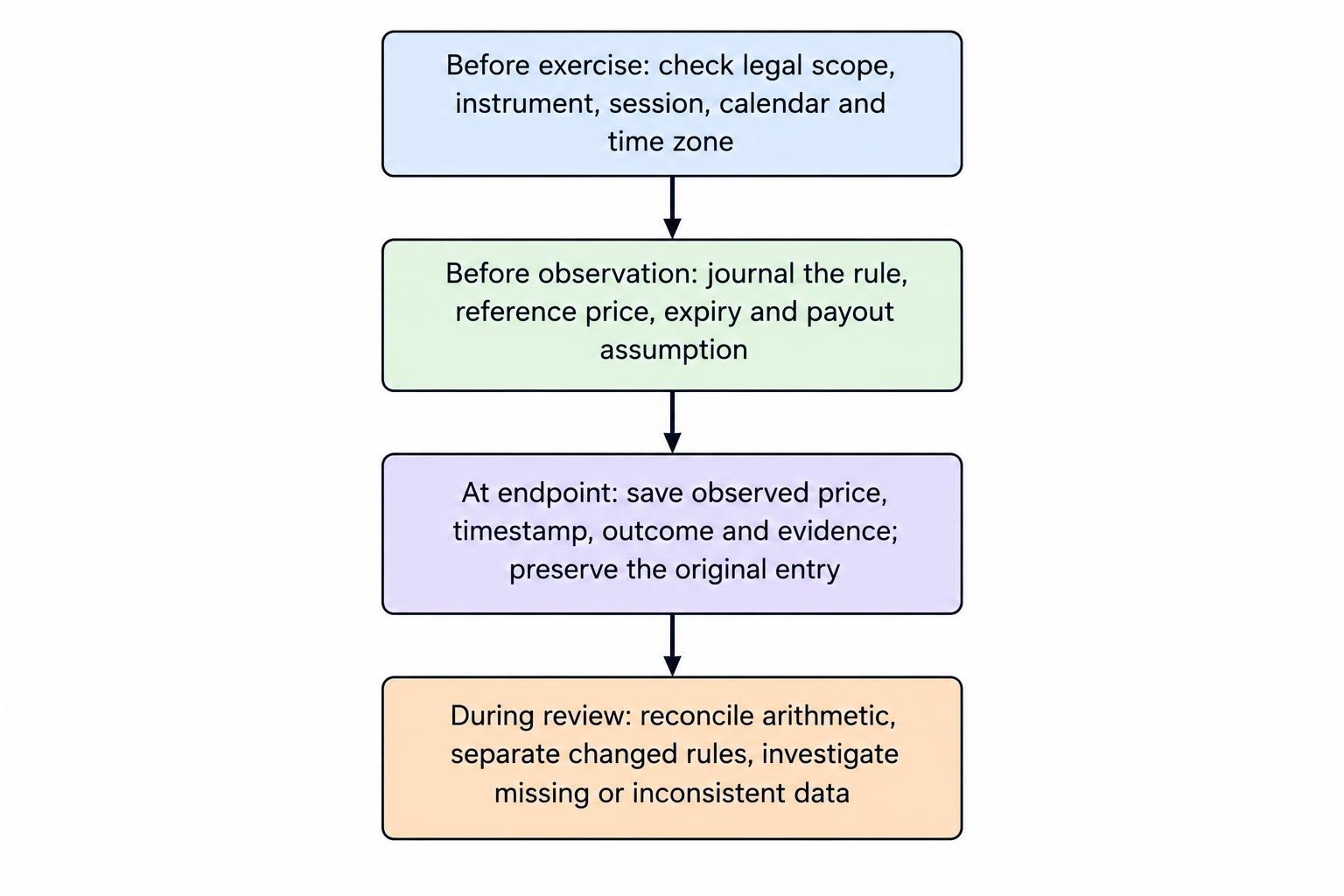
Give each tool one defined role. The calendar supplies event times, the hours tool supplies session context, the calculator checks arithmetic and the journal preserves the record. The practice plan determines what you are testing.
The standard is straightforward: can another person follow the inputs and reproduce the calculation? If not, simplify the process before adding more software. Useful binary options trading tools make uncertainty and mistakes easier to see. They do not make either disappear.
This article was last updated on: October 22, 2026