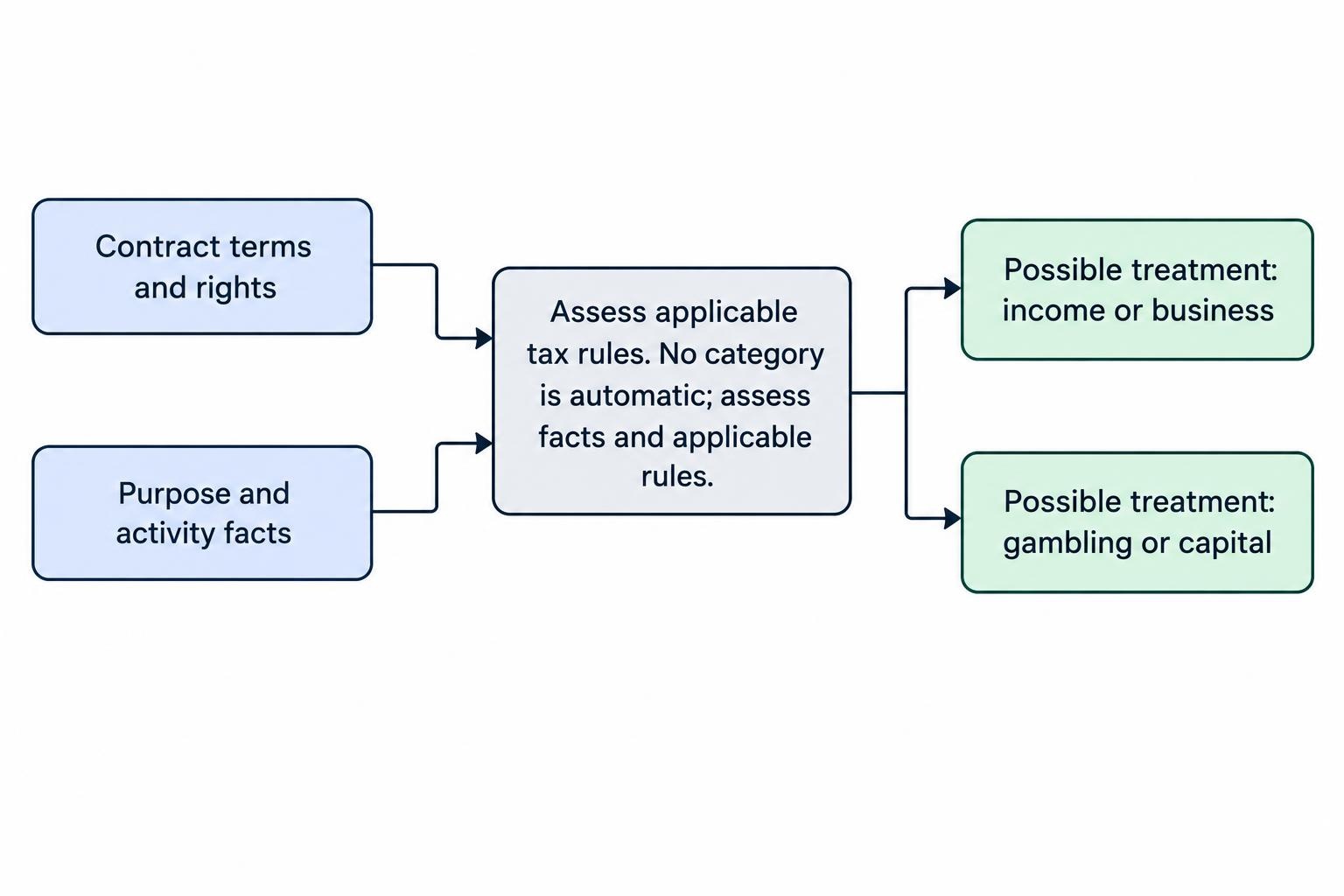
Binary options profits can be taxable in Australia, but there is no separate “binary options tax” or automatic tax exemption. The treatment depends on the contract, the purpose of the activity and the tax rules that apply to the person or entity holding it. Losses need their own assessment: losing money does not automatically create a deduction.
The main mistake is choosing a label before examining the transactions. Calling an account “gambling”, “investing” or a “trading business” does not settle its tax treatment. Nor does leaving the money with an overseas platform.
This guide covers the questions Australian taxpayers should resolve before preparing a return, including income versus capital treatment, losses, offshore accounts and cryptocurrency funding. It provides general information, not a tax opinion on any particular contract.
The Australian binary options ban and tax are separate issues
ASIC’s order banning the issue and distribution of binary options to retail clients took effect on 3 May 2021 and has been extended until 1 October 2031. The dates and scope are set out in ASIC’s announcement extending the binary options ban.
This matters because a tax article should not imply that Australian retail clients can lawfully obtain these products simply by choosing an offshore provider. A platform accepting an Australian address, deposit or identity document is not proof that its offer complies with Australian requirements.
At the same time, the regulatory position does not answer how historical transactions should appear in a tax return. Keep those questions separate when obtaining advice: whether a provider could offer a product, and how your receipts, expenses or losses should be treated.
For the product restrictions rather than tax reporting, see the guide to binary options regulation in Australia. The discussion below is relevant to reviewing past activity and other circumstances requiring a tax assessment; it is not an invitation to bypass the retail ban.
Start with the contract, not the platform’s description
Before deciding whether a result belongs on income or capital account, establish what the customer actually bought. Save the agreement, settlement rules and payment terms. A dashboard label such as “options”, “digital trading” or “fixed return” is not a substitute for those documents.
A binary contract usually pays a predetermined amount if its condition is met, rather than producing a gain that increases with every point of favourable price movement. That distinction matters when comparing it with other derivatives.
ATO Taxation Ruling TR 2005/15 on financial contracts for differences distinguishes commercial profit-making transactions from recreational gambling. However, its stated scope is financial contracts for differences, including features where the gain or loss depends on exposure to price movement. It is not a blanket ruling that every binary option receives the same treatment.
The practical implication is straightforward: use derivative tax guidance carefully, not by analogy alone. An adviser needs to compare the ruling’s arrangements with your contract before relying on its treatment.
Prepare a short description in plain English. State what you paid, what rights that payment created, how the outcome was determined and what you received when the contract ended. This is more useful than sending an accountant a screenshot showing only an account balance.
Income, capital or gambling: which treatment needs consideration?
These categories are not interchangeable, and the most favourable result is not necessarily the correct one. The same facts used to support the treatment of profits should also inform the treatment of losses.
Commercial profit-making activity
A commercial activity undertaken to earn profits requires an income tax assessment, even if it sits alongside employment rather than replacing it. Do not assume that only a full-time trading business can produce taxable income.
When briefing an adviser, describe what you were trying to achieve before the trades occurred. Useful evidence might include a written plan, performance targets, research subscriptions and records showing how decisions were made. These documents help explain the activity; they do not guarantee a particular tax outcome.
Consider a hypothetical employee who sets aside money, follows a documented trading process and measures returns each month. “I also have a salary” does not explain the nature of those transactions. Equally, a profitable month does not prove that the person operates a business.
The distinction between revenue treatment and capital treatment deserves attention before amounts are entered into a return. The separate guide to income versus capital treatment addresses that classification in more detail.
Trading as a business
Business status needs a factual assessment, not a self-selected account setting. Bring together evidence about the scale, organisation, regularity and commercial purpose of the activity. Explain how it operated in practice, including periods when the original plan was not followed.
Avoid building the explanation around a single number. “I placed 500 trades” leaves plenty unanswered: over what period, under what process, using how much money and for what purpose?
For example, two people could place the same number of contracts. One might follow an organised process with budgets and maintained records. The other might make sporadic bursts of trades after seeing social media promotions. The count alone misses most of the useful context.
Keep the evidence factual rather than dressing it up after a loss. A business plan written in July cannot show what you intended the previous January unless other records support that account. The guide to trading as a business covers the supporting evidence and classification questions.
Recreational gambling
A fixed payout and an uncertain outcome do not, by themselves, establish tax-free gambling. The nature and purpose of the activity still need examination.
The statutory CGT exemption for gambling is also narrower than saying “anything risky is gambling”. Section 118-37 addresses gains and losses relating directly to gambling, while section 102-10 prevents a net capital loss from being deducted from assessable income. Both provisions appear in the income tax legislation covering capital losses and gambling exemptions.
Do not treat the gambling argument as a one-way door. A position that excludes recreational winnings also raises the question of why related losses would be deductible. “Tax-free when I win, deductible when I lose” is not a classification method.
If you believe the activity was genuinely recreational, provide the facts supporting that view. Do not rely on a platform’s marketing, a foreign tax article or the fact that the trades were short.
Capital treatment
Capital treatment should be considered where the contract and surrounding facts support it, not used as a default because the product contains the word “option”. Owning shares, holding conventional options and entering fixed-payout contracts are different arrangements.
Ask the adviser to document why capital treatment does or does not apply. That written explanation is useful if the activity continues, the contract changes or a later return includes a different result.
Keep separate schedules for different products until their treatment has been assessed. Combining share investments, cryptocurrency disposals and binary contract settlements into one “trading profit” figure can conceal differences that matter.
Calculate the trading result before calculating the tax
Classification and calculation are different jobs. Even a correct tax category will not rescue a spreadsheet that counts returned stakes as new profit or mistakes withdrawals for earnings.
Start by identifying what each platform field means. “Payout” might describe profit alone, or it might include the original stake. The difference is not cosmetic.
Assume a hypothetical contract costs A$100. If it succeeds, the account receives A$180, including the returned A$100 stake. The economic profit is A$80. If it fails and nothing is returned, the economic loss is A$100.
| Outcome | Amount paid | Total amount returned | Economic result |
|---|---|---|---|
| Successful contract | A$100 | A$180 | A$80 profit |
| Unsuccessful contract | A$100 | A$0 | A$100 loss |
| Stake refunded without a fee | A$100 | A$100 | A$0 |
Now assume six successful contracts and four unsuccessful contracts, each with those terms. The successful contracts generate A$480 in economic profit. The unsuccessful contracts lose A$400. The combined result is A$80 before fees.
That calculation is a reconciliation example, not a direction to report only one net amount. Preserve the underlying payments and receipts so the adviser can apply the correct reporting method without rebuilding the history.
Deposits and withdrawals need their own ledger
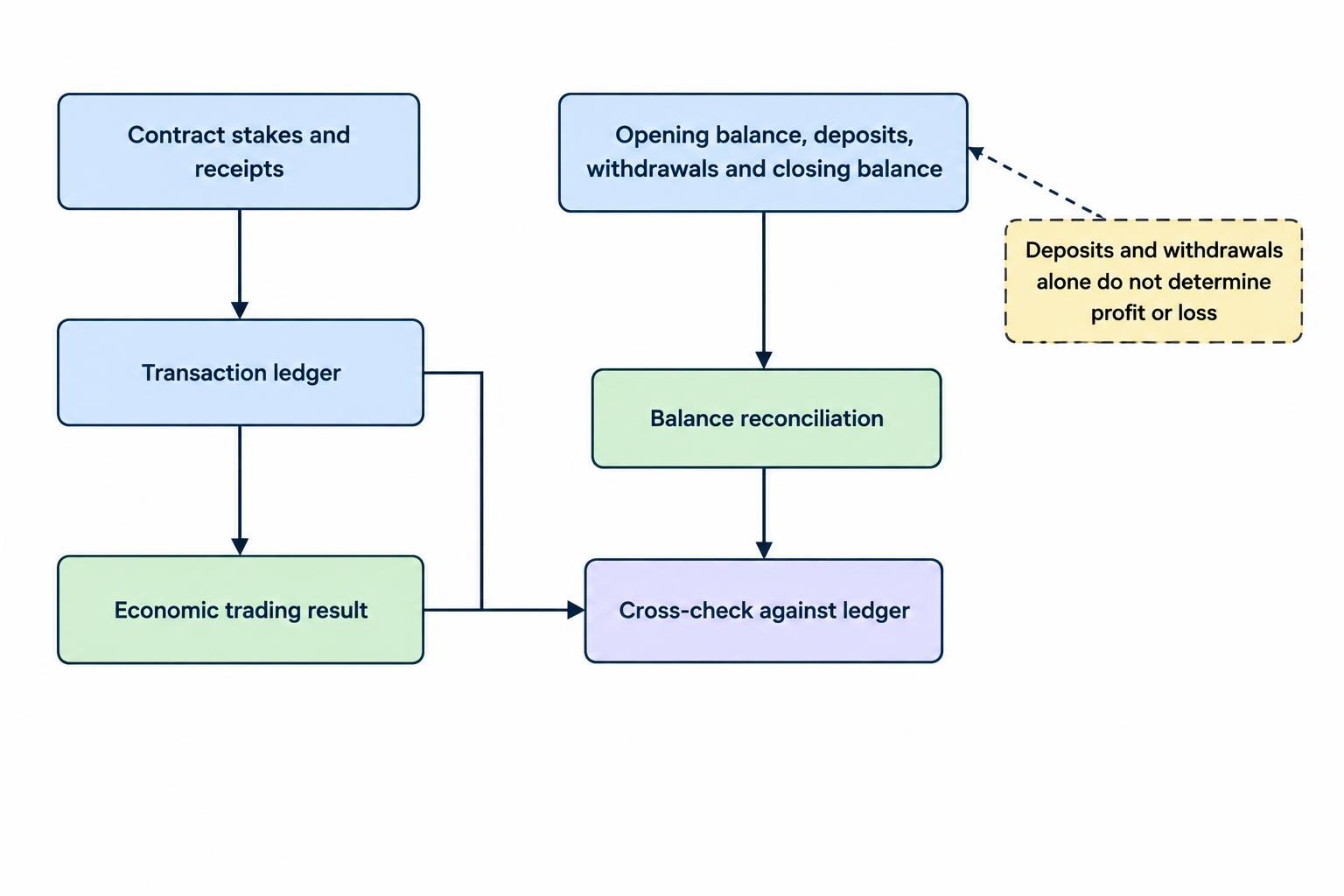
A deposit tells you how much money entered an account. A withdrawal tells you how much left. Neither figure, standing alone, identifies the trading result.
For a simple account with no open contracts, bonuses or currency movements, consider an opening balance of A$2,000, deposits of A$3,000, withdrawals of A$1,000 and a closing balance of A$4,600. The balance reconciliation produces a A$600 increase attributable to activity inside the account:
A$4,600 closing balance + A$1,000 withdrawals − A$2,000 opening balance − A$3,000 deposits = A$600.
Use this as a cross-check against the transaction ledger, not as a replacement for it. If the figures disagree, investigate missing fees, unsettled contracts, reversed payments or adjustments. A matching total is reassuring, but it still does not establish the tax classification.
Are binary options losses tax deductible?
Not automatically. A deduction needs a legal basis, and its availability depends on the character of the loss and the applicable rules.
Section 8-1 allows deductions for qualifying income-producing or business losses and outgoings, subject to exclusions including private and capital amounts. Section 6-5 deals with ordinary income. Where an individual carries on a business, Division 35 can defer losses from non-commercial business activities. These rules are contained in the income tax provisions on ordinary income, deductions and business loss deferral.
Separate the questions rather than jumping straight to a refund estimate. Was the transaction on revenue account? Is the loss deductible under an applicable provision? Does another rule defer or restrict its use?
For example, a hypothetical A$4,000 loss does not mean a A$4,000 tax refund. Even where a deduction is available, its effect depends on the taxpayer’s wider position. If the loss is deferred, its treatment differs again.
Do not place every negative amount in the same bucket. An expired contract, a withdrawal fee and money lost to a fraudulent provider are different events requiring separate descriptions.
The guide to tax treatment of binary options losses examines those distinctions. Keep evidence even when no immediate deduction appears available; an adviser may need it to assess the event or explain the position adopted.
Related expenses also require assessment
Prepare a schedule of platform charges, analysis subscriptions, signal services and other costs you want reviewed. Include the invoice, payment date, service period and an explanation of its connection to the activity.
Separate private use rather than assuming the entire household internet bill or computer purchase belongs in a trading deduction. Also identify costs already included in a platform’s reported result, double counting them would distort the calculation.
Suppose a statement shows A$900 profit after a A$100 platform charge. A second deduction for that same charge would turn an economic A$900 result into an A$800 figure. Clear labelling prevents a fairly ordinary spreadsheet mistake from becoming a tax return mistake.
For equipment and larger purchases, ask whether a different deduction method or capital treatment is required. Payment in one year does not establish that the whole amount belongs in that year’s deduction schedule.
Offshore accounts do not decide the Australian tax position
Australian tax residency is the starting point for assessing overseas income. Australian residents generally declare worldwide income, subject to applicable exemptions and rules, including those for temporary residents. The ATO guidance on Australian residents’ foreign and worldwide income sets out the general reporting obligation.
Do not substitute the provider’s location for an assessment of your residency or the character of the income. An offshore address on a statement does not answer either question.
Give the adviser the legal entity name, account jurisdiction and any foreign tax documents. Distinguish an actual tax deduction supported by documentation from a platform entry simply labelled “tax”.
If you moved countries during the year, provide the dates and surrounding circumstances before the return is prepared. The useful question is not just where you were sitting when you clicked a button, but what residency rules applied to you.
The dedicated guide to offshore trading accounts and income covers the cross-border issues without treating an overseas account as an exemption.
Convert foreign currency amounts to Australian dollars
Keep the original account currency and the Australian dollar calculation. Section 960-50 contains the rules for translating foreign currency amounts, including different translation requirements for different amounts. See the statutory rules for translating amounts into Australian currency.
Do not assume that converting the final annual US dollar balance at one convenient exchange rate produces the correct tax calculation. Ask which method applies to the transactions being reported, then retain the rates and calculations used.
As an arithmetic example only, US$80 converted at A$1.50 per US dollar equals A$120. A separate US$100 loss converted at A$1.55 equals A$155. Those translated amounts produce a A$35 difference, rather than simply converting the US$20 net difference using an unrelated year-end rate.
The point is not that these example rates are appropriate for a return. It is that currency conversion can affect the result. A record showing only “net loss US$20” may be missing information needed for the Australian calculation.
Cryptocurrency funding can create another tax calculation
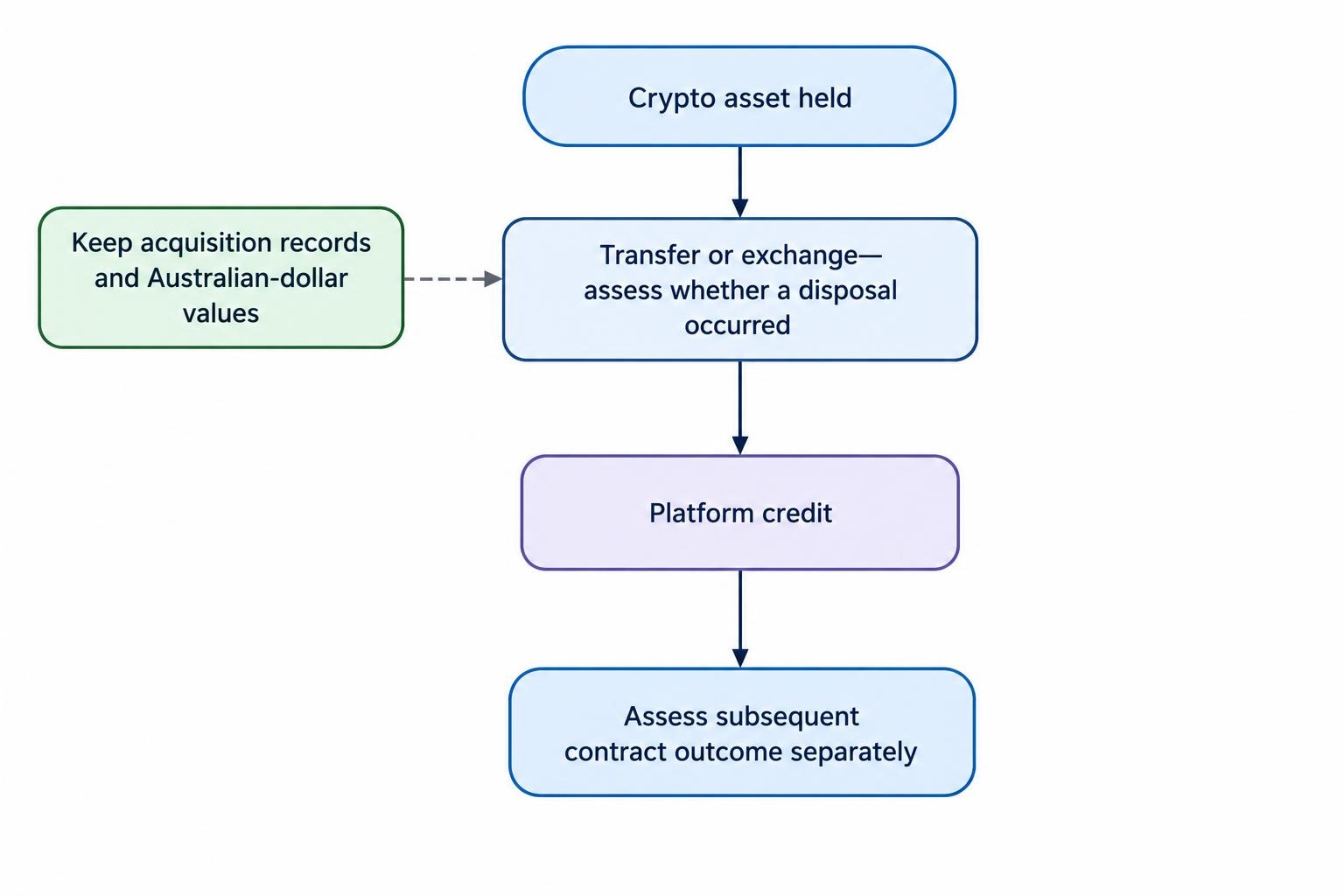
Funding a platform with cryptocurrency does not merge the crypto transaction and the binary contract into one event. First establish what happened to the tokens: were they retained in your ownership, exchanged, sold or transferred in payment for another right?
Disposing of a crypto asset can trigger a CGT event, including when it is sold, exchanged or used to buy goods or services. The ATO guidance on crypto asset transactions identifies common disposal events. Business treatment may differ.
Consider a hypothetical taxpayer who acquired cryptocurrency for A$1,000. They later transfer it, when worth A$1,400, in a transaction that disposes of the tokens in exchange for platform credit. On those assumptions, the crypto disposal needs assessment separately from whatever subsequently happens to the credit.
If the person later loses A$300 on contracts, do not automatically subtract that from the crypto gain. The two results may have different tax characters and different rules for using losses.
Preserve wallet transaction identifiers, token quantities, acquisition records, platform conversion details and Australian dollar valuations. “USDT deposit” is not enough to establish what happened legally or how to calculate the result.
The guide to tax considerations for crypto-funded trading accounts addresses this second layer. It is particularly useful where a platform converts deposits into an internal balance without providing a conventional purchase confirmation.
Keep records that explain the transactions
A bank statement can prove that money moved, but it may not explain why it moved or what happened afterwards. The ATO guidance on substantiating tax return amounts states that records generally need to be kept for five years from lodgment and that a bank or credit card statement is not acceptable evidence on its own. Check whether longer retention is needed for your circumstances.
Build a file that another person could follow without accessing your account. Useful material includes the contract terms, transaction exports, deposit and withdrawal records, fee invoices, currency calculations and correspondence about disputed balances.
Keep original exports unchanged. Make corrections in a separate working copy and explain them. If a provider reverses a settlement, preserve both entries rather than deleting the first one from the history.
For missing records, start with what can be recovered: emails, payment confirmations, wallet histories, downloaded statements and previous account screenshots. Mark estimates and gaps clearly. A reconstructed ledger should distinguish evidence from assumptions.
The guide to trading records for tax purposes covers the supporting documents. As a practical filing system, keep one folder for raw evidence, one for calculations and one for advice and lodged returns. Boring filenames are fine; “final-final-real-final.xlsx” is less helpful.
Resolve the treatment before lodging the return
Do not start by searching for a return field called “binary options”. Start with the legal classification and calculation, then identify the appropriate reporting fields for that taxpayer and income year.
For a review of the year ended 30 June 2026, prepare records covering 1 July 2025 to 30 June 2026, together with opening balances and any earlier information needed to explain them. Highlight transactions around the year end rather than assuming the platform’s annual export uses the same reporting period.
A useful briefing pack for a registered tax agent should contain:
- The account holder’s identity, entity type and relevant residency information.
- The contract terms and a plain-English explanation of settlement.
- A transaction ledger separating stakes, receipts, fees and account transfers.
- Australian dollar calculations and any separate crypto disposal schedule.
- An explanation of purpose, operating method and the treatment used in previous returns.
Ask for the reasoning, not just the final number. A short written note explaining classification, timing and loss treatment can prevent the same uncertainty from returning next year.
Where the contract or facts leave a material question unresolved, consider seeking a private ruling. A ruling binds the Commissioner where it applies to the taxpayer and is relied upon, but materially different facts can remove that protection. The requirements are addressed in ATO Taxation Ruling TR 2006/11 on private rulings.
An application needs a complete description of the arrangement. Asking “Are binary options taxable?” leaves out the very details needed to answer it: the contract, the taxpayer, the purpose and the relevant transactions.
If a previous return may contain an error, give the adviser both the original calculation and the corrected records. Do not hide the difference inside the next year’s figures. Ask what action is appropriate for the earlier year.
Treat platform “tax release” demands as a separate problem
If a provider demands another payment before releasing a withdrawal, pause the transaction and preserve the message. Do not assume that the word “tax” makes the demand legitimate, or that the demanded amount belongs in your Australian tax calculation.
Request the legal basis, recipient details and supporting documentation, then have the claim checked independently. Keep the withdrawal dispute separate from the tax working papers, while retaining the evidence for both.
The guide to fake tax and withdrawal release fees addresses that situation. A sensible tax process should make the account history clearer, not require another unexplained deposit.
For Australian tax reporting, the practical order remains the same: identify the contract, establish the character of the activity, reconcile the transactions and assess each income, expense or loss item under the relevant rules. Complete records and a defensible explanation are more useful than a confident label.
This article was last updated on: October 22, 2026