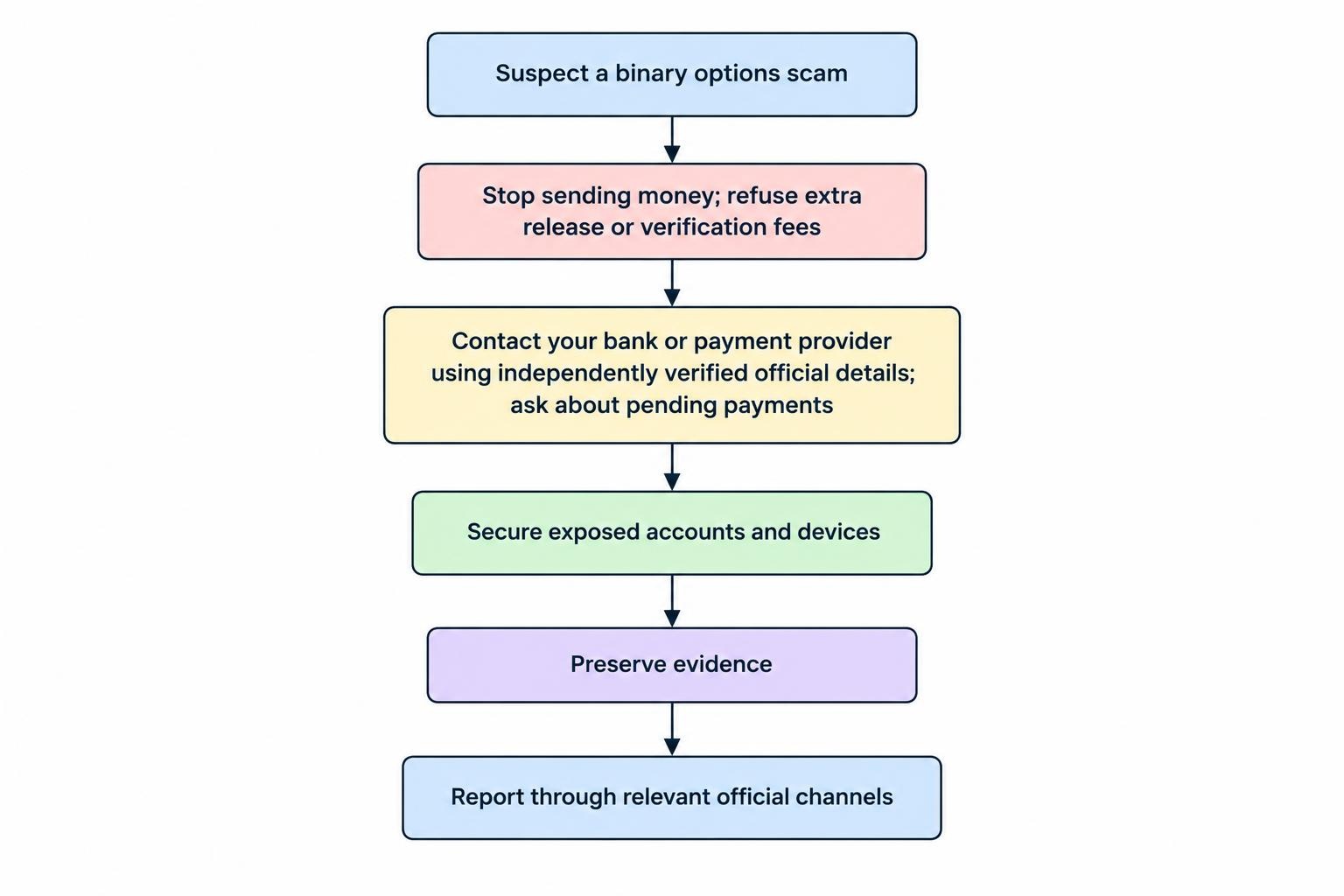
If you suspect a binary options scam, stop sending money and contact your bank or payment provider immediately. Then secure any exposed accounts, preserve your evidence and report what happened. You do not need to prove the entire fraud before asking for help.
Recovering money is not guaranteed. Your options depend on how you paid, where the money went and whether a financial firm contributed to the loss. The immediate aim is to prevent another payment, protect your identity and give the organisations handling your case a clear record.
Stop payments and contact your bank now
Call your bank through its official app, the number printed on your card or contact details you independently verify. Do not use a number supplied by the trading platform, an account manager or someone claiming to investigate the scam.
Explain that you suspect investment fraud. Identify recent payments and ask whether anything pending can be stopped. If someone accessed your account without permission, say so immediately and ask how to secure it. These are the first actions in Moneysmart’s guidance for people who have been scammed.
Do not wait for a withdrawal deadline, a promised callback or the platform’s “compliance review” to finish. Tell the bank when each payment happened, the amount and currency, and the recipient details shown on your statement. Ask for a case reference and record any instructions.
Do not pay another deposit to release an existing withdrawal. If the platform demands a tax payment, insurance premium or verification transfer, preserve the demand rather than paying it. Our guide to fake tax and withdrawal release fees covers these demands separately.
Choose the recovery route that matches your payment
Give your provider the payment trail, not just the trading brand. The name on your statement may differ from the name on the platform. Report each transaction accurately, including payments made through an intermediary.
| Payment method | What to ask immediately | Records to provide |
|---|---|---|
| Credit or debit card | Ask the card issuer to assess a transaction dispute and whether chargeback rights apply. | Statement entries, receipts, promised services and withdrawal correspondence. |
| Bank transfer or PayID | Ask whether the bank can stop or recall the payment and contact the receiving institution. | Recipient account details, payment references, dates and amounts. |
| Payment app or digital wallet | Report the transaction to the provider and ask what dispute or fraud procedures apply. | Transaction IDs, recipient identifiers and funding records. |
| Cryptocurrency | Notify the exchange or service used to send it and ask what action remains possible. | Transaction hashes, blockchain network, destination addresses and exchange receipts. |
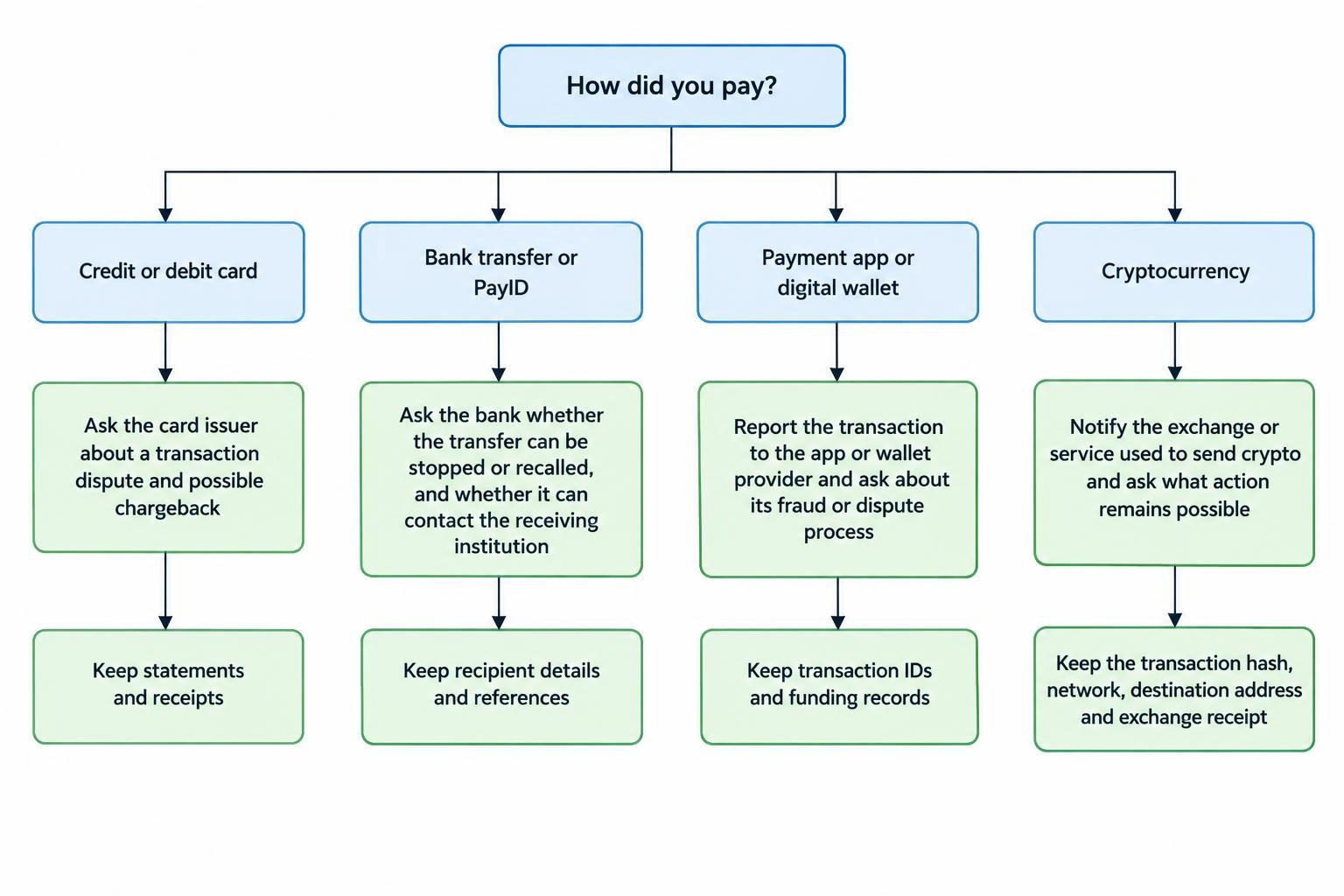
A chargeback can reverse an eligible card transaction, but it is not an automatic refund for every scam loss. Consumer Affairs Victoria’s chargeback guidance explains the process and the need to act within applicable time limits. Ask your issuer which deadline applies rather than assuming every transaction has the same window.
Be precise about authorisation. If you approved a payment because someone deceived you, explain that. Do not describe it as a transaction you never approved. Equally, identify any separate payments the scammer made without your permission.
If you bought cryptocurrency through an exchange before sending it onward, show both stages. Identify who charged your card, what they supplied and where the crypto went next. Keep these transactions separate in your account of events. Our trading payment chargeback guide covers card disputes in more detail.
Secure your devices, accounts and identity
If you gave an account manager remote access to your computer or phone, disconnect that device from the internet. Use a different, trusted device to contact your bank and change exposed passwords. Do not log into banking while the person can still view or control your screen.
Prioritise your email account because it may receive password reset messages for other services. Change reused passwords, end unfamiliar sessions and enable multifactor authentication where available. Check account recovery details for changes you did not make.
Arrange trusted technical assistance if you installed software at the scammer’s request. Ask for checks for persistent remote access, malware and account changes; simply closing the trading app does not address those risks. IDCARE’s remote access scam response checklist sets out the immediate steps.
If you supplied a passport, driver licence, Medicare details or other identity documents, tell IDCARE what you shared. Its Australian support number is 1800 595 160. Ask for a response plan based on the exposed information, including whether you should contact document issuers or take credit protection steps.
Do not upload another identity document to the suspected platform because it promises that one final verification will release your money.
Preserve evidence without delaying urgent action
Contact your bank before spending hours assembling a perfect file. Once urgent payment and security steps are underway, save what you already have. Victoria Police’s cybercrime reporting guidance recommends preserving screenshots, emails and chat logs before they disappear.
Build one folder with a short timeline and the supporting records. Useful material includes:
- The platform’s exact web address, app name, trading account ID and claimed company name.
- Payment receipts, bank statements, recipient details and cryptocurrency transaction hashes.
- Emails and exported conversations showing promises, payment instructions or pressure to deposit.
- Withdrawal requests, rejection messages and demands for additional fees.
- Names, phone numbers, email addresses and social media handles used to contact you.
Keep original files where possible. Preserve the full conversation rather than only the most alarming message. Record dates, currencies and time zones, especially if the platform’s clock differs from your bank’s records.
Separate money paid from money displayed. If you deposited A$4,000 and the dashboard later showed A$19,000, record both figures with clear labels. Do not present the displayed balance as a verified cash loss. Record any genuine withdrawals you received too.
Do not reconnect an exposed device, install another app or make a payment just to obtain more evidence. Give investigators what you have and describe any gaps honestly.
Report the scam through Australian channels
Make a police report through ReportCyber if money or personal information was stolen online. Access it through the official cyber.gov.au service or the police guidance above. Keep the report reference with your banking case details. For threats or immediate danger, contact police directly; call 000 in an emergency.
Also submit a Scamwatch report about the suspected scam. Include the platform address, contact details and payment instructions. Scamwatch uses reports to identify scams, warn others and support disruption work. Reporting a scam is not the same as opening a bank dispute, so complete both where relevant.
Use the same factual timeline across your reports. Correct mistakes when you notice them and keep copies of submissions. Avoid posting unredacted bank statements, identity documents or personal contact details on public forums.
Australian retail clients should also know that ASIC’s ban on issuing and distributing binary options to retail clients runs until 1 October 2031. A platform’s claim that it is authorised to offer these products deserves scrutiny. The ban itself does not establish how much money you can recover.
Make a formal complaint if the bank’s response is inadequate
A fraud report and a formal complaint serve different purposes. If you believe a bank mishandled your report or contributed to the loss, ask for the matter to enter its internal dispute resolution process. Explain what happened, what you believe went wrong and what outcome you want.
Keep the complaint focused on evidence. Describe when you notified the bank, any warnings or conversations before payment, and what happened afterward. Ask for a written response and keep a log of who you spoke to, and what they agreed to do.
Since 12 March 2026, AFCA can consider eligible scam complaints involving receiving banks, including where the complainant was not their customer. It can also consider eligible complaints about accounts opened without consent. Raise the complaint with the relevant bank first, then use AFCA’s receiving bank and unauthorised account complaint guidance if the response is unsatisfactory. Eligibility and time limits still apply.
This does not mean every bank must reimburse every scam payment. Explain why you believe the firm’s conduct caused or increased your loss rather than relying only on the fact that a scam occurred.
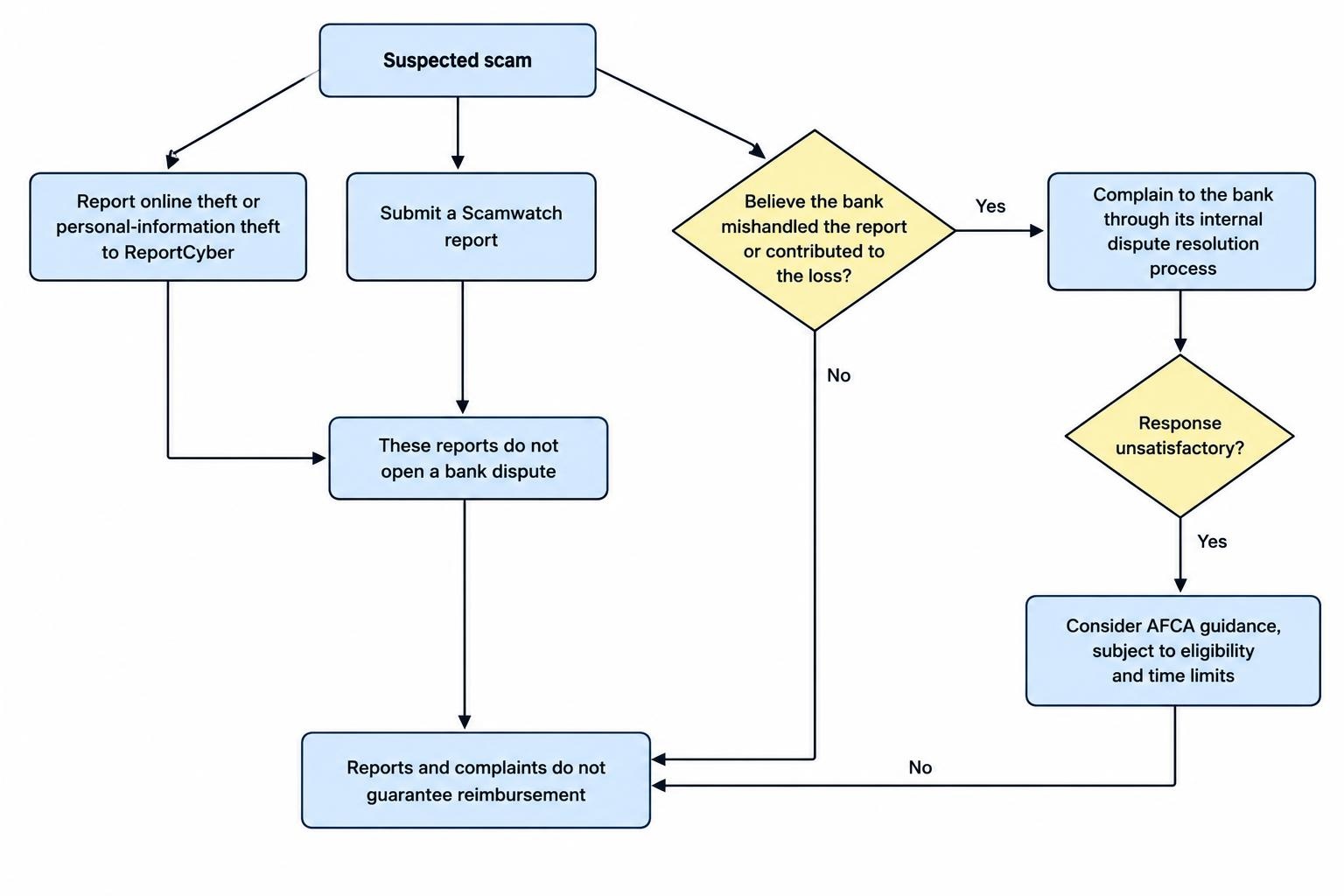
For an offshore platform, do not assume AFCA can hear a complaint against the operator itself. A complaint about your Australian bank is a separate matter. Our guide to broker complaints and AFCA explains that distinction.
Reject unsolicited recovery offers
Be wary of anyone who contacts you claiming they have found your money. A caller may know the platform name, your deposit amount or details of your earlier complaint. Those details do not prove they represent a regulator, police force or legitimate recovery business.
ASIC’s warning about follow-up recovery scams identifies demands for upfront recovery fees, cryptocurrency payments and supposed taxes to release funds. ASIC also states that it cannot recover scam losses for individuals.
Do not share passwords, one-time security codes, wallet seed phrases or remote access with someone offering recovery. Verify unexpected contact through independently obtained details. A convincing letterhead or a screen showing “recovered funds” is not proof that money is waiting for you.
If you decide to obtain legal advice, choose the adviser independently and ask about costs, jurisdiction and realistic enforcement prospects before committing. Do not let a stranger’s deadline replace those checks. Our guide to trading fund recovery scams covers the warning signs without assuming every paid professional service is fraudulent.
Protect your finances while the case remains open
Work from the money you can access now, not the balance shown on the trading dashboard or an expected refund. List upcoming bills and contact lenders early if repayments are at risk. Ask about hardship assistance and consider speaking with a free financial counsellor.
Tell someone you trust what happened. They can help organise records, sit with you during calls and check unexpected messages. You do not need to handle every conversation alone.
Do not borrow money or open another trading account to win back the loss. Keep following up through your bank, payment provider and official complaint channels, but refuse further deposits and recovery fees. Stopping the next loss remains worthwhile even when the outcome of the first is uncertain.
This article was last updated on: October 22, 2026