Financial promotions and affiliate marketing can turn a broker review, trading video or social media post into a commercial sales channel. For Australian readers, the first question is not whether the promoter has disclosed a commission. It is whether the underlying activity is permitted.
ASIC’s ban on issuing and distributing binary options to retail clients took effect on 3 May 2021 and has been extended until 1 October 2031. An affiliate disclosure does not override that restriction. The ASIC announcement extending the binary options ban confirms its duration and retail scope.
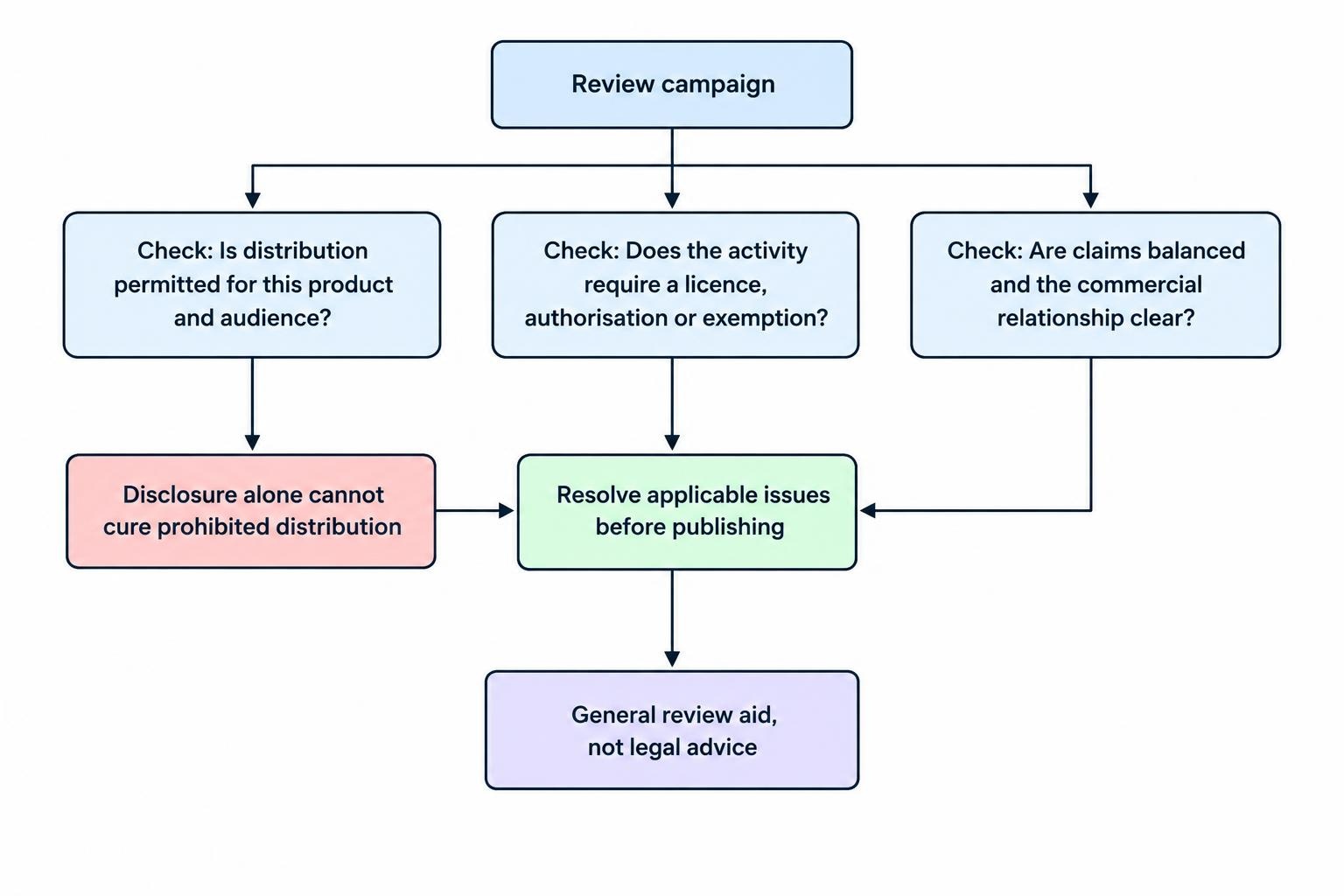
Publishers, influencers and readers therefore need to separate three issues: prohibited distribution, financial services licensing, and misleading advertising. A promotion can create problems under more than one of these rules.
What Counts as a Financial Promotion?
In ordinary publishing terms, a financial promotion is content that encourages someone to use a financial product or service. It might be an obvious advertisement, but it can also look like editorial content: a broker ranking, sponsored tutorial, trading app demonstration or invitation to join a private signals group.
Affiliate marketing adds a payment arrangement. A publisher receives money or another benefit when a reader takes an agreed action through a tracked link or referral code. That action might be submitting contact details, opening an account or meeting a deposit requirement.
The format is not a reliable guide to the substance. A page labelled “review” can still operate as a sales pitch. A video labelled “education” can still encourage transactions. For the wider legal framework, see our guide to binary options regulation in Australia.
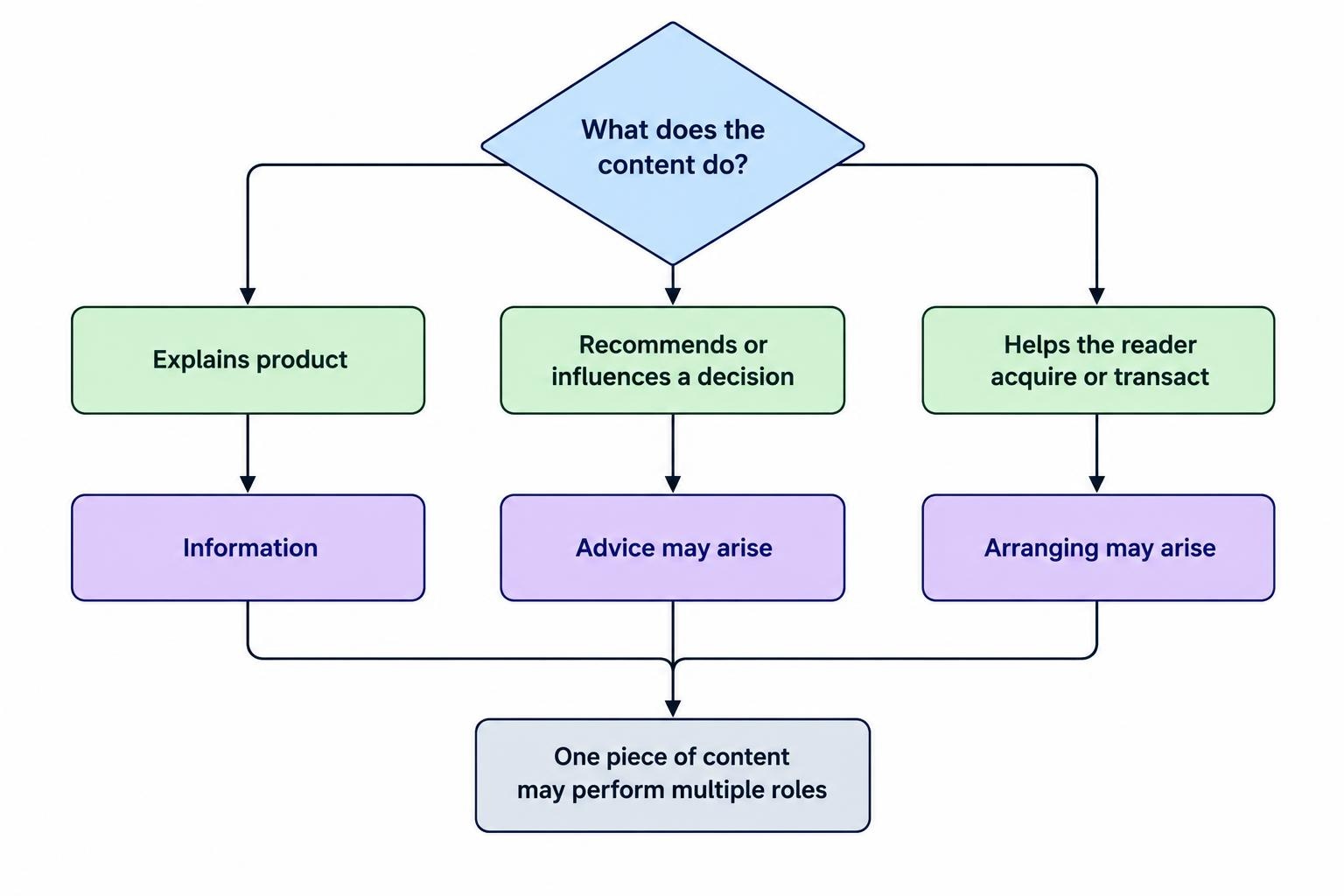
A useful assessment starts with the reader’s next step. Does the content explain a product, recommend it, or help the reader acquire it? Those are different activities, even when they appear on the same page.
How the Binary Options Ban Affects Affiliates
The prohibition reaches beyond the business issuing the contract. Section 5 of the binary options product intervention order also prohibits businesses from arranging relevant issues or acquisitions for retail clients. Its territorial provisions include circumstances where an offer is received in Australia, subject to the statutory limits on the order’s application. An offshore address is not, by itself, an answer to Australian distribution rules.
This distinction matters for referral campaigns. Consider a hypothetical publisher that offers Australian readers a broker signup link, a deposit incentive and help completing their first transaction. That arrangement deserves a different assessment from an article explaining why binary options have been restricted.
The practical response is to examine the entire referral process before discussing advertising wording. Improving a disclosure cannot fix a business model that involves prohibited distribution.
Nor should a publisher treat an Australian financial services licence as permission to bypass a product intervention order. Licensing and product restrictions are separate checks. A campaign needs to satisfy both where they apply.
Education, Advice and Arranging Transactions
Australian law distinguishes factual information from financial product advice. A recommendation or opinion intended, or reasonably regarded as intended, to influence a financial product decision can be advice. Advice does not have to be personalised: section 766B distinguishes personal advice from general advice. These definitions sit alongside the licensing requirements in section 911A of the Corporations Act provisions on financial services and licensing.
Compare two hypothetical statements. “This contract settles by comparing a reference price with a strike price” describes mechanics. “This is the best product for beginners to earn an extra income” recommends a course of action. Adding technical facts around the second statement does not remove its recommendation.
Affiliate links create a separate question. Arranging a transaction is a financial service, and the extent of the promoter’s involvement matters. ASIC contrasts providing a licensee’s contact details without further involvement with a paid, exclusive link that also gives followers a transaction benefit. The latter is likely to be dealing by arranging. Carrying on a financial services business generally requires an AFS licence, appropriate authorisation or an exemption. ASIC’s guidance on online financial discussions and affiliate links addresses these distinctions.
There is no sensible blanket rule that every hyperlink requires a licence. Equally, calling a transaction channel a “referral” does not settle its legal treatment. Assess the content, payment terms, incentives and involvement together.
Affiliate Payments and Conflicts of Interest
Readers should ask what triggers a promoter’s payment, not just whether payment exists. Different arrangements create different incentives. The following are illustrative models, not claims about any named platform.
| Payment model | Possible payment trigger | Conflict to examine |
|---|---|---|
| Lead payment | A reader submits qualifying contact details | The publisher benefits from generating enquiries |
| Acquisition payment | A referred customer meets account or funding conditions | The publisher benefits from converting readers into customers |
| Revenue share | A share of contractually defined revenue | Payment may depend on subsequent customer activity or results |
| Sponsored placement | A fixed fee for coverage or positioning | Commercial payment may influence visibility or rankings |
A commission does not prove that a review is false. It does mean the reader needs enough information to assess the commercial relationship. “Independent” is a difficult claim to evaluate when the selection method, payment arrangements and ranking criteria remain hidden.
Make the Relationship Obvious
Hidden incentives and vague sponsorship labels can leave readers mistaking advertising for an unpaid endorsement. The ACCC report on influencer testimonials and endorsements identifies concerns including undisclosed commissions, confusing relationship labels and disclosures buried in captions or account biographies. These are useful transparency warnings; financial product promotions also require assessment under financial services law.
For otherwise lawful affiliate content, plain wording is preferable: “We may receive a payment if you open and fund an account through this link.” If payment affects which providers appear or where they rank, explain that separately.
Place the explanation where readers encounter the recommendation, before they act. In a video, consider both spoken and visible disclosure. Do not expect a reader to hunt through a footer policy to work out who is paying whom.
That example is a disclosure approach, not an approved template or permission to promote binary options to Australian retail clients.
Why “Not Financial Advice” Is Not a Shield
A disclaimer cannot decide the legal character of the conduct around it. Content may still constitute financial product advice despite being described as “not financial advice” or “for educational purposes only”. That position is stated expressly in ASIC’s warning letter template for suspected unlawful finfluencers.
For an editorial review, read the page without its disclaimer. If the remaining message is “use this broker, deposit this amount and follow these trades”, a sentence at the bottom has not changed what the content encourages.
Apply the same test to a private group. Calling it a classroom tells the reader little about whether its messages explain historical trades or direct members into new transactions.
Publishers should obtain legal advice about the actual service before accepting referral payments. A disclaimer belongs at the end of that assessment, not in place of it.
Misleading Claims: Look Beyond the Fine Print
Financial advertising should give a balanced presentation of benefits and risks. Warnings must have enough prominence to convey their message and should not contradict the headline. Sending readers to another page does not correct a misleading headline. These principles appear in ASIC’s June 2026 guidance on financial advertising, which also addresses comparisons, performance claims and sponsored content.
For binary options coverage, examine what the advertised number actually measures. A payout percentage, a trading win rate and an account return are not interchangeable.
Take a hypothetical contract risking A$100 for A$80 net profit if successful, with the full stake lost otherwise. The successful outcome returns A$180, including the original stake. That is not an 80% chance of success or a promised 80% account return.
Across ten equal trades, five wins produce A$400 profit and five losses cost A$500. The result is a A$100 loss before any other costs. Presenting only the winning payout leaves out half the arithmetic.
When reviewing performance material, ask for a defined period, all relevant trades and a clear distinction between deposits and trading gains. A balance screenshot alone does not show how the money arrived. Treat a demonstration account, a historical simulation and an actual customer account as different forms of evidence.
These checks help assess the claim. They do not establish that the product may lawfully be distributed.
Publisher and Licensee Responsibilities
Responsibility does not disappear because someone else supplied the advertisement. For authorised finfluencers, ASIC expects licensees to maintain documented arrangements, actively supervise conduct and retain supervision records. Its 2026 notice on finfluencer supervision reinforces that licensees remain responsible for their representatives’ conduct.
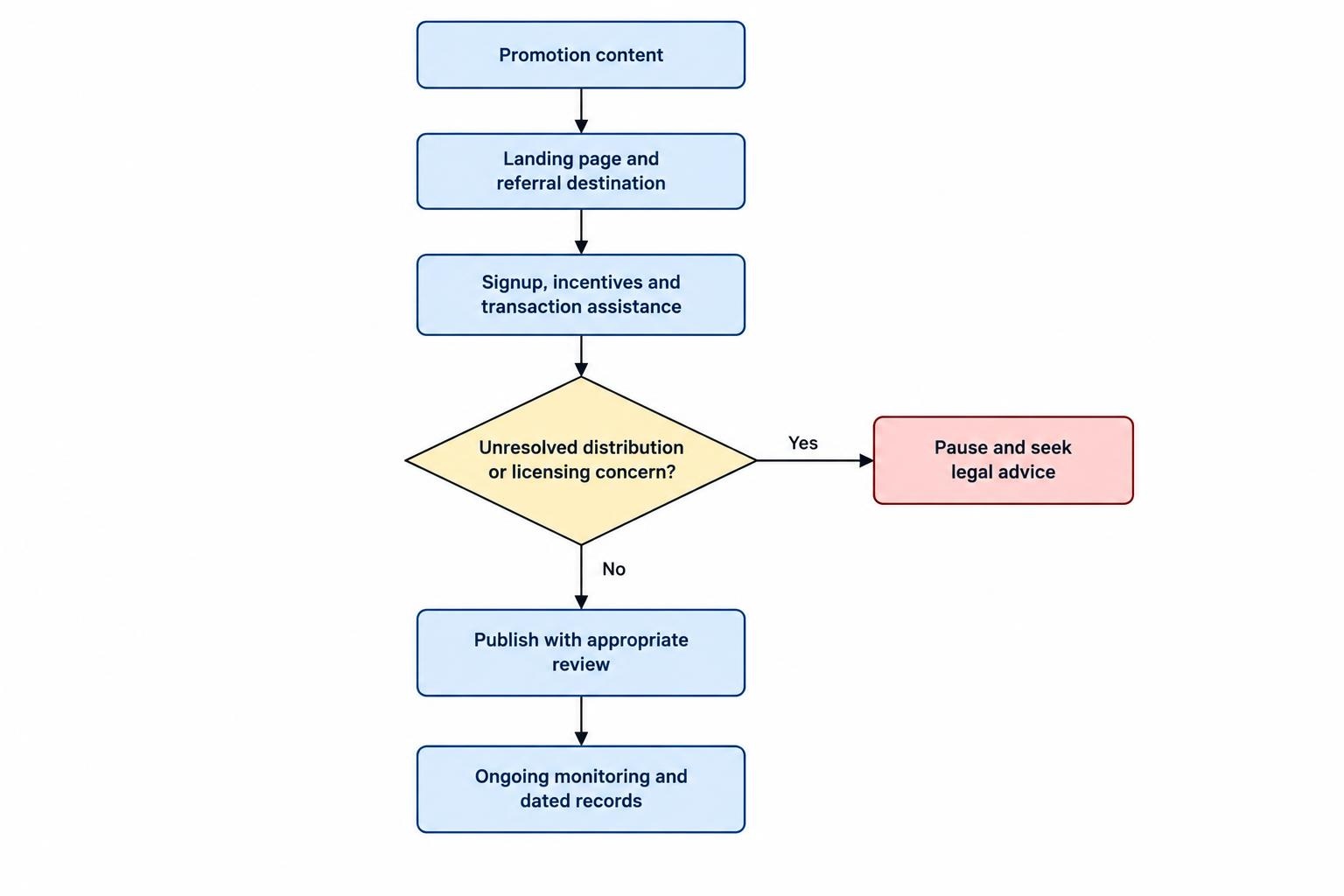
A practical publishing review should cover the whole campaign rather than one approved script. Include landing pages, referral destinations, email messages, video descriptions and the replies used to answer prospective customers.
Before publishing, work through these checks:
- Product and audience: Establish what is being promoted and whether distribution to the intended audience is permitted.
- Role and authority: Assess whether the publisher provides information, advice or transaction assistance, and confirm any required authorisation.
- Commercial terms: Record the payment trigger, incentives and any influence over selection or ranking.
- Evidence: Keep support for factual claims and label hypothetical examples accurately.
- Ongoing review: Assign someone to check changes, complaints, expired claims and referral destinations.
Keep dated copies of approved material. A later edit can otherwise make it difficult to establish what readers saw when they clicked.
Where a campaign raises unresolved questions about prohibited distribution or unlicensed services, pause it while obtaining legal advice. Replacing a signup button with “learn more” is not a substitute for examining where that button leads.
How Readers Can Assess a Promotion
Start with identity. Establish who operates the promoted business, who publishes the recommendation and whether the two have a financial relationship. A brand name alone is not enough to match the promotion to a legal entity.
Next, check the claimed authority rather than relying on a badge or screenshot. Our guide to checking a broker’s licence sets out the verification process. Keep the licence check separate from the question of whether the advertised product may be offered to you.
Then examine the recommendation itself. Does the publisher explain why a provider appears, what evidence supports its rating and how it gets paid? Can you assess the offer without joining a messaging group or speaking to a salesperson?
Do not let a countdown replace those checks. Save the advertisement, disclosure and relevant messages if something appears wrong. Stop before sending money when the identity, authority or payment terms remain unclear.
The standard is straightforward: a clear commercial relationship, supportable claims and a lawful underlying activity. A promotion needs all three. An affiliate disclosure answers only one part of the problem.
This article was last updated on: October 22, 2026