A trading signal performance audit tests whether a provider’s claimed results can be reconstructed from records captured before the outcome was known. For binary options, that means checking more than direction: entry timing, accepted strike, expiry, settlement price, payout and subscription costs all affect the result. A correct forecast is not automatically a profitable contract.
This article sets out an audit protocol, not a completed provider comparison. No signal service is ranked or certified here. All worked figures are hypothetical and demonstrate how to assess the evidence without treating a promotional win rate as a finding.
For Australian readers, ASIC’s prohibition on issuing and distributing binary options to retail clients began on 3 May 2021 and extends until 1 October 2031. This methodology supports scrutiny of historical claims and paper research, not access to prohibited products. See ASIC’s binary options ban extension.
Define What the Audit Is Testing
Start with the claim, written exactly enough to test. “Our signals are accurate” leaves too much room for interpretation. “These alerts produced a positive result after subscription fees during the stated period, under a documented execution rule” gives an auditor something measurable.
Separate three questions: was the prediction correct under its original terms, could the alert have been followed after receipt, and did the resulting contracts make money after costs? Report each answer separately. Otherwise, a profitable provider account might be presented as evidence that every subscriber could obtain the same result.
Keep historical simulations, prospectively recorded paper results and actual account transactions in separate datasets. Hypothetical results can benefit from hindsight and cannot fully reproduce financial risk or execution conditions. These distinctions are addressed in the NFA notice on hypothetical performance presentations. That notice concerns NFA members; it is not an Australian permission to offer binary options.
Freeze the Scope Before Reviewing Outcomes
Write an audit plan before collecting the evaluation sample. Specify the provider, subscription tier, delivery channel, markets, contract types, observation dates and strategy version. Define whether the audit covers every alert or a stated subset, such as weekday high-low signals with a fixed expiry convention.
Set the inclusion rules in advance. Decide how to handle duplicates, cancellations, late arrivals, unavailable contracts and alerts without usable expiry instructions. A cancellation received after the scheduled entry should remain visible rather than erase the original alert.
Record any exclusions with reasons. A missing settlement record should become an unresolved observation, not disappear from the denominator. Publish the number of unresolved cases and, where feasible, show how favourable and unfavourable resolutions would change the result.
Our guide to evaluating trading signal track records covers the initial screening of provider claims. A performance audit goes further by rebuilding the underlying record instead of accepting the summary.
Capture the Original Signal and Its History
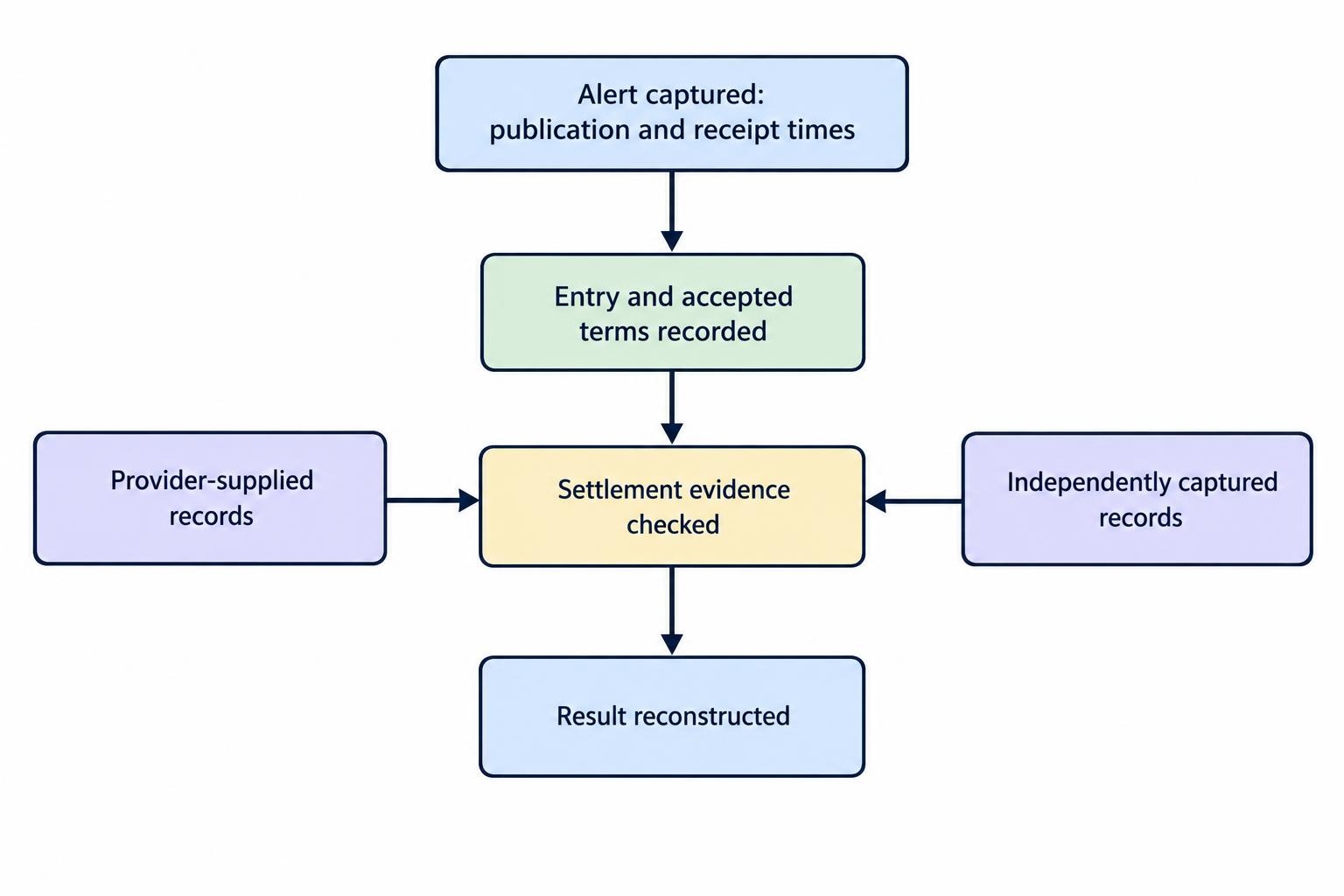
Preserve each alert when it arrives, before its outcome is available. Store the original message, its identifier, publication timestamp where available, local receipt timestamp and every later amendment. Use one documented time standard, such as UTC, and record known clock differences.
The minimum record should identify the instrument, direction, entry instruction, expiry instruction and any conditions attached to the signal. Preserve the channel name and strategy version too. An alert saying “buy now” without a defined expiry cannot support a precise contract result.
Use archived messages and transaction records together rather than relying on screenshots alone. A screenshot may document what was displayed, but it does not establish that the complete history has been supplied. Where possible, retain original exports and a separate record of when they were received.
Platform records also require scrutiny. Complaints documented in the joint CFTC and SEC binary options fraud alert include allegations of manipulated prices, payouts and expiry handling. An audit should therefore distinguish evidence supplied by the provider from evidence independently captured by the reviewer.
Reconstruct Entry, Expiry and Settlement
Choose an entry rule that uses information available after the subscriber received the alert. For paper research, this might be the first eligible recorded quote after a stated processing delay. Define the delay before inspecting results, and label the resulting entries as simulated.
For actual transactions, use the accepted contract details. Record the order submission time, acceptance time, strike, expiry timestamp, stake and offered payout. Do not substitute the price printed in the signal if the account received a different strike.
Distinguish a fixed expiry timestamp from a duration measured after acceptance. “Expires at 14:05” and “lasts five minutes” are not interchangeable. Preserve the settlement rules, including price precision, ties, refunds and voided contracts. An unrelated chart can be a cross-check, but it cannot replace the contract’s designated settlement feed.
Compare the original alert with later chart displays to identify changes. The practical issues covered in signal repainting and latency matter here: an attractive historical marker does not establish when a subscriber first saw the instruction.
Calculate Profit From Payouts, Not Just Accuracy
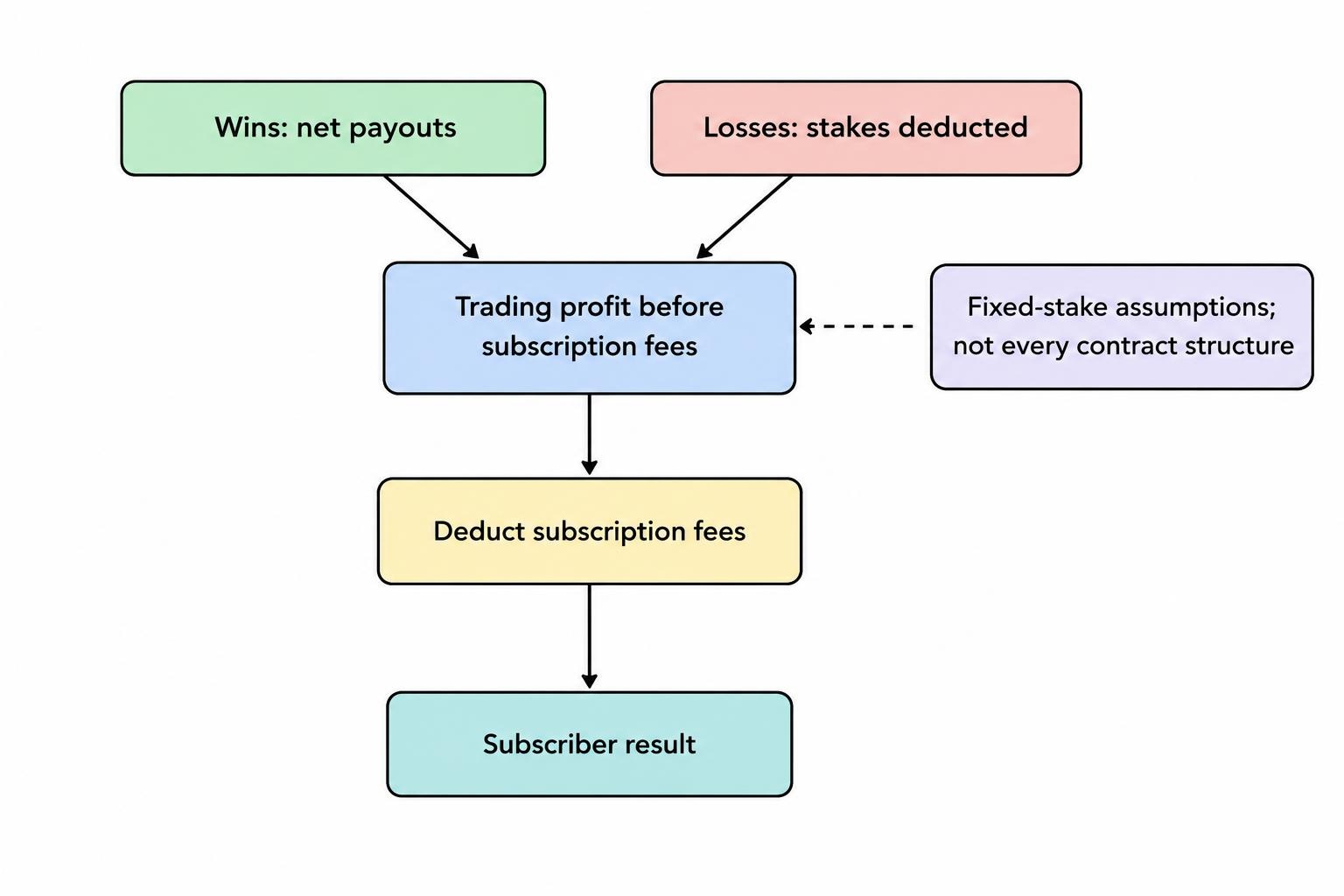
For a fixed-stake contract that loses the entire stake when unsuccessful, define the payout as net profit on a winning trade. An 80% payout on a $10 stake therefore means an $8 profit, with the original $10 also returned.
Under those assumptions, expected profit per dollar staked is:
Expected return = p × r − (1 − p), where p is the probability of winning and r is the net winning payout expressed as a decimal.
Setting that expression to zero gives a break-even win rate of 1 ÷ (1 + r). At an 80% payout, that is approximately 55.56% before other costs. Refunds, partial losses and different contract structures require adjusted calculations.
Hypothetical Audit Example
Assume 100 resolved paper contracts, each with a $10 stake and an 80% net winning payout. There are 60 wins, 40 losses, no ties or refunds, and a $90 subscription fee covering the observation period. All amounts below are Australian dollars.
| Item | Calculation | Result |
|---|---|---|
| Winning contract profits | 60 × $8 | $480 |
| Losing contract stakes | 40 × $10 | −$400 |
| Trading result before subscription | $480 − $400 | $80 |
| Subscription fee | Full period cost | −$90 |
| Result after subscription | $80 − $90 | −$10 |
The hypothetical 60% win rate produces a loss after the subscription charge. Dividing the $90 fee across 100 contracts gives a cost of $0.90 per contract. At this stake and payout, the fee-adjusted break-even win rate becomes approximately 60.56%.
When payouts or stakes vary, calculate each contract separately and sum the monetary results. Report trading profit before service fees and the subscriber result after fees. Do not multiply a headline win rate by an advertised maximum payout and call it an audited return.
Measure Uncertainty Around the Win Rate
A sample win rate needs an uncertainty estimate, not just another decimal place. Using the NIST method for Wilson confidence intervals, 60 wins from 100 independent observations gives an approximate two-sided 95% interval of 50.2% to 69.1%.
That interval includes values below the 55.56% break-even threshold for an 80% payout before fees. Under the assumed binomial model, the sample does not establish that the underlying win probability exceeds that threshold. The interval is not a forecast of future performance.
State the assumptions beside the calculation. If alerts overlap or respond to the same market event, do not simply assume independence. Consider uncertainty estimates based on groups such as trading days, with the method documented. Where payouts vary, assess uncertainty in monetary returns too; a win-rate interval alone does not answer the profitability question.
Check Selection Bias and Strategy Changes
Ask how the reported strategy was selected. Repeatedly testing settings on the same history increases the opportunity to select an apparently successful result by chance. This problem is examined in The Probability of Backtest Overfitting research paper.
Request a record of tested versions, parameter changes and abandoned approaches. If that history is unavailable, state that selection bias could not be assessed. Do not describe the winning version as independently validated simply because its final spreadsheet balances.
Report results by version and calendar period. A change to entry timing, expiry selection or filtering should receive a dated version identifier. Keep the earlier results visible rather than combining incompatible versions into one uninterrupted success rate.
Also distinguish planned subgroup analysis from patterns noticed afterwards. Finding that one currency pair performed well is a useful research question. Removing every other pair after reviewing the outcomes is not a fair test of the original service.
Stress Test the Subscriber Result
Recalculate the record under less favourable but explicitly stated assumptions: later receipt, lower available payouts, missed alerts and contract rejection. Use measured observations where available. Where they are absent, label the exercise as sensitivity analysis rather than observed execution performance.
For the worked example, changing one $8 winner into a $10 loser reduces profit by $18. That arithmetic makes clear why checking only the provider’s direction can miss the economic effect of a different strike or expiry.
Track the number of alerts issued, received, eligible and actually executed. Report rejected and missed alerts separately, with reasons. Do not assign them invented fills. A subscriber result must reflect the contracts the subscriber could take under the declared rules.
Include the longest losing sequence, maximum drawdown and concurrent exposure. Where a provider uses increasing stakes after losses, publish a constant-stake comparison as well. Keep deposits, withdrawals and bonuses separate from trading profit, and never label profit divided by total stakes as a return on account capital.
Write a Verdict That Matches the Evidence
The report should identify the observation period, data supplied, collection method, unresolved records, calculation rules and reviewer’s relationship with the provider. Disclose referral payments, free subscriptions or other commercial interests. Explain whether the reviewer selected the sample or received a provider-selected extract.
Use restrained verdicts. Not auditable means the records cannot support reconstruction. Inconclusive means usable evidence remains insufficient to establish positive performance after costs. Historically positive under stated assumptions describes a reconstructed result without promising its continuation. None of these labels certifies the provider’s legal status or withdrawal reliability.
A subsequent forward test of binary options signals should freeze the rules and capture new alerts before outcomes are known. It can remain entirely paper based; stronger evidence does not require funding an account.
The useful output is a reproducible record: what was sent, when it was received, which contract terms applied, what it cost and how uncertainty affects the result. If another reviewer cannot reproduce the headline from those records, the audit has not yet earned its headline.
This article was last updated on: October 22, 2026