Binary options scams use the appearance of trading to persuade people to send money, disclose personal information or pay invented charges. The warning sign is not always a spectacular promise. It may be a helpful account manager, a convincing trading dashboard or a small withdrawal that makes a much larger deposit feel safe.
If you have already sent money and suspect fraud, stop making payments and contact your bank or payment provider immediately. You do not need to prove the entire scheme is fraudulent before asking for help.
Australia’s binary options ban comes first
Australia prohibits the issue and distribution of binary options to retail clients. The restriction took effect on 3 May 2021 and runs until 1 October 2031 under ASIC’s extended binary options product intervention order.
For an Australian retail customer, that is the starting point. A polished platform, an overseas registration or an account manager’s reassurance does not answer whether the offer complies with the Australian ban. Do not treat a foreign licence as an exception.
Also distinguish an unlawful offer from a proven scam. They are not interchangeable labels. You should not need a finding of fraud, however, to reject an offer that conflicts with the retail restriction.
A trading loss is not automatically evidence of fraud
A binary option pays according to whether a stated condition is met, such as whether a price finishes above a strike at expiry. Losing the stake under the agreed contract terms does not, by itself, establish deception.
Consider a hypothetical contract with a $100 stake, an $80 profit on a win and a $100 loss on a losing trade. Five wins produce $400 in profit; five losses cost $500. The result is a $100 loss before any other charges, despite getting half the predictions right.
Fraud is a separate concern: false claims about the business, invented account balances, misuse of identity documents or dishonest interference with withdrawals and trading results. Keep those issues separate when describing what happened. “The account lost money” is less useful evidence than a dated record showing that the operator changed an agreed expiry or demanded an undisclosed payment.
How a binary options scam builds trust
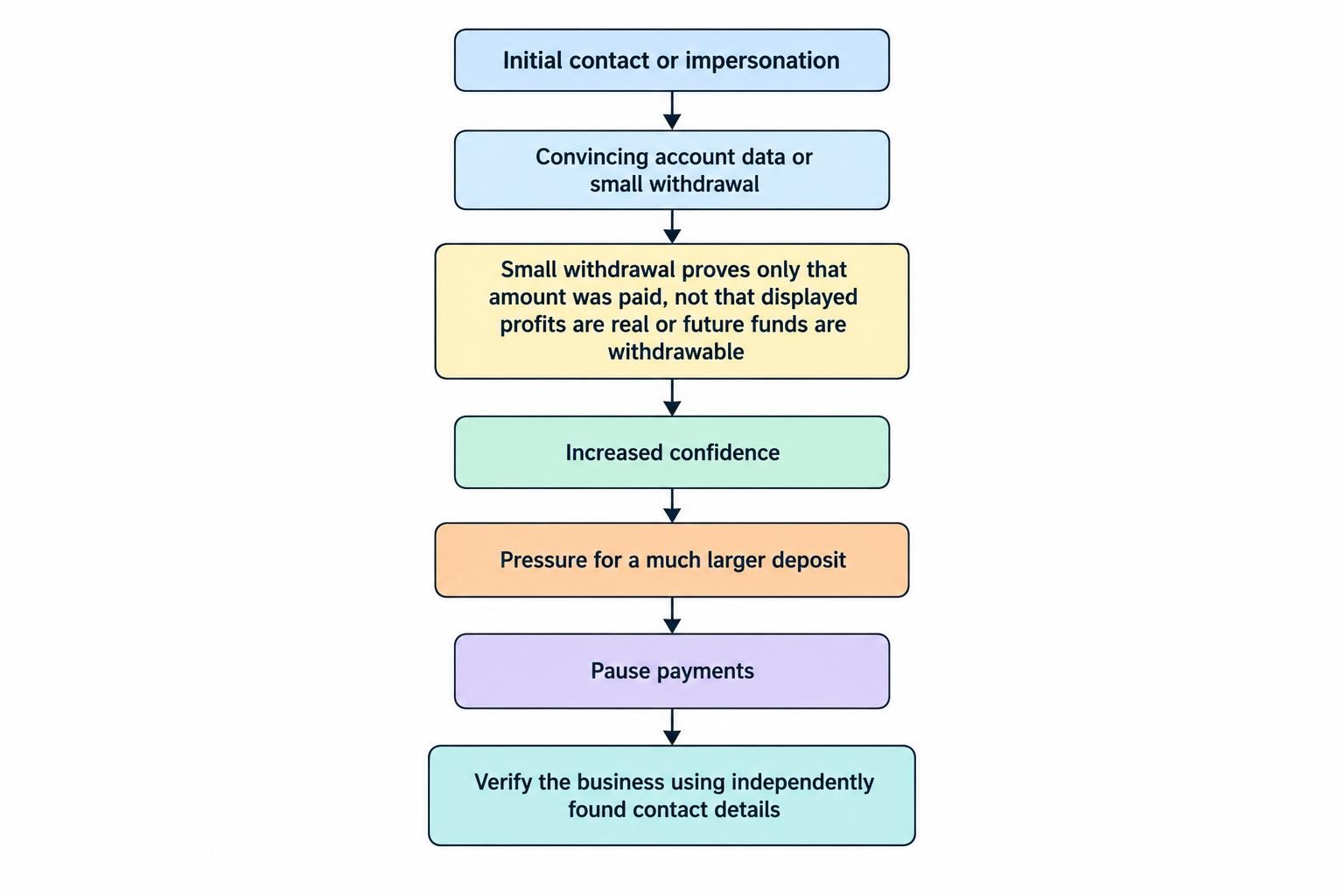
Investment scams can start through social media, dating apps, advertisements or contact from someone impersonating a financial business. Fake account data and small initial withdrawals can make the arrangement appear genuine before the demands increase. These tactics feature in Scamwatch’s investment scam warning signs.
The practical lesson is that apparent success inside the platform proves very little about what happens outside it. A rising dashboard balance is not the same as money held somewhere you can independently verify.
For a hypothetical example, suppose someone deposits $500 and withdraws $100. A salesperson then uses that payment to encourage a $10,000 deposit. The first withdrawal establishes only that $100 was paid. It does not establish that the displayed profits are real, that the larger deposit will remain accessible or that the operator is authorised.
Before making another payment, step outside the conversation. Check the business independently, without using the links or telephone numbers supplied by the person selling the opportunity.
Common binary options scam warning signs
Documented binary options complaints include refusal to return customer funds, identity theft and alleged manipulation of trading software to create losing trades. The SEC and CFTC binary options fraud alert details these categories. Those complaints establish recognised risks, not a finding against every platform.
Withdrawals that require another deposit
Treat a demand for new money before existing funds can be returned as a reason to stop and investigate. Ask for the contractual basis, the amount supposedly owed and the identity of the recipient in writing. Do not accept a telephone explanation as sufficient evidence.
A withdrawal delay alone does not prove fraud. The useful distinction is between a documented process and a moving target: each completed requirement leads to another payment demand, with no clear route to receiving your money. Our guide to binary options withdrawal problems covers how to organise the evidence and assess the explanations.
Tax, insurance and withdrawal release charges
If a platform says you must pay “tax”, “insurance” or a “release fee”, the label is not evidence that the debt exists. Verify the demand through an independently obtained channel before paying anything.
Suppose an account shows $18,000, but support demands a separate $2,700 payment before withdrawal. Do not calculate whether paying seems worthwhile against the displayed balance. First establish whether that balance and the claimed obligation are genuine. Otherwise, an unverified number on a screen becomes the justification for sending real money.
Keep the payment instructions and any claimed official documents. The guide to fake tax and withdrawal release fees examines this demand in more detail.
Guaranteed signals, AI bots and managed accounts
Treat “guaranteed profit” as an unsupported claim, whether the seller credits a human analyst, artificial intelligence or an automated bot. Calling software intelligent does not demonstrate that its results are genuine.
When assessing a claimed trading record, ask what it actually measures. Does it include every trade, losing periods, subscription costs and the payout available when each signal was issued? Can the record be checked independently, or does the seller control every screenshot and spreadsheet?
Do not provide your trading credentials or send money to a personal account because someone promises to trade for you. Our coverage of social media trading signal scams addresses the risks around group chats, profit screenshots and deposit pressure.
Identity requests and suspicious platform behaviour
A request for identity documents deserves scrutiny, especially when you have not established who operates the platform. Do not send further documents simply because an account manager says they will speed up a withdrawal. Never disclose banking passwords, security codes or a cryptocurrency wallet recovery phrase.
For suspected trading manipulation, preserve the contract terms, trade reference, strike, expiry, settlement price and screenshots showing the time. Record what changed and when. Avoid assuming that every losing trade or chart discrepancy proves interference; a precise account of the disputed event is much stronger than a general allegation that the platform is rigged.
How to check the business behind the platform
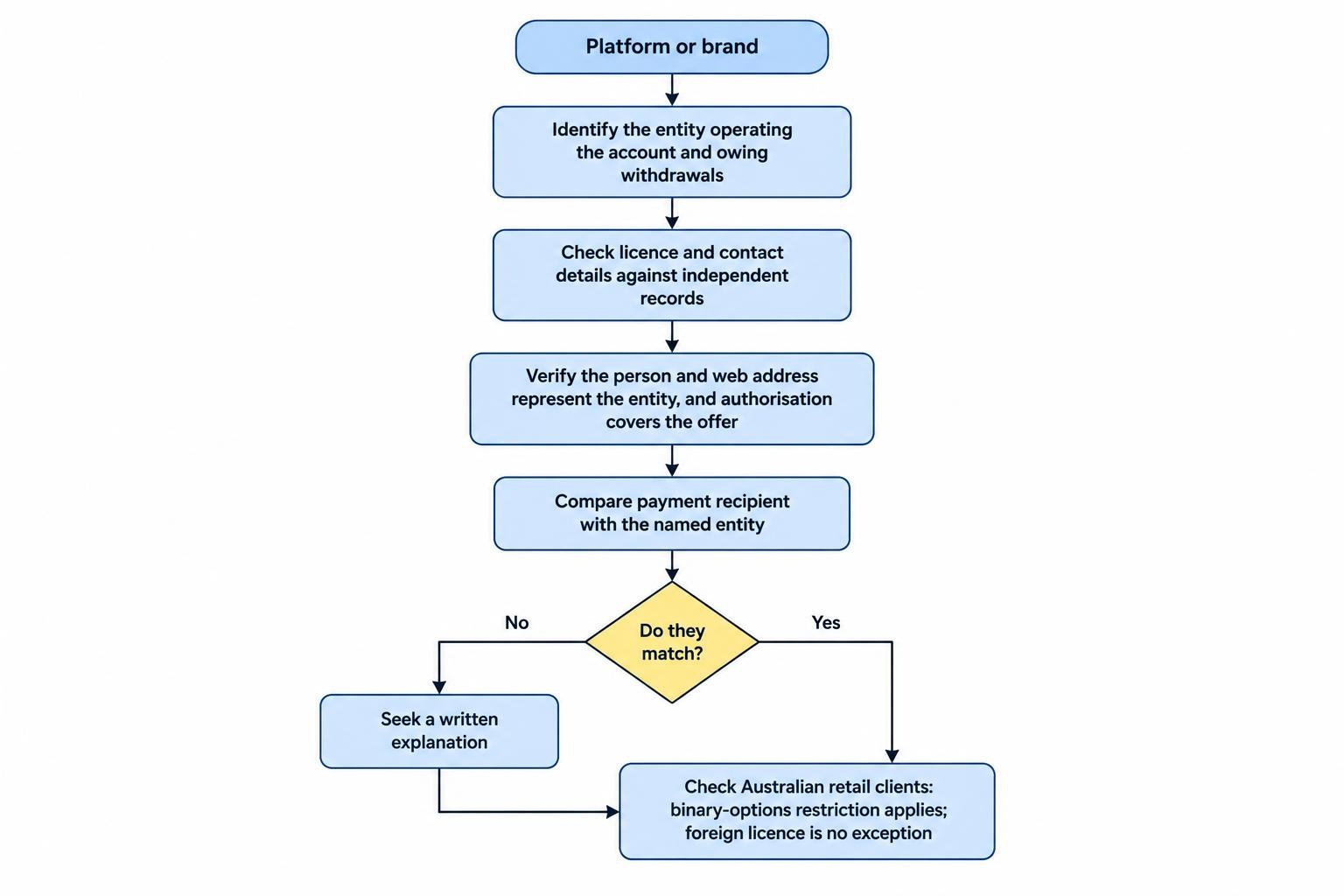
Start with the legal entity, not the brand name. Ask which company takes the deposit, operates the account and owes any withdrawal. Then compare those details with independently obtained records.
Company registration is not financial services authorisation. Scammers can also misuse the details of genuine licence holders. Match the name, licence number and contact details, then verify the relationship with the real business through a channel you found yourself. Moneysmart’s investment verification checklist covers these checks and warns that an AFS licence is not an endorsement or guarantee of safety.
Do not stop at finding a matching licence number. The question is whether the person contacting you actually represents that licence holder, whether the web address belongs to it and whether the claimed authorisation covers the offer.
Check the payment recipient too. If its name differs from the entity in the account agreement, request a clear written explanation. Do not let urgency replace verification.
The guide to clone broker scams covers impersonation in more detail. For Australian retail clients, even a genuine overseas business still needs to be considered against Australia’s binary options restriction.
Do not confuse supporting material with independent proof
Use reviews, testimonials and promotional videos as leads to investigate, not as a substitute for verification. Ask whether the evidence comes from a party outside the sales process.
A useful question is: what would change your mind? If every concern receives another screenshot, another testimonial or another promise from the same account manager, you have not obtained independent confirmation. You have received more sales material.
Also avoid treating the absence of a warning as approval. Search results can help identify concerns, but they cannot establish that every aspect of an offer is lawful or genuine.
What to do if you suspect a binary options scam
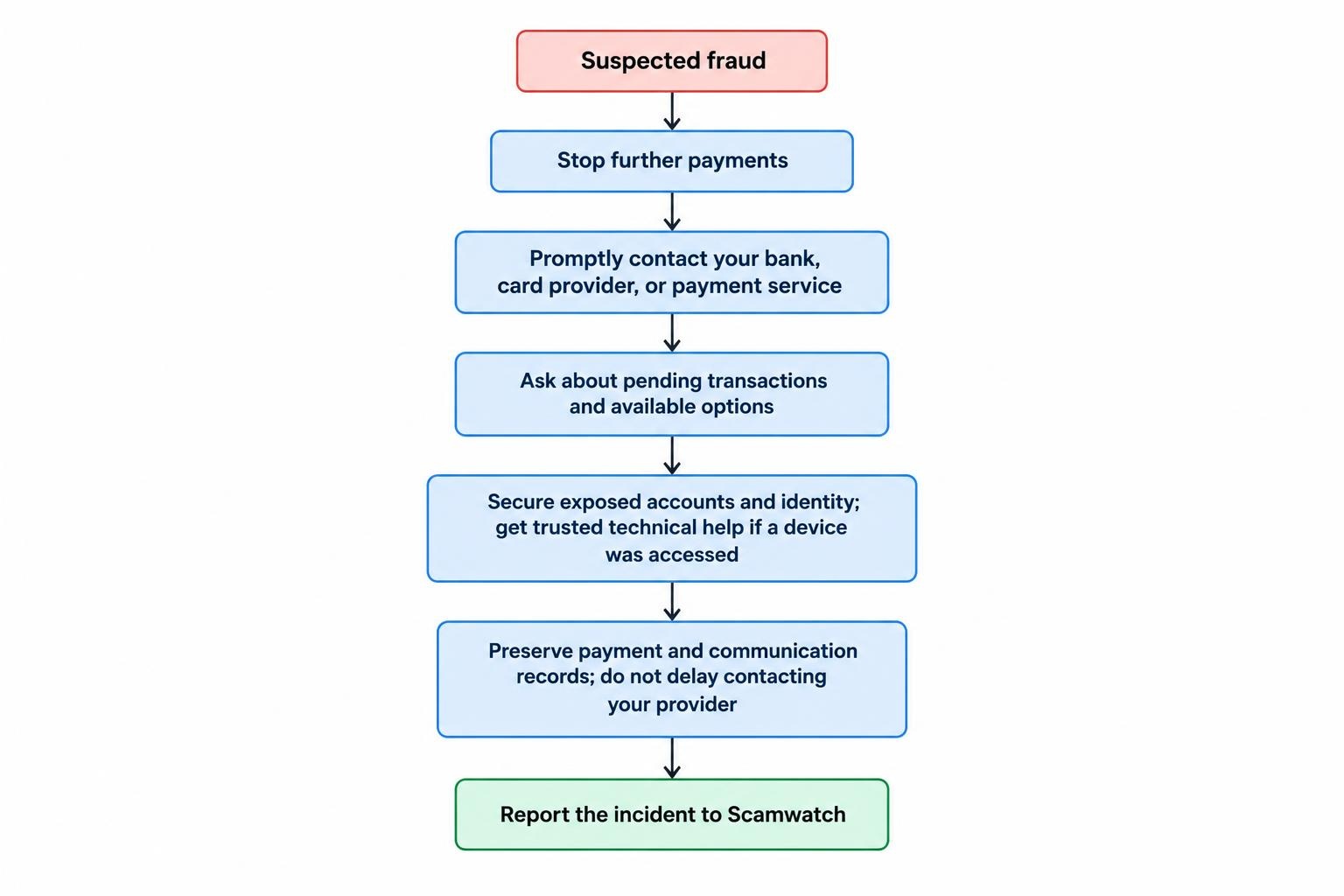
Prioritise stopping further loss over continuing an argument with the operator. Contact your financial institution promptly, secure exposed accounts and report the incident. Moneysmart’s steps after a scam cover payment providers, compromised information, device access and reporting.
- Stop further payments. Do not add money to recover losses, satisfy a new release condition or qualify for a promised refund.
- Contact the payment provider. Tell your bank, card provider or cryptocurrency service what happened. Ask whether it can stop a pending transaction and what recovery or dispute options may apply.
- Protect your accounts and identity. Change exposed passwords and enable multifactor authentication. If identity documents were shared, contact IDCARE for help planning a response.
- Address device access. If someone accessed your computer or phone, obtain trusted technical help to check it and secure your accounts.
- Report the incident. Report the scam to Scamwatch. Preserve records before blocking further contact, but do not delay contacting your bank while assembling a perfect evidence file.
Build a short chronology. Include the first contact, each payment, withdrawal requests and the explanations given when payment was refused. Separate money actually sent from profits shown only on the platform.
Save account statements, chat exports, emails, website addresses, payment receipts and cryptocurrency transaction identifiers where relevant. Keep original files where possible, not just cropped screenshots. Do not publish identity documents or complete banking details when asking others for help.
Be accurate with your bank. If you authorised a payment because you were deceived, describe that sequence rather than claiming the transaction occurred without your approval. Ask what evidence it needs and keep a record of the case number.
Our action plan after a binary options scam provides a fuller response process. There is no need to wait for the platform to admit wrongdoing before taking protective steps.
Can you recover the money?
Ask your payment provider to assess the available options rather than assuming recovery is either guaranteed or impossible. Explain how the payment was made, when it was sent, who received it and what was promised. Do not spend more money on the strength of a refund assurance that you cannot verify.
Keep your claim grounded in actual payments. If you deposited $4,000 and the dashboard later displayed $25,000, record the $4,000 transfer separately from the unverified account balance. That distinction helps avoid presenting promotional figures as established losses.
Also separate reporting from recovery. Make the report, but continue following the payment provider’s instructions and protecting your accounts. Do not assume that submitting a report has stopped a pending transfer.
Watch for a second scam promising recovery
Be especially cautious if someone contacts you unexpectedly claiming that your money has been located. A convincing letter or knowledge of your earlier loss does not establish that the caller can recover anything.
ASIC does not collect payments to release funds or assets and does not guarantee their release. Demands using its name are addressed in ASIC’s warning about recovery scams impersonating the regulator.
Before discussing any paid recovery service, independently verify the provider’s identity, professional status, written terms and proposed work. Reject any promise that depends on first paying an unexplained tax, deposit or insurance bond. Do not hand over account credentials or wallet recovery phrases.
Keep communications about the original incident separate from new approaches. Someone claiming to be a lawyer, regulator or investigator should be checked through contact details you obtain independently, not by replying to the message.
The guide to trading fund recovery scams covers these follow-up approaches. The immediate objective is to protect the money and information you still control, not to fund another promise.
This article was last updated on: October 23, 2026