Binary options are banned for retail investors in Australia. ASIC prohibits their issue and distribution to retail clients. A trading platform accepting an Australian registration or deposit does not establish that its offer is lawful. The current Moneysmart warning on binary options also cautions against accepting wholesale classification simply to access these products.
That changes the starting point for assessing a provider. Payout percentages, withdrawal speeds and trading software come after a more basic question: can this business lawfully offer this contract to this customer?
This guide covers the Australian prohibition, the distinction between retail and wholesale clients, licence checks, overseas providers and complaint options. It is general information, not a legal opinion about an individual account or transaction.
Australia’s binary options ban: dates and reasons
The retail prohibition took effect on 3 May 2021. ASIC subsequently extended the order, announcing that the ban would continue until 1 October 2031. Before the prohibition, its review of five licensed issuers found that 74–77% of active retail clients lost money during the 13 months to 3 May 2021. Retail accounts recorded aggregate net losses of $14 million. These dates and findings appear in ASIC’s announcement extending the binary options ban.
As at 21 October 2026, the prohibition remains in force. The original 18-month duration should not be mistaken for the present position, and the announced 2031 end date should not be treated as a promise that retail trading will reopen then.
ASIC identified three harmful product characteristics: the possibility of losing the entire amount committed, short contract durations and negative expected returns. The intervention therefore addressed the product’s structure, not just dishonest businesses selling it.
That distinction matters. A contract can settle exactly as advertised and still be financially unfavourable. Removing a scammer does not remove an unfavourable payoff.
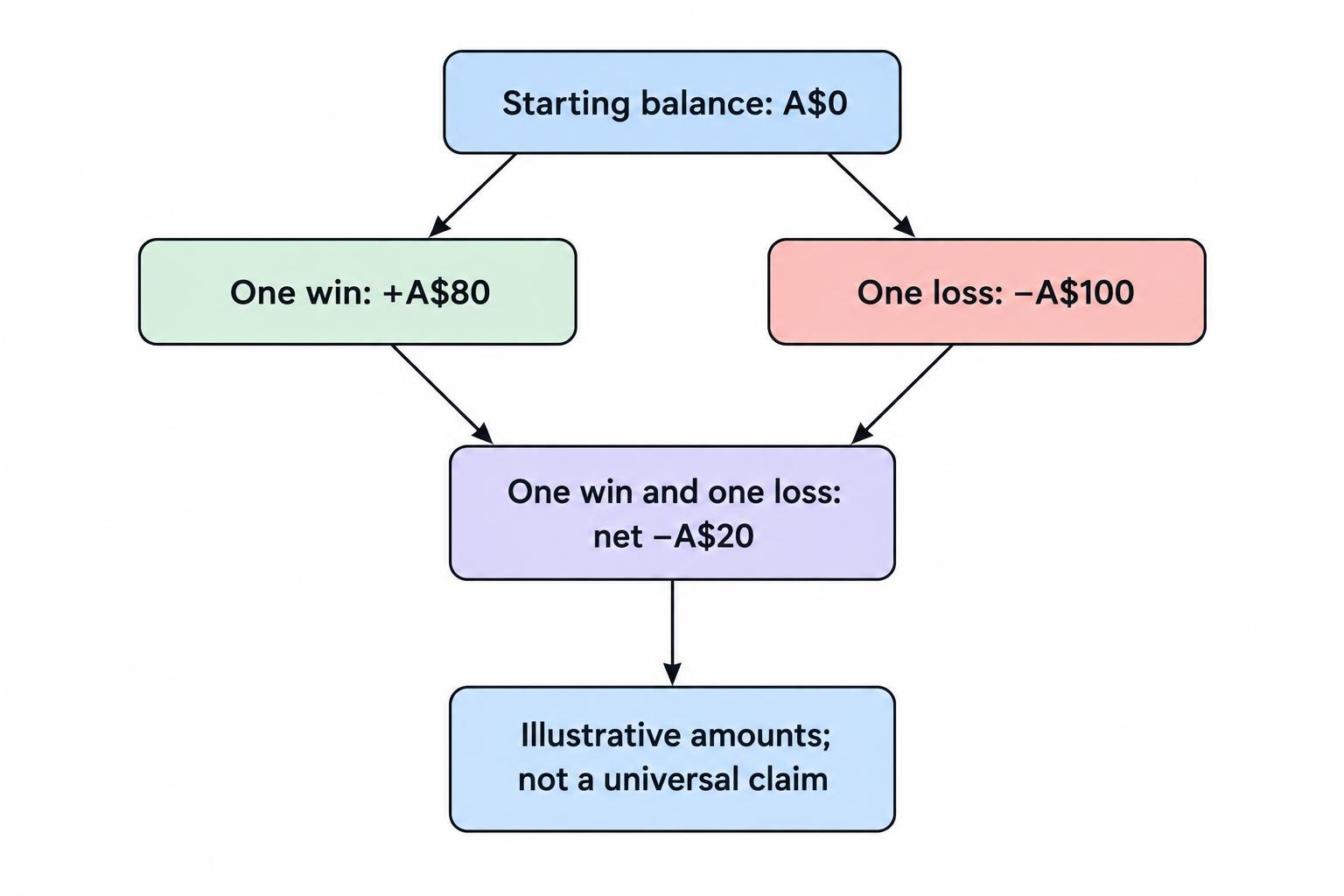
Consider a hypothetical contract that risks A$100 to earn A$80 in profit. One winning trade followed by one losing trade produces a net loss of A$20. Correctly predicting half the outcomes would not cover the losses in that example. This is a payoff illustration, not a claim about every contract or an individual trader’s results.
Better charts, faster execution or a more polished application would not change that arithmetic. Nor would a warning acknowledging that trading is risky. The regulatory question is whether the product may be supplied, not whether the customer has clicked a sufficiently alarming disclaimer.
What the prohibition covers
The ASIC binary options product intervention order prohibits providers from issuing covered binary options to retail clients. It also prohibits certain business activities involving arranging their issue or acquisition, and acquiring them as an agent for a retail client. Its definition concerns over-the-counter derivatives with predetermined outcomes linked to conditions involving assets, rates, indices or commodities. Cryptoassets are expressly included.
The practical point is that the prohibition is not confined to a familiar currency pair or a button labelled “binary option”. Assess the contract rather than relying on its product name.
Ask what determines the outcome, what the customer pays, what can be received at settlement and who issues the contract. A different label does not answer those questions. Neither does a claim that a platform uses an unusual price feed or a proprietary market.
The order can also cover a contract that permits early termination. An early-close feature should not be treated as proof that a product sits outside the prohibition.
At the same time, do not reverse the reasoning and assume that every product called an “option” falls within this order. Ordinary exchange-traded options, for example, require a separate assessment of their structure and applicable rules. This article concerns the Australian binary options intervention, not a universal ban on options.
The order addresses providers, arrangers and agents. It should not be casually rewritten as a statement that every retail customer who reads about binary options, practises a hypothetical example or previously held an account has committed an offence. Questions about an actual transaction need advice based on its facts.
Retail and wholesale clients are different legal categories
Retail or wholesale status is not a measure of enthusiasm. Nor is it a reward for passing a trading platform’s quiz.
For financial services outside categories with their own treatment, a person will generally be a retail client unless a relevant wholesale test applies. Different tests can involve financial circumstances, professional status or an assessment of experience, with requirements attached to the route used. ASIC’s guidance on retail and wholesale client classification explains that many financial services obligations apply only to retail clients.
The binary options prohibition is directed at retail clients. That does not mean every offer described as “wholesale only” is properly licensed, correctly classified or otherwise lawful. Client classification and the provider’s authority are separate questions.
If a provider proposes changing your status, request the legal basis in writing. Ask which test it relies on, what evidence supports the assessment and which protections would change. Keep the documents rather than accepting a summary from a salesperson.
A hypothetical customer might have years of experience buying shares but little knowledge of short-duration derivatives. That history does not, by itself, establish the correct classification for every financial service. Equally, a comfortable salary does not make every declaration placed in front of the customer accurate.
Do not sign statements that exaggerate your experience, assets or knowledge. If an application form describes transactions you have never made, correct it rather than treating it as routine administration.
The phrase “professional account” also needs care. It may be a marketing label rather than an explanation of the Australian legal test being applied. Ask for the substance behind the label.
Our guide to retail and wholesale trading clients examines classification separately. For this parent guide, the central point is straightforward: wholesale treatment is not a consumer workaround for the retail ban. Obtain independent advice before accepting a change whose purpose is to regain access.
How to assess an Australian licence claim
An Australian financial services licence is not a blanket approval of everything a business sells. A useful check must connect the licence holder to the actual service, customer category and contracting entity.
Use ASIC’s Professional Registers Search to check the person or organisation and the services it is licensed or registered to provide. The register includes AFS licensees and authorised representatives, with information such as status, licence conditions and, where recorded, licensee website addresses.
Begin with the legal name in the customer agreement, not just the brand on the trading screen. Then compare the licence details with that entity. Where a representative is involved, identify the licensee responsible for the representative’s authorised activities.
A corporate group can contain several businesses. A licence held by one company should not be treated as authority for an agreement with another company simply because both use the same logo.
Save the relevant register result and the agreement you were shown. A dated record is more useful than a note saying that the company “looked regulated”. It also helps establish which entity and terms were presented at the time.
Our step-by-step guide to checking a broker’s licence covers the verification process in more detail.
Company registration is not financial services authorisation
Keep different records separate. An ABN, ACN, registered business name or Australian address does not answer the same question as an AFS licence check. A company can exist without being authorised to provide the financial service being advertised.
There is also an identity problem: the licence number may be genuine but belong to somebody else. Moneysmart’s checks before investing warn that scammers misuse licence details and impersonate licensed businesses. The guidance also makes clear that an AFS licence is not ASIC endorsement or a guarantee against loss.
Verify contact details independently. If a website address appears in the register, compare it carefully with the address you have been using. Do not rely on a telephone number supplied by the person whose identity you are checking.
For a retail binary options offer, even a genuine licence does not settle the issue. You still need to account for the product prohibition. Licensing and product restrictions are separate checks, not interchangeable stamps of approval.
Offshore providers do not remove the Australian question
A provider’s overseas location does not automatically place its activities beyond Australian financial services law. The circumstances in which an overseas business may need an AFS licence, and the exemptions that may be available, form part of ASIC’s guidance on conducting financial services business in Australia.
Separate three questions: where the provider is established, what its overseas authorisation permits and what Australian requirements apply to its dealings with customers here. Answering the first question does not answer the other two.
For the binary options order, territorial connections can include an offer received in Australia. A statement that the company’s servers are abroad is therefore not a complete legal explanation.
Request the name of the issuer, its jurisdiction, the basis on which it claims to serve you and the agreement governing your account. If the response consists only of a foreign registration certificate, the Australian question remains unanswered.
Payment acceptance proves little. A successful card deposit, wallet transfer or cryptocurrency transaction shows that money moved. It does not establish the provider’s authority, the lawfulness of the product or access to a complaint scheme.
Do not treat technical access as permission either. A working registration form or an application available for download is not a legal assessment of your circumstances. Avoid providing false residency information to get past restrictions; inaccurate records make an already difficult situation harder to assess.
For further detail, see our guide to offshore binary options brokers. The useful question is not whether an overseas platform can accept your money. It is what lawful basis, accountable entity and practical recourse sit behind the offer.
Foreign regulators and private certificates
Regulatory claims need to be read precisely. A statutory financial services licence, company incorporation document, membership certificate and commercial award are different records. Their appearance on the same webpage does not make them equivalent.
For any overseas claim, identify the issuing body and verify the record independently. Check the legal entity, the authorised activities and the customers or territories covered. Do not assume that a licence for one service also covers another.
A private organisation may offer membership standards or a dispute process. Assess those arrangements on their own terms rather than treating the organisation’s name as proof of government supervision.
Useful questions include whether participation is current, whether the relevant company is actually covered, whether a decision binds that company and what happens if it refuses to comply. Those questions are worth asking before money is sent, not after a withdrawal has stalled.
The same approach applies to certificates displayed as images. Ask for a verifiable record rather than another copy of the image. A badge is a starting point for investigation, not the end of it.
Our guide to foreign regulators and private certificates separates these claims without assuming that every overseas regulator or private arrangement offers the same protections.
Client money claims need a separate assessment
Even after establishing who operates a service, consider who receives and holds the money. Do not assume the trading brand, payment recipient, account holder and issuer are the same company.
Ask for an explanation of the payment chain. If your agreement names one entity but the deposit instructions name another, request a written explanation before proceeding. Record any payment processor or intermediary involved.
Be equally careful with terms such as “segregated funds” and “protected account”. Ask what the claim means under the agreement and applicable law. Which money does it cover? Where is it held? Who has an obligation to repay it? What happens if the issuer or another business in the chain becomes insolvent?
These are different questions from whether a trade won or lost. A correct settlement calculation does not establish that the amount shown on screen can be withdrawn, and a displayed account balance is not independent evidence of where funds are held.
Do not infer a government guarantee from an Australian connection, a licence number or the word “segregated”. Request the actual basis for any protection claim. If the explanation relies on insurance or a compensation arrangement, ask who provides it, what it covers and what exclusions apply.
This guide does not attempt to summarise every client money or insolvency rule. Those questions depend on the arrangement and applicable law. Our separate guide to client money and broker insolvency provides the relevant follow-up questions. For retail binary options, none of these assurances replaces the need to address the prohibition itself.
Advertising, affiliates and social media promotions
A binary options promotion can raise financial services issues even where the promoter does not operate the trading platform. Recommendations, paid introductions and involvement in transactions need to be assessed by what they do, not simply what the promoter calls them.
Financial product advice and arranging a dealing can require an AFS licence, representative authorisation or an applicable exemption. Online material may also breach misleading or deceptive conduct rules. ASIC’s guidance on discussing financial products online addresses these distinctions, including affiliate activity.
For a reader assessing an offer, a large following does not establish either the promoter’s authority or the provider’s. Nor does a disclaimer establish that the surrounding message is accurate.
Read the promotion as a whole. What action does it encourage? Does it explain the Australian retail prohibition? Does it identify the contracting entity, or send you straight to an account-opening form?
Profit screenshots and withdrawal videos should not replace those checks. Even if an image is genuine, it does not answer whether the same product may lawfully be offered to you. A referral incentive is also worth identifying: understand who benefits when you register, deposit or trade.
Keep a copy of the advertisement and referral page if either influenced your decision. Save the date, account name and destination address. Our guide to financial promotions and affiliate marketing examines these arrangements separately from the trading contract.
Complaints and AFCA: check the route before relying on it
Do not assume every business describing itself as regulated belongs to the Australian Financial Complaints Authority. AFCA’s jurisdiction depends on its rules, including membership, eligibility, time requirements and other thresholds.
AFCA’s criteria for complaints it can consider require the complaint to concern a member financial firm and fall within its jurisdiction. AFCA does not generally consider a complaint solely about an investment’s performance. That is different from raising concerns about conduct, representations or transactions.
Identify the firm you want to complain about and describe what it did. Avoid submitting only an account balance or a statement that trading went badly. Explain the event, the evidence and the outcome you want.
A useful written complaint might identify an allegedly misleading licence claim, a disputed transaction or a failure to follow an instruction. It should distinguish what the documents show from what you suspect. Unsupported accusations can distract from a clear, evidenced account.
Prepare a short chronology with dates, amounts and named entities. Attach the agreement, payment records, relevant messages and the firm’s responses. Keep originals and provide readable copies rather than a large collection of unexplained screenshots.
If the provider is overseas or unlicensed, do not assume an Australian complaint route will cover it. Conversely, a wholesale label on an account is not enough to determine every jurisdictional question without checking the applicable rules.
A complaint concerning the response of your bank or payment provider is separate from a complaint against the trading business. Keep each firm’s conduct distinct rather than assuming responsibility transfers automatically between them.
Our guide to broker complaints and AFCA covers preparation and escalation. No complaint process should be treated as a promise that lost trading funds will be recovered.
If you have already deposited money
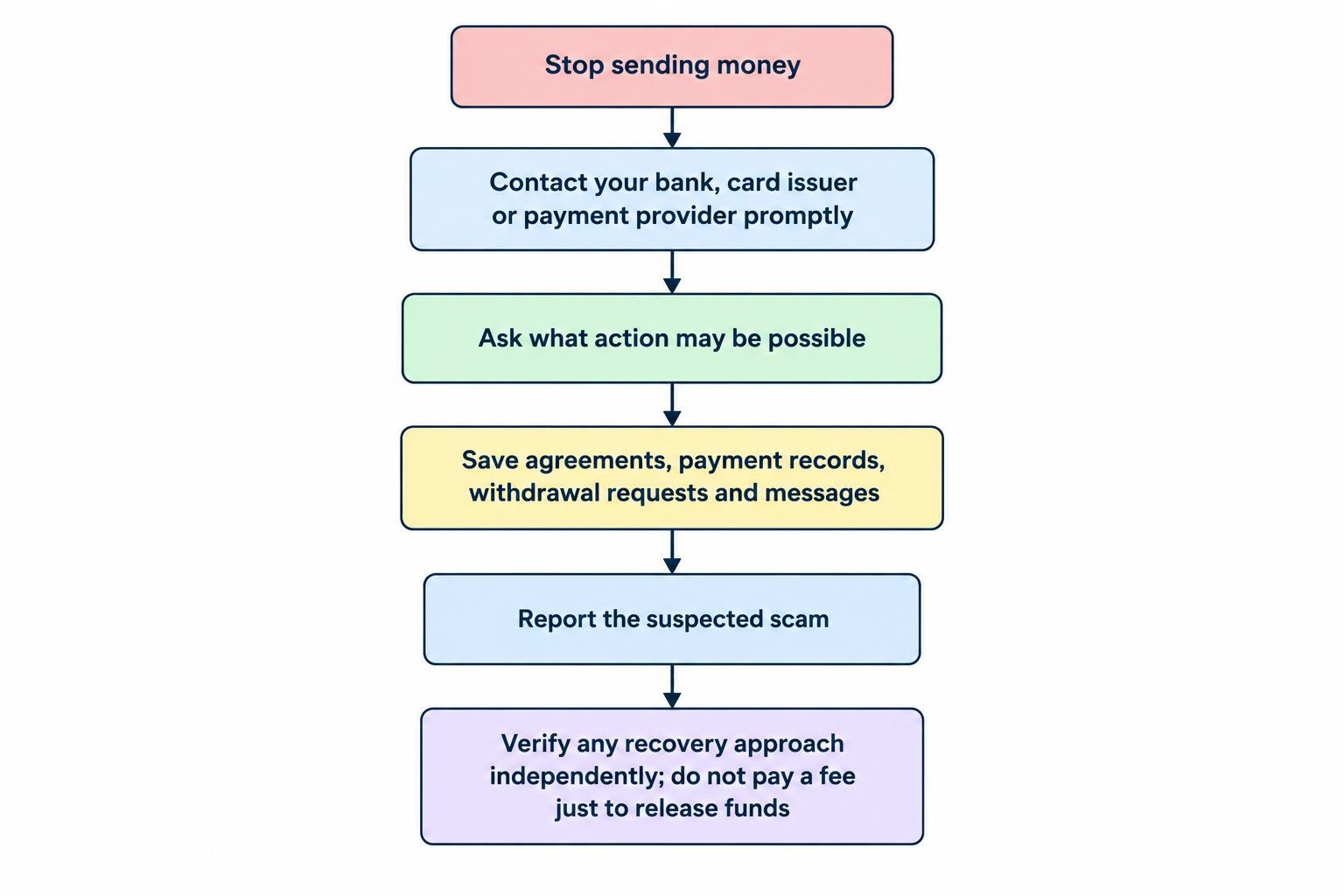
If you suspect a scam, stop sending money and contact your bank or card provider promptly. Ask what action may still be possible. Scamwatch’s steps after a scam recommend immediate contact with the payment provider, reporting the scam and watching for follow-up approaches offering to recover funds.
Preserve evidence before access disappears. Save the customer agreement, deposit receipts, withdrawal requests, account history and messages. Include the advertisement or referral that brought you to the platform, especially if it contained claims about Australian regulation.
For cryptocurrency payments, retain transaction records and the destination address. For card or bank payments, retain statements and payment references. Ask the relevant provider about available dispute or recovery options without assuming a reversal is possible.
Do not send another payment simply because somebody says it will release an existing balance. Pause and verify the demand independently. Apply the same caution to anyone who contacts you afterwards claiming to be a recovery specialist.
If you supplied identity documents or access to a device, address those exposures as well as the money. Tell the organisations helping you what was shared so they can assess the appropriate protective steps.
A practical example: separate the claims before deciding
Consider a hypothetical Australian retail customer shown a platform advertising short-duration currency contracts. The page displays a foreign certificate, an Australian company number and an image of a successful withdrawal. An account manager then offers a “professional” upgrade.
Each claim needs a different check. The company number concerns identity. The foreign certificate needs verification against its issuer’s records. The withdrawal image does not establish lawful access. The proposed upgrade needs a genuine classification basis, not just the customer’s agreement to a label.
The customer should request the contract, identify the issuer and establish the basis on which the product is offered in Australia. If the answers remain unclear, a small test deposit does not resolve the uncertainty. It adds money to it.
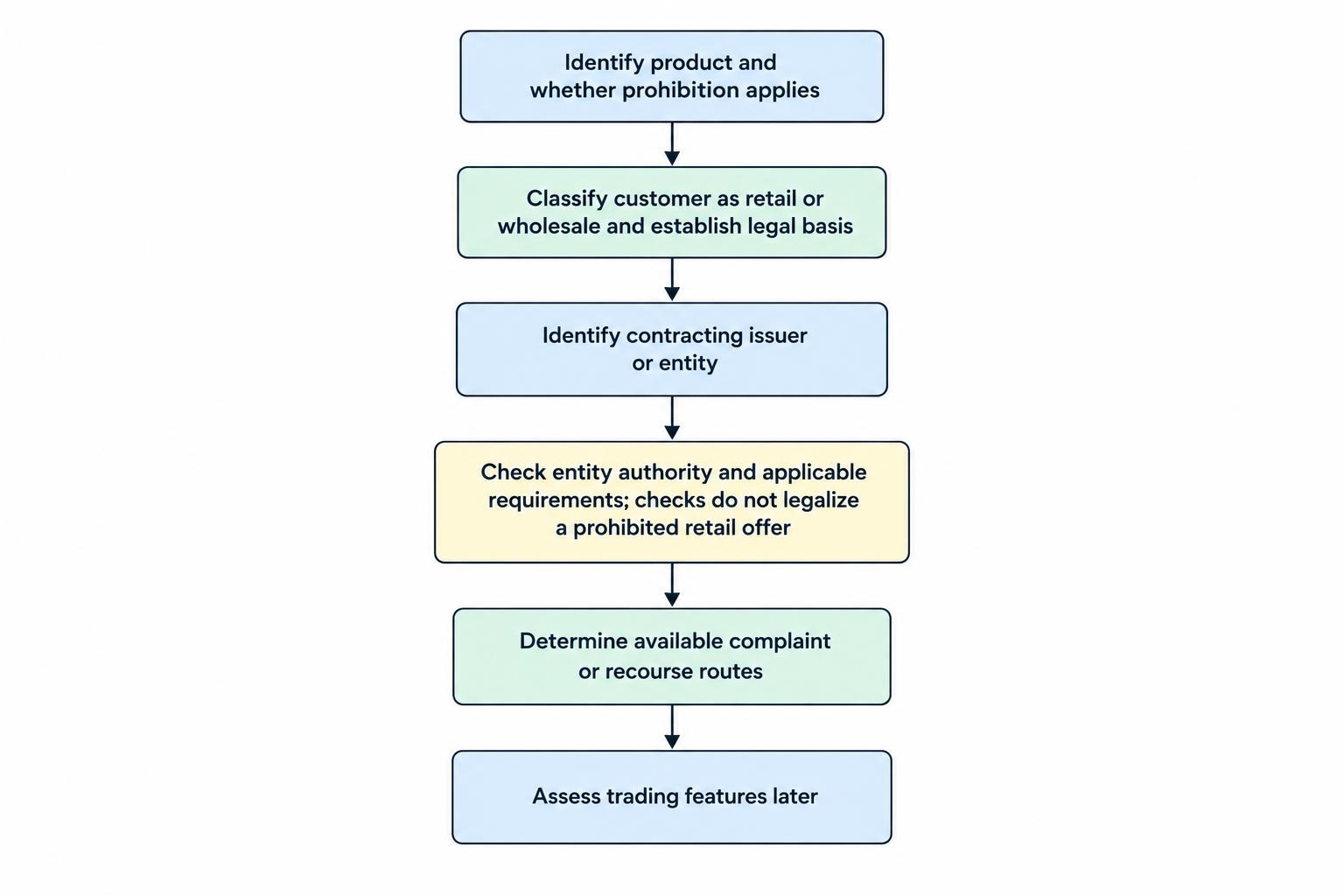
That is the practical order of assessment: product, customer classification, legal entity, authority and recourse. Trading features come later.
What to consider instead
If your purpose is to build savings, obtain market exposure or learn how prices move, define that purpose before selecting a product. A timed yes-or-no contract is not the only way to pursue market knowledge.
Compare ownership, holding period, costs, possible losses and the legal protections attached to an alternative. Different products carry different risks; avoiding binary options does not make another product suitable by default.
Our guide to alternatives to binary options provides a separate starting point. For an Australian retail customer, the regulatory position should come before any provider comparison: a deposit button is not permission, and a regulation badge is not a substitute for checking the actual offer.
This article was last updated on: October 22, 2026