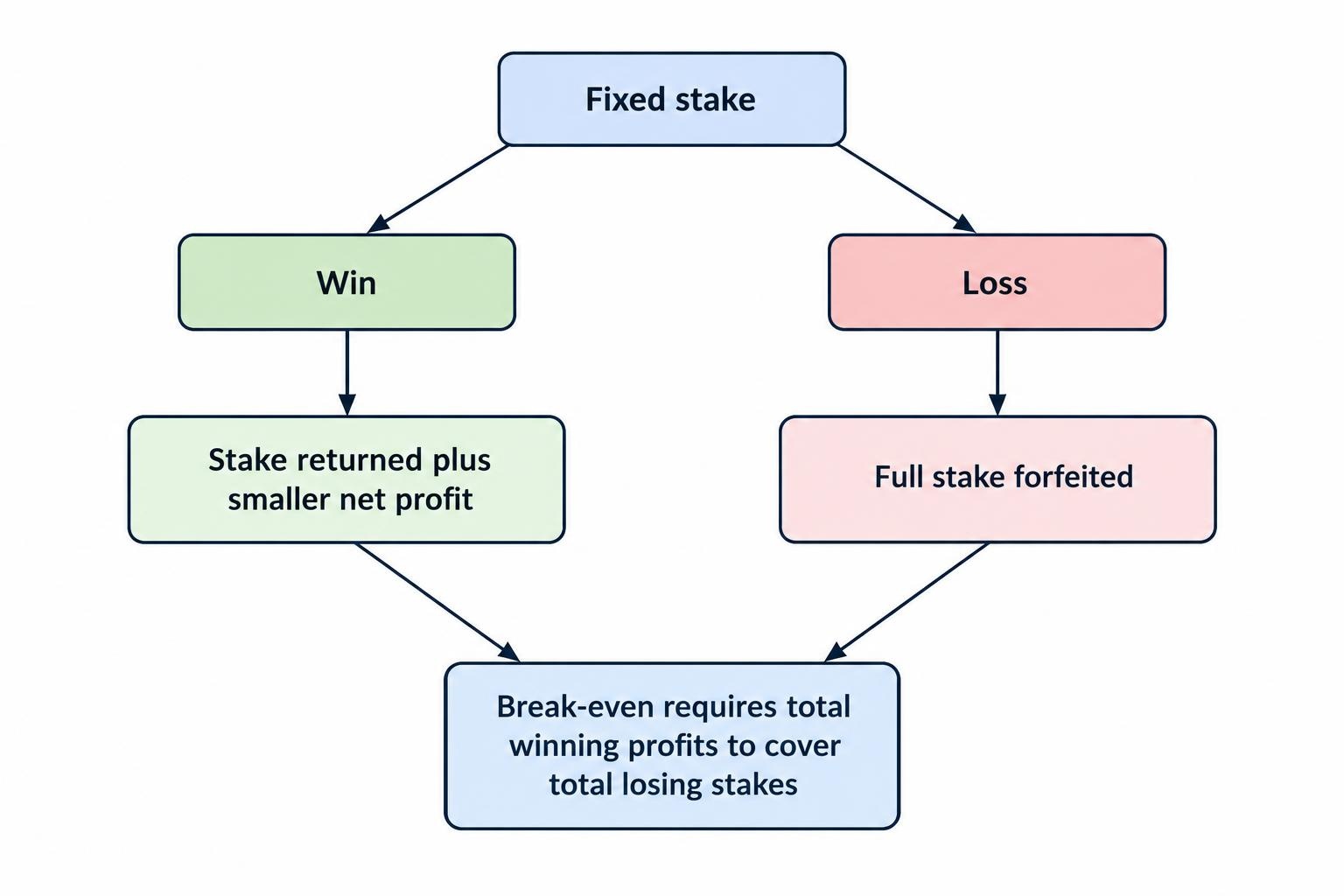
Binary options traders lose money for more than one reason, but the first is arithmetic. A losing trade can cost the entire stake, while a winning trade earns only a fraction of that amount. Traders can therefore win more often than they lose and still finish with less money.
Short expiries, rising stakes, weak performance evidence and platform fraud can compound that disadvantage. Treating every loss as a failure of discipline misses the economics of the contract itself. This article examines the fixed stake, fixed profit model commonly associated with online binary options, rather than every possible binary payoff structure.
For Australian readers, the regulatory position comes first. ASIC prohibited the issue and distribution of binary options to retail clients from 3 May 2021 and extended the prohibition until 1 October 2031. The hypothetical examples below explain the losses, not how to access these products.
What the Australian loss figures actually show
Historical Australian data provides a useful starting point. Between April 2020 and the prohibition taking effect, 74–77% of active retail clients lost money in each quarter covered by ASIC’s analysis. Across the approximately 13 months before the ban, retail accounts recorded aggregate net losses of A$14 million. These findings appear in ASIC’s analysis of binary options client outcomes.
Those figures need careful interpretation. They describe historical outcomes among the issuers assessed, not a current global failure rate. They also measure clients losing money, not the percentage of individual trades that lost.
That distinction matters. A client might win most of their trades but lose money because their losing stakes were larger, their winning payouts were smaller, or both. Counting green ticks is not the same as measuring profit.
1. Winning trades pay less than losing trades cost
Consider a contract requiring an A$10 stake and offering an 80% profit on a win. A successful trade returns the A$10 stake plus A$8 profit. An unsuccessful trade loses A$10. One win therefore does not pay for one loss.
This imbalance can produce a negative expected return even without fraud or separate dealing fees. The distinction between an advertised winning payout and the expected result across repeated trades is addressed in the CFTC and SEC investor alert on binary options payout risk.
The following calculations assume every losing trade forfeits the full stake, every winning trade pays the stated net profit, and there are no ties, refunds or extra costs.
| Net profit on a winning stake | Win rate needed to break even |
|---|---|
| 60% | 62.50% |
| 70% | 58.82% |
| 80% | 55.56% |
| 90% | 52.63% |
A 55% win rate can still lose money
Suppose someone makes 100 hypothetical trades at A$10 each, with an 80% winning payout. They win 55 and lose 45.
The wins produce A$440 profit: 55 multiplied by A$8. The losses cost A$450: 45 multiplied by A$10. The final result is an A$10 loss, before any other expenses.
The break-even formula is one divided by one plus the net payout expressed as a decimal. At an 80% payout, that is 1 ÷ 1.8, or approximately 55.56%. Earning a profit requires more than reaching that threshold.
Our guide to probability and expected value in binary options examines the calculation further. The practical point is straightforward: accuracy has no useful meaning without the payout, stake sizes and costs attached to it.
2. A correct market view can expire as a losing contract
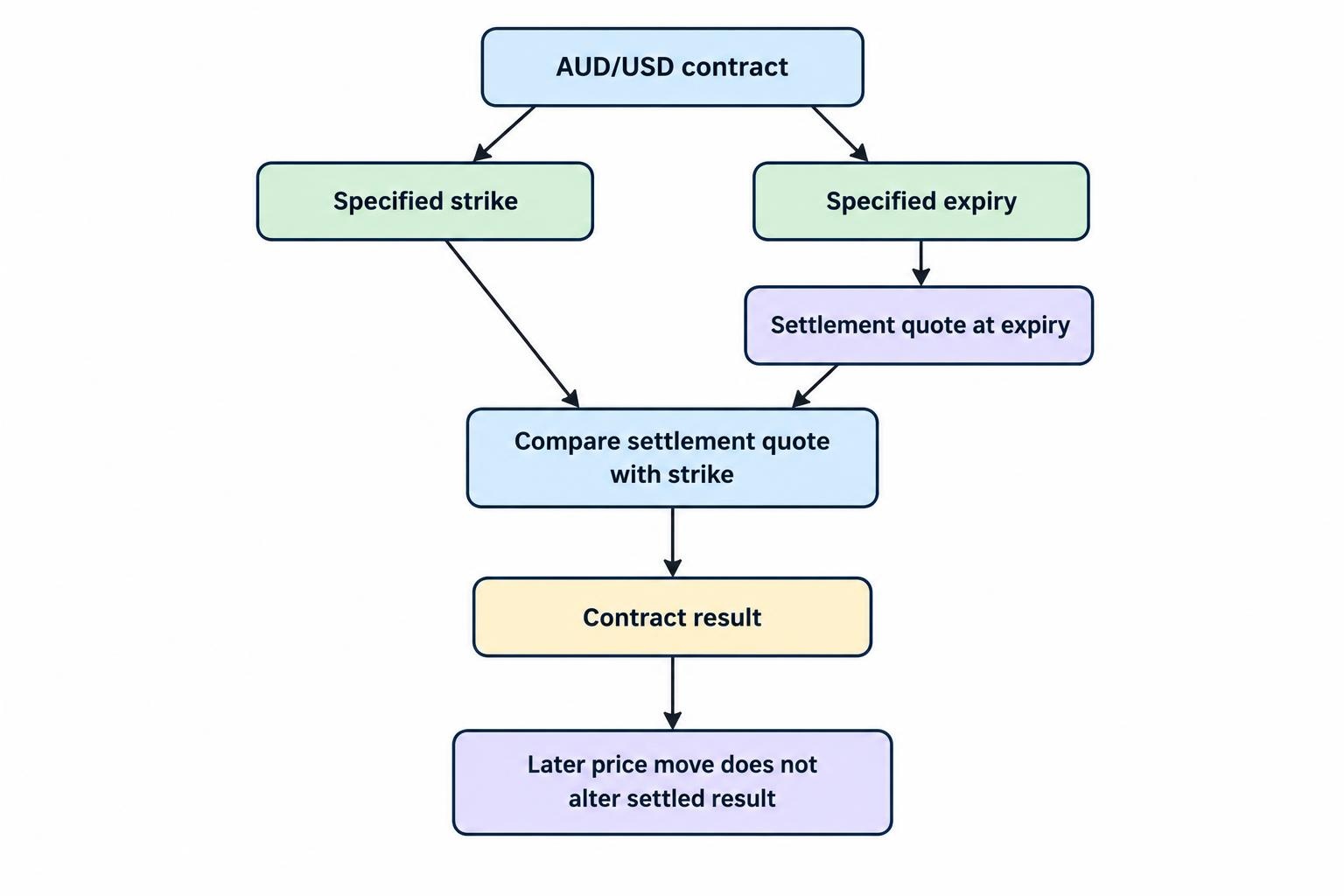
A directional opinion and a winning binary contract are different things. Expecting AUD/USD to rise during the morning does not establish that it will settle above a chosen strike at one particular minute.
Consider a hypothetical contract that requires AUD/USD to finish above 0.6500 at 10:01 am. It settles at 0.64999, then reaches 0.65050 at 10:05 am. The later rally does not change the expired result. The broad direction was right, the contract still lost.
This creates a timing burden that a general market forecast does not answer. The relevant question is not simply whether the asset looks bullish. It is whether the contract’s settlement condition will be satisfied at its expiry.
Entry timing, the accepted strike and the settlement benchmark also matter. A separate chart is not necessarily the reference named in the contract. When the final quote sits close to the strike, overlooking those details can mean analysing a different proposition from the one actually purchased.
Extending the expiry does not automatically solve the problem. It changes the proposition and requires its own evidence.
3. Stakes grow faster than the account can absorb
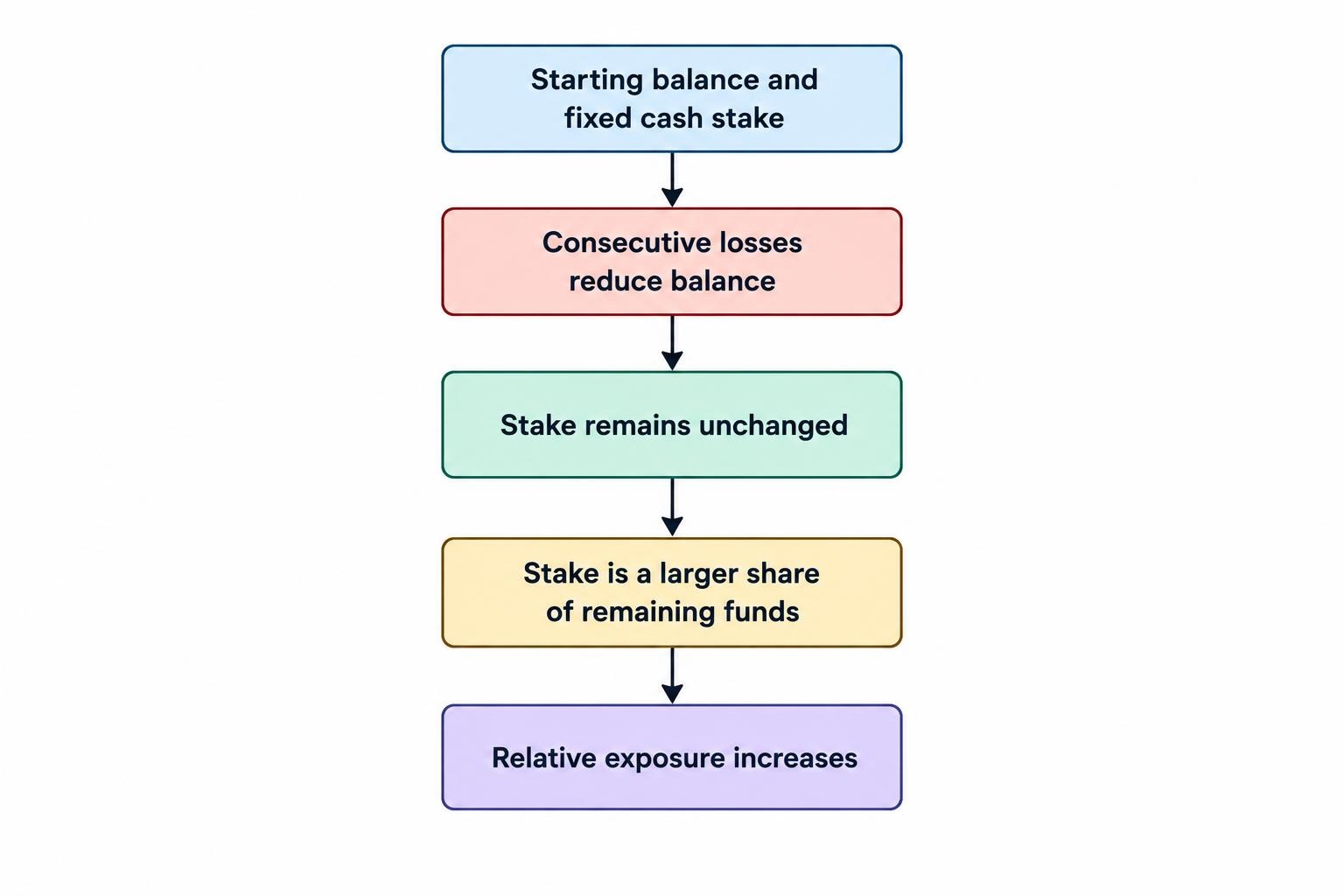
A known maximum loss per contract does not make a sequence of contracts affordable. The account damage depends on how large each stake is relative to the money remaining.
Take a hypothetical A$500 balance with A$50 staked per trade. Three consecutive losses remove A$150, leaving A$350. That is a 30% decline. Returning from A$350 to A$500 then requires a gain of approximately 42.9% on the remaining balance.
Keeping the stake at A$50 also raises its share of the account from 10% to about 14.3%. The next trade is riskier relative to the remaining funds, even though the cash stake has not changed.
Variable stakes create another problem. Nine small wins can be erased by one much larger loss. A high win rate can conceal this concentration if the record shows outcomes but omits amounts.
Smaller stakes reduce the damage from individual losses. They do not turn an unprofitable contract selection method into a profitable one. Controlling exposure and establishing a genuine advantage are separate tasks.
4. Loss recovery systems concentrate the damage
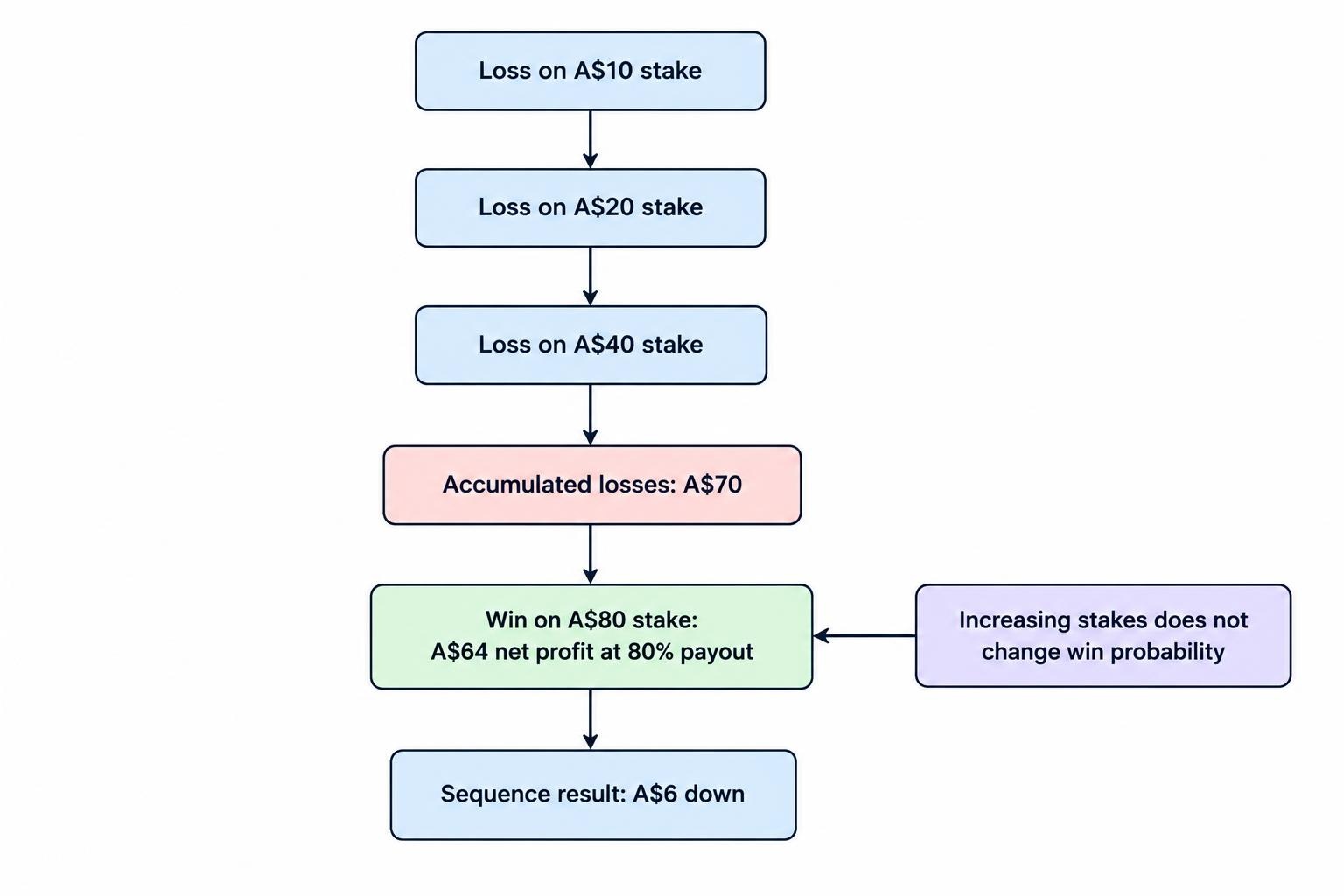
Increasing the next stake to recover a previous loss changes the amount at risk, not the probability of the next contract winning. The account balance does not influence where the underlying market settles.
Simple doubling is particularly misleading when winning profits are below 100% of the stake. At an 80% payout, losing A$10, A$20 and A$40 costs A$70. A subsequent winning A$80 trade earns A$64 profit. The sequence still ends A$6 down.
A progression designed to recover every previous loss plus a target profit must grow faster than simple doubling under those assumptions. Eventually, the required stake can exceed the available balance or the contract’s maximum stake.
The problem with martingale staking in binary options is not that losing streaks are surprising. It is that the method needs enough money to keep increasing exposure through them. Frequent small recoveries can make the record look reassuring, until one sequence consumes the gains and more.
A loss does not create a debt that the market must repay on the next trade.
5. Overtrading repeats the same disadvantage
More trades are not automatically more opportunities. If each trade has a negative expected result, increasing the number of trades increases the expected aggregate loss, assuming the same stakes and probabilities.
Using the earlier A$10 stake and 80% payout, suppose the true chance of winning is 50%. The expected result per trade is half of A$8 minus half of A$10: a loss of A$1. Trading more frequently does not repair that imbalance.
This is an expectation, not a prediction that every session will lose exactly A$1 per trade. Actual results fluctuate. A profitable afternoon can occur within a method whose repeated average outcome is negative.
Activity becomes especially costly when someone trades to reach a daily income target or erase a morning loss. Neither objective provides evidence about the next settlement price. They can instead encourage weaker entries, shorter waiting periods and larger stakes.
The same issue applies to overlapping positions. Several contracts tied to the same market move are not necessarily separate opportunities. A single price movement can damage all of them at once.
6. A winning streak is mistaken for a proven method
A short profitable record shows what happened during that sample. It does not, by itself, establish a reliable future win probability.
This is easy to miss when testing many indicators or settings. If enough combinations are tried, some will fit the historical data well by chance. Selecting the best result after seeing every outcome produces a different test from following rules chosen beforehand.
Historical testing can also become misleading if it uses information unavailable at the supposed entry time, assumes a payout that was not offered, or ignores the delay between receiving a signal and obtaining an accepted contract.
Promotional evidence deserves separate scrutiny. Paid rankings and invented credentials are documented concerns in the SEC warning about binary options sales pitches. A confident presenter or polished profit screenshot is not independent verification.
Demo results answer a narrower question than a claim of live profitability. A simulated balance does not establish that the same entries, contract terms and behaviour would occur with real money. It cannot demonstrate successful withdrawals either.
A useful trading journal records accepted entries, expiries, payouts, stakes, results and costs, rather than wins alone. Without those details, it is difficult to distinguish a repeatable advantage from favourable sampling, changing stakes or selective reporting.
7. Platform and withdrawal risk sit outside chart analysis
Not every loss comes from a market prediction. A displayed profit and money returned to a bank account are different things.
US regulators have received complaints involving binary options platforms refusing to return funds, misusing identity information and manipulating software to generate losing trades. These are documented categories of alleged misconduct in the SEC and CFTC alert on binary options fraud.
That does not mean every losing settlement proves manipulation. A contract can operate exactly as stated and still offer poor economics. Equally, excellent market analysis cannot compensate for a platform that refuses to honour its obligations.
The distinction matters when reviewing losses. A trading problem concerns the contract’s probabilities, payout and execution. A platform problem concerns whether the operator applied the agreed terms and returned money owed. They require different evidence.
Preserve transaction histories, contract confirmations, withdrawal requests and correspondence if something appears wrong. Sending more money is not a way to verify an existing balance. Nor should a request to trade more be treated as an explanation for why a withdrawal has not arrived.
What a useful loss review should establish
A useful review separates the product’s economics from decisions made around it. It should answer four questions:
- Did the results exceed the actual break-even threshold? Use the payouts offered on those contracts, not a headline maximum.
- Did stake changes cause the damage? Recalculate the record with constant stakes to identify the effect of increasing exposure.
- Can the results be reconstructed? Check accepted strikes, timestamps, expiries and settlement records rather than relying on screenshots.
- Does the account reconcile? Deposits, trading results, fees, withdrawals and the remaining balance should tell the same financial story.
These questions help identify why money disappeared. They do not establish that continuing would be sensible. An unexplained loss is a reason to pause, not increase the next stake.
The broader principles of binary options risk management concern controlling exposure, but exposure control has a boundary: it cannot manufacture positive expected returns or make a dishonest operator reliable.
Discipline can reduce avoidable mistakes. It cannot rewrite payout maths, reverse an expired contract or guarantee payment. For Australian retail clients, the prohibition on issuing and distributing these products remains the starting point—not a hurdle to work around.
This article was last updated on: October 22, 2026