Demo and live binary options trading can look almost identical on screen. The difference is what the results prove. A demo account uses virtual money and can help you learn the controls, check contract terms and record decisions. A live account puts actual funds at risk and adds questions about execution, withdrawals and the firm holding your money.
Demo profits are not evidence that you will earn the same return with real money. A useful comparison separates three issues: whether the trading conditions match, whether your decisions remain consistent, and whether the provider can lawfully offer the product.
The Australian restriction comes first
ASIC’s ban on the issue and distribution of binary options to retail clients took effect on 3 May 2021 and has been extended until 1 October 2031. That restriction matters more than any demo performance target. A profitable practice account does not change it. See ASIC’s announcement extending the binary options ban.
For Australian retail readers, this comparison is educational, not a progression from practice to depositing with an offshore platform. Treat a demo as a way to study contract mechanics and assess claims, rather than an invitation to bypass the restriction.
Demo vs live: what actually changes?
The table below separates what a simulation can demonstrate from what requires evidence beyond the practice screen. It is a comparison framework, not a promise that every platform operates the same way.
| Area | Demo account | Live account |
|---|---|---|
| Money at risk | Trades change a virtual balance. | Losses reduce actual funds. |
| Contract mechanics | Can demonstrate direction, strike price, expiry and settlement. | The accepted contract terms determine the financial outcome. |
| Payout comparison | The displayed practice payout is an assumption to record. | The accepted payout must be checked rather than inferred from demo results. |
| Execution | Shows how the simulation accepts an instruction. | Requires evidence of the price, time and terms actually accepted. |
| Behaviour | Allows rehearsal without losing trading capital. | Introduces the consequences of actual financial loss. |
| Withdrawals | Cannot demonstrate repayment of actual customer funds. | Depends on the provider honouring valid withdrawal requests. |
A demo is useful for narrow questions: Did you select the correct expiry? Did you confuse profit with total return? Did you follow the rule you wrote before entering? It cannot answer every question about the live service.
Payout differences can reverse a profitable result
The most useful comparison is not the balance shown at the top of the screen. It is the profit or loss generated by the same decisions under the same contract assumptions.
Consider a hypothetical fixed stake contract. You risk A$10, lose the entire stake when wrong, and receive your stake back plus an A$8 profit when right. That is an 80% net profit payout. The total amount returned after a win is A$18, not A$8.
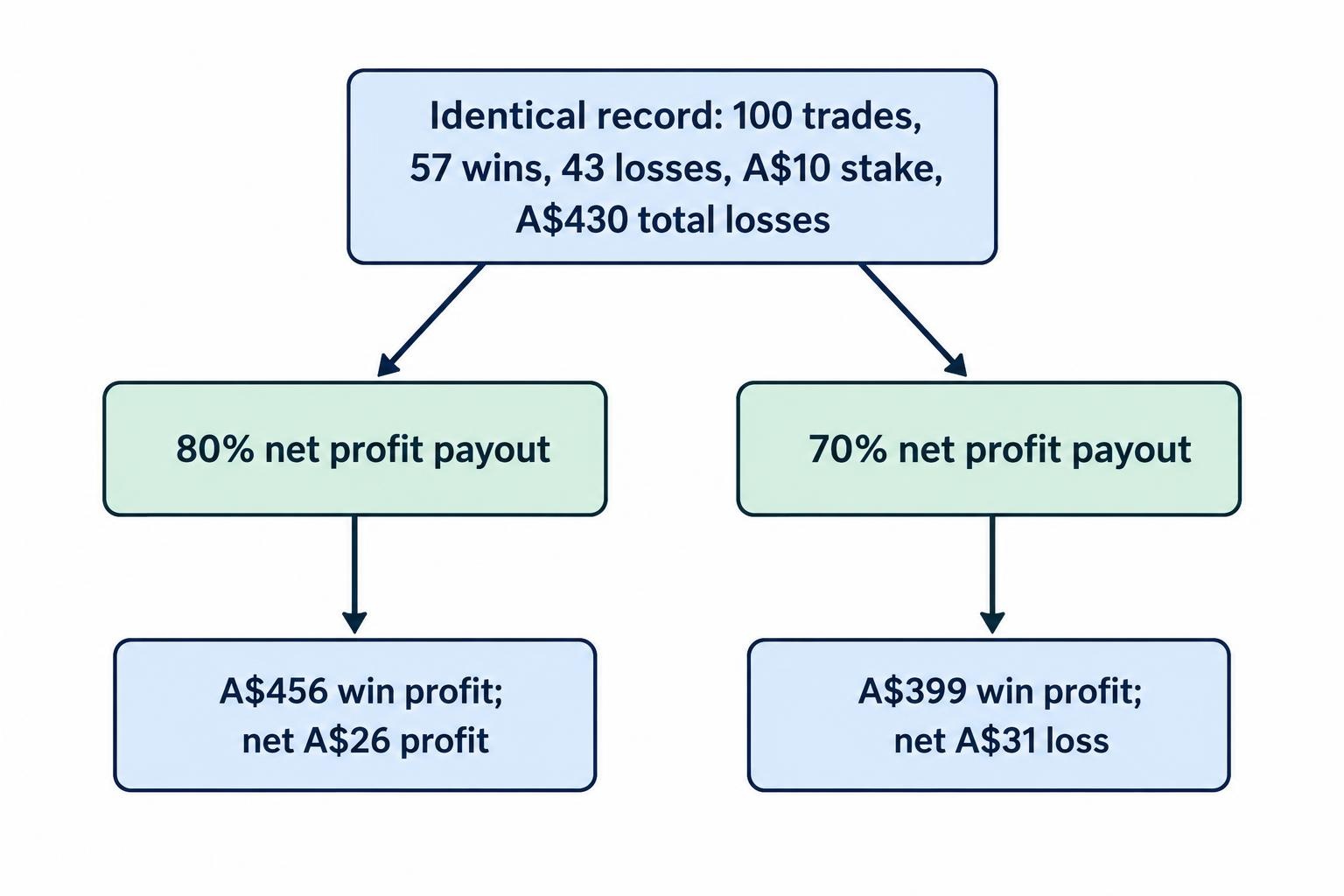
Now suppose a practice record contains 100 trades: 57 wins and 43 losses. Compare that record under two assumed payouts, with no ties, refunds or other costs.
| Measure | 80% net profit payout | 70% net profit payout |
|---|---|---|
| Stake per trade | A$10 | A$10 |
| Profit from 57 wins | A$456 | A$399 |
| Loss from 43 losses | A$430 | A$430 |
| Net result | A$26 profit | A$31 loss |
| Break-even win rate | 55.56% | 58.82% |
Nothing changed about the predictions. The payout alone changed the result from positive to negative. This does not show that live payouts are always lower; it shows why matching them matters.
With a full stake loss on losing trades, the break-even win rate is 1 divided by 1 plus the net profit payout expressed as a decimal. The calculation and its assumptions are covered in probability and expected value in binary options.
For a fair comparison, record the payout attached to each practice trade. Do not apply the best advertised payout to the entire history. If the live terms are unknown, label the result conditional rather than treating it as transferable.
Matching charts does not establish matching execution
A chart is not a complete record of a contract. To compare practice and live conditions, distinguish the price visible before clicking from the strike and expiry actually accepted.
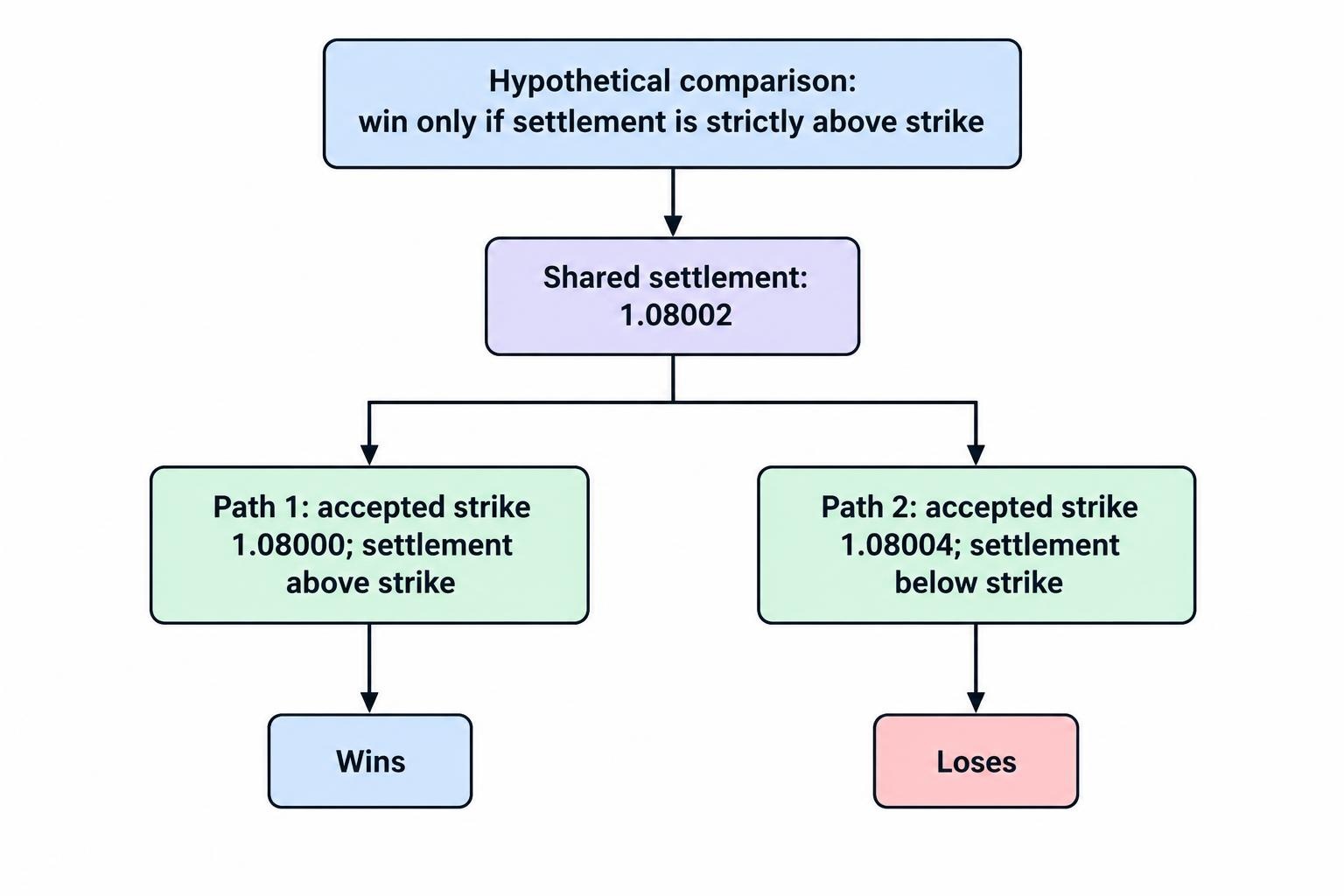
Consider a hypothetical “higher” contract whose strike is set at acceptance. A demo accepts a strike of 1.08000. Another execution accepts 1.08004. Both settle at 1.08002. Under a strict “above the strike” rule, the first contract wins and the second loses.
The broad market direction was the same. The entry terms were not. That example illustrates sensitivity to the accepted strike; it does not establish that a particular provider changes prices between account modes.
Check the contract record, not just the screenshot
A useful comparison records the instrument identifier, requested entry time, acceptance time, accepted strike, expiry timestamp, payout and settlement value. Check whether the expiry is a fixed clock time or a duration measured from acceptance.
Also check what happens when settlement equals the strike. Do not assume a tie produces a refund, or that the chart’s displayed last price is necessarily the settlement reference. The relevant question is whether the documented rules and recorded outcome agree.
The separate guide to binary options execution and latency examines these timing issues. Here, the practical rule is straightforward: without comparable contract records, neither matching results nor different results prove that execution is equivalent.
A discrepancy deserves investigation, not an instant verdict. Different instruments, timestamps or settlement references can make an apparent like-for-like comparison invalid. Equally, “the chart looks close enough” is not a satisfactory explanation for an unresolved contract difference.
Virtual losses cannot reproduce financial pressure
A simulation does not reproduce the financial consequences of actual losses. That includes whether someone can tolerate a losing run and continue following their stated method. These are recognised weaknesses of hypothetical performance in the NFA notice on hypothetical trading results. The notice concerns US derivatives promotional material; its caution about simulated performance is relevant to this comparison, not a statement of Australian law.
Consider a practice rule that fixes every stake at A$10 and ends the session after three losses. Following it with virtual money demonstrates that you can operate the rule in that setting. It does not establish how you would respond after losing actual funds.
The useful rehearsal is therefore behavioural as well as financial. Record whether you entered too early, took an unplanned trade or increased the stake after a loss. A profitable trade that broke the rules is still a process failure.
Keep the virtual balance realistic enough for the exercise. If the planned stake is A$10, a huge simulated balance can make the consequences of repeated losses hard to judge. Retain the full history rather than resetting whenever the result becomes uncomfortable. A reset is excellent at repairing a screen; it repairs nothing else.
Judge the record, not the winning streak
Separate three questions when reviewing a demo account: did you operate the platform correctly, did you follow a defined method, and did the recorded method produce a positive result under the stated payout assumptions? These are different achievements.
For an educational test, write the entry conditions, permitted market hours, expiry choice and payout requirement before starting. If you change a rule, give the revised version a new record. Otherwise, it becomes difficult to tell which method produced which result.
A future observation period is more informative than repeatedly adjusting rules to fit results already seen. The guide to forward testing binary options strategies covers that distinction without treating a favourable test as a guarantee.
A positive sample is not a proven earning rate
In the earlier example, 57 wins from 100 hypothetical trades produced a small profit at an 80% payout. That arithmetic describes the sample. It does not establish that the next 100 decisions will have the same win rate.
Avoid inventing a universal graduation rule such as “two profitable weeks” or “100 trades means ready”. A record concentrated in one session or one market condition answers a narrower question than a record gathered across different conditions. There is no sensible shortcut from a green balance to dependable income.
Keep both financial and process measures. Record net profit or loss, payouts, stake changes and the worst decline from an earlier balance peak. Alongside those figures, record rule violations and missing contract information. A result with incomplete terms should remain unresolved, not be counted as a convenient win.
A trading journal gives these observations a consistent format. Its value is the audit trail: another review should be able to reconstruct what was decided, what was accepted and how the result was calculated.
A demo cannot test whether your money will come back
Counterparty risk sits outside the practice balance. Virtual credits do not demonstrate that a firm holds customer funds safely or will honour a withdrawal. A polished interface and responsive support do not answer that question either.
The joint CFTC and SEC alert on binary options fraud documents complaints involving refused reimbursements, identity theft and software manipulation. These are distinct from ordinary trading losses. A strategy can be assessed correctly while the firm taking the deposit remains unsafe.
Do not treat a worse live result, by itself, as proof of manipulation. Preserve the accepted terms and settlement evidence before drawing that conclusion. But do not treat a successful demo as evidence against fraud, either. It has not tested the provider’s handling of actual customer money.
This distinction also changes how account promotions should be assessed. An extra balance is not necessarily money available for withdrawal. The CFTC warning about off-exchange binary options describes bonuses tied to minimum trading requirements before funds can be withdrawn.
Keep promotional credits separate from any performance calculation. For a practice comparison, exclude them entirely. Otherwise, the apparent improvement may reflect a credit added to the account rather than a profitable decision.
There is no need to fund an account to investigate these distinctions. In particular, a “small test deposit” should not be presented as a workaround for the Australian retail restriction.
What demo success should mean
A useful demo outcome is narrower than “ready to trade”. It means you can identify the contract, calculate its possible result, apply your written rules and retain enough evidence to review the exercise. It may also reveal that the method fails under less generous payout assumptions. That is useful information, even when the balance is red.
For Australian readers, success should not mean accepting a different client label just to gain access. Wholesale clients do not have the same consumer protections as retail clients, and Moneysmart’s binary options warning expressly advises against agreeing to wholesale treatment merely to trade these products.
Nor does a demo need to lead anywhere. It can serve its purpose by exposing a misunderstanding about payouts, showing inconsistent decisions or identifying contract terms that cannot be independently checked. Stopping after that assessment is a valid outcome, not a failed progression.
If you are reviewing an offer, separate the educational exercise from the legal checks. Our guide to binary options regulation in Australia covers the regulatory context in more detail. No practice result should substitute for that assessment.
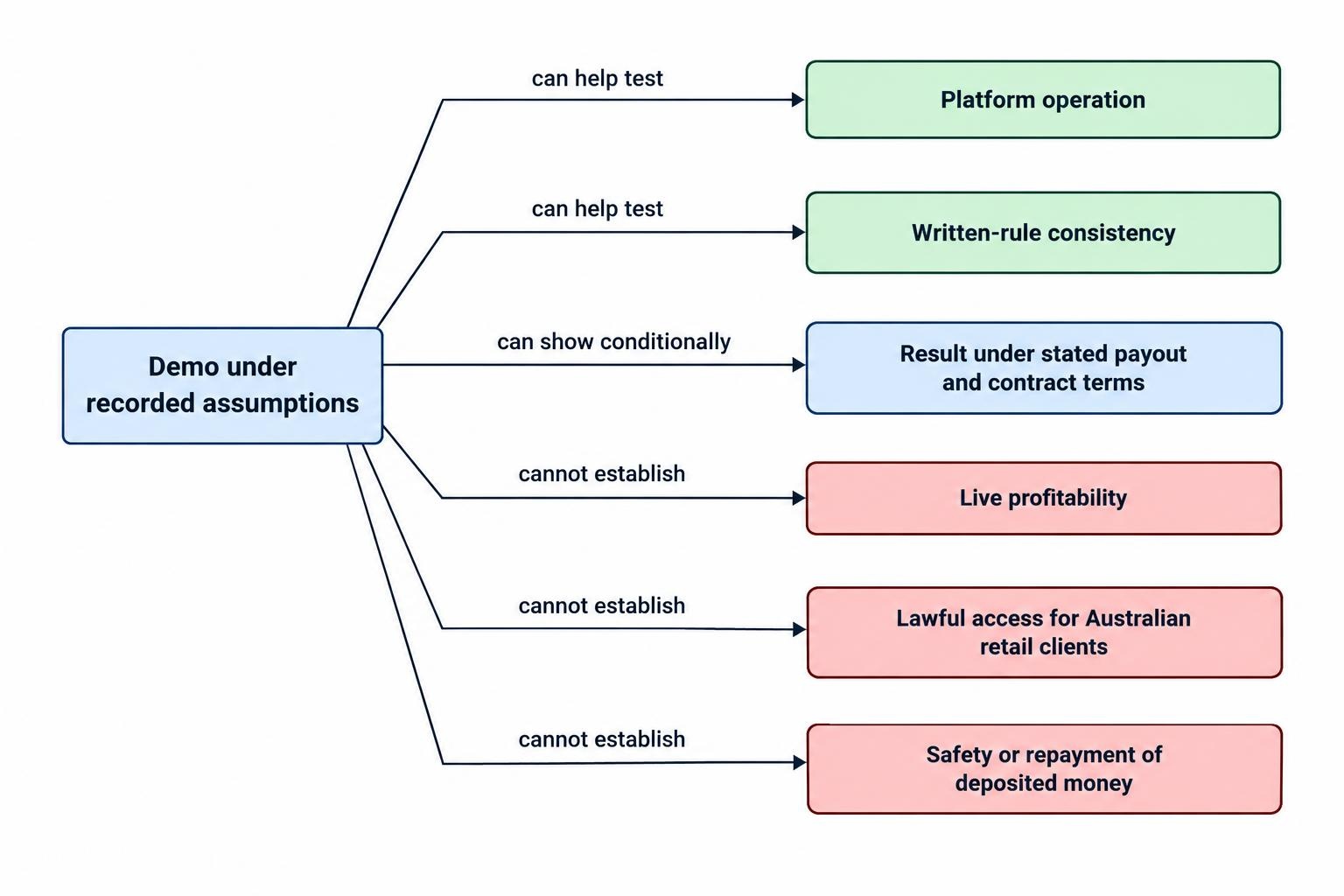
The distinction is simple: a demo can test a process under recorded assumptions; it cannot establish live profitability, lawful access or the safety of deposited money. Judge it by how well it answers the first question, not by how confidently it appears to answer the others.
This article was last updated on: October 22, 2026