Martingale in binary options trading means increasing the stake after a loss, aiming to recover earlier losses with the next winning contract. It changes how much money is at risk, not the quality of the trade. A weak entry rule does not become profitable because the next stake is larger.
For Australian readers, the regulatory position comes first: ASIC prohibits the issue and distribution of binary options to retail clients. The ban took effect on 3 May 2021 and was extended until 1 October 2031 under ASIC’s binary options product intervention order. The examples below explain the risks; they are not a recommendation to trade.
What the Martingale Strategy Actually Does
The classic Martingale system starts with a base stake, doubles it after each loss, then returns to the base stake after a win. At an even money payout, a winning bet recovers the preceding losses and produces a profit equal to the original stake.
Start with $10 and lose three times: the stakes are $10, $20 and $40, leaving a cumulative loss of $70. A subsequent $80 bet earning $80 in net profit would recover those losses and leave $10 profit. This doubling mechanism, and the problem of potentially enormous losses before a win, are covered in Columbia University’s mathematical notes on gambling strategies.
That neat recovery depends on the payout. Binary options paying less than 100% net profit do not fit the classic calculation.
Martingale also supplies no entry signal. It does not determine whether to choose a higher or lower outcome, which market to analyse, or which expiry to select. Its instruction is simply to commit more money after losing.
Why Doubling Fails With an 80% Binary Options Payout
Throughout these examples, an 80% payout means an 80% net profit on the stake. A successful $10 contract returns the original $10 plus $8 profit, for a total credit of $18. A losing contract loses the full $10. There are no refunds, fees or ties in the model.
This distinction matters because a returned stake is not profit. The separate guide to binary options payouts covers that calculation in more detail.
With an 80% net payout, ordinary doubling produces these results:
- Lose $10, then win with $20: $16 profit minus $10 lost leaves $6.
- Lose $10 and $20, then win with $40: $32 profit minus $30 lost leaves $2.
- Lose $10, $20 and $40, then win with $80: $64 profit minus $70 lost leaves a $6 loss.
By the fourth attempt, a winning contract no longer restores the starting balance. “One win recovers everything” has stopped being true.
Increasing the multiplier can restore the recovery calculation, but it does so by demanding even larger stakes. It repairs the arithmetic, not the risk.
The Payout Adjusted Martingale Formula
To recover all earlier losses and earn a fixed profit, the next stake must account for the net payout:
Required next stake = (accumulated losses + target profit) ÷ net payout rate
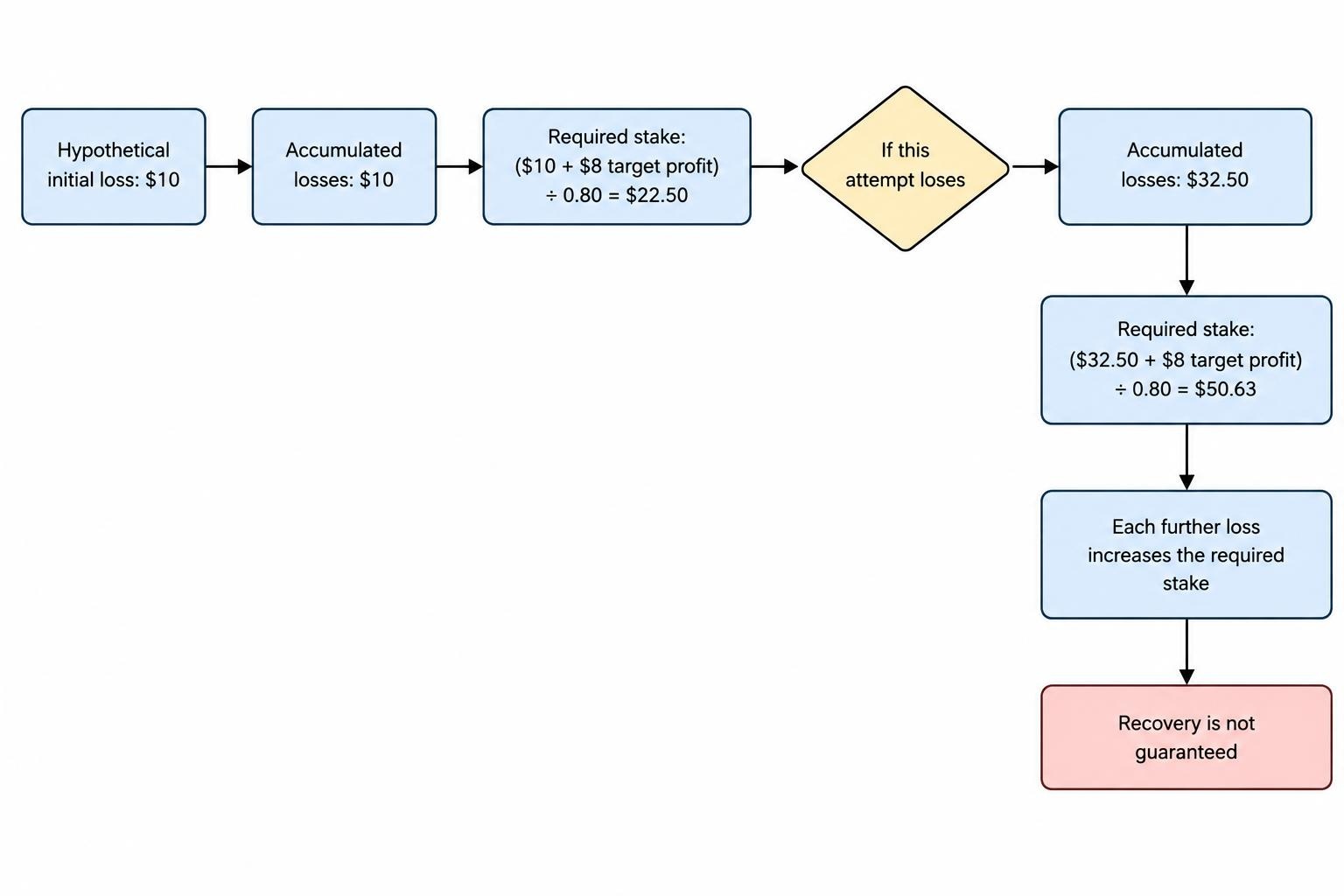
Suppose the initial stake is $10, the net payout remains 80%, and the target profit for each completed recovery sequence is $8. After losing the first $10, the next required stake is:
($10 + $8) ÷ 0.80 = $22.50
If that contract also loses, accumulated losses reach $32.50. The next stake becomes $50.625, rounded up to $50.63. Each further loss pushes the required amount higher.
| Attempt | Losses before attempt | Required stake | Total losses if it loses |
|---|---|---|---|
| 1 | $0.00 | $10.00 | $10.00 |
| 2 | $10.00 | $22.50 | $32.50 |
| 3 | $32.50 | $50.63 | $83.13 |
| 4 | $83.13 | $113.92 | $197.05 |
| 5 | $197.05 | $256.32 | $453.37 |
| 6 | $453.37 | $576.72 | $1,030.09 |
Amounts are in Australian dollars. Each recovery stake is rounded up to the next cent and subsequent calculations use those rounded stakes. Actual settlement rounding would also need to be checked.
A Small Starting Stake Does Not Mean Small Exposure
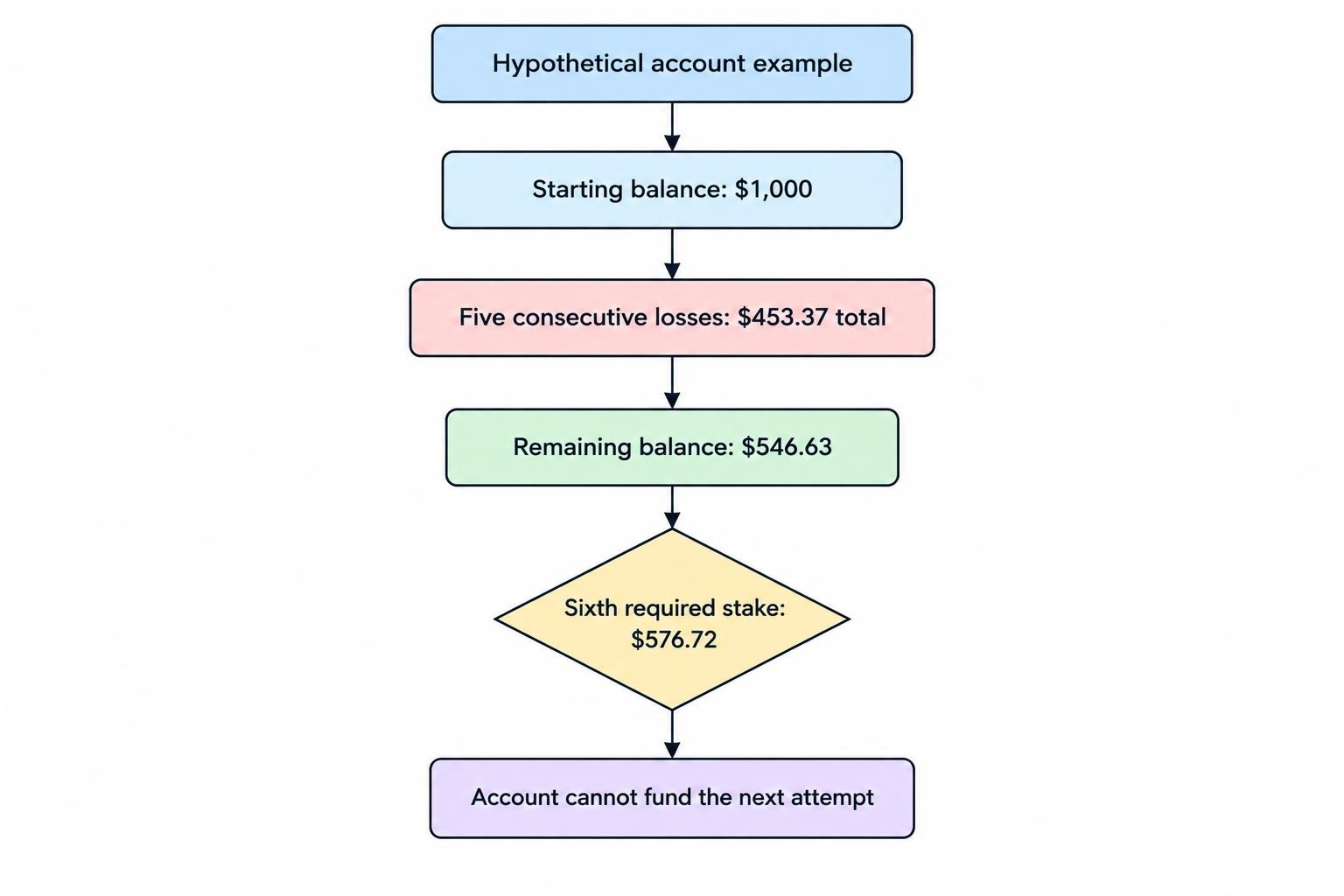
With a hypothetical $1,000 balance, the first $10 stake represents 1% of the account. After five consecutive losses, however, $453.37 has gone and only $546.63 remains.
The sixth required stake is $576.72. The account cannot fund it.
This is the difference between the first stake and the sequence exposure. Calling the system “1% risk” because it begins at $10 ignores everything that happens after the first loss. A stake sizing rule must be judged by the exposure it permits throughout the sequence, not its most comfortable opening number.
In the unrounded model, successive stakes grow by a factor of 2.25 at an 80% payout when recovering losses and maintaining the original profit target. That is faster than ordinary doubling.
Martingale Cannot Repair Negative Expected Value
A staking system and a trading edge are separate matters. Expected value measures the average result implied by the probability of winning and the amount gained or lost.
An unequal payout can create a negative expected return even when winning and losing are equally likely. This payout imbalance is addressed in the CFTC and SEC investor alert on binary options.
For the hypothetical full loss contract used here, expected profit per dollar staked is:
Expected profit = (win probability × net payout rate) − loss probability
Assume a genuine 55% probability of winning and an 80% net payout:
(0.55 × 0.80) − 0.45 = −0.01
That is an expected loss of one cent per dollar staked. Increasing a subsequent stake increases the dollar exposure to that negative expectation; it does not turn the expectation positive.
The break even win rate at an 80% payout is:
1 ÷ (1 + 0.80) = approximately 55.56%
This calculation excludes fees and assumes every loss forfeits the entire stake. Different contract terms require different calculations. The guide to probability and expected value in binary options separates win rate, payout and profitability.
Even a verified positive expectation would not make Martingale necessary. A profitable entry rule can still suffer losing sequences, and staking more after losses can produce an account ending drawdown before that edge has time to show.
Why a High Recovery Rate Can Be Misleading
Martingale results can look impressive when performance is reported by completed recovery sequence rather than by individual contract.
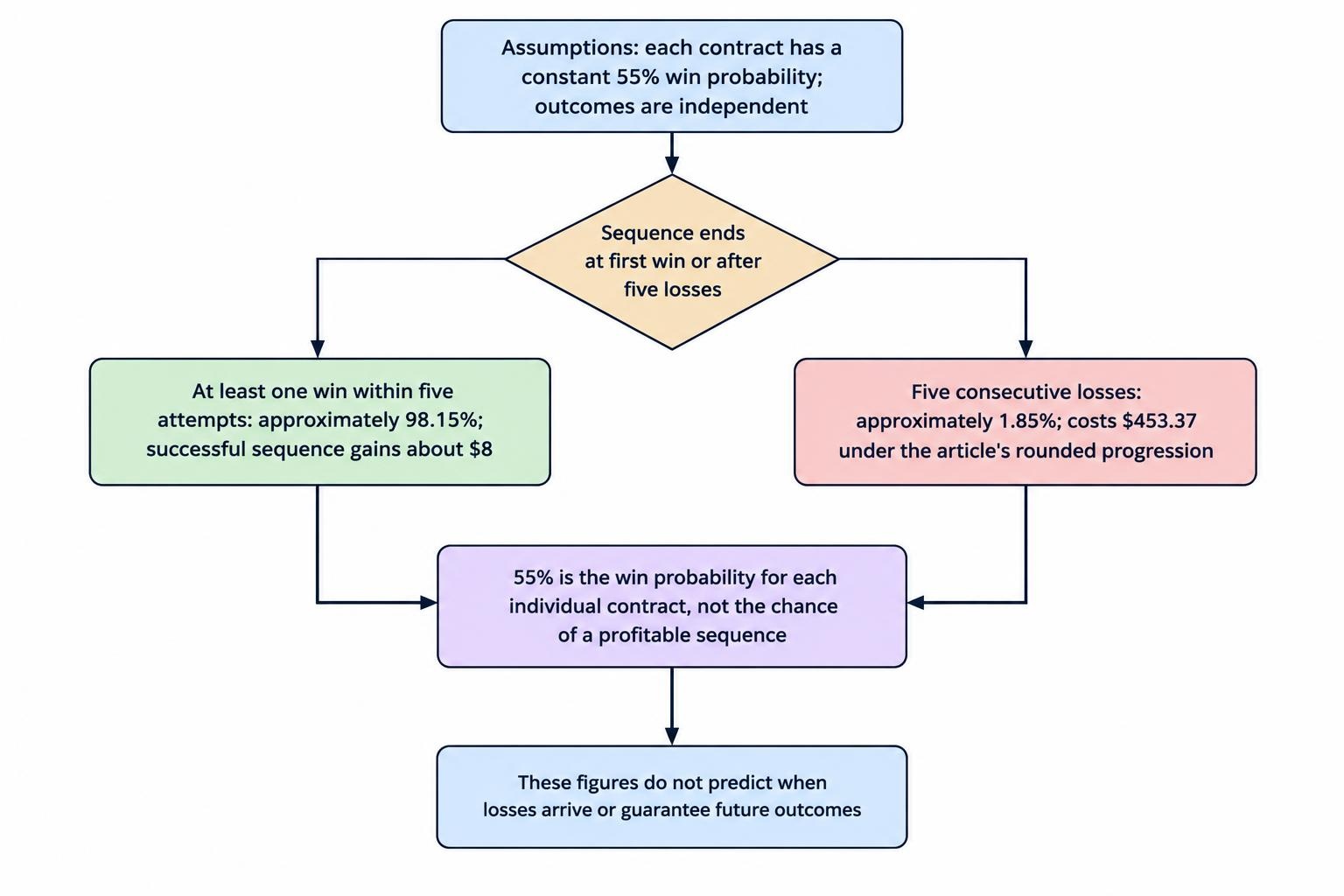
Take the same hypothetical 55% contract win probability. Assume outcomes are independent, the probability stays constant, and each sequence stops after either its first win or five consecutive losses.
The probability of losing all five attempts is:
0.455 = approximately 1.85%
Consequently, approximately 98.15% of sequences contain a win before that stopping point. A presentation could advertise a recovery rate above 98% even though each individual contract wins only 55% of the time.
The missing detail is the size of the unsuccessful sequence. Using the rounded progression above, five losses cost $453.37. Each successful sequence earns approximately $8. It would take roughly 57 successful sequences to offset one such failure.
Frequent small profits do not prove that a strategy is profitable. The size and frequency of losses must be included.
Nor does a 1.85% probability mean a five loss sequence arrives neatly once every 54 sequences. Probability does not issue appointments. The guide to losing streaks in binary options examines why apparently reliable methods still encounter clusters of losses.
The independence assumption also matters. If the same entry rule performs badly under a persistent market condition, earlier losses may reveal a problem with the setup. They do not establish that a recovery win is now due.
Where the Recovery Plan Breaks
Account Balance and Contract Caps
A progression fails when the next required stake exceeds the available balance or an applicable contract cap. Having enough money for the next attempt is not the same as having enough for every possible continuation.
Splitting the required exposure across several identical contracts does not remove the economic risk. If they share the same settlement condition, their outcomes may be effectively the same. Several tickets can still represent one large bet.
A Lower Payout Requires a Larger Stake
The recovery formula depends on the payout available for the next contract. After a $10 loss, recovering that amount plus an $8 target requires $22.50 at an 80% payout. At a 70% payout, it requires approximately $25.72.
A progression calculated using one payout cannot safely be reused with another. The accepted contract terms, rather than a previously displayed percentage, determine the calculation.
The Next Trade Still Needs a Valid Setup
An instruction to trade immediately after a loss can conflict with the entry method. There may be no qualifying signal, the expiry may differ, or the original market conditions may no longer apply.
Waiting for a valid setup does not remove the accumulated loss. Trading without one does not improve the recovery odds. Martingale belongs in the staking discussion, separate from the entry methods covered under binary options trading strategies.
A previous loss is a fact about the account. By itself, it is not evidence about the next price movement.
Do Capped Martingale and Other Variants Help?
A capped Martingale stops increasing stakes after a chosen number of losses. This creates a defined stopping point, but also accepts that some sequences finish with an unrecovered loss. The cap should therefore appear in every performance calculation.
A partial Martingale increases stakes more slowly. It may reduce the exposure at later stages, but one win may no longer recover all previous losses. Its recovery claim must be recalculated rather than assumed.
Anti Martingale reverses the direction: stakes increase after wins and decrease or reset after losses. That produces a different exposure pattern, not an automatic trading edge.
None of these labels answers the main questions: what is the expected return, how large can the loss become, and can the account survive the permitted sequence? A more reassuring name does not change those numbers.
How to Assess Martingale Without Funding It
A spreadsheet or paper simulation can expose the recovery requirement without putting money at risk. Keep the entry rule separate from the stake rule so that changing position size does not disguise weak trade selection.
Record every contract’s stake, payout, result and account balance. Also record each sequence’s maximum exposure and whether the next required stake would have been affordable. Do not exclude a failed sequence because the recovery remained “unfinished”. That is precisely the result being measured.
Compare identical trade outcomes under a fixed stake and the proposed progression. Review net profit, worst drawdown, largest stake and stopping events, rather than counting winning sequences alone. The guide to backtesting binary options strategies covers the broader testing process.
Include deliberately adverse sequences. A test that stops just before the account runs out of money has not demonstrated safety. Neither has a demo balance that can be replenished whenever the progression becomes uncomfortable.
Fixed staking does not cure negative expected value either. Its advantage in this comparison is transparency: the next loss remains the chosen stake, rather than an escalating recovery obligation.
Is Martingale Suitable for Binary Options?
Martingale is not a substitute for a trading edge or a dependable loss recovery method. Below a 100% net payout, ordinary doubling can leave a loss even after a winning contract. Adjusting the stakes to recover everything demands faster growth and greater exposure.
The useful lesson is mathematical, not promotional: evaluate the entire sequence, including the point where it fails. A small first stake and a high recovery rate tell only part of the story. The largest affordable loss tells the rest.
This article was last updated on: October 22, 2026