ASX 200 binary options are contracts whose outcome depends on whether a stated condition involving an Australian share market benchmark is met. In a simple higher-or-lower contract, the question is whether the settlement price finishes above or below a strike at expiry. You do not buy the index’s shares, receive dividends or build an ownership interest in Australian companies.
For Australian readers, access is the first issue, not chart selection. ASIC’s prohibition on issuing and distributing binary options to retail clients took effect on 3 May 2021 and has been extended until 1 October 2031. The ASIC announcement extending the binary options ban sets out that restriction. The examples below are educational, not instructions for opening an offshore trading account.
What Does an ASX 200 Binary Option Reference?
The S&P/ASX 200 measures the performance of 200 of the largest eligible stocks listed on the Australian Securities Exchange. It uses float-adjusted market capitalisation: companies with a larger market value of shares available to public investors receive more weight. It is not an equal allocation across 200 businesses.
That weighting matters. A move in a heavily weighted company can influence the index more than a much larger percentage move in a small constituent. The S&P/ASX 200 index profile provides its construction details and constituent information. Large banks and resources companies feature prominently, so reading the index as a broad technology benchmark would miss much of what it represents.
A binary contract adds a separate layer over that benchmark. Its terms specify the price reference, strike, expiry, winning condition and payment. Correctly forecasting Australian equities does not automatically mean correctly forecasting that contract.
For example, expecting the index to rise during the week says little about whether it will finish above a particular strike at 11:05 am today. The investment view and the contract’s question operate on different clocks.
Cash Index, SPI Futures and Platform Quotes Are Different
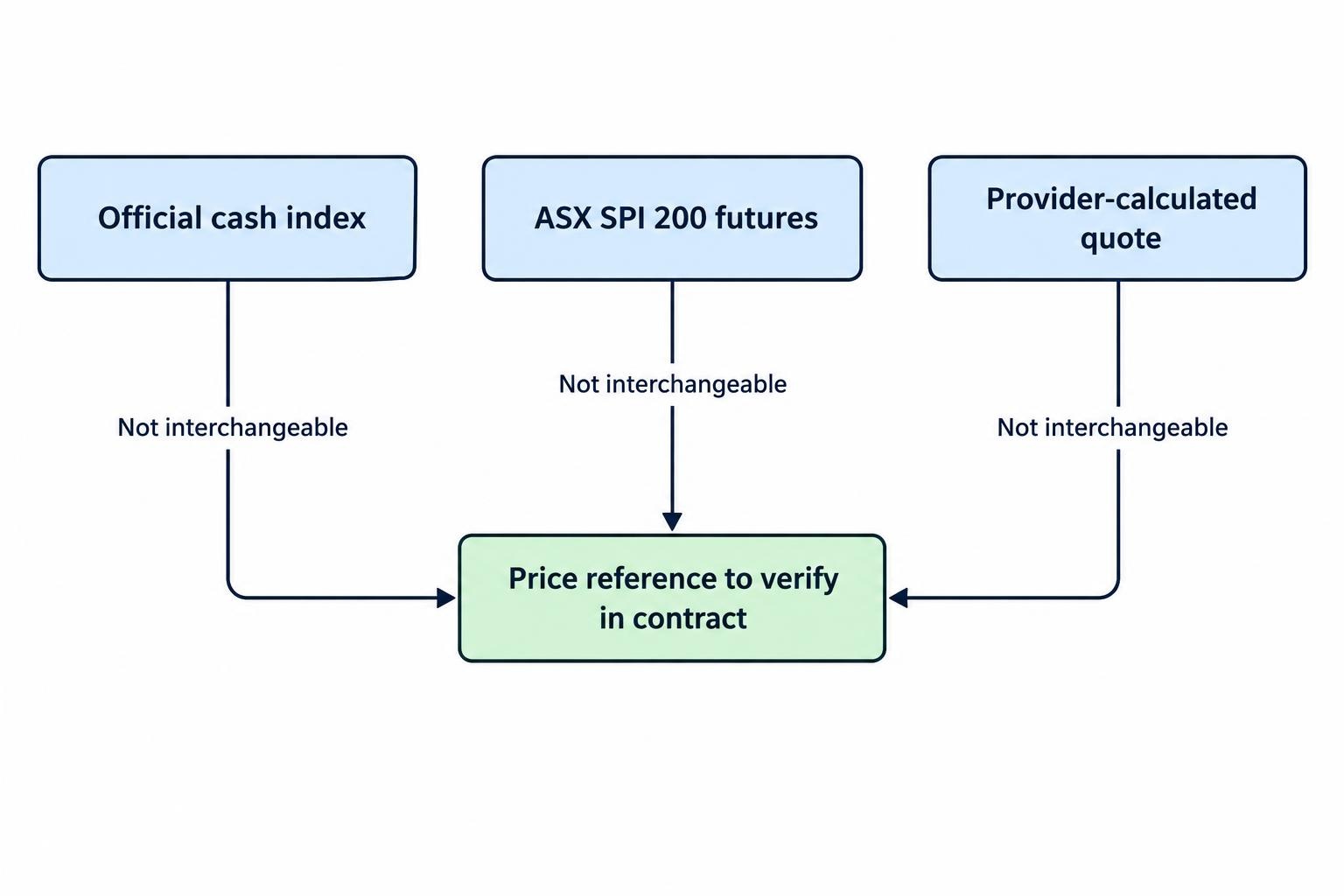
Before examining an ASX 200 chart, establish what the displayed number represents. A benchmark label alone is not enough. The official cash index, a futures contract and a provider’s calculated quote should not be treated as interchangeable prices.
ASX SPI 200 futures are exchange-traded contracts based on the S&P/ASX 200. They have their own contract specifications and day and night trading sessions. They are not fixed-payout binary options. The ASX equity index futures brochure describes that separate product structure.
This distinction becomes especially relevant outside the cash share market session. An overnight futures move is not a new transaction in every share used to calculate the cash index. Nor should a moving line labelled “Australia 200” automatically be read as a live official cash index value.
For any hypothetical contract, identify the named instrument, data supplier and settlement rule. If those details are missing, there is no sound basis for deciding whether an external chart matches the contract. The guide to cash index prices versus futures prices covers the broader distinction without assuming that one can replace the other.
Trading Hours Change the Meaning of an Expiry
Normal ASX share trading runs from around 10:00 am to 4:00 pm Sydney time. The opening auction begins in a randomised window starting at 9:59 am, with continuous trading beginning shortly afterwards. A separate closing auction takes place around 4:10 pm, after continuous trading has stopped. The ASX cash market trading timetable distinguishes these phases.
For contract analysis, “expires at the close” is therefore too vague. Does that mean 4:00 pm, a value following the closing auction, or a provider’s own cut-off? Those choices can produce different settlement values.
Use Sydney local time rather than assuming Australian market hours stay at one fixed UTC offset throughout the year. Sydney observes daylight saving, and a platform clock may use another time zone entirely. Record both the local expiry and its UTC equivalent in any research notes.
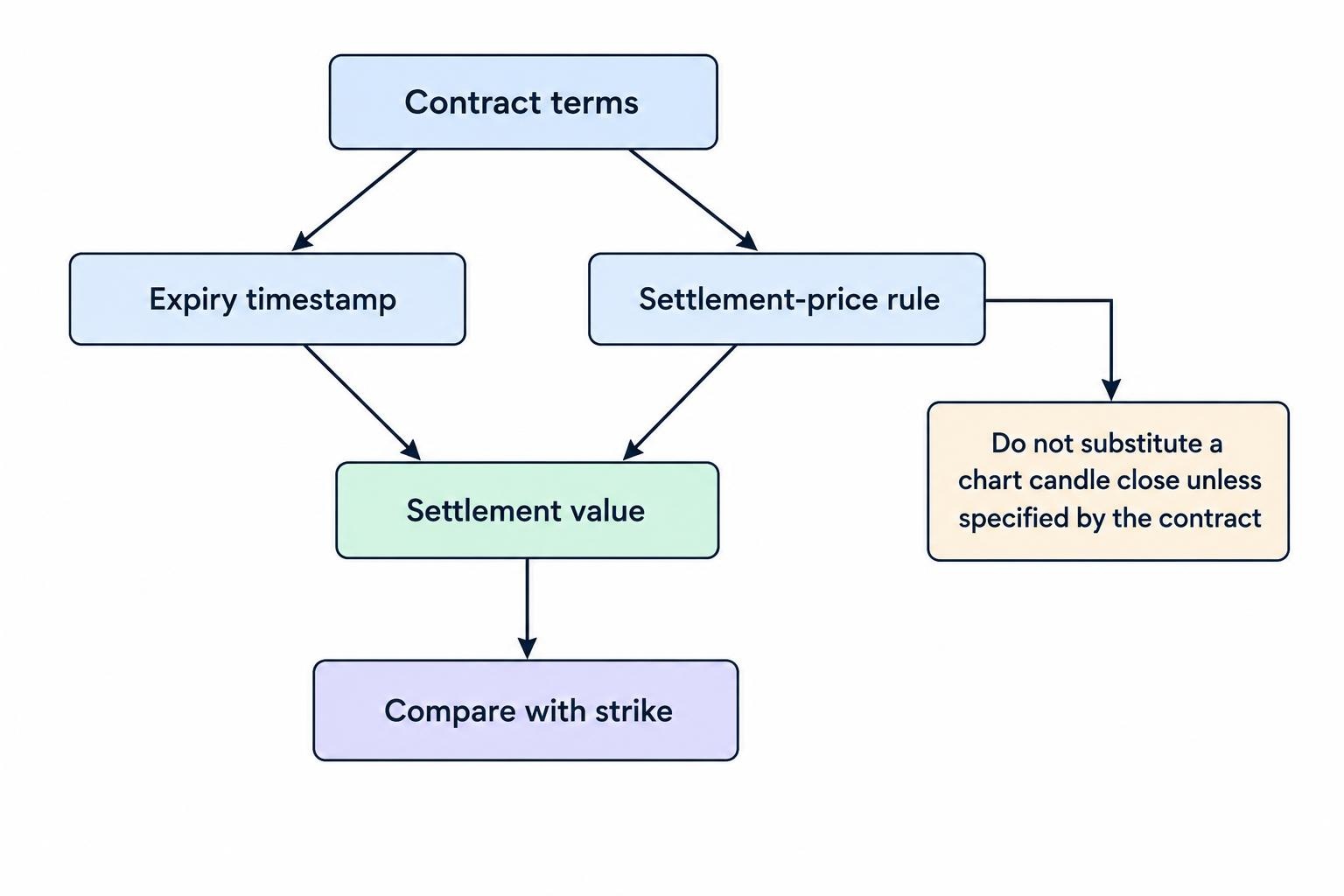
Also separate the expiry timestamp from the rule used to select a price. A contract might specify a timestamp, a qualifying observation or another calculation. Do not silently substitute the closing value of a chart candle. A five-minute candle labelled 11:00 may describe an interval rather than the exact instant required by the contract.
A Worked ASX 200 Binary Option Example
Consider a fictional higher contract with a strike of 8,200.00, a stake of A$100 and an expiry at 11:05 am Sydney time. Assume the terms require the settlement value to be strictly above the strike. A successful outcome earns A$80 profit and returns the A$100 stake.
These numbers illustrate the payment structure only. They are not a current index quotation, an available offer or a forecast.
| Settlement value | Contract outcome | Total amount returned | Net result |
|---|---|---|---|
| 8,205.00 | Above the strike | A$180 | A$80 profit |
| 8,195.00 | Below the strike | A$0 | A$100 loss |
| 8,200.00 | Equal to the strike | Depends on the tie clause | Depends on the tie clause |
Under these assumed terms, finishing five points above the strike earns the same profit as finishing fifty points above it. A larger favourable move does not increase the payment. A small adverse move can still cost the entire stake.
Equality needs its own rule. Do not assume a tie returns the stake, counts as a loss or receives some other treatment. That answer belongs in the contract wording.
The example also shows why direction alone is insufficient. The index could rise from its morning opening level yet settle below an even higher strike. “The market went up” and “the higher contract won” are not necessarily the same statement.
The Payout Determines the Required Accuracy
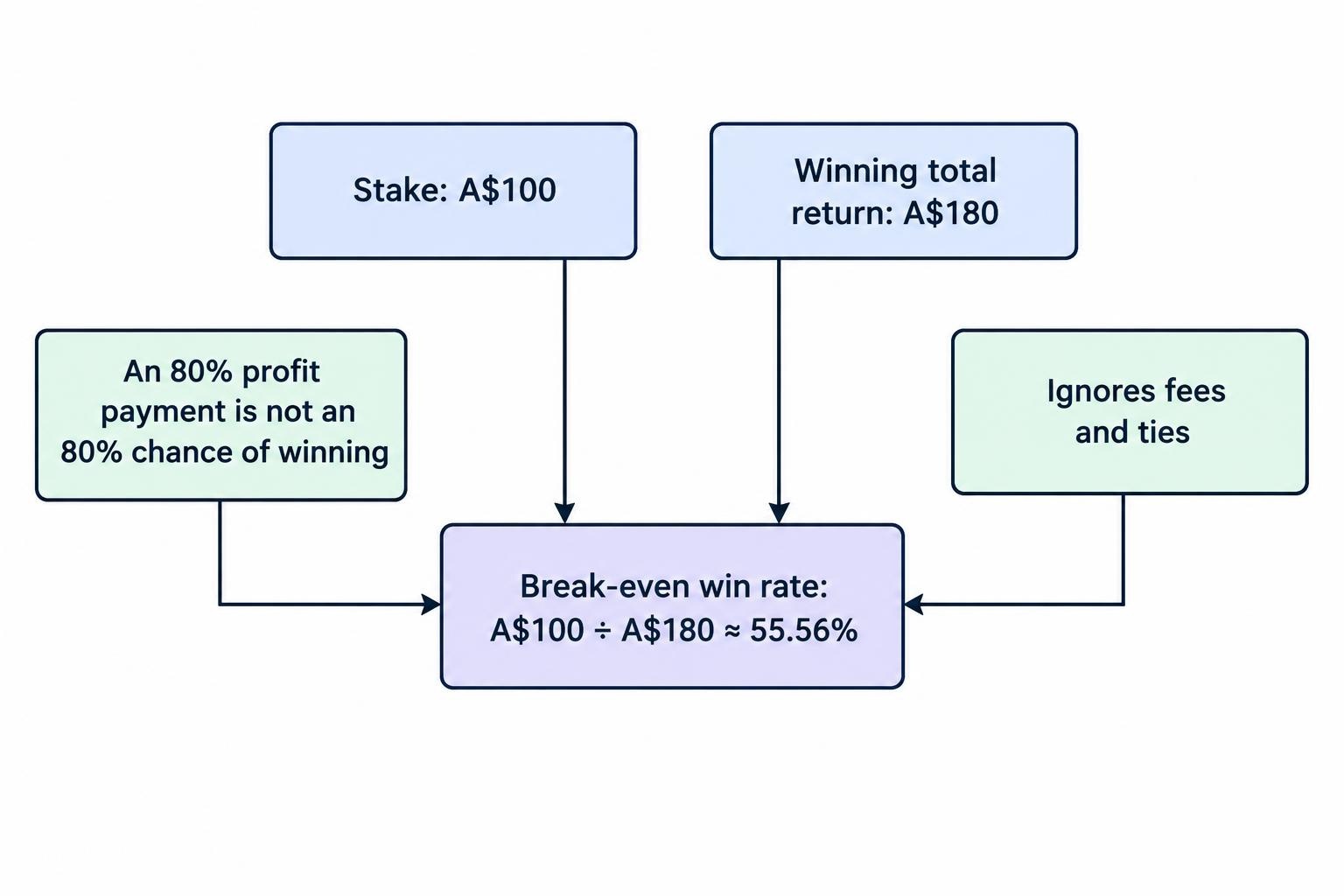
An 80% profit payment does not mean an 80% chance of winning. It describes the reward relative to the stake. In the example above, a successful contract earns A$80 while an unsuccessful one loses A$100.
Ignoring fees and ties, the break-even calculation is A$100 divided by A$180, or approximately 55.56%. A hypothetical method must win more often than that to produce a positive expected result under the stated assumptions.
Suppose 100 contracts each use an A$100 stake and 55 succeed. The wins produce A$4,400 profit, while the 45 losses cost A$4,500. The net result is a A$100 loss despite getting the direction right more often than wrong. The guide to probability and expected value in binary options develops this relationship.
Keep the payment assumption attached to every research result. A hit rate calculated with one payout cannot establish profitability at another. Where payments vary, record them individually rather than applying the most attractive advertised rate to the entire sample.
What Can Influence the ASX 200?
For research purposes, separate the forces that could change company valuations from the timing question imposed by a binary contract. A reasonable economic explanation is not proof of a repeatable short-term signal.
Interest Rates and Economic Releases
Interest rates affect borrowing costs, spending and the valuation of future income. Lower rates can support equity valuations through a higher present value of future income, other things equal. The RBA explanation of monetary policy transmission sets out the asset-price, cash-flow and exchange-rate channels.
That is a framework, not an instruction to mark every rate cut as bullish. When assessing an announcement, ask what changed relative to the research assumption: the decision, the accompanying message, or the expected path of future rates. A contract expiring minutes later requires a timing forecast as well as an economic view.
Company Earnings and Sector Moves
Use the index’s weighting when choosing which company announcements deserve attention. A practical research question is whether an apparent index move reflects broad participation or a small group of large constituents.
For a resources company, examine how a change in assumed commodity prices could affect expected revenue. For a bank, examine funding costs, lending conditions and credit losses. These are ways to structure analysis, not fixed rules that a particular headline must push the index up or down.
Overnight Information and the Opening Price
Separate an opening gap from movement after the open. If an observation begins after the market has already repriced, measuring performance against the previous close can exaggerate what the proposed entry could have captured.
In a paper test, use the first price actually available under the entry rule. Do not award the method an earlier, more favourable starting point just because the overnight explanation sounds convincing.
Price Precision Can Decide the Result
Near a strike, the price source becomes part of the financial outcome. Suppose a hypothetical higher contract requires settlement above 8,200.00. One screen displays 8,200.01 and another displays 8,199.99. That difference is tiny in index terms but decisive for the contract.
Compare timestamps, decimal precision, update frequency and instrument definitions before concluding that two quotes disagree. Also check whether a displayed figure is rounded. A chart that looks level with the strike may conceal a different underlying value.
The guide to price feeds and benchmarks covers those checks. For an ASX 200 exercise, keep the entry reference and expiry reference consistent. Testing entries on cash index data and settling outcomes against a different futures series would change the question halfway through.
Execution assumptions matter too. If a method requires an observation at 11:00:00, do not assume an order could be accepted at that same price after the signal has been calculated and transmitted. Record a realistic delay or mark that observation as unsuitable for evaluation.
How to Study ASX 200 Binary Outcomes Without Funding an Account
A written exercise can examine contract mechanics without making a deposit. Define the hypothetical rules before looking at the outcome. Retrospective rules have an unfortunate habit of being excellent at predicting yesterday.
A useful research record contains:
- The exact price series and whether it represents cash, futures or another calculation.
- The observation time, hypothetical strike and expiry time.
- The assumed payment, losing outcome and treatment of equality.
- The entry delay, missing-data rule and settlement-price rule.
- The result, including rejected observations and reasons for rejecting them.
Keep opening-auction observations separate from ordinary continuous-session observations. Do the same for scheduled announcement periods. This does not establish that either group offers an advantage; it prevents unlike conditions from being mixed without inspection.
The paper trading binary options guide provides a broader recording framework. Apply it with unchanged rules across a fresh sample rather than repeatedly adjusting the method until the historical results look attractive.
Be clear about what the exercise cannot demonstrate. A spreadsheet using published market data does not verify a provider’s execution, settlement process, withdrawal handling or legal status. Even a well-recorded hypothetical result remains hypothetical.
Keep the Benchmark Separate From the Product
The ASX 200 is a share market benchmark; a binary option is a contract written around a condition. Familiarity with Australian companies does not remove payout asymmetry, expiry risk or uncertainty about the price reference.
An “ASX 200” or “AUS200” label is not proof that a contract is exchange-listed or lawfully available to Australian retail clients. Do not treat offshore account availability as regulatory approval.
For wider market comparisons, the stock index binary options guide explains how index references fit within this product category. For ASX 200 research, start with the instrument and settlement terms, then assess the forecast. A clear market opinion cannot repair an unclear contract.
This article was last updated on: October 22, 2026