Trading a binary option means taking a position on a defined outcome, such as whether AUD/USD will finish above a stated price at a stated time. The practical process involves choosing the contract, checking its payout, setting the stake, submitting the order and checking settlement. Getting the direction right is only part of the task: the timing and contract terms must also match your forecast.
For Australian retail readers, there is a restriction before any of those steps. ASIC’s binary options product intervention order bans their issue and distribution to retail clients until 1 October 2031. The walkthrough below is therefore an educational process for paper trading, not an instruction to open or fund an offshore account.
1. Check Whether the Product Can Be Offered to You
Start with your jurisdiction and client status, not a platform’s registration form. A business accepting your email address or Australian payment card does not establish that it may lawfully offer you the product. Nor should you treat a foreign licence badge as permission to serve Australian retail clients.
Do not agree to wholesale classification simply to gain access. Wholesale clients do not receive the same consumer protections as retail clients, and Moneysmart’s binary options warning expressly cautions against changing classification for this purpose.
For learning, use a spreadsheet, a notebook or a simulation that requires no deposit. You need a recorded price, a written contract condition and a way to check the outcome later. You do not need to send money or identity documents to an unfamiliar operator to practise the arithmetic.
Readers outside Australia should check their own regulator’s current rules before considering real transactions. This guide does not establish eligibility in another country, and paper trading results do not change the Australian restriction.
2. Define the Contract Before Studying the Chart
A binary option pays according to whether its stated condition is satisfied. It does not give you ownership of the underlying currency, share or commodity, or the right to buy or sell that asset. The joint SEC and CFTC investor alert on binary options sets out this distinction and the predetermined cash settlement structure.
For an introductory exercise, use a straightforward higher/lower contract. Write the condition as a complete sentence: “AUD/USD must settle strictly above 0.6600 at 10:05 UTC.” That is more useful than writing “AUD up”, which leaves the price threshold and timing unanswered.
Identify these terms before recording an entry:
- Underlying market: the asset and price reference being used.
- Strike: the threshold against which settlement is judged.
- Expiry: the exact date, time and time zone.
- Stake and return: the amount at risk and the amount credited for a win.
- Settlement rules: the price source, treatment of equality and any cancellation provisions.
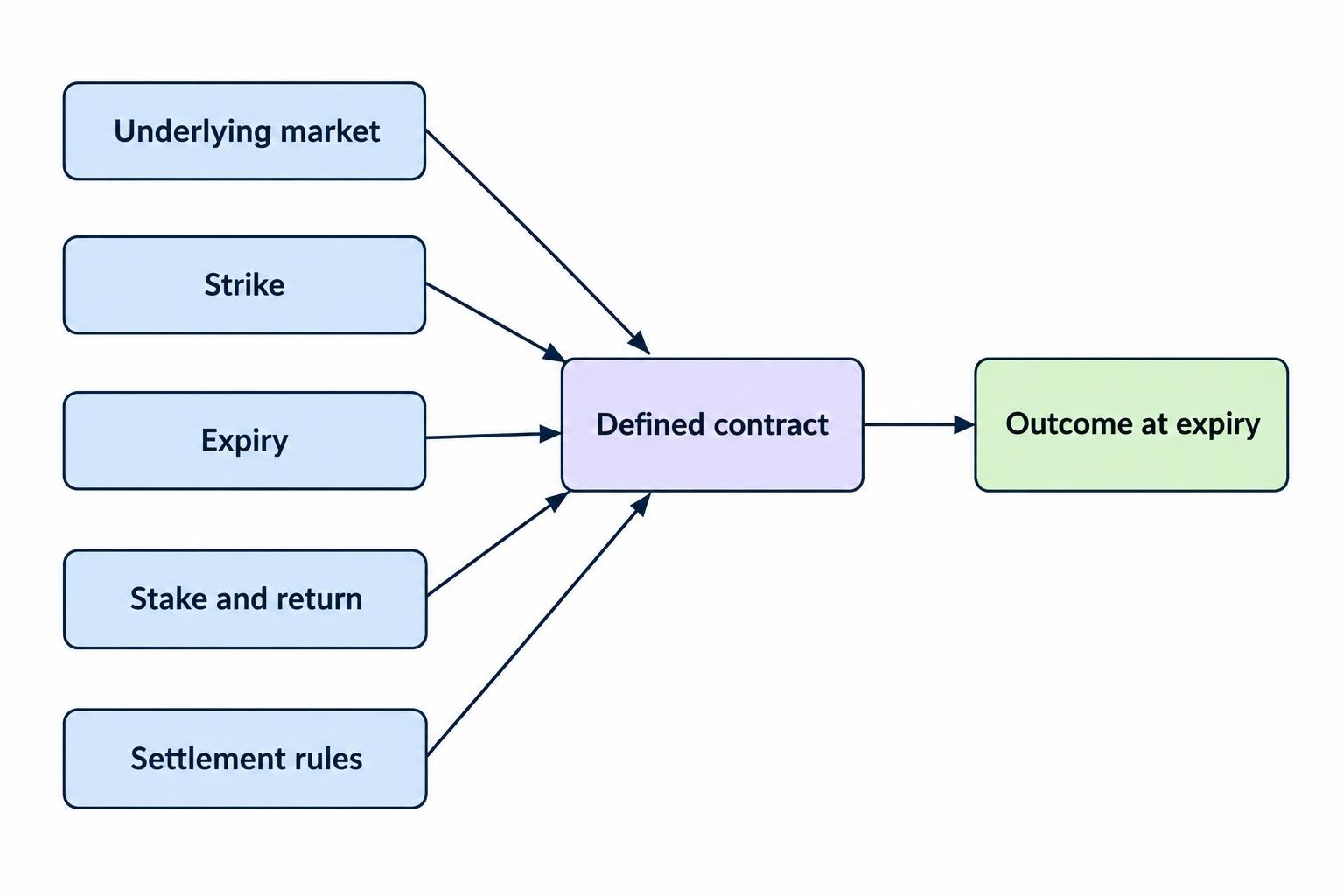
Keep the exercise to one contract type. A rule based on the final price cannot automatically be applied to a contract that depends on touching a barrier before expiry.
3. Choose a Market and Match the Expiry to the Forecast
Choose one market for the initial practice record rather than switching whenever another chart looks promising. Define the session, data source and observation period in advance. This makes it easier to compare decisions made under the same rules.
Market selection and expiry selection belong together. A forecast that a currency will strengthen over the next week does not, by itself, justify a contract expiring in five minutes. Your reasoning must address the period the contract actually measures.
Keep three clocks separate: the chart’s candle interval, the time your order is accepted and the contract’s expiry. A five minute candle is a chart setting, not necessarily five minutes of remaining contract life. The guide to binary options expiry times covers these timing differences in more detail.
For a paper exercise, choose an absolute expiry, such as 10:05 UTC, and write it down before the observation starts. If you record an entry at 10:02 UTC, the remaining period is three minutes. Do not retrospectively call it a five minute trade.
Also define when to skip an observation. Examples include missing price data, an unclear settlement benchmark or a scheduled announcement that your exercise was not designed to study. Skipping is a valid decision; there is no prize for filling every row.
4. Check the Payout and Calculate the Break Even Rate
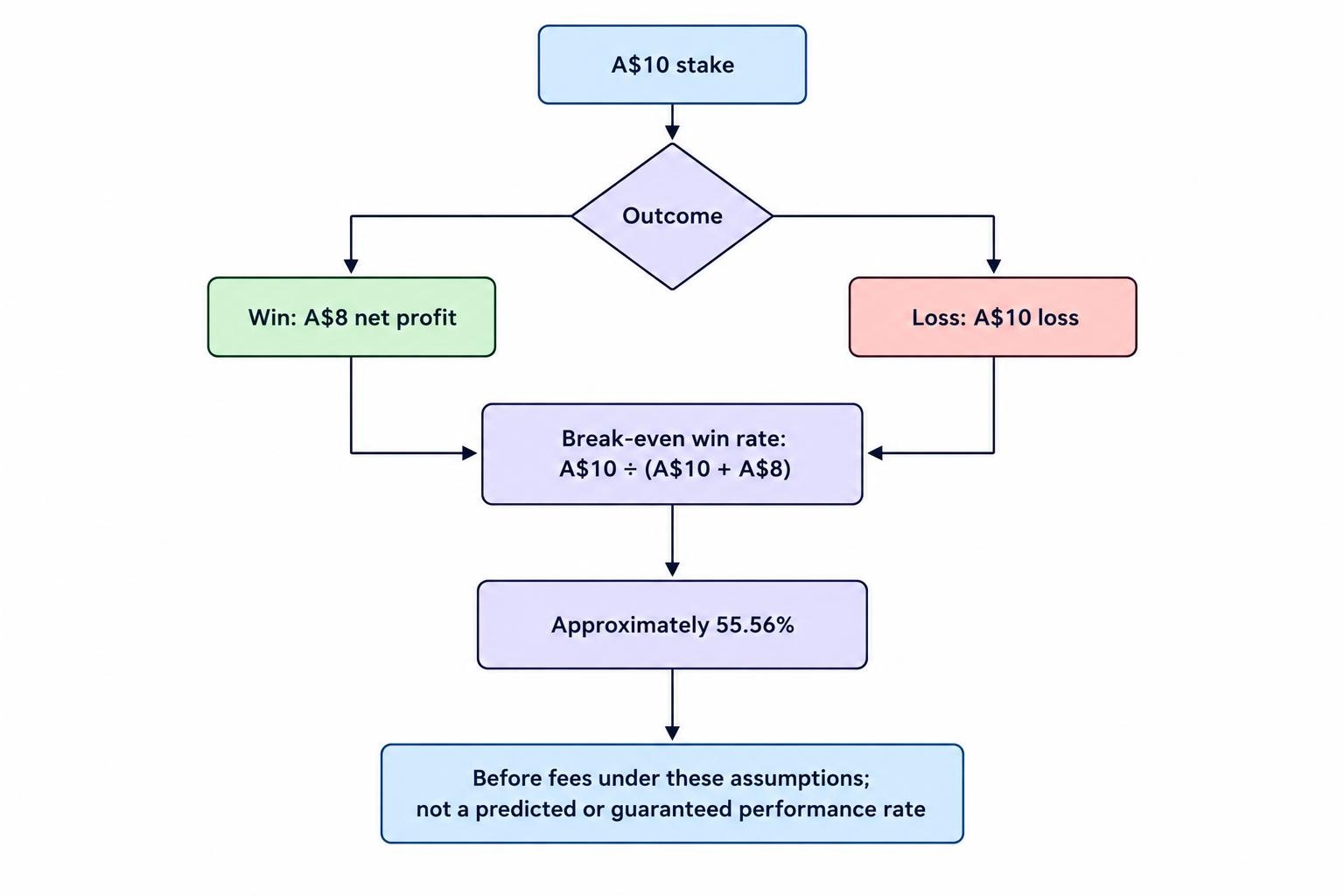
Read the return as money, not just a percentage. In the fixed stake example used here, an “80% return” means an A$8 profit on an A$10 winning stake. The total credit is A$18 because it includes the returned A$10 stake. A losing outcome costs the full A$10.
Those figures create an uneven trade-off. One win earns A$8, but one loss costs A$10. Winning half your trades would therefore lose money under these assumptions.
Break even win rate = stake ÷ (stake + profit on a win)
For this example, A$10 ÷ A$18 = approximately 55.56%. You need a win rate above that threshold to make a profit before fees, assuming identical stakes, an unchanged return and no refunds or ties.
| Wins and losses | Profit from wins | Loss from losses | Net result |
|---|---|---|---|
| 50 wins, 50 losses | A$400 | A$500 | −A$100 |
| 55 wins, 45 losses | A$440 | A$450 | −A$10 |
| 60 wins, 40 losses | A$480 | A$400 | +A$80 |
This table is arithmetic, not a forecast of achievable results. Two possible outcomes do not mean each outcome has a 50% probability. Nor does a recent winning percentage establish your future probability of success.
Use the actual return for each observation if it varies. The separate guide to probability and expected value in binary options develops that calculation without reducing performance to a headline win rate.
5. Write the Entry Rule and Stake Before the Outcome
A testable entry rule tells another person when the same paper trade would qualify. “The chart looks strong” is too vague. A rule should name the market, observation time, qualifying condition, direction, expiry and situations that cancel the entry.
For example, a practice protocol might record whether a completed candle closes above a previously marked level, then measure the outcome at a fixed later time. That is a recording method, not evidence that the pattern predicts profitable trades. Decide how it works before looking at the result.
Keep the virtual stake constant while checking the process. An A$1,000 paper balance with A$10 per observation makes the arithmetic easy: each losing contract removes 1% of the starting balance. That percentage is a teaching assumption, not a claim that risking 1% makes binary options safe.
The stake sizing guide covers how trade size affects account losses. For this exercise, the useful discipline is simple: do not increase the stake because the previous trade lost.
Doubling creates rapidly growing exposure. Stakes of A$10, A$20, A$40 and A$80 produce A$150 of accumulated losses if all four lose. An A$160 winner at an 80% net return earns A$128, so even that win would not recover the earlier losses.
Set a practice session length and stopping rule as well. These restrictions help keep the record consistent; they do not repair an unprofitable contract or prediction method.
6. Check the Order, Then Check Settlement
Before submitting a simulated order, read the entire ticket again. Confirm the market, direction, strike, stake, return and expiry. Pay particular attention to whether the expiry is a fixed clock time or a duration measured from acceptance.
In a platform simulation, distinguish clicking a button from receiving confirmation. Record the accepted terms shown on the confirmation rather than assuming they match an earlier screen. If the order is rejected, record a rejection. Do not count it as a completed trade because the later chart would have produced a win.
For a manual exercise, use a declared convention, such as recording the first available quote after the scheduled observation time. Apply that convention consistently. Do not choose a more favourable quote after seeing the outcome.
A Complete Paper Trade Example
Assume the following invented contract terms: a higher position on AUD/USD, a strike of 0.6600, expiry at 10:05 UTC, an A$10 stake and an 80% net return. The condition requires settlement strictly above the strike, and the example’s written rules refund the stake on equality.
If the settlement benchmark records 0.6603, the condition is satisfied. The account receives A$18, giving an A$8 net profit. If settlement is 0.6598, the condition fails and the net loss is A$10. If settlement is exactly 0.6600, the example returns A$10, producing no profit or loss.
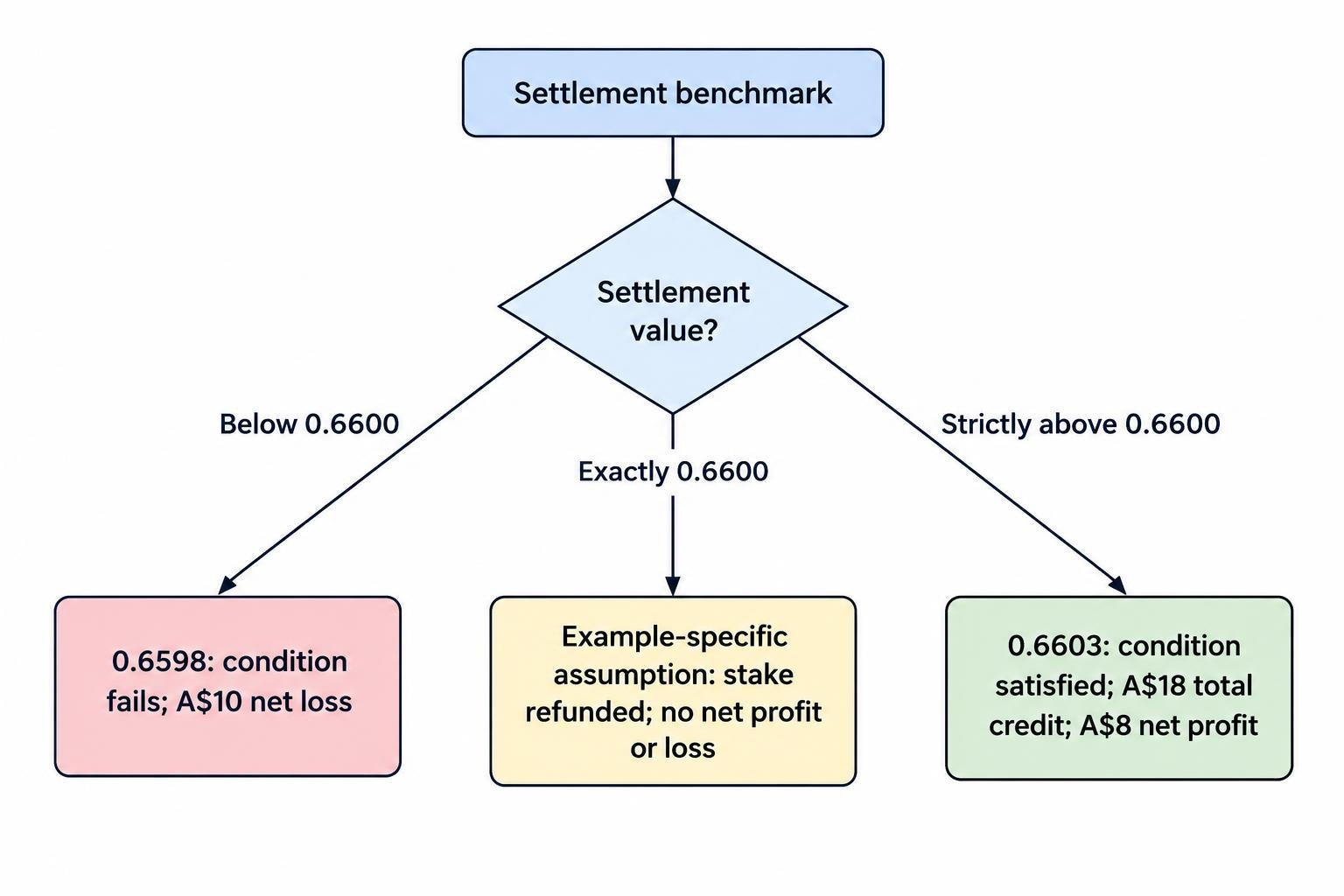
The equality refund is an assumption for this example, not a universal rule. Always check the contract’s treatment of ties. The guide to binary options settlement and ties covers the distinction between a refund and a losing outcome.
For this expiry based contract, an earlier move above the strike does not decide the result. The stated settlement condition does. A screenshot taken halfway through the observation is not a substitute for the final benchmark.
7. Review the Record, Not Just the Balance
Keep a journal containing the planned rule, entry time, accepted or assumed strike, expiry, return, settlement value and net result. Add a separate field for whether the observation followed the written procedure.
Separating execution from outcome prevents a common reporting mistake. A profitable paper trade entered outside the rules is still a rule breach. A losing observation that followed the protocol belongs in the record rather than being deleted as an exception.
At the end of a practice block, calculate the win rate, average winning profit, average losing amount and total net result. Count ties, rejected orders and missing observations separately. If stakes or returns changed, a single win percentage will not describe the financial result.
Keep simulated performance clearly labelled. Assumed trades have not faced actual market conditions and can overstate or understate performance, a limitation addressed in the CFTC advisory on hypothetical trading results. A successful paper record is not proof that a live account would reproduce it.
When you change a rule, start a separately labelled test. Otherwise, you risk combining several different methods into one flattering result. A good result is useful, it is not proof.
Do Not Replace the Process With a Sales Pitch
Guaranteed returns, pressure to deposit immediately and promises of easier withdrawals after an extra payment are reasons to stop, not reasons to hurry. The SEC’s warning about fraudulent binary options platforms identifies unsolicited offers, pressure tactics, identity theft and withdrawal delays among the risks.
Do not send another payment just because an account representative says it will release an existing balance. Preserve transaction records and communications, and contact your payment provider promptly if you suspect fraud. A displayed account profit is not the same thing as money returned to your bank account.
The practical learning objective is narrower than “find a winning signal”. It is to define a contract, calculate its financial terms, record a decision before the result and check settlement without changing the rules afterwards. Australian retail readers should keep that work in paper form rather than treating practice as a route around the ban.
This article was last updated on: October 22, 2026