Ethereum binary options are contracts whose payout depends on a defined event involving the price of ether, usually whether ETH finishes above or below a strike price at expiry. You are taking a position on a price condition, not buying cryptocurrency. The distinction matters: a correct view on Ethereum’s long term prospects can still produce a losing binary option.
For Australian retail clients, there is a more immediate restriction. ASIC banned the issue and distribution of binary options to retail clients from 3 May 2021, and extended that prohibition until 1 October 2031. The ASIC binary options prohibition is the starting point, regardless of which cryptocurrency appears on the trading screen. This article explains the product for educational purposes, not how to access it around that restriction.
What an Ethereum Binary Option Actually Tracks
Ethereum is the blockchain network; ether, with the ticker ETH, is its native cryptocurrency. ETH pays for transaction fees and participates in the network’s validation process. Those functions belong to the cryptocurrency itself, not to a binary contract referencing its market price. The distinction is set out in Ethereum’s technical introduction to ether.
A contract labelled “Ethereum” still needs a complete price definition. ETH/USD measures ether against US dollars. ETH/USDT measures it against a dollar tracking token. ETH/BTC measures its value against bitcoin. These are different relationships, even when the platform places the same Ethereum logo beside them.
Suppose ETH rises in dollar terms but bitcoin rises faster. ETH/USD could increase while ETH/BTC falls. A forecast that “Ethereum will go up” is therefore incomplete until the quote currency is identified.
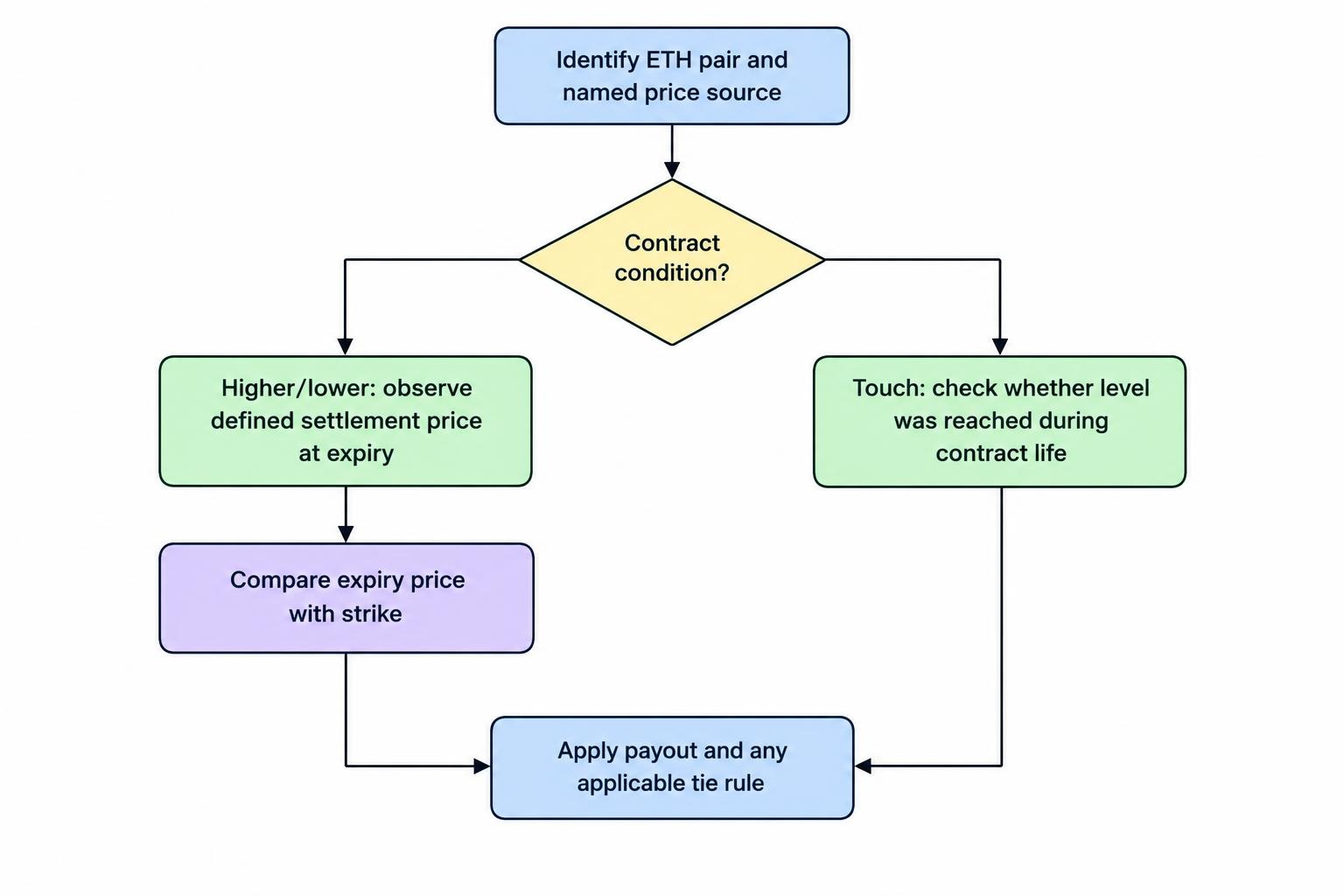
The contract also needs a strike, an expiry, a settlement method and payout terms. A higher/lower contract might ask whether ETH/USD will finish above US$3,500 in 15 minutes. A touch contract asks a different question: whether a price level is reached during the contract’s life. Do not transfer assumptions between them.
The broader cryptocurrency binary options guide covers the asset category. For Ethereum, the practical task is narrower: identify exactly which ETH price the contract follows and what must happen for it to pay.
A Worked ETH/USD Example
Consider a fictional higher/lower contract with an ETH/USD strike of US$3,500, a 15 minute expiry and an A$50 stake. Assume a winning position earns 80% of the stake as net profit. A losing position loses the full stake, with no rebate.
For this illustration only, an exact tie returns the stake. These are assumed terms, not a description of every platform or a current market quote.
| Settlement price | Result for “above US$3,500” | Amount returned | Net result |
|---|---|---|---|
| US$3,500.10 | Win | A$90 | A$40 profit |
| US$3,499.90 | Loss | A$0 | A$50 loss |
| US$3,500.00 | Tie under the assumed refund rule | A$50 | A$0 |
The size of the winning price movement does not change the assumed payout. Finishing at US$3,500.10 and finishing at US$3,600 both produce A$40 profit. Equally, finishing just below the strike produces the same A$50 loss as a much larger fall.
The route taken before expiry does not rescue this position either. ETH could climb well above the strike, then fall below it at settlement. Without an applicable early exit arrangement, the earlier paper win has no bearing on the final result.
Notice that the underlying price is quoted in US dollars while the stake and payout are in Australian dollars. Those are separate contract details. A dollar quoted reference price does not automatically mean the trading account holds US dollars.
Why the Payout Matters More Than a Good Looking Chart
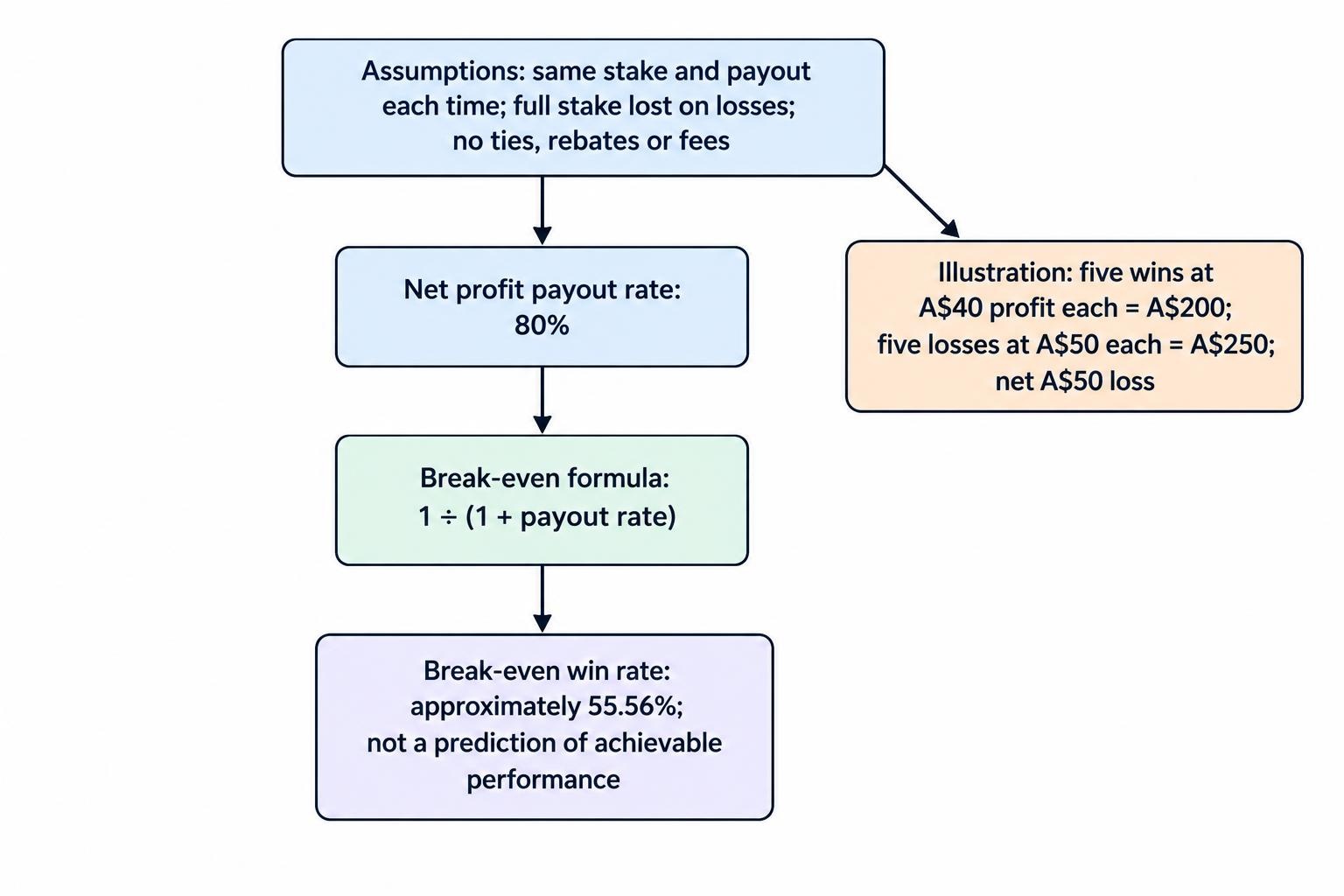
An 80% profit payout does not mean an 80% probability of winning. It means a winning A$50 position earns A$40, while a losing one costs A$50. That imbalance sets the minimum accuracy required before fees.
If every position has the same stake and payout, losses consume the full stake, and there are no ties or rebates:
Break even win rate = 1 ÷ (1 + net profit payout rate)
At an 80% payout, the calculation is 1 ÷ 1.80, or approximately 55.56%. A strategy winning half its positions would lose money under those assumptions.
Across ten hypothetical A$50 positions, five wins generate A$200 profit and five losses cost A$250. The net result is a A$50 loss. Being right half the time sounds respectable until the arithmetic turns up.
A lower payout raises the hurdle. At 70%, the break even rate becomes approximately 58.82%. That means a chart setup cannot be evaluated separately from the payout available when the position would have been accepted.
The fuller treatment of probability and expected value in binary options covers changing payouts and other assumptions. For ETH analysis, record the proposed payout alongside every hypothetical signal. A win rate without that information does not establish profitability.
Do not treat the break even percentage as an achievable target by default. It is a mathematical threshold, not evidence that a method can reach it reliably.
Which Ethereum Price Decides the Result?
There is no single trading screen that represents every ETH transaction. A contract might reference one exchange, a composite index or another defined price series. Two charts carrying the ETH/USD label can therefore show slightly different values at the same moment.
The distinction between a continuously updated index and a daily benchmark is especially useful. The CME CF Ether Dollar Real Time Index publishes a price once per second, around the clock. The Ether Dollar Reference Rate is a daily benchmark calculated from transactions during a defined window. These are separate products within the CME CF ether pricing framework, not interchangeable readings.
That example does not mean a binary platform uses either benchmark. It shows why “we use market prices” is not enough detail to reproduce a settlement.
Before assessing a historical result, establish the named feed, quote currency, settlement timestamp and price type. A last traded price is not necessarily the same as a bid, offer or midpoint. An average across several observations is not the same as the final tick.
Rounding matters too. A displayed price of US$3,500.00 may conceal extra decimal places. A screenshot cannot prove a tie unless the contract settles using the displayed precision.
The price feeds and benchmarks guide covers these distinctions across markets. With ETH, keep the trading pair and venue attached to every observation rather than recording a bare price.
Separate execution timing from settlement timing as well. A click at one moment does not prove acceptance at that same moment. If a strike is assigned when an order is accepted, a delay can change the starting condition. Historical analysis should use the accepted strike and expiry, not whichever candle was visible when the decision was made.
What to Examine When Analysing ETH
Keep three research questions separate: what may affect Ethereum’s valuation over months, what may affect ETH trading over the next session, and what determines the chosen binary outcome. They overlap, but they are not substitutes for one another.
Ethereum network developments
ETH supply reflects both issuance and burning. New ETH enters circulation, while the burning of transaction base fees removes ETH. The balance between those processes determines whether supply expands or contracts over a period, as detailed in Ethereum’s explanation of issuance and burning.
That mechanism does not create a dependable short term trading signal. A change in network activity is not a countdown to a price rise, and a protocol upgrade is not an appointment for a winning expiry.
When reviewing a development, ask what changed relative to expectations. Separate a confirmed technical change from a rumour, and distinguish the announcement date from the activation date. A sound explanation of a network improvement still needs a separate argument about price and timing.
Broader market conditions
Use bitcoin’s direction, scheduled economic releases and wider market stress as context checks. Do not assume ETH must copy another asset, or attach an invented probability to that assumption.
For a short expiry, write down the immediate reason for the forecast. “Ethereum adoption may grow” is a valuation thesis. “The settlement price will be above this strike in 15 minutes” is a different proposition requiring different evidence.
This separation also makes a practice journal more useful. If the explanation changes after the outcome is known, the record is describing the past rather than testing a repeatable decision.
Expiry Times, Weekends and Volatility
A continuously available ETH price feed does not guarantee that a binary contract is available continuously. The underlying market, the data service and the contract provider each have their own operating arrangements. Check the contract schedule rather than inferring it from cryptocurrency’s around the clock reputation.
Nor does constant availability mean constant trading conditions. Compare the period being studied with other periods using the same feed and measurement method. Do not assume that a quiet chart, a weekend label or a particular hour gives the same conditions every time.
Crypto prices can move sharply over short periods, a risk highlighted in Moneysmart’s crypto asset risk guidance. For a binary contract, however, a large movement does not increase the agreed winning payout. It can change the path and uncertainty without improving the reward.
Short expiries also leave little room for a forecast to be early. A view that proves correct an hour later does not repair a contract that settled after one minute. Longer expiries change the question; they do not automatically make the position safer.
For timing research, the cryptocurrency volatility and market hours guide provides the wider framework. Keep comparisons consistent: a setup evaluated on hourly observations should not be presented as evidence for a 60 second contract.
Ethereum Binary Options Are Not ETH Ownership
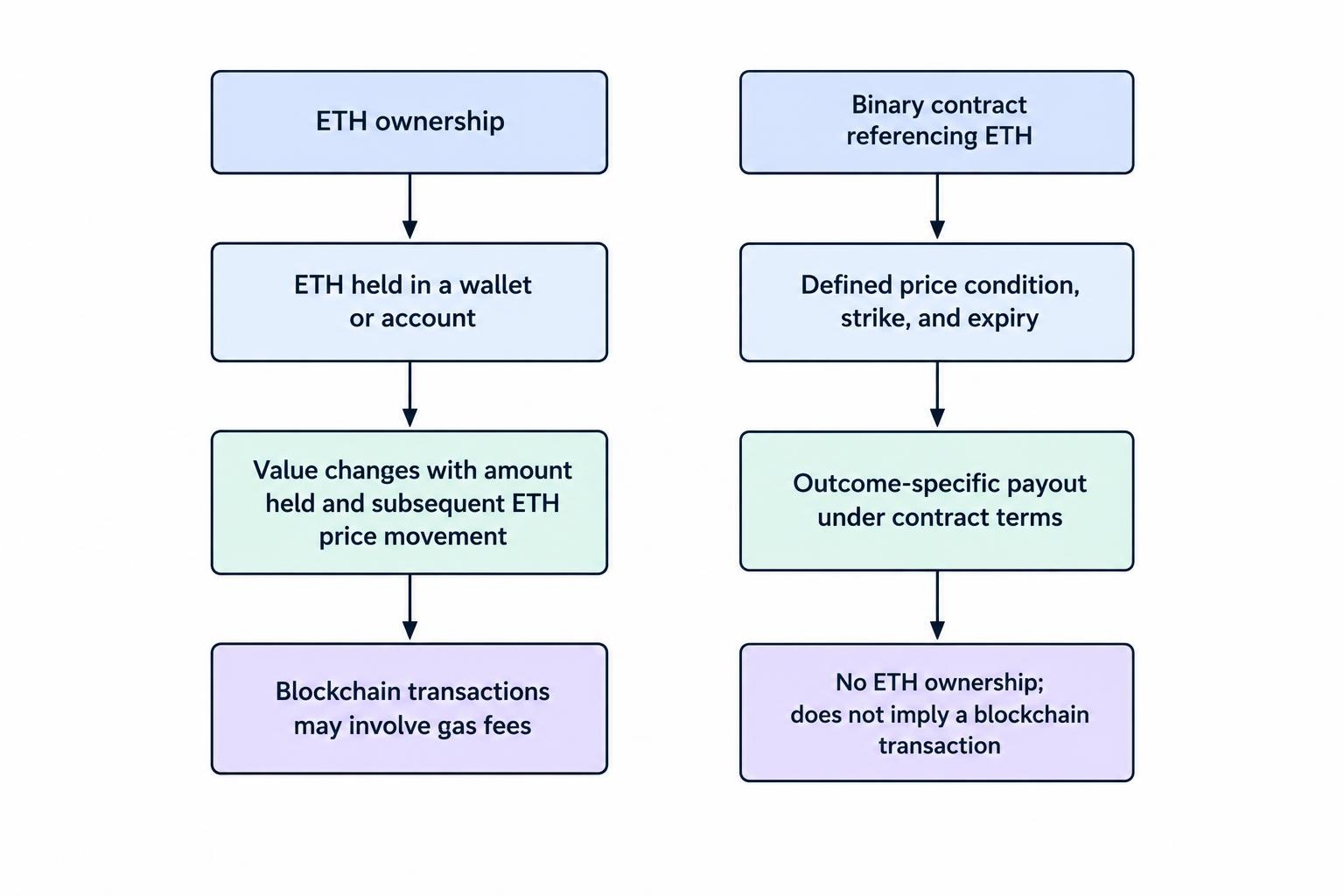
A conventional binary contract gives exposure to a defined outcome. It does not put ETH in a wallet, provide control of cryptocurrency or create participation in Ethereum’s validation process.
The financial exposure is different too. With the hypothetical binary above, a small favourable move earns A$40 and a small unfavourable move loses A$50. Holding ETH outright produces a result that changes with the amount held and the subsequent price movement, before costs. Neither structure makes the other harmless.
Keep funding separate from the underlying asset. Paying a platform with ETH does not prove that its contracts settle on Ethereum or follow an independent ETH benchmark. The payment method, account balance and settlement reference are three different things.
An ETH denominated balance also introduces another valuation question. Even if the number of ETH in the account stays unchanged, its Australian dollar equivalent can change. Any analysis of results should state whether performance is measured in ETH, Australian dollars or another currency.
Gas fees belong to blockchain transactions. Do not assume each position creates a blockchain transaction, or confuse a provider’s trading charge with a network fee.
Contract Risk and Platform Risk Are Separate
A known maximum loss on one position does not cap losses across an account. Twenty hypothetical A$50 losing positions cost A$1,000. Repeated stakes, overlapping positions and attempts to recover losses can turn a small individual exposure into a much larger total.
There is also the separate question of whether the operator honours its terms. A correct forecast has little practical value if the settlement cannot be checked or the balance cannot be withdrawn.
Binary platform fraud complaints have included withdrawal refusals, identity theft and alleged manipulation of trading software. These categories appear in the SEC investor warning on binary options fraud. They are not evidence that every disputed ETH result is fraudulent, but they show why a chart alone is not a platform assessment.
Treat claims such as “guaranteed Ethereum income” or “AI accuracy with no losses” as reasons to stop, not reasons to deposit. An attractive dashboard cannot resolve missing settlement terms, unclear ownership or an unverifiable operating entity.
For Australian retail readers, the prohibition stated above comes before any commercial comparison. A platform accepting a registration or displaying an Australian flag is not proof that its offering is permitted.
How to Study Ethereum Contracts Without Funding One
A paper exercise can test whether a price proposition is clear without sending money to a binary platform. It should also expose assumptions that a polished historical chart can hide.
Start with one named ETH price series and one trading pair. Write down the hypothetical entry time, strike, expiry, profit payout and tie rule before observing the result. If the settlement rule uses an average, reproduce that average rather than substituting the final candle close.
Record every qualifying observation, including losses and awkward outcomes. Track net hypothetical profit alongside accuracy, and label any assumed payout as assumed. If no historical payout record exists, do not present the exercise as a reconstruction of executable returns.
Use an initial period to develop the rules, then assess them on a later period without rewriting them after each loss. The paper trading binary options guide covers the recording process in more detail.
Keep the claim modest. A favourable paper result does not establish live execution quality, withdrawal reliability or future profitability. It also does not change Australia’s retail prohibition.
The useful question is not whether Ethereum is promising technology. It is whether a clearly defined price event, measured against an auditable feed, has enough supporting evidence to overcome the contract’s payout disadvantage. If the pair, price source, expiry or settlement rule is unclear, there is no sound basis for evaluating the proposition.
This article was last updated on: October 22, 2026