USD/JPY binary options tie a fixed payout to a condition involving the US dollar against the Japanese yen. In a standard higher/lower contract, the question is whether the exchange rate finishes above or below a stated strike price at expiry. Getting the broader currency trend right is not enough: the settlement price must satisfy the contract’s condition at the required moment.
For Australian retail clients, the regulatory position comes first. ASIC’s prohibition on issuing and distributing binary options to retail clients began on 3 May 2021 and extends until 1 October 2031. The ASIC announcement extending the binary options ban sets out the restriction. The examples below explain market and contract mechanics; they are not a recommendation to open an account or use an offshore provider.
How to Read USD/JPY
USD/JPY expresses how many Japanese yen buy one US dollar. At 150.00, one dollar is worth 150 yen. A rise to 150.50 means the dollar has strengthened against the yen. A fall to 149.50 means the yen has strengthened against the dollar.
This direction matters because “buying the yen” and selecting “higher” on a USD/JPY contract express opposite views. A higher contract generally requires the dollar to strengthen against the yen, not the other way around.
A conventional pip in USD/JPY is 0.01. A move from 150.00 to 150.10 is therefore ten pips. A quote displayed to three decimal places includes fractional pips: 150.001 differs from 150.000 by one tenth of a pip. Do not confuse the last displayed digit with a full pip.
Unlike a conventional currency position, a fixed payout binary does not pay progressively more as the exchange rate moves further in your favour. The guide to forex markets for binary options covers the wider distinction between analysing a currency pair and evaluating the contract built around it.
How a USD/JPY Binary Contract Settles
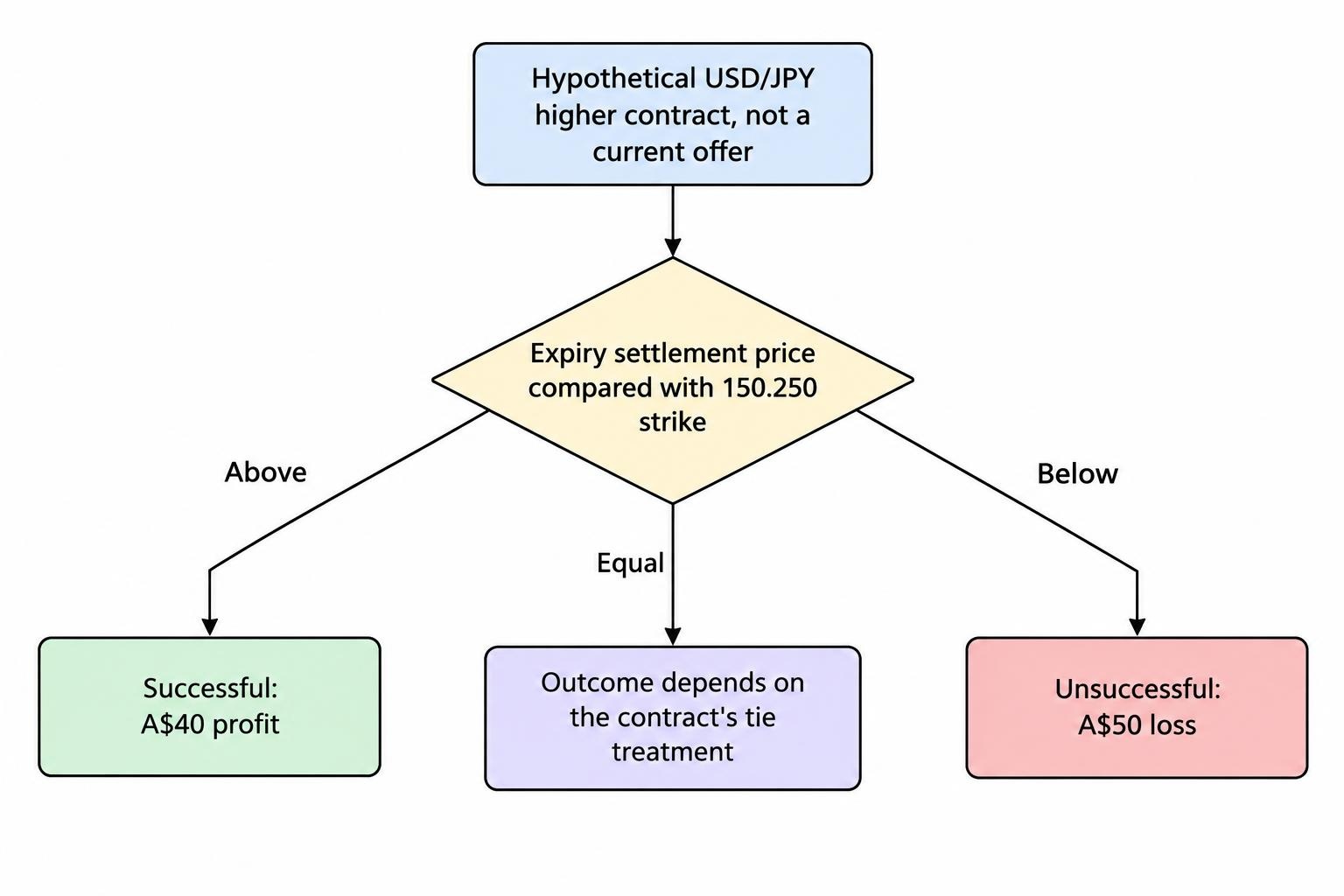
Consider a hypothetical higher contract with a strike of 150.250, an expiry ten minutes away, and a stake of A$50. Assume a successful result pays an 80% profit on the stake, while an unsuccessful result loses the entire stake.
Under those assumptions, a win returns A$90: the original A$50 plus A$40 profit. A loss returns nothing. These figures illustrate the fixed stake model, not a current offer. Other binary contract structures can use different pricing and settlement arrangements.
| Settlement price | Result for the higher contract | Net outcome |
|---|---|---|
| 150.251 | Above the strike: successful | A$40 profit |
| 150.400 | Above the strike: successful | A$40 profit |
| 150.249 | Below the strike: unsuccessful | A$50 loss |
| 150.250 | Equal to the strike: contract rules decide | Depends on the stated tie treatment |
A tiny favourable difference can produce the same payout as a much larger move. The reverse also applies: finishing just below the strike can lose the full stake. That makes price precision and expiry timing part of the trade, rather than administrative details.
The path before expiry does not settle a standard higher/lower contract. USD/JPY could rise to 150.500 during the ten minutes, then finish at 150.240 and lose. Touch contracts work differently, so never transfer the rules of one contract type to another.
Payouts Matter as Much as Direction
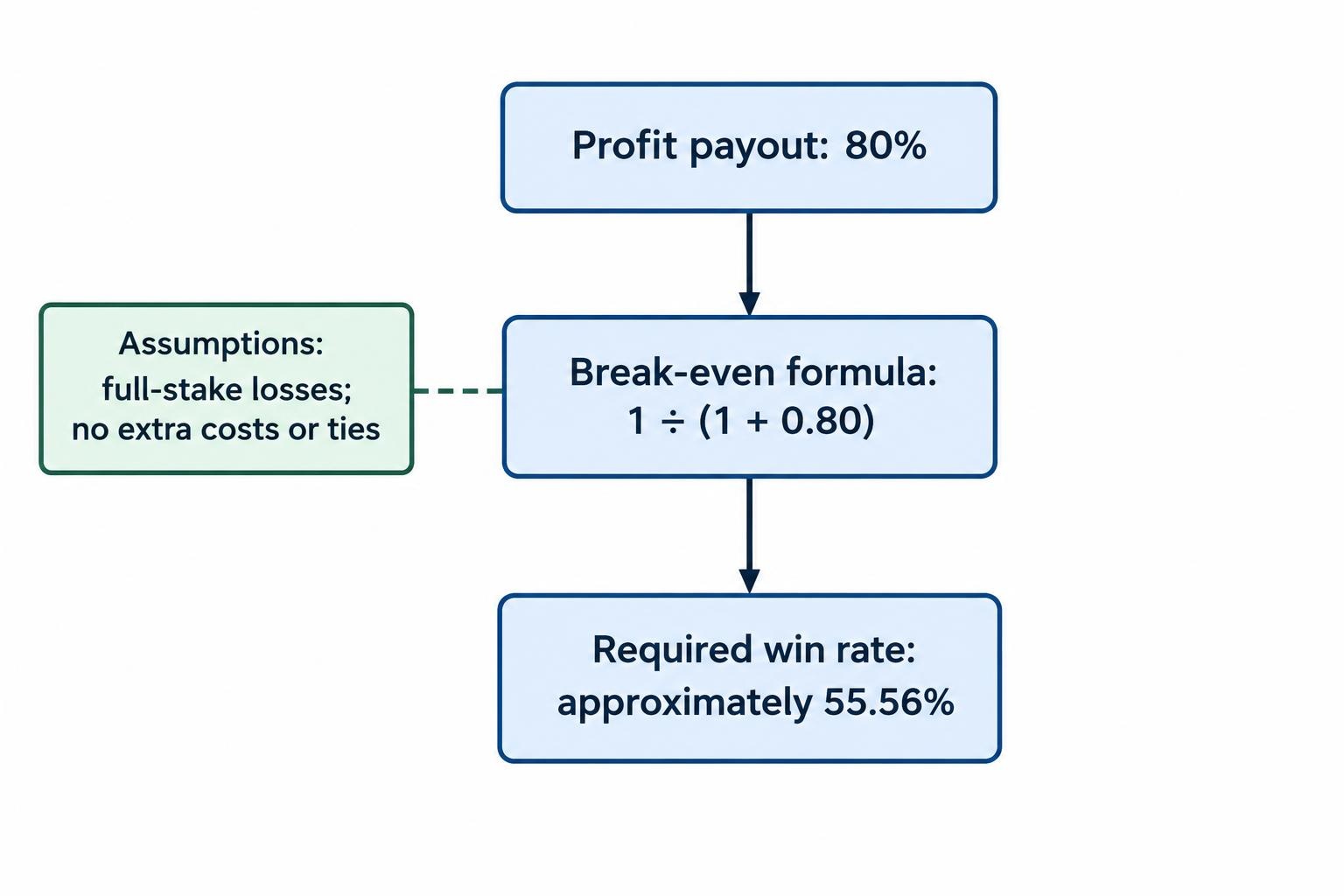
An 80% profit payout does not mean an 80% chance of success. It describes the reward when the contract wins. Because the hypothetical loss is larger than the profit from one win, a 50% success rate loses money over a balanced sequence.
For a contract that loses the full stake on failure, with no ties or extra costs, the break even calculation is:
Required win rate = 1 ÷ (1 + profit payout expressed as a decimal)
At an 80% profit payout, the required win rate is approximately 55.56%. At 70%, it rises to approximately 58.82%. A lower payout demands more accurate predictions, even if the chart setup looks unchanged.
Take 100 hypothetical A$50 contracts at an 80% profit payout. Winning 55 produces A$2,200 in profits, while losing 45 costs A$2,250. The net result is a A$50 loss despite winning more often than losing. The explanation of probability and expected value develops this relationship without assuming that a high win rate automatically means a profitable method.
What Moves USD/JPY?
US and Japanese Interest Rate Expectations
USD/JPY analysis needs both sides of the pair. The Federal Reserve’s Federal Open Market Committee sets the target range for the federal funds rate, while its decisions and communications affect broader financial conditions. The Federal Reserve’s explanation of monetary policy describes this transmission process.
For a currency contract, however, the published rate is only part of the question. A decision that matches expectations may provide little new information. An unchanged rate accompanied by a different outlook can matter more than a widely anticipated rate change.
Compare US and Japanese bond yields over matching maturities rather than comparing unrelated numbers. Then ask what changed during the period you are studying. A binary expiring in five minutes cannot simply inherit a view formed around the next six months of central bank policy.
The US–Japan yield gap has been an important influence on the pair. A Bank of Japan study of yen exchange rate expectations documents yen depreciation as that gap widened during 2022–2023. That historical relationship is useful context, not a mechanical rule that every increase in US yields must push USD/JPY higher.
Economic Releases and the Surprise Factor
When assessing a release, compare the actual result with what markets expected, then examine revisions and the accompanying detail. “Strong US data” is too vague to serve as a complete trading rule. A result can look strong against the previous month but weak against the forecast.
For paper research, write the forecast, actual result and first price reaction separately. Then record where USD/JPY stands at your intended expiry. This helps distinguish a reasonable economic interpretation from a prediction that actually matched the contract’s timing.
Carry Trade Unwinding
Carry trades involve funding positions in a lower yielding currency to hold higher yielding assets elsewhere. When yen funded positions unwind, buying back yen can contribute to abrupt currency moves. The BIS analysis of the August 2024 market turbulence examines an episode in which carry trade unwinding amplified volatility.
For a USD/JPY binary, the practical implication is that a previously orderly move can reverse within the contract’s life. Treat a sudden acceleration as a reason to reassess the conditions, not proof that the next expiry will continue in the same direction.
Holding a USD/JPY binary does not itself earn the interest difference associated with a carry trade. The contract’s payout condition remains the deciding factor. A macroeconomic explanation and a source of income are not the same thing.
Japanese Currency Intervention
Monetary policy and currency intervention are separate processes. Japan’s Minister of Finance directs foreign exchange intervention, and the Bank of Japan executes the transactions as the government’s agent. The Bank of Japan’s intervention procedures describe that division of responsibility.
Do not assume that a round exchange rate creates a guaranteed intervention threshold. A level such as 150 or 160 may attract attention, but attention is not a contractual floor or ceiling.
A responsible paper test should also separate confirmed intervention information from rumours circulating during a price move. Labelling every sharp fall “intervention” after the event produces a neat story, not necessarily a usable explanation.
Trading Sessions and Release Timing
There is no universally best time for USD/JPY binary options. A useful research window depends on the event being studied, the quality of the price data and the intended expiry. Tokyo business hours provide a natural window for following Japanese developments; US releases require a separate schedule.
The US Employment Situation and Consumer Price Index releases are scheduled at 8:30 a.m. Eastern Time in the Bureau of Labor Statistics release calendar. Check the date and time for each release rather than relying on a remembered monthly pattern.
For Australian readers, convert the event time for the actual date and location. Do not save one permanent Sydney or Melbourne equivalent and assume it works throughout the year. Record the event time and your chart’s time zone separately, especially when comparing records from different platforms.
Keep session comparisons consistent. Mixing Japanese announcement periods, ordinary Tokyo trading and US release windows into one result can hide very different conditions. The forex trading sessions guide provides the broader framework; a USD/JPY test should still label each observation by its actual window.
Expiry Selection: Match the Question to the Clock
A one minute expiry and a one hour expiry ask different questions. Neither becomes suitable simply because a trend indicator points in the same direction. Before recording a hypothetical entry, state why the expected move should occur within that contract’s remaining life.
Suppose USD/JPY has risen for an hour and then pulls back. A bullish view may still make sense over the afternoon, yet the pullback could continue through the next minute. A short higher contract can lose without disproving the broader view.
Distinguish a fixed expiry from a duration measured after acceptance. A contract expiring at 10:30 is not necessarily a ten minute contract when the entry is accepted at 10:24. Record the actual acceptance time and remaining duration, not just the label shown beside the order button.
Longer expiry does not automatically mean safer. It changes the time available for the condition to succeed, but also changes which events can occur before settlement. The useful question is whether the tested rule fits that duration, not whether a longer countdown feels more comfortable.
Price Feeds Can Decide a Close Result
When the settlement price sits near the strike, the contract’s reference price matters. Check whether settlement uses a bid, ask, midpoint, last price or another stated calculation. Also check the timestamp, decimal precision, rounding treatment and rules for missing quotes.
An outside chart is not automatically the contractual benchmark. A visual candle can help with analysis without proving the exact price used to settle a contract. The guide to price feeds and benchmarks covers why those distinctions matter.
The accepted strike deserves the same attention. If a paper strategy assumes entry at 150.250 but the contract would have been accepted at 150.270, testing against the earlier price gives the strategy an advantage it did not earn.
Keep ordinary weekday USD/JPY observations separate from anything labelled “weekend” or “OTC”. Here, OTC can describe a trading arrangement or a platform label; it does not, by itself, establish where the displayed quote came from. Require a documented pricing method before treating two feeds as interchangeable.
A Practical USD/JPY Paper Test
Australian readers can study these mechanics without funding a binary options account. Start with one clearly written hypothesis, one observation window and one expiry rule. Treat the hypothesis as something to reject or refine, not something that deserves money because it sounds plausible.
A test might ask whether a move beyond the recorded Tokyo morning high remains above the hypothetical entry price fifteen minutes later. That is a research question, not an established profitable strategy. Define the observation period and entry condition before looking at the results.
For every qualifying observation, record:
- The date, time zone, entry condition and assumed acceptance time.
- The strike, expiry and prices used to determine the outcome.
- The assumed profit payout and treatment of ties.
- Any scheduled release or unusual event during the observation.
- The net hypothetical result, including every qualifying loss.
Use a later, untouched period to check a rule developed on earlier data. If you change the rule after seeing those later results, treat it as another revision rather than independent confirmation. Separate results by session and payout so a favourable average does not conceal an unworkable subgroup.
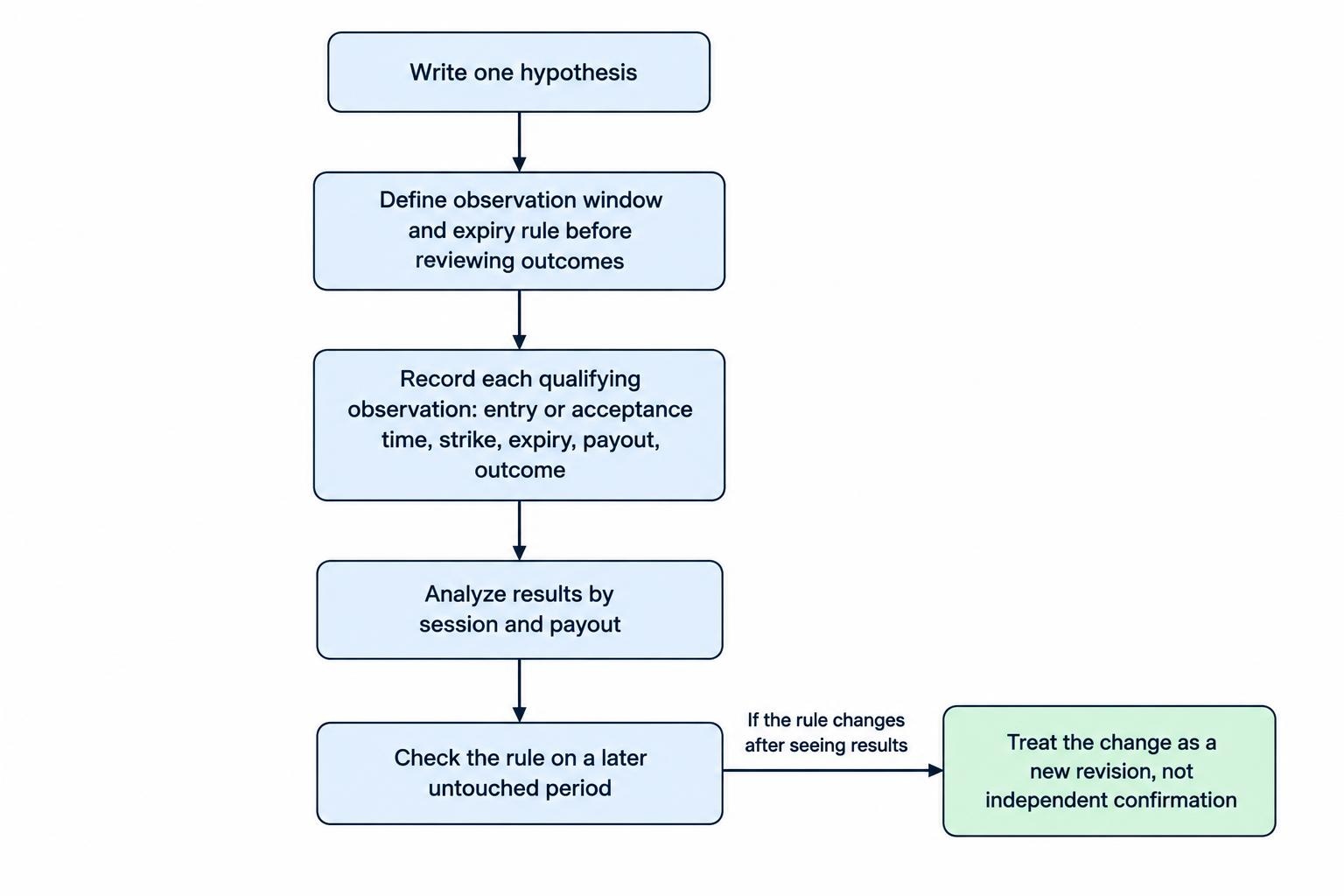
The paper trading guide sets out a fuller recording process. For USD/JPY, the central discipline is simple: evaluate the accepted strike, the exact expiry and the payout together. A correct view on the yen is useful analysis; it is not, on its own, a winning binary contract.
This article was last updated on: October 22, 2026