Binary options reduce a market question to two outcomes: a fixed payment if a condition is met, or a loss if it is not. The buttons may look simple. The contract terms and payout maths deserve more attention.
For Australian beginners, the starting point is regulation, not choosing a platform. ASIC banned the issue and distribution of binary options to retail clients from 3 May 2021, and extended that prohibition until 1 October 2031. This guide is for education and practice without deposits, not instructions for bypassing the ban.
What Are You Actually Buying?
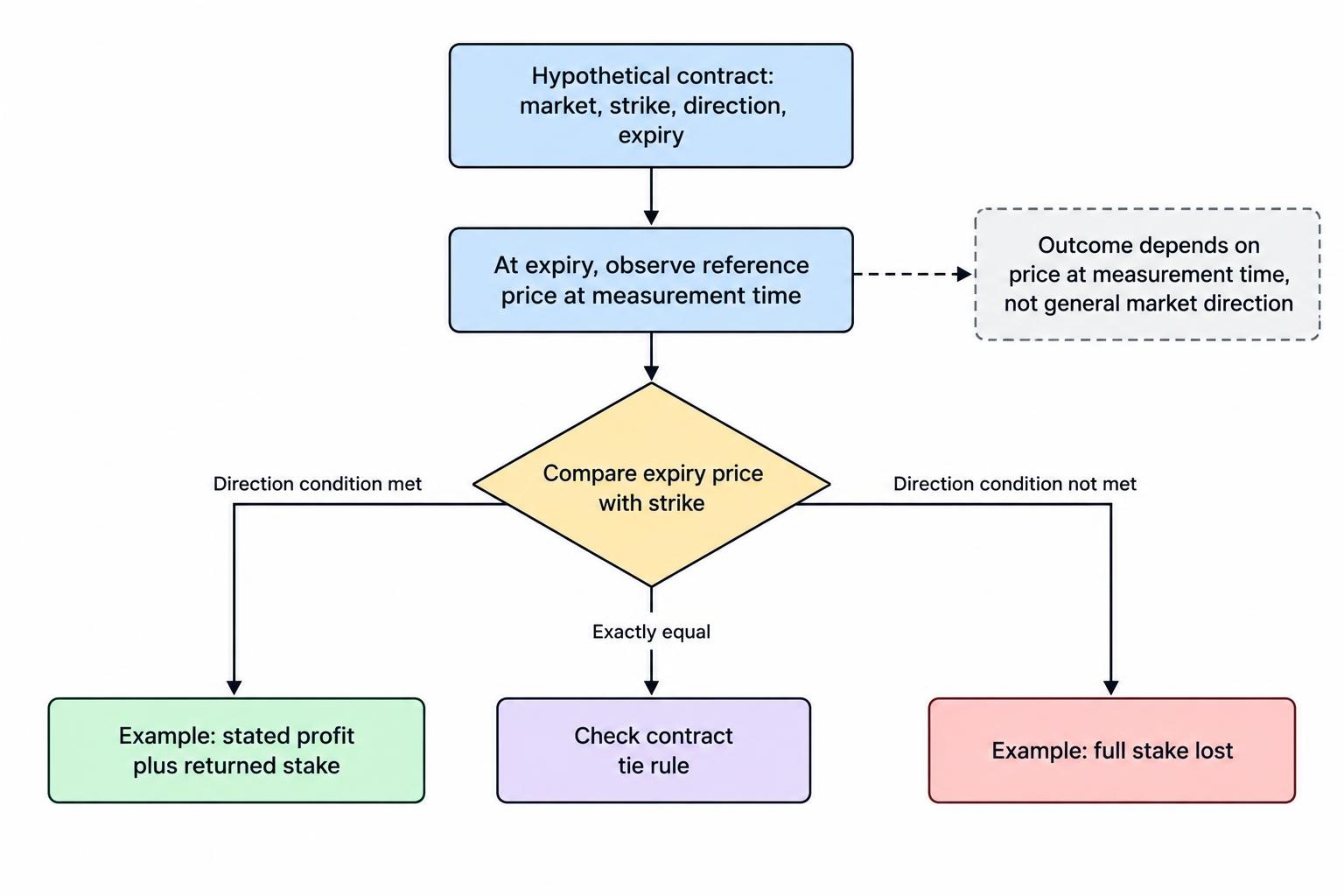
A binary option is a contract tied to a yes-or-no proposition. A basic example asks whether a market price will be above a stated level at a stated time. The outcome determines the payment.
You do not buy the underlying currency, share or commodity. Nor does the contract give you the right to purchase that asset later. That distinction separates binary options from conventional options, as set out in the SEC and CFTC explanation of binary option contracts.
Consider an educational contract asking whether AUD/USD will finish above 0.6500 at 11:00 am. Your task is not simply to predict that the Australian dollar will strengthen eventually. The price must satisfy the contract’s condition at its measurement time.
Being right about the broader direction but wrong about the timing can still produce a losing result. That is the first distinction to get comfortable with before studying any chart pattern.
Read the Contract Before Reading the Chart
A price forecast means little until you know what the contract measures. For a basic high-low contract, write down the following terms before calculating an outcome.
| Term | What to establish |
|---|---|
| Underlying market | The asset, currency pair or index referenced by the contract. |
| Strike price | The price level against which the result is judged. |
| Direction | Whether the condition requires a price above or below the strike. |
| Expiry | The exact date, time and time zone used for the outcome. |
| Stake | The amount committed and potentially lost. |
| Payout | The profit on a win, distinguished from the total amount returned. |
| Settlement rules | The reference price, treatment of equal prices and rules for disrupted data. |
Do not assume that “80% payout” means an 80% chance of winning. It describes a payment calculation, not a probability. Also check whether an advertised amount includes the returned stake.
The introductory guide to how binary options work follows the contract from its initial terms through to settlement. Keep that process separate from deciding whether a prediction looks convincing.
A Worked Example Using Hypothetical Terms
Suppose a paper exercise uses a hypothetical A$20 stake on AUD/USD finishing above 0.6500 at 11:00 am. A successful outcome earns 80% net profit, with the stake also returned. An unsuccessful outcome loses the full stake. There are no fees in this example.
If the reference price at expiry is 0.6501, the condition is met. The net profit is A$16, and the total amount returned is A$36: the original A$20 plus that profit.
If the reference price is 0.6499, the condition is not met. Nothing is returned and the net loss is A$20.
Notice the imbalance. One win earns A$16, but one loss costs A$20. A win followed by a loss leaves the exercise A$4 down.
A finish exactly at 0.6500 requires another check. Do the hypothetical rules provide a refund, count equality as a loss, or use another treatment? Never fill in that blank yourself. The guide to binary options settlement and ties covers this contract detail.
For this basic contract, finishing far above the strike would not increase the agreed profit. A larger market move does not automatically produce a larger payment.
Why Winning Half Your Trades Can Still Lose Money
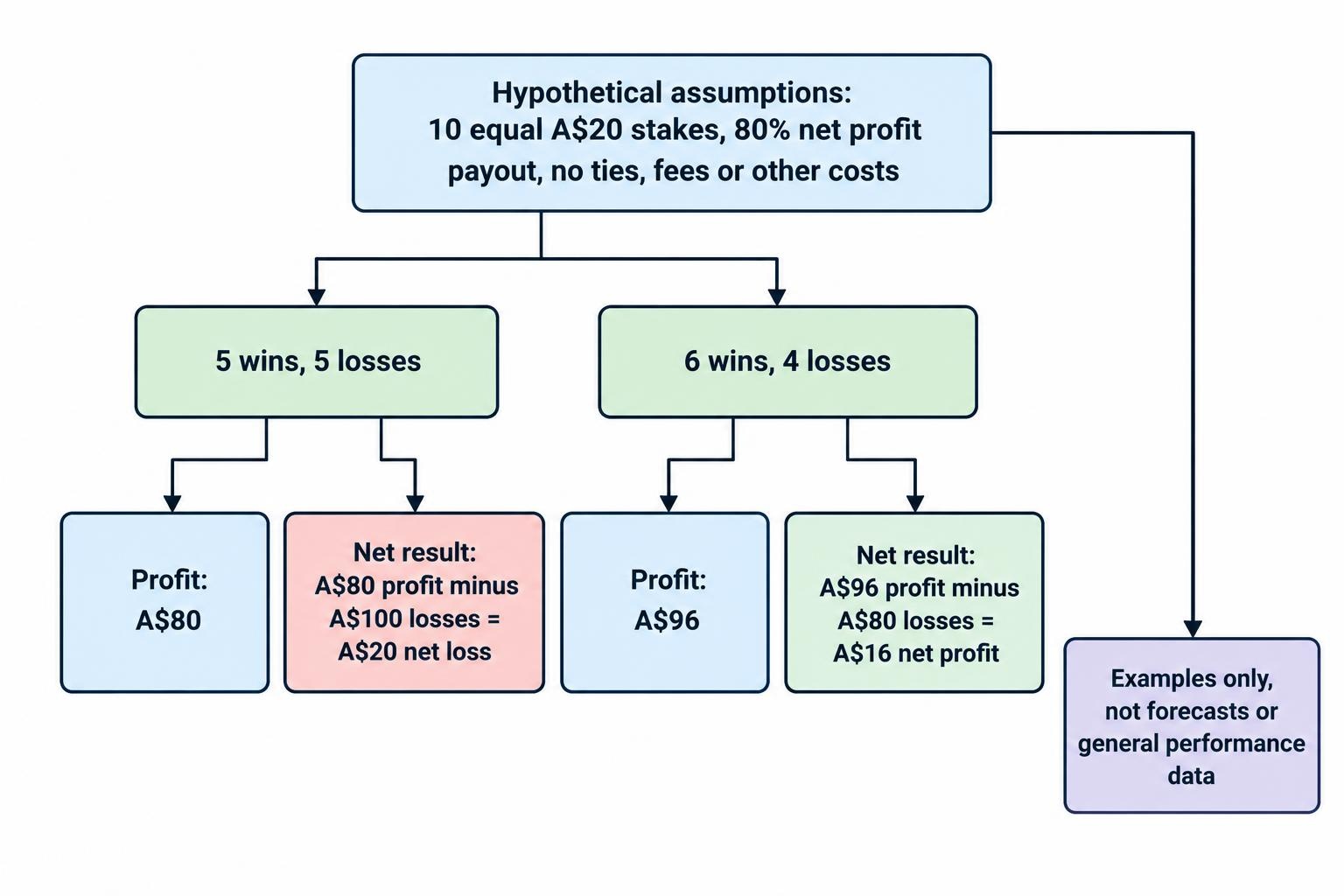
With the example’s 80% profit payout, ten equal A$20 stakes produce the following results:
- Five wins and five losses: A$80 in profits minus A$100 in losses, leaving a A$20 loss.
- Six wins and four losses: A$96 in profits minus A$80 in losses, leaving a A$16 profit.
These are arithmetic examples, not forecasts. They assume identical stakes, an unchanged payout, no ties and no other costs.
Under those assumptions, the break-even win rate is:
Break-even win rate = 1 ÷ (1 + net profit payout expressed as a decimal)
For an 80% profit payout, that becomes 1 ÷ 1.80, or approximately 55.56%. A lower payout raises the required win rate. At 70%, the threshold is approximately 58.82%.
This is why a signal service’s claimed accuracy cannot be judged on its own. Even a genuine record needs the payout, stake sizes, losing results and costs attached. “Six correct predictions” says little without knowing how many predictions were made.
The guide to probability and expected value in binary options develops this calculation. For a beginner, the immediate task is simpler: calculate the threshold before assessing a claimed trading advantage.
Separate the Risks Instead of Calling Everything “Risky”
There are several different questions to ask. Can the price prediction fail? Can the payment structure produce losses despite frequent wins? Can the provider fail to honour its obligations? A promising answer to one does not resolve the others.
The Full Stake Can Be Lost
In the example above, a tiny miss below the strike loses the same A$20 as a much larger miss. Knowing the maximum loss beforehand does not make that loss small relative to an account.
Ten consecutive A$20 losses would remove A$200. Reducing each stake would reduce the amount lost, but would not turn an unfavourable payment structure into a favourable one.
Real Account Results Have Been Poor
Between April 2020 and the ban’s commencement on 3 May 2021, 74–77% of active retail clients lost money in each quarter examined. Retail accounts recorded aggregate net losses of A$14 million over that period. These findings appear in ASIC Report 736 on the binary options intervention order.
Those historical figures are not a personal probability of losing on your next hypothetical prediction. They are evidence against treating the product’s simple presentation as evidence of easy profits.
A Recovery Plan Can Increase the Damage
Increasing stakes after losses changes the exposure, not the probability of the next outcome. Straight doubling also fails to recover every losing sequence at an 80% profit payout.
For example, losing A$10 and then winning with A$20 produces A$16 profit on the second contract. The combined result is A$6 profit. But losing A$10 and A$20 before winning with A$40 produces A$32 profit against A$30 of previous losses: just A$2 remains. Another step changes the result again. There is no free recovery built into the arithmetic.
An Offshore Account Is Not a Beginner’s Shortcut
Do not treat an invitation to become a wholesale client as a routine account upgrade. Wholesale clients do not receive the same consumer protections as retail clients. Moneysmart’s binary options warning advises against accepting wholesale classification simply to access these products.
For learning purposes, there is no need to solve an account-access problem. You can study price behaviour, calculate payouts and record hypothetical outcomes without sending money to anyone.
Keep two questions separate: “Can I open this page?” and “Is this an appropriate, lawful service for my circumstances?” A working deposit button answers neither the regulatory question nor the consumer-protection question.
How to Learn Without Making a Deposit
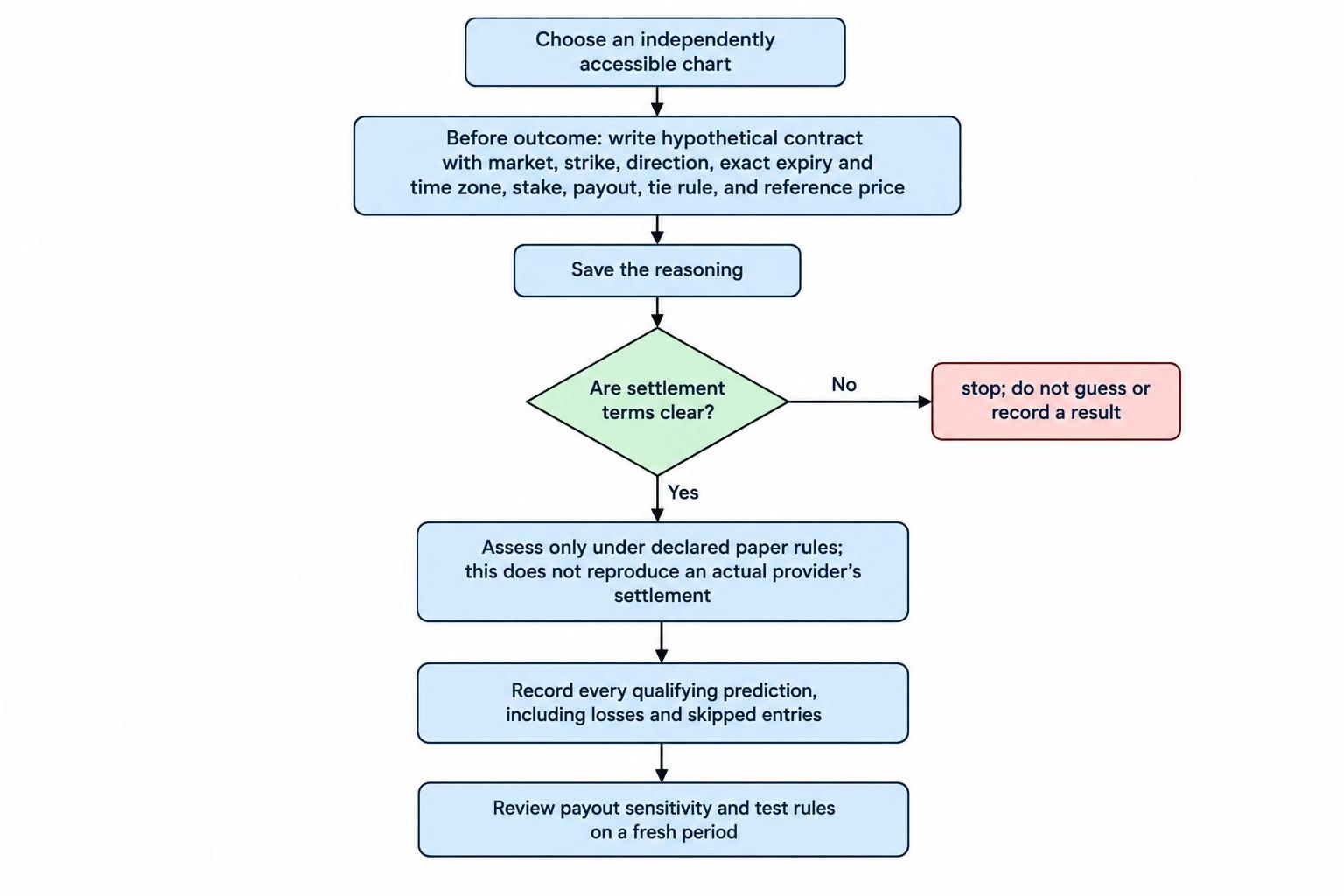
Start with a spreadsheet or notebook and an independently accessible market chart. Define a hypothetical contract before its outcome is known. Use the same rules throughout the exercise rather than changing them after a loss.
Write a Complete Prediction
“AUD/USD looks strong” is too vague to assess. A usable paper entry states the market, strike, direction, observation time, expiry, hypothetical stake, profit payout and tie rule.
Use an exact time zone. “11:00 am” is not a complete timestamp when the chart and your notebook may use different clocks. Record where the reference price comes from too.
For a manual exercise, describe the outcome as a result under your chosen paper rules. Do not claim that it reproduces an actual provider’s settlement.
Keep the Record Honest
Record every prediction that meets your written conditions, including losses and occasions when you decide not to make one. Save the reasoning before expiry. Otherwise, hindsight can turn a loose impression into a suspiciously perfect forecast.
Alongside each result, note whether you followed the plan. A profitable outcome from an accidental entry is not evidence that the planned method worked. A losing outcome does not automatically mean you broke the rules.
A structured binary options practice plan helps keep the exercise focused on repeatable decisions rather than a running score.
Test What the Payout Changes
Take the same set of paper results and calculate the net outcome at several hypothetical payouts. This exposes how much the payment terms matter without making another prediction.
Then review performance on a fresh period that you have not used to adjust the rules. Treat a short winning run as a result to investigate, not proof of a dependable income. Practice should answer questions, not manufacture confidence.
You can also stop the exercise if the terms are unclear. “No result recorded because the settlement rule was missing” is better research than guessing a favourable outcome.
Recognise Sales Pressure Before Assessing a Strategy
Unsolicited offers, promised easy returns, pressure to deposit and demands for more money to obtain better withdrawal terms are warning signs. The SEC investor alert on fraudulent binary options platforms documents these sales and withdrawal tactics.
Do not let a discussion about trading accuracy distract from the basic transaction. Who receives the money? What exactly are they promising? Why do they need a decision immediately?
Use the same scepticism with screenshots. Ask whether a claimed record includes every prediction, the original timestamps, actual payouts and all losses. A balance image is not enough to reconstruct performance.
If someone promotes a guaranteed recovery method, run the numbers yourself. A method that requires ever larger deposits after losses has not removed the risk. It has handed the risk a larger budget.
If You Have Already Sent Money
If you suspect a scam, stop sending money and contact the bank, card provider or payment service used. Ask what transactions can be stopped and what further action is available. Report the matter and follow Moneysmart’s steps after a scam, including its warning about follow-up offers to recover losses for a fee.
Keep copies of messages, payment confirmations, account records and withdrawal requests. Separate what the platform displayed from what actually reached your bank account. That distinction matters when describing what happened.
Where to Go Next
A useful beginner’s milestone is being able to explain a contract, calculate its net outcomes and identify what remains uncertain. It is not opening an account or reaching a daily profit target.
Use the binary options learning hub to study individual topics in more detail. Work through contract mechanics and payout arithmetic before indicators or strategies. If your aim is long-term saving or building assets, start with that goal rather than assuming a short expiry contract is the right tool.
This article was last updated on: October 22, 2026