A closed binary options broker and a renamed broker are not the same thing. A brand can disappear while its operating company continues, a company can withdraw from one country without closing elsewhere, and a familiar name can return under an unrelated operator. Each situation calls for a different check.
For anyone tracing an old account, the priority is to identify the company that accepted the money and establish what happened to it. For readers comparing historical binary options brokers, the task is different: separate dated information from evidence of a current service. An old review, working login page or recognisable logo cannot settle either question.
The Australian Position Comes Before the Brand Name
ASIC’s prohibition on issuing and distributing binary options to retail clients took effect on 3 May 2021. The regulator subsequently extended the order until 1 October 2031. A broker’s change of name does not create an exception to that prohibition; the ASIC announcement extending the binary options ban sets out its scope and duration.
Keep that restriction separate from the historical question of whether a business closed, rebranded or changed its product range. Evidence that a brand operated years ago is not evidence that it can offer binary options to Australian retail clients now.
The broader Australian binary options regulation guide covers the regulatory position. Here, the focus is on tracing old names, checking claimed successors and protecting records connected with an existing account.
What Does “Closed Broker” Actually Mean?
Before accepting a closure claim, ask what has closed: the website, the trading platform, a regional business, a product line or the company itself. These descriptions should not be used interchangeably.
| Description | What it may mean | What to check |
|---|---|---|
| Brand retired | A trading name is no longer being used. | Whether the operating company continues under another name. |
| Rebrand | The business presents itself under a new name or identity. | The announcement, company details and account arrangements. |
| Regional withdrawal | The provider stops serving clients in one country. | The affected entity, customers, products and effective date. |
| Licence surrendered or cancelled | A regulatory permission has ended. | The regulator’s notice and any arrangements for existing customers. |
| Business wind-down | The operator is ending activities rather than accepting new business. | Withdrawal instructions, deadlines and the responsible contact. |
| Website unavailable | The domain or service cannot currently be reached. | Independent evidence before treating an outage as a permanent closure. |
These categories describe different questions, not a ladder of seriousness. A licence notice can provide firm evidence about a regulated entity without explaining what happened to every website carrying its brand. Conversely, a dead website tells you little about the status of the company behind it.
Use narrow wording when the evidence is narrow. “The regulator published a licence renunciation notice” is more useful than declaring that every associated operation vanished on the same day.
Documented Examples of Brand and Operating Changes
The following examples show why historical labels need care. They record dated events, not recommendations or a live directory of providers accepting Australian customers.
Binary.com and Deriv: An Announced Rebrand
Binary.com announced its rebranding to Deriv.com on 4 May 2020. The announcement described the launch of the new brand and changes to its platform and product offering. This establishes a documented connection between the names, rather than leaving readers to infer one from a redirect or similar website design. The Binary.com rebranding announcement published through PR Newswire provides the dated record.
The practical distinction is that retiring a name is not, by itself, evidence of insolvency or an unexplained disappearance. Even with a documented rebrand, an account holder should check which legal entity appears on their own agreement. A group branding announcement does not answer every question about individual accounts, regional eligibility or responsibility for an old balance.
Banc De Binary: A Regulatory Renunciation Record
CySEC published a notice titled “Renouncement of the authorization of Banc De Binary Ltd” on 11 January 2017. That is a regulatory event attached to a named company, not simply a report that a website stopped loading. The CySEC notice concerning Banc De Binary Ltd’s authorisation is the appropriate historical reference.
Publication dates and effective dates should not be assumed to match. Nor should a licence event be stretched into a claim about every associated company or the outcome of every customer withdrawal.
If someone now claims to operate a successor business, ask for evidence connecting that business to the entity named in the old account agreement. Reusing the name does not establish responsibility for historical customer money.
24option and Rodeler: Action Against an Identified Operator
On 1 June 2020, the FCA announced action involving Rodeler Ltd, trading as 24option, and three other Cypriot investment firms. The action concerned CFD services to UK investors. The announcement also recorded the full suspension of Rodeler’s regulatory authorisation by CySEC. The FCA announcement identifying Rodeler and 24option states the affected firms and measures.
This example needs two boundaries. The notice concerned an identified legal entity, and its product context was CFDs. It should not be rewritten as an Australian binary options closure notice or treated as proof of the present status of every similarly named business.
For historical account research, record the brand, operator, jurisdiction, product and date together. Dropping any one of those details can turn an accurate notice into a misleading summary.
How to Check a Claimed Successor Brand
Start With the Account Agreement
Look for the full company name on the agreement that applied when the account was opened. Save its registration number, stated jurisdiction, licence number and complaints contact. Compare those details with statements and withdrawal correspondence, rather than relying on the logo at the top of the page.
A useful comparison has three columns: the original account operator, the company announcing the change, and the company asking you to act now. Where the names differ, request a written explanation of the relationship. Do not fill the gaps with assumptions about common ownership.
Payment records are worth preserving too. Record the merchant descriptor, bank beneficiary or crypto transaction reference exactly as shown. Treat those details as evidence to investigate, not automatic proof that the payment recipient was the contracting broker.
Check Permissions Separately From Branding
For an Australian authorisation claim, compare the company and licence details with ASIC’s records. Check the licence status and conditions, not just whether a search produces a matching name. ASIC’s guidance on using its resources to avoid investment scams recommends matching the supplied details and checking the services and client categories covered.
Keep corporate identity and financial services permission as separate checks. A company number identifies a business; it is not a substitute for checking the permission being claimed. Neither check should distract from the Australian retail binary options prohibition described above.
Ask What Happened to the Account, Not Just the Website
A satisfactory migration explanation should identify the old and new operators, the effective date, and what happens to balances, records and unresolved complaints. Ask whether the proposal changes the company responsible for the account or only its branding.
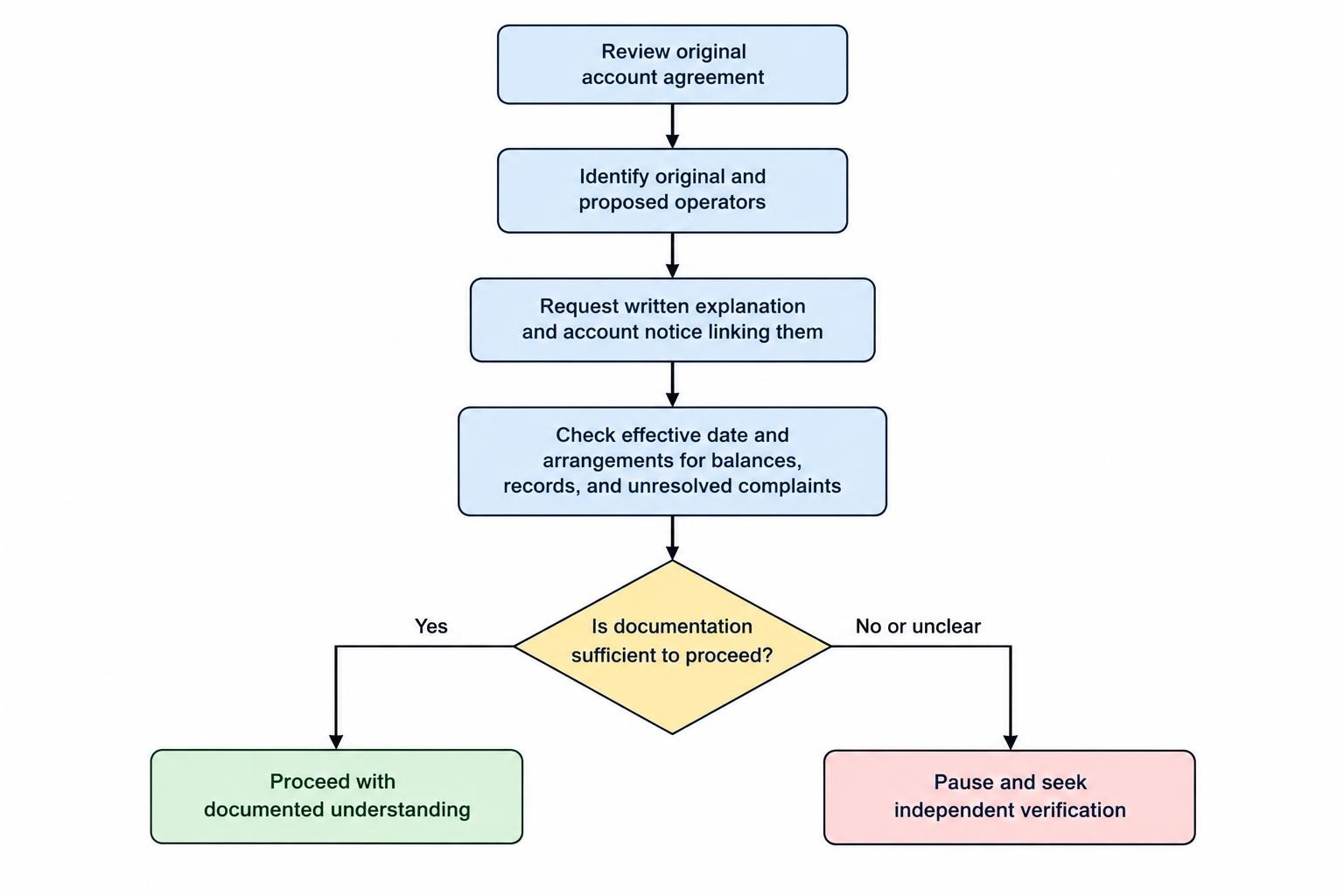
A redirect is a clue, it is not the paperwork. An email saying “we have moved” is also insufficient where it leaves the receiving entity unnamed or asks you to accept unexplained terms.
Consider a hypothetical message stating that an old balance has moved to a new platform. Before logging in or submitting documents, establish who sent the message and request the supporting account notice. Do not make a fresh deposit simply to test whether the migration is genuine.
Reopened Names, Clones and Lookalike Websites
Assess a purported reopening as a claim requiring proof. Ask how the current operator acquired the brand, whether it has assumed any customer obligations, and where those arrangements are documented. The answers matter more than a familiar colour scheme.
Compare the exact domain and contact details with independently obtained records. Pay attention to extra words, changed endings and small spelling differences. Do not use a telephone number supplied in the disputed message as your only method of checking that same message.
The guide to clone broker scams covers impersonation checks in more detail. For a closed or renamed brand, the immediate question is narrower: can the sender demonstrate that it represents the company responsible for your account?
A missing link in that chain is a reason to pause. It is not necessary to prove fraud before declining to send money, identity documents or account credentials.
What to Do With an Old Account or Unpaid Balance
Treat account recovery as a records problem before treating it as a trading problem. Your objective is to establish the balance, the company involved and the available contact route—not to place more trades to “reactivate” an account.
- Preserve the account evidence. Save agreements, statements, transaction histories, withdrawal requests and correspondence. Keep original files where available, alongside screenshots showing dates and addresses.
- Build a short timeline. Record when the account opened, when payments were made, when withdrawal was requested and when any closure or migration message arrived.
- Identify the responsible contact. Look for a verified complaints address, wind-down contact or formally appointed administrator. Check the appointment independently before submitting documents.
- Request a written position. Ask which entity holds responsibility for the account, what balance it recognises and what process applies to the withdrawal or complaint.
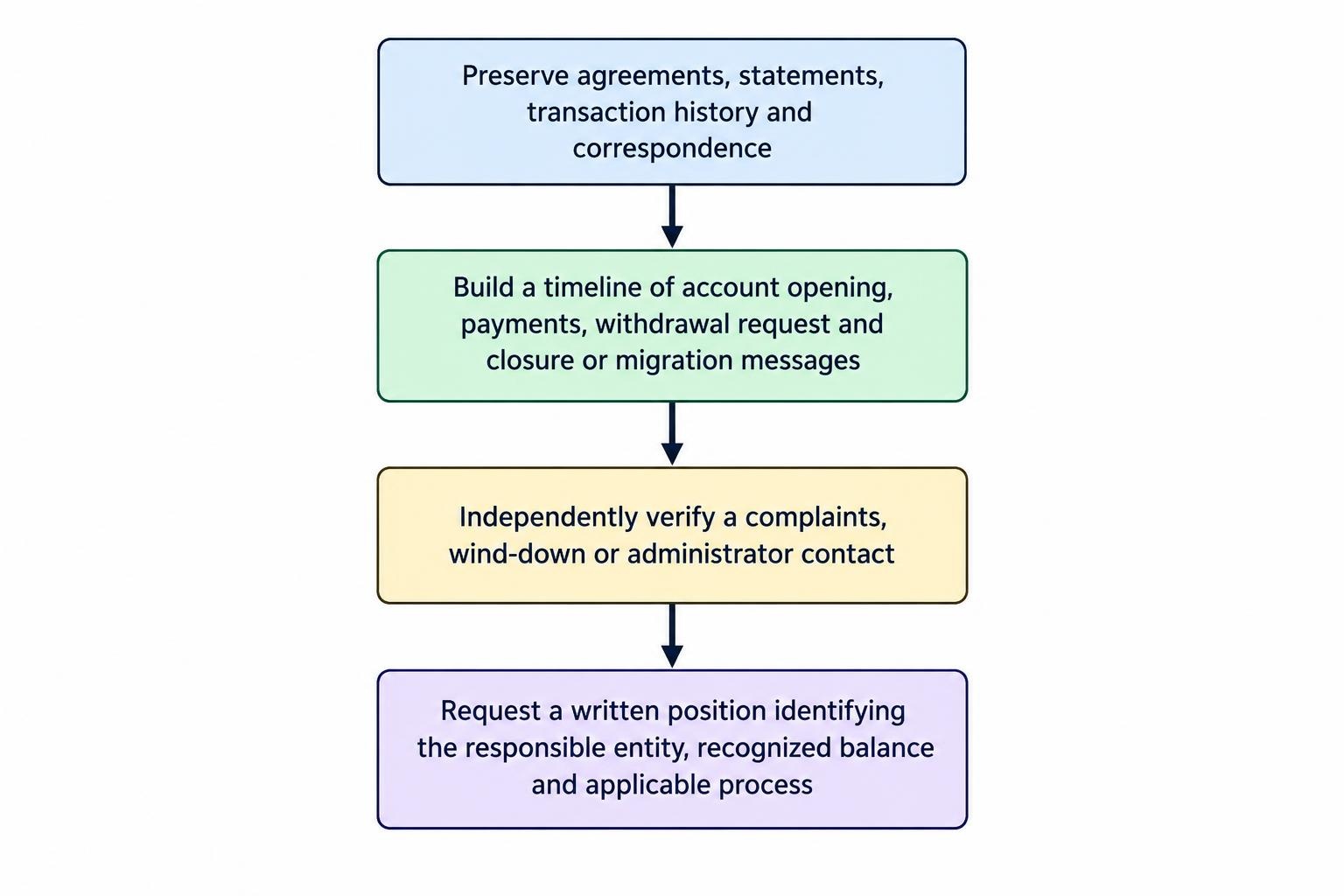
Keep the request factual. Separate money deposited, trading results, fees and payments already received. A concise reconciliation is easier to assess than a long email mixing account figures with unrelated complaints.
Do not assume that a new brand has accepted an old liability, or that a name change has erased it. Both questions depend on the documents and circumstances. Obtain legal advice where responsibility is disputed or the amount warrants it.
The binary options withdrawal problems guide addresses withdrawal disputes more broadly. A closure announcement adds an identity and process check; it does not, by itself, establish whether a particular balance will be repaid.
Beware of Offers to Release or Recover Old Funds
Do not send another payment because an unsolicited caller says it will release money from a closed account. Moneysmart warns about follow-up scams involving recovery offers and demands described as taxes, deposits, retainers or refundable insurance bonds. Its guidance on what to do after a scam also advises stopping further payments and contacting the relevant financial institution promptly.
Someone quoting an old account number or balance still needs independent verification. Ask for the legal entity name, the basis for contacting you and documentary evidence of authority. Do not install remote access software or disclose passwords to help someone “locate” the balance.
Keep any recovery offer separate from the original account investigation. A persuasive story about a new owner, regulator or compensation department should not replace evidence.
How to Read an Old Broker Review
Read historical reviews as dated descriptions, not current operating instructions. Check whether the article names the legal entity, identifies the country it covers and distinguishes binary options from other products. A page update date alone does not demonstrate that each underlying claim has been checked.
Separate four questions: did the brand exist, what happened to its operator, is a present claimant genuinely connected, and can the proposed service lawfully be offered to you? One document rarely answers all four.
The safest working rule is straightforward: trace the company, verify the event and preserve the account records. A familiar broker name can help start that research. It should never finish it.
This article was last updated on: October 22, 2026