Binary options and exchange traded funds (ETFs) can reference the same market, but they give you very different financial exposure. A binary option pays a predetermined amount if a contract condition is met. An ETF gives you an interest in a fund whose value changes with its investments.
For Australian retail clients, the comparison also has a firm legal boundary. ASIC banned the issue and distribution of binary options to retail clients from 3 May 2021, and extended that prohibition until 1 October 2031. This article compares their mechanics; it does not treat offshore binary trading as a workaround.
Binary Options vs ETFs: Main Differences
The most useful distinction is between predicting an event and holding an investment. Watching the same price chart does not make the products interchangeable.
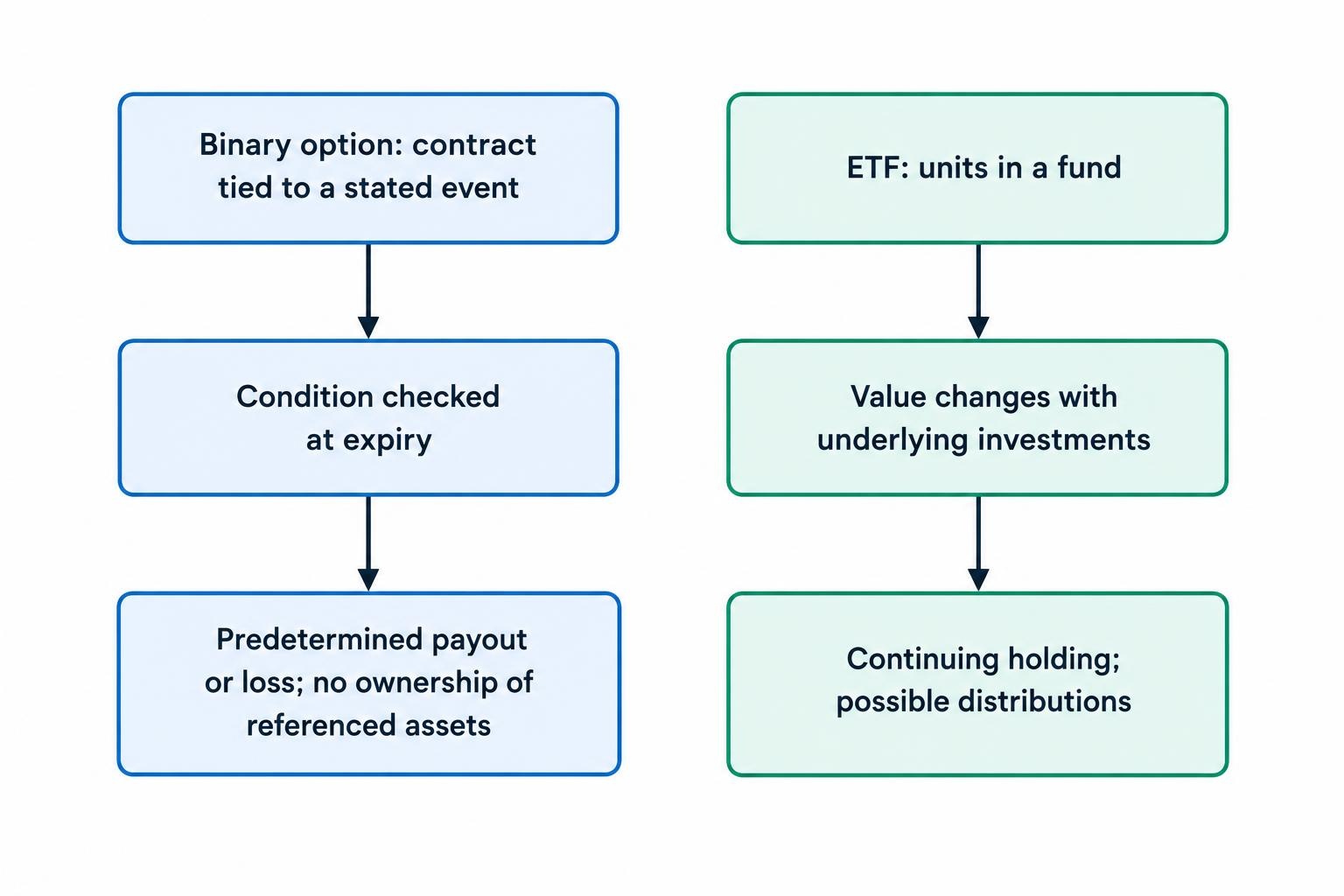
| Feature | Binary options | ETFs |
|---|---|---|
| What you hold | A contract tied to a stated event | Units or shares in a fund |
| Return structure | Predetermined payout or loss under the contract terms | Changes in unit value, plus any distributions |
| Time horizon | A defined expiry determines the outcome | Normally no investor-selected expiry |
| Price movement | The settlement condition matters more than the size of the move | The size of the price change affects your gain or loss |
| Income | No entitlement to income from the referenced assets | Some funds distribute income |
| Costs | Payout terms affect the economics; other charges may apply | Fund expenses, spreads and possible brokerage or platform fees |
| Australian retail availability | Issue and distribution prohibited | Exchange quoted funds are available, subject to product and platform access |
What Do You Actually Own?
A binary option creates a conditional payment
A binary option might ask whether an index will finish above 8,000 at a stated time. If the condition is satisfied, the contract pays the agreed amount. Otherwise, the stake may be lost entirely.
You do not acquire the companies in the index. You receive no dividends from those companies, and the contract does not become a continuing investment after expiry. Your claim concerns the contract’s outcome, not ownership of the referenced assets.
That distinction also prevents a common misunderstanding: a binary option linked to an ETF is not an investment in that ETF. The reference asset supplies the measurement; the contract supplies your financial rights.
An ETF provides an interest in a fund
Buying ETF units gives you an interest in a managed fund, rather than direct ownership of each underlying holding. The fund may invest in shares, bonds or other assets. Its returns depend on those investments, its strategy and its expenses, as covered in Moneysmart’s explanation of ETF ownership and returns.
A broad share index ETF can therefore provide continuing exposure to a portfolio. Your holding does not settle as a win or loss because the index crosses a threshold at lunchtime.
This does not mean every ETF is suitable for long term investing. It means the structure permits continuing ownership, rather than requiring a fresh prediction after each expiry.
Payouts: A Fixed Outcome vs a Changing Investment Value
A binary option’s advertised payout and an ETF’s investment return measure different things. Comparing the percentages without checking their meaning is an expensive shortcut.
A hypothetical binary option
Assume a contract requires a $100 stake and offers an $80 net profit if the prediction is correct. A winning contract returns $180 in total: the original $100 plus $80 profit. A losing contract returns nothing.
Those terms produce uneven outcomes. One win followed by one loss leaves you $20 down, despite getting half the predictions right.
The break-even win rate, ignoring fees, refunds and ties, is:
Break-even win rate = stake ÷ (stake + winning profit)
With these assumptions, $100 ÷ $180 equals approximately 55.56%. You need a win rate above that level to make a profit over the trades counted.
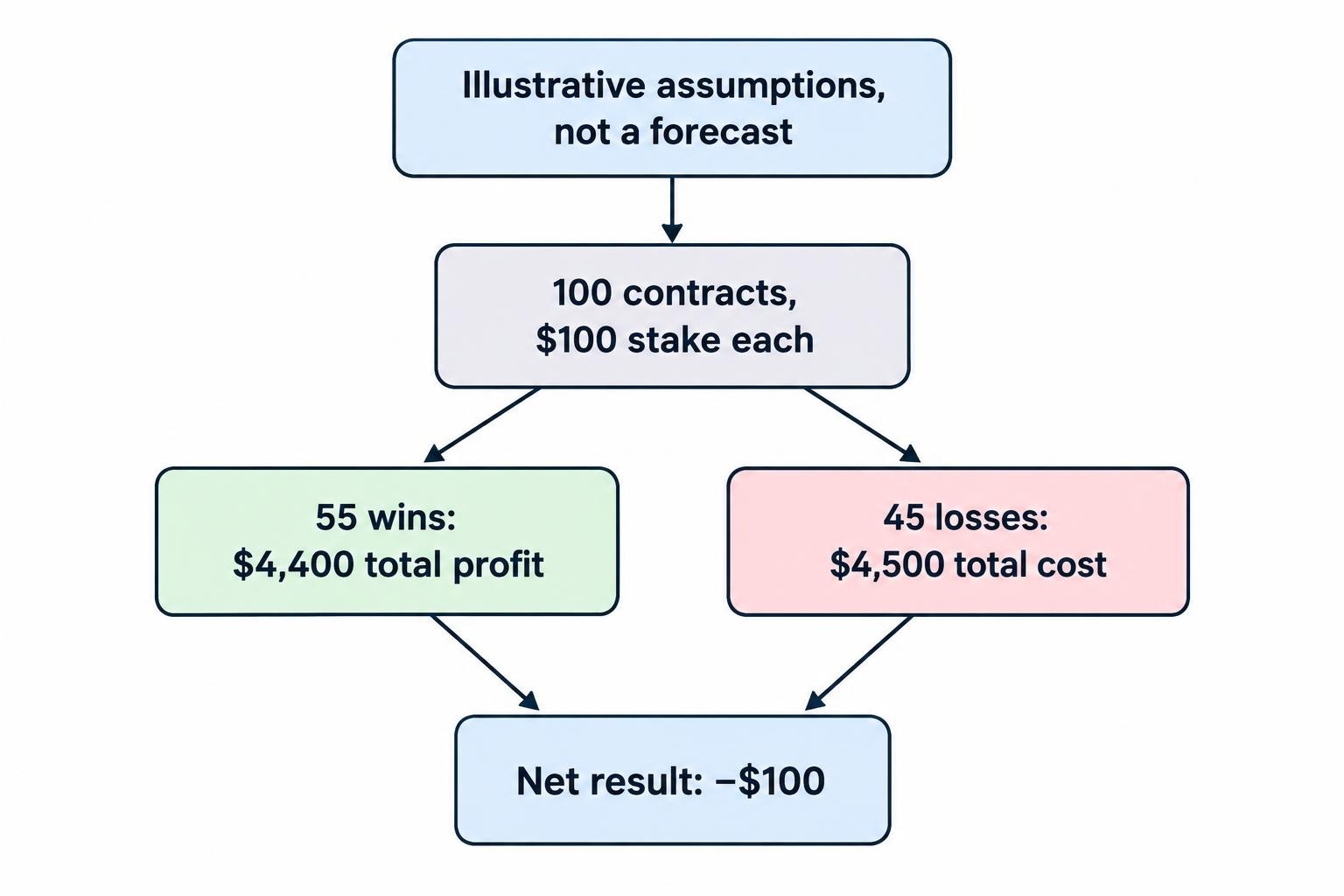
Across 100 contracts with the same stake and payout, 55 wins produce $4,400 in winning profits, while 45 losses cost $4,500. The net result is a $100 loss. A majority of correct predictions still leaves the account behind. The relationship between payout and required accuracy is covered further in probability and expected value in binary options.
A hypothetical ETF holding
Now assume you buy 50 ETF units at $20 each, investing $1,000 before trading costs. If the unit price rises to $21, the holding is worth $1,050. If it falls to $19, it is worth $950.
The price change produces a proportional change in the holding’s value. There is no predetermined $80 reward and no expiry threshold that turns a small adverse movement into the loss of the entire purchase price.
Distributions, where paid, also belong in the return calculation. If you receive $30 in cash distributions and later sell those units for $1,050, the combined gain is $80 before transaction costs and tax. Neither the price rise nor the distribution is guaranteed.
These examples compare payoff structures, not recommended allocations. Putting $100 into one contract and $1,000 into a fund does not make their risks equivalent.
Risk: A Known Stake Is Not the Same as a Safer Product
A binary option can make the maximum contractual loss easy to identify: the stake. That clarity should not be confused with a low probability of loss, favourable pricing or protection against platform failure.
Repeated stakes also matter. Ten separate $100 losses still remove $1,000 from an account. Breaking exposure into small tickets changes its presentation, not the arithmetic.
An ETF has a different risk profile. Its assets can fall in value, sometimes sharply. A fund concentrated in one sector or country can suffer losses even though it holds several investments. Overseas exposure can also introduce currency risk.
Fund structure matters too. Derivatives, illiquid assets and borrowing can introduce risks beyond ordinary share market movements. The ASX overview of ETF benefits and risks covers these differences between products.
Consider an illustrative 30% fall in an ETF holding. A $10,000 position becomes worth $7,000 before other changes. Recovering from $7,000 to $10,000 requires a gain of about 42.9%. A loss does not become harmless simply because the investment has no countdown timer.
There is also a distinction between market risk and the risk that a provider fails to honour its obligations. Binary contract terms do not remove counterparty and platform risk. Assessing the likely price direction answers only part of the risk question.
Costs: Look Beyond “Commission Free”
For binary options, the payout schedule belongs in the cost assessment. In the earlier example, successful predictions earn less than unsuccessful predictions lose. A separate commission is not necessary for the terms to create a demanding break-even rate.
ETF costs usually require a different calculation. Check ongoing fund expenses, the spread between buying and selling prices, and any brokerage or account charges. The SEC’s ETF investor bulletin distinguishes fund expenses from the costs investors can incur when trading ETF shares.
Suppose a hypothetical ETF charges 0.20% annually. On a constant $10,000 balance, that is approximately $20 for a year. This simplified calculation excludes other costs and changes in the investment’s value; it is not a quote for an actual fund.
Trading frequency can change the result. If a platform charges $5 per purchase, a $100 purchase carries a 5% entry cost before considering the spread. The same $5 charge on a $2,000 purchase is 0.25%.
A low annual management fee cannot rescue an inefficient buying pattern. Compare costs in dollars against the amount and frequency you intend to invest, rather than choosing whichever percentage looks smallest.
Expiry, Liquidity and Control Over Your Exit
Binary options make timing part of the contract outcome. A prediction can be directionally sensible but still lose because the required movement happens after expiry. Any early closing facility depends on the contract terms and should not be assumed.
With an ETF, you normally choose when to submit a sale order rather than selecting an expiry when you buy. That provides flexibility, not certainty about the sale price or immediate access to cash.
ETF units trade at market prices, which can differ from the value of the fund’s underlying net assets. Market makers help support trading near that value, but their presence is not a capital guarantee. The ASX guide to buying and selling ETFs explains market making and net asset value.
A limit order lets you set the highest purchase price or lowest sale price you will accept. It does not guarantee execution. This is a useful distinction if you need to sell during unsettled trading: controlling your acceptable price and obtaining an immediate sale are different objectives.
Neither product should be assessed on the assumption that every exit will happen exactly when and how you want.
Not Every ETF Is a Plain Index Fund
The ETF label tells you something about the trading structure, but not enough about the investment strategy. A broad share portfolio, a narrow thematic fund and a geared fund should not receive the same risk assessment.
Some ETFs use borrowing, short selling or derivatives. Leveraged exposure can magnify losses as well as gains; inverse exposure aims to benefit from movements opposite to its reference market, subject to the fund’s stated method.
ASIC’s Regulatory Guide 282 on exchange traded products addresses complex strategies and product labelling. Read the product disclosure statement rather than treating “ETF” as shorthand for a simple or conservative investment.
The fair comparison here is therefore between binary contracts and an identified ETF strategy, not between binary contracts and an imaginary fund with no fees, no volatility and permanent positive returns. That fund has yet to file its paperwork.
Which Structure Fits the Financial Goal?
For a goal based on accumulating assets over years, a suitable diversified ETF can provide a structure for regular contributions and continuing market exposure. Whether it fits depends on the assets held, the investment horizon, costs and the investor’s capacity to absorb losses.
Binary options do not provide the same ownership or income rights. Increasing the stake after a win is not equivalent to holding productive assets and reinvesting their income. The distinction is examined further in why binary options are not investing.
A short deadline changes the assessment again. If money must remain available for a bill or near term purchase, a volatile share ETF may be inappropriate. Being a more conventional investment does not make it suitable for every purpose.
Nor does an interest in short term trading make binary options an appropriate substitute. Australian retail restrictions still apply, and choosing a product because it offers a faster result says nothing about whether that result is likely to be profitable.
What to Check Before Choosing an ETF Alternative
Start with the intended use of the money, then examine the product. Three checks keep the comparison practical:
- Exposure: Identify the assets, concentration, currency exposure and any borrowing or derivative strategy.
- Total costs: Read the fund and platform disclosures, then calculate the effect on your intended purchase size.
- Loss tolerance and access: Decide whether you could withstand a substantial fall without being forced to sell.
If the main question is whether to own assets or speculate on a contract outcome, the ownership distinction comes first. If the question is which investment vehicle suits an established plan, compare ETFs with other lawful alternatives rather than using binary payouts as a return benchmark. The broader binary options product comparisons cover other structural differences.
Binary options and ETFs are not substitutes with different speed settings. One resolves a conditional contract; the other provides a continuing interest in a fund. For Australian retail investors, that economic difference sits alongside a prohibition on issuing and distributing binary options.
This article was last updated on: October 22, 2026