Social media trading signal scams use trading tips to steer people into payments they would otherwise question: a subscription, a broker deposit, a cryptocurrency transfer or a supposed withdrawal fee. The signal is the bait. The money request is what needs scrutiny.
The pattern can cross markets. A group advertised as sharing stock tips may direct members to a fake cryptocurrency platform, complete with invented trades and profits. This sequence appears in ASIC’s warning about messaging groups promoting fake trading platforms.
If you have already sent money and suspect fraud, stop paying and contact your bank or payment provider immediately. Do not wait for the next signal to recover the loss.
The Australian Binary Options Restriction Comes First
For Australian retail clients, checking whether a signal looks convincing misses an earlier question: can the promoted product lawfully be offered? ASIC’s order bans the issue and distribution of binary options to retail clients. The ban began on 3 May 2021 and extends until 1 October 2031, under ASIC’s binary options product intervention order extension.
An offshore address, foreign certificate or invitation to use a VPN does not establish compliance with that Australian restriction. Neither does calling the group an academy rather than a trading service.
Keep the questions separate. A promoter’s claimed forecasting ability does not establish that the platform is genuine, that its offer complies with Australian rules, or that deposited money will be returned. A winning prediction answers none of those questions.
How a Trading Signal Becomes a Payment Request
The free group creates a reason to stay
A free tip gives you something to watch without an immediate commitment. The practical danger starts when apparently useful commentary becomes a reason to trust a payment instruction. Assess those decisions separately: reading a market opinion does not require funding the account its author recommends.
Before following a referral, write down what has changed. Were you originally offered education, but are now being asked to deposit? Has access to the next signal become conditional on opening an account? Has the conversation shifted from analysing prices to proving your commitment with money?
That change of purpose deserves more attention than another screenshot of a profitable trade. Our broader guide to binary options scams covers the other routes through which a trading promotion can become a demand for funds.
The group supplies its own apparent proof
Fake investment groups may impersonate financial professionals or present an invented expert as their leader. The SEC’s investor alert on group chat investment scams describes allegations involving a “professor”, an assistant, purported AI trading signals and members posting screenshots of successful trades.
The lesson is not that a particular job title proves fraud. It is that the group’s claims need evidence from outside the group. An administrator recommending a platform, an assistant helping with deposits and another member praising withdrawals are not automatically three independent checks.
Ask what you can verify without their help. A chat history shows what accounts posted; it does not establish who controls those accounts or whether their claimed balances exist. Even a private message from a helpful member should be treated as another unverified contact.
A small withdrawal encourages a larger deposit
Investment scammers may allow small withdrawals to build trust before refusing access to larger amounts. Scamwatch’s investment scam guidance identifies this tactic alongside fake account growth, impersonation and pressure to act quickly.
Suppose you deposit A$300 and receive A$50 back. That establishes that A$50 reached you. It does not establish where the remaining money sits, whether any trading occurred, or whether a later A$10,000 deposit would be recoverable.
Do not treat the first withdrawal as permission to stop checking. Judge the next payment on its own merits. Money already received should not become a reason to risk a much larger amount.
The withdrawal becomes another sale
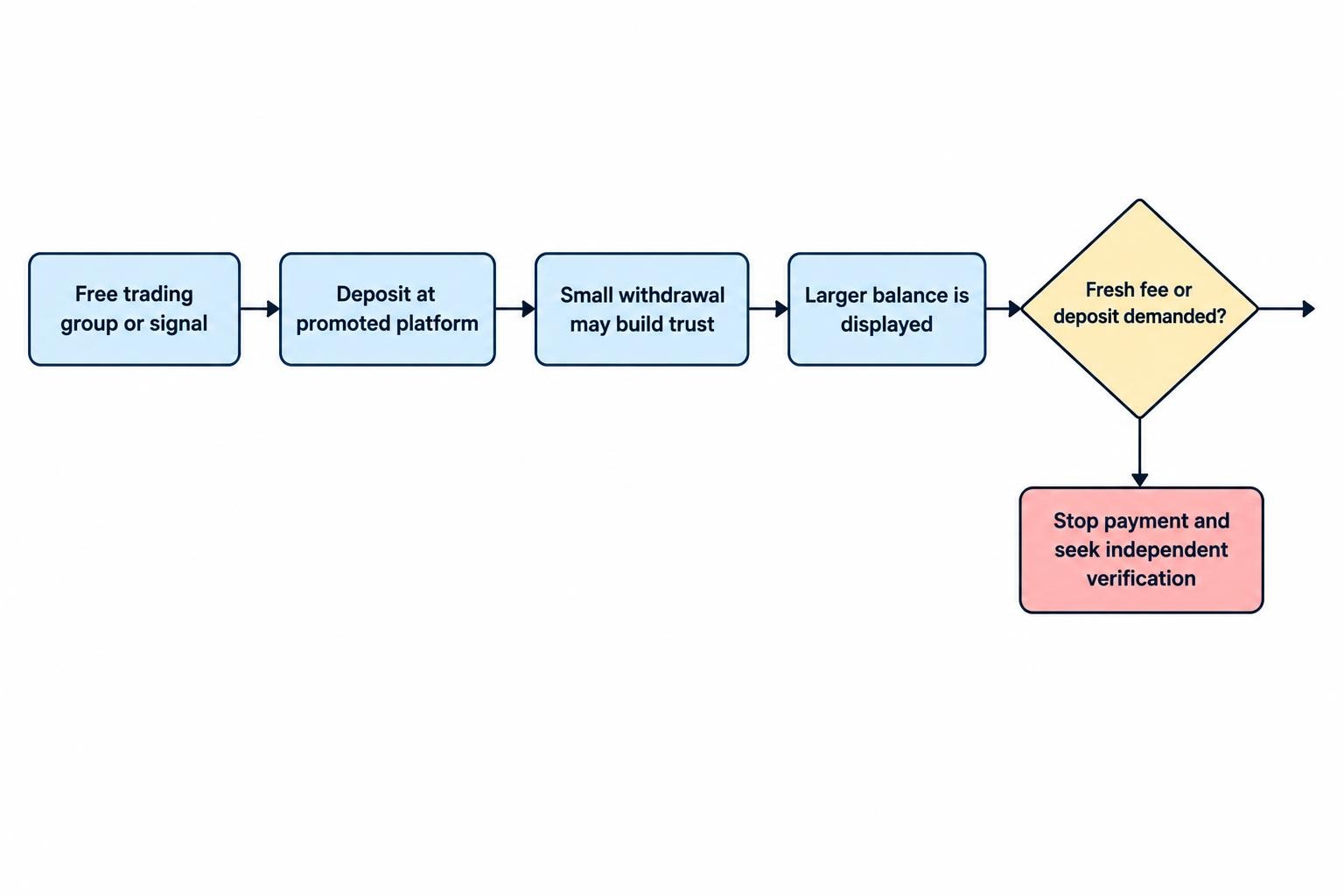
A particularly serious warning is a demand for fresh money before an existing balance can be released. The explanation may involve a tax, security deposit or account clearance charge. In the fake-platform pattern, the displayed profit becomes the pressure: pay a smaller amount now to avoid losing the larger balance.
Do not accept the account screen as proof that the larger balance exists. Preserve the demand and seek independent verification rather than paying to find out. The guide to fake tax and withdrawal release fees covers that stage without relying on the promoter’s explanation.
Warning Signs Worth Acting On
You do not need to prove criminal fraud before declining an offer. These are reasons to stop, question the arrangement and withhold further payments, rather than a scoring system where several reassuring details cancel out one serious problem.
| What you encounter | What to question |
|---|---|
| Guaranteed profits or almost no losing signals | Where is the complete record, including losses and costs? |
| Access depends on funding a nominated account | Why does receiving information require this deposit? |
| Members repeatedly post profitable screenshots | Can those results be checked independently? |
| An urgent upgrade or deposit deadline | Why must payment happen before verification? |
| Instructions to disguise the payment’s purpose | Why are you being asked to mislead your bank? |
| More money is required to withdraw | What independently verified obligation supports the demand? |
Pay particular attention to how the promoter responds to a reasonable question. You are asking about your money, not applying for membership of a secret society. If the response is anger, guilt or another deadline, end the payment discussion.
Set a simple boundary before reviewing anything else: no payment while identity, authorisation or withdrawal terms remain unresolved. That prevents an interesting market discussion from becoming a financial commitment by small steps.
Why Screenshots and Win Rates Are Weak Evidence
A selection of winners is not a track record
For a claimed signal record to be useful, you need more than the result. You need the asset, direction, publication time, intended entry, expiry, quoted payout and outcome. You also need every losing call, not just the trades selected for the promotional summary.
Check whether each recommendation was available before the proposed entry. If you cannot establish that, you cannot use the example as evidence of a forecast. Keep an independent record of what arrived and when, without placing trades or paying for access to collect it.
These are evidence checks, not a reason to join a suspicious service for further investigation. The separate guide to evaluating trading signal track records covers performance assessment in more detail.
Also distinguish a provider’s claimed result from a follower’s possible result. A signal received after its intended entry time is not the same trade. If the advertised record assumes an entry that subscribers could not verify or obtain, it does not demonstrate their likely outcome.
Being right more often than wrong may still lose money
Consider a hypothetical set of 100 binary trades, each risking A$100. Assume a winning trade returns the stake plus A$80 profit, while a losing trade loses the full stake. There are no ties, refunds or other charges.
With 56 wins and 44 losses, winning trades produce A$4,480 profit and losing trades cost A$4,400. The result is just A$80 before fees. A hypothetical A$100 signal subscription turns it into a A$20 loss, despite the majority of predictions being correct.
Under those assumptions, the break-even win rate before fees is approximately 55.56%: A$100 divided by A$180. The relationship between payout and required accuracy is covered in probability and expected value in binary options.
This example does not establish that any service can achieve that accuracy. It shows why a win percentage, even if genuine, is incomplete. Ask for the net result after losing stakes and charges, not a percentage chosen because it looks reassuring.
Separate Signal Quality From Platform Fraud
A losing recommendation alone does not prove fraud. Equally, a successful recommendation does not validate the platform receiving your deposit. The joint SEC and CFTC binary options fraud alert records complaints involving withheld funds, identity theft and software manipulation. Those are different issues from poor forecasting.
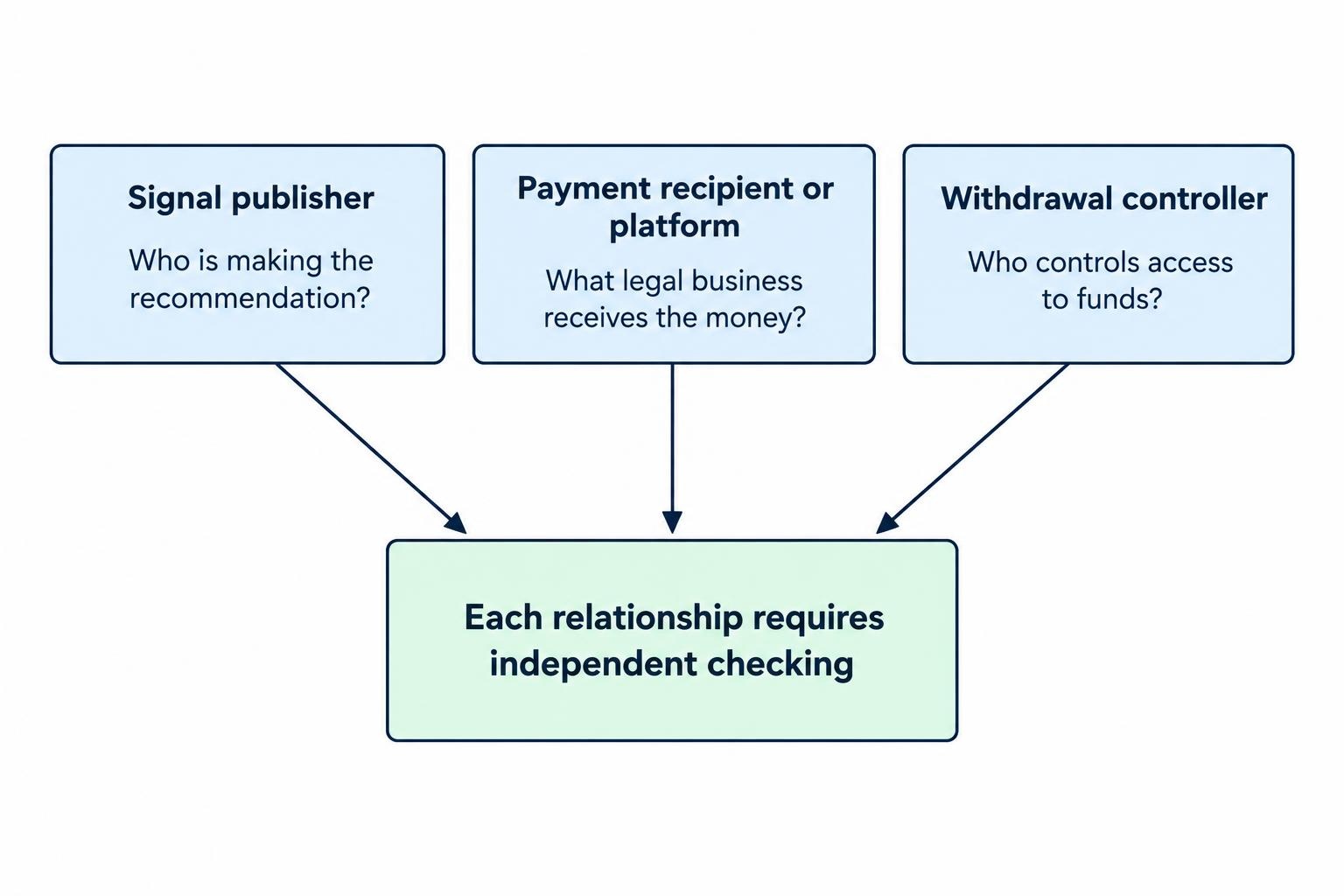
When reviewing a social media promotion, examine three relationships separately: who publishes the signal, who receives the payment, and who controls withdrawals. Do not let a familiar face in the chat stand in for identifying the legal business holding the money.
Ask how the promoter gets paid. Is there a subscription, a referral payment or another financial arrangement? A disclosed referral payment is not, by itself, proof of fraud. It is a conflict to examine. The recommendation needs scrutiny beyond whether the promoter sounds enthusiastic about it.
Do not send account passwords, authentication codes or identity documents to a group administrator as a shortcut to verification. A request for more access should trigger more checking, not less.
Verify Identity Without Following the Promoter’s Route
Start with the exact legal entity and any claimed Australian financial services licence or authorised representative details. Verify them through official records, then compare the business name and available contact information. Company registration alone does not establish authorisation to provide financial services, and an AFS licence is not an ASIC endorsement. These distinctions are set out in Moneysmart’s investment verification checklist.
Contact the genuine organisation using details you obtained independently. Ask whether the person, group, domain and offer are theirs. Do not use the telephone number supplied by the account whose identity you are checking.
Keep the enquiry narrow. You are not asking a business whether it has heard of scams generally; you are asking it to confirm an exact social media account or payment request. Save the response.
If you cannot resolve a mismatch, do not send money. You do not owe the promoter an opportunity to explain away every concern, particularly when the explanation requires another payment first.
What to Do After Contact or Payment
Stop the money movement
If you paid by bank transfer or card, contact your bank or card provider immediately through its official app or a verified number. Explain that you suspect an investment scam and ask what transactions can be stopped or investigated. If you sent cryptocurrency, notify the service used to send it. Moneysmart’s steps after a scam cover payment methods and reporting.
Describe what actually happened, including payments you authorised after being deceived. Have amounts, dates and recipient details ready. Ask what evidence the provider needs and record the case number. Do not assume reimbursement is guaranteed.
Do not place another trade to rescue the balance, pay an administrator to accelerate a withdrawal, or borrow money to complete a supposed clearance process.
Secure exposed accounts and devices
If you granted remote access, notify your bank and report the incident through ReportCyber. Change passwords for important accounts and enable multi-factor authentication. These measures appear in the Australian Cyber Security Centre’s remote access scam protection advice.
Use a device you trust to secure accounts, and obtain technical help if you are unsure whether the affected device is safe. Tell your bank if someone could see your banking session or authentication messages.
If identity documents were shared, record exactly what was exposed and tell affected financial institutions. Avoid sending further documents to the promoter, even if the request is presented as the final step before repayment.
Preserve evidence, then report and block
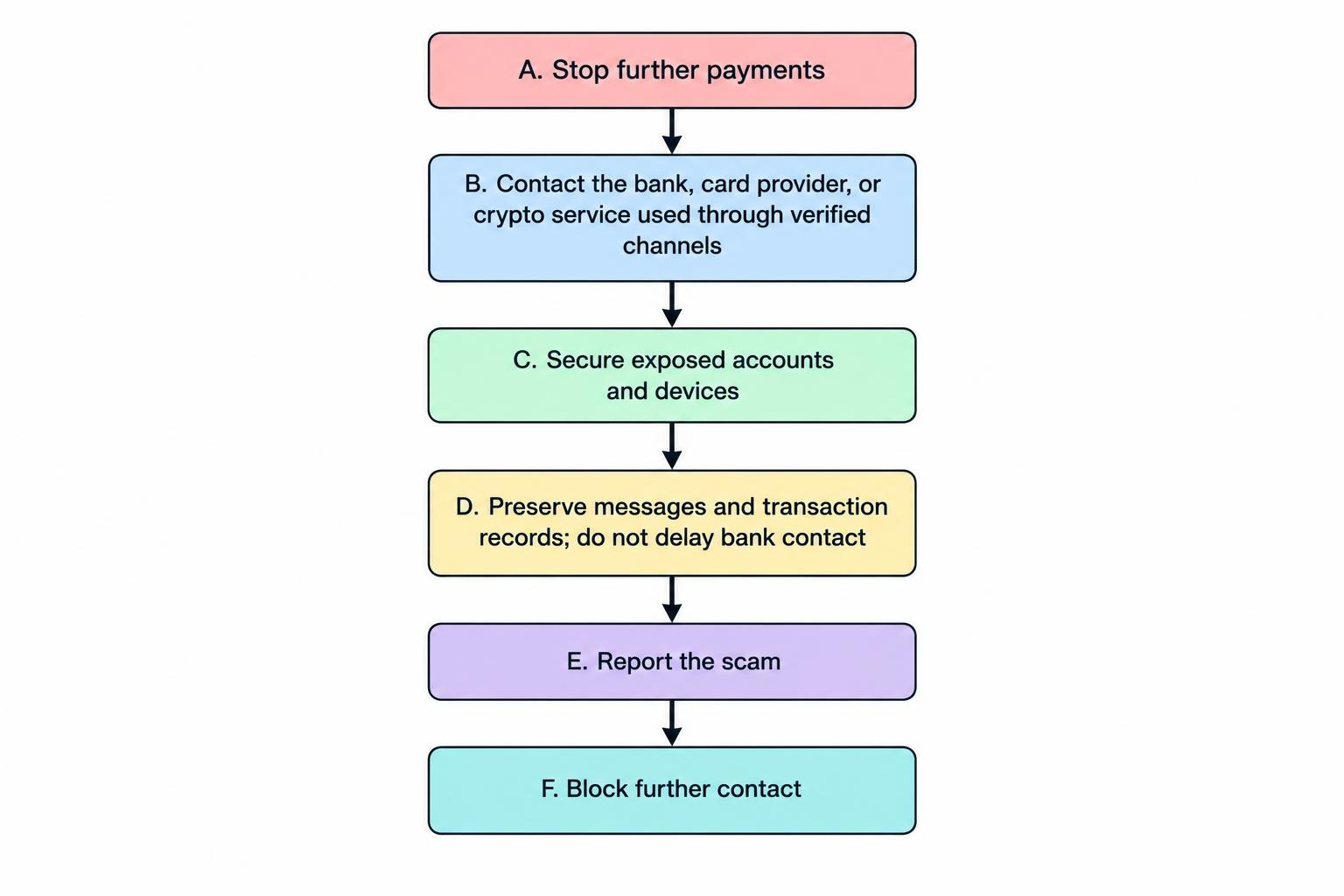
Without delaying the call to your bank, save the material already available: the original advertisement, profile and group identifiers, messages, payment instructions, receipts, transaction references and withdrawal demands. Keep full conversations where possible rather than only the most alarming sentence.
Create a short timeline connecting the promises to the payments. Note when you joined, what you were asked to do, what you sent and what happened when you requested withdrawal. Keep bank-confirmed transfers separate from balances shown only inside the platform.
Report the scam to Scamwatch and report the accounts and advertisements through the relevant social media service. Do not remain in the group to confront its operators or warn every member individually. Save what you have, then block contact. The guide to what to do after a binary options scam provides a broader response checklist.
Do Not Buy a Second Promise to Fix the First
After a scam, be wary of unsolicited offers to recover the loss for a fee. Follow-up scammers may describe their charge as a tax, retainer, deposit or refundable insurance bond. Moneysmart’s recovery guidance warns about these further payment demands.
Apply the same independent checks to a recovery approach that should have applied to the original promotion. Someone knowing the group’s name or the amount you lost does not establish that they represent a regulator, investigator or legitimate professional.
Do not pay someone who contacts you through comments or private messages claiming they can retrieve the funds. Our guide to trading fund recovery scams examines that follow-up risk.
If you are helping someone else, focus on the next safe action rather than arguing about every claimed winning trade. Offer to sit with them while they contact their bank and organise the evidence. The immediate objective is to prevent another payment, not to win a debate with the group administrator.
This article was last updated on: October 22, 2026