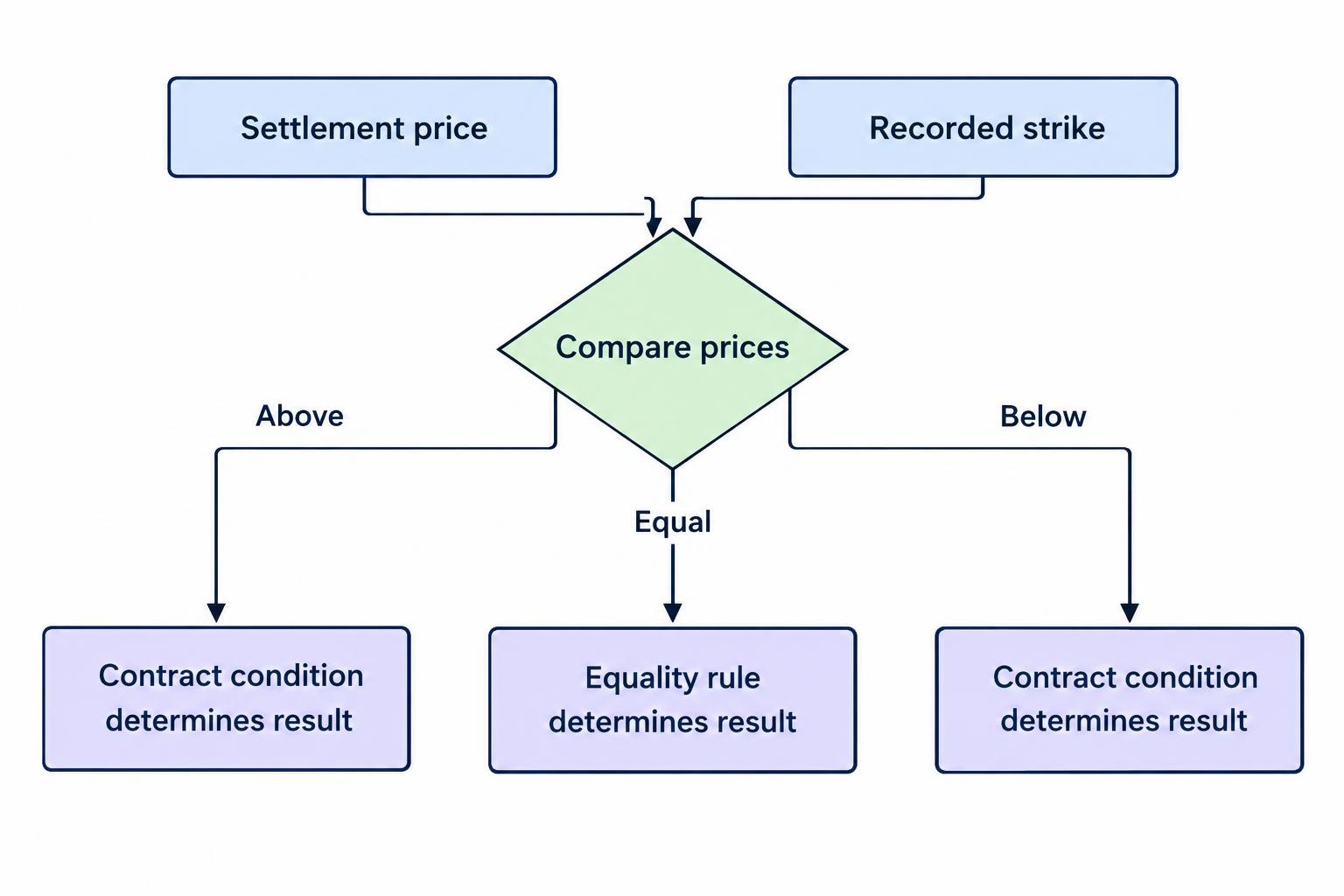
A binary options strike price is the reference level used to decide whether a contract’s price condition has been met. In a simple expiry based contract, the settlement price is compared with the strike: above it, below it, or equal to it under the contract’s rules.
The distinction matters because predicting a rising market is not always enough. A price can rise and still finish below the required strike. Equally, a falling market can remain above a strike set earlier.
Australian retail restriction: ASIC bans the issue and distribution of binary options to retail clients. The ban took effect on 3 May 2021 and was extended until 1 October 2031. The examples here explain contract mechanics, not a route around that restriction.
What Does the Strike Price Represent?
The strike turns a market forecast into a measurable condition. “EUR/USD will strengthen” is a view. “EUR/USD will settle above 1.0800 at the stated expiry” is a condition that can be checked against a defined price.
That 1.0800 level is the strike. It is quoted in the underlying market’s units: an exchange rate for a currency pair, index points for an index, or a price per share for a share based contract.
Despite the options terminology, the strike does not give a binary option holder the right to buy or sell the underlying asset. The payoff depends on the contract’s yes/no condition, rather than an asset purchase at that level. This distinction forms part of the SEC’s definition of binary options.
For a straightforward “finish above” contract, the question is whether the settlement value clears the strike. How far it clears that level does not increase the agreed expiry payment.
Strike Price, Stake and Contract Price Are Different
Several numbers can appear on a contract screen. They do different jobs, and treating them as interchangeable makes the contract harder to assess.
The strike price defines the threshold. The stake or purchase price is the amount paid to enter the position. The payout is the amount returned if the required condition is met. The settlement price is the underlying market value used to decide the outcome.
Consider a hypothetical contract asking whether an index will finish above 8,000 points. Suppose it costs A$40 and returns A$100 if successful. The strike is 8,000, not A$40 or A$100. A successful outcome produces A$60 profit before fees because the A$100 payment includes recovery of the purchase cost.
In a percentage return format, a A$100 stake might instead offer A$80 profit plus the stake back. Neither figure tells you where the underlying market must finish. That information comes from the strike and the condition attached to it.
How Binary Options Strike Prices Are Set
A strike established when the trade is accepted
An up/down contract may use a reference price established at acceptance. Under that design, the contract asks whether the settlement price will be higher or lower than its starting reference.
Suppose a hypothetical EUR/USD “higher” contract records a strike of 1.08002. The relevant comparison is against 1.08002, even if the chart showed 1.08000 just before submission. If settlement is 1.08001, the price is above that earlier chart quote but below the recorded strike.
This is why the accepted contract record matters more than a remembered screen price. The quote visible before submission and the reference recorded at acceptance need to be checked separately. The distinction is covered further in binary options execution and latency.
A strike selected from preset levels
Other contract designs offer several thresholds rather than setting the strike from the current market price. A hypothetical index at 8,020 could have contracts asking whether it will finish above 8,000, 8,025 or 8,050 at the same expiry.
Those are different propositions. Finishing above 8,000 does not require the index to rise from 8,020; finishing above 8,050 does. ASIC’s analysis of OTC binary options distinguishes up/down contracts from contracts quoted across a range of strikes with different exercise probabilities.
A new contract can have a different strike. That does not mean the strike on an existing, unchanged contract moves whenever the market quote changes.
Worked Example: Comparing Settlement with the Strike
Assume a hypothetical EUR/USD contract has a strike of 1.0800 and is held until expiry. The “higher” condition requires settlement strictly above the strike; the “lower” condition requires settlement strictly below it. Equality is handled separately.
| Settlement price | Relationship to 1.0800 | Strictly higher condition | Strictly lower condition |
|---|---|---|---|
| 1.0799 | Below the strike | Not met | Met |
| 1.0800 | Equal to the strike | Apply the equality rule | Apply the equality rule |
| 1.0801 | Above the strike | Met | Not met |
| 1.0850 | Further above the strike | Met | Not met |
Settlement at 1.0801 and 1.0850 satisfies the same “higher” condition. The larger move does not earn an extra expiry payment under this fixed payout example.
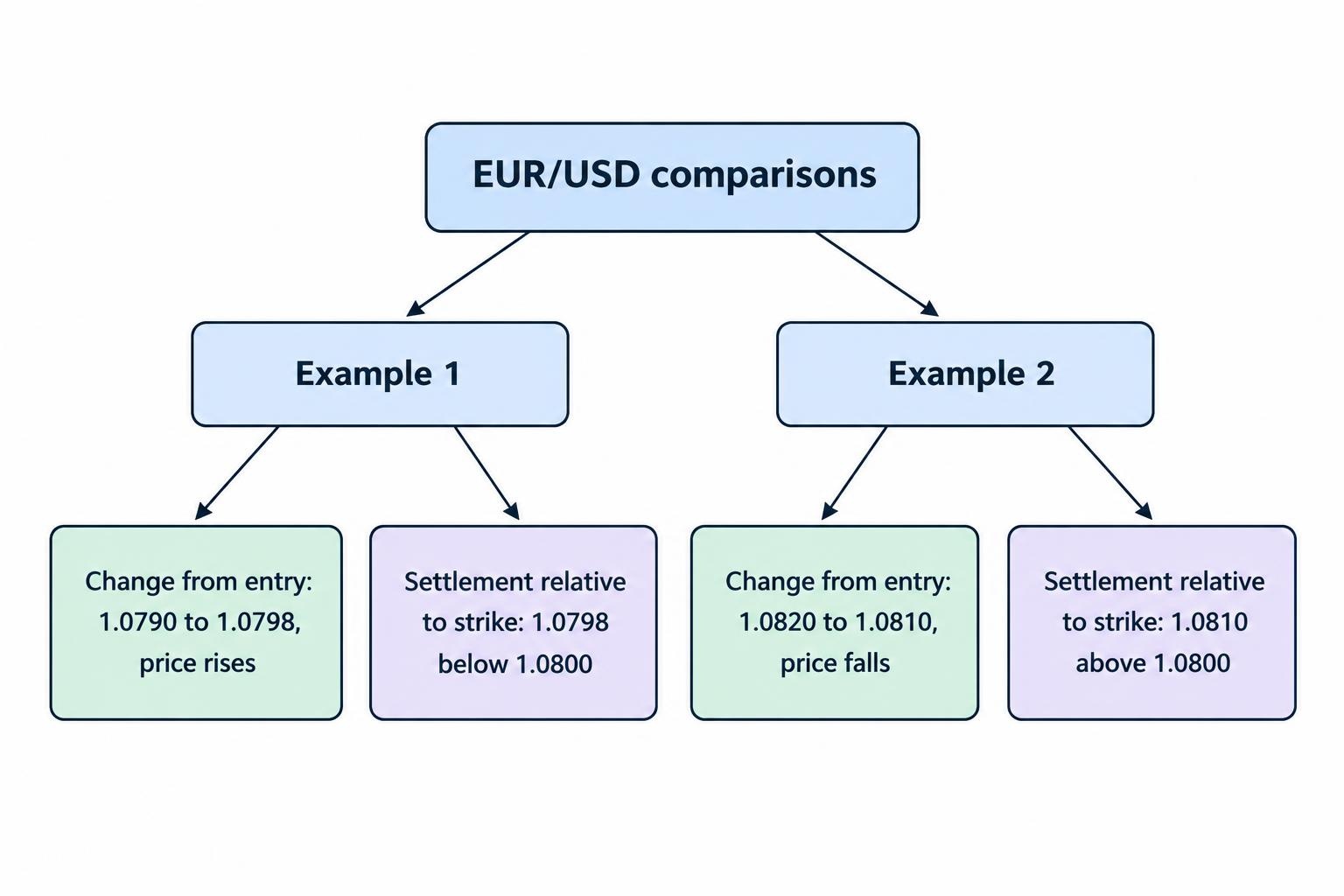
Now separate the strike from the price observed when entering. Suppose EUR/USD is 1.0790 when someone considers a preset strike of 1.0800. It later settles at 1.0798. The currency pair rose, but the “above 1.0800” condition still failed.
The reverse can happen too. With the same strike, an entry observation of 1.0820 followed by settlement at 1.0810 means the market fell but still finished above the threshold. Direction from entry and position relative to the strike are not the same calculation.
In the Money, At the Money and Out of the Money
These terms describe the relationship between the underlying value and the strike. For a strictly “finish above” condition, a value above the strike is in the money, a value below it is out of the money, and an equal value is at the money. Reverse the above/below relationship for a strictly “finish below” condition.
Before expiry, these labels describe the current position, not a settled result. A higher contract can be in the money with two minutes remaining and finish out of the money. The market has not agreed to stay put.
Being in the money also does not measure how attractive the contract was at its purchase price. That requires considering what was paid, the possible payment and the chance of receiving it. A favourable position relative to the strike does not answer all three questions.
What Happens When Settlement Equals the Strike?
Equality needs an explicit rule. “Above 1.0800” and “at or above 1.0800” are different conditions. The same distinction applies to “below” and “at or below”.
Do not assume that an equal result automatically returns the stake. As a concrete example, the binary index option definitions reproduced in an SEC notice containing Cboe’s binary option rules give a call its settlement payment when the underlying settlement value is at or above the exercise price, while a put requires a value below it. That treatment belongs to those rules; it is not a universal convention.
Displayed precision can create another apparent tie. A strike of 1.08004 and settlement of 1.08003 both display as 1.0800 when rounded to four decimal places. At their full precision, however, settlement is below the strike.
Check whether the contract applies its comparison before or after rounding. A chart label that appears equal is not enough to establish an equal settlement.
Distance from the Strike Depends on Time and Price Movement
A strike’s distance from the current market price is useful only with context. An index 20 points below its strike has a different task with several hours remaining than with a few seconds remaining.
For an otherwise identical “finish above” contract, a lower strike is easier to satisfy than a higher one: every settlement above the higher strike also clears the lower strike. That logical relationship does not make the lower strike risk free or better value.
Time and the range of possible price movements affect how much confidence to place in the current gap. More movement can help an out of the money contract cross its threshold, but it can also remove the apparent cushion on an in the money contract.
The comparison must use the actual expiry, not a convenient chart interval. A five minute candle and a contract expiring at a stated clock time need not end together. The guide to binary options expiry times covers that distinction without changing the basic strike calculation.
A More Favourable Strike Is Not Automatically Better Value
The strike determines the condition; the payment terms determine the financial reward for satisfying it. Those must be assessed together.
Consider a hypothetical A$100 stake that earns A$80 net profit on success and loses A$100 on failure. Ignoring fees and assuming no refunds or ties, the break even success rate is:
A$100 ÷ (A$100 + A$80) = 55.56%.
A contract that appears slightly more likely than not to finish on the required side of its strike could still fall short of that rate. With a smaller profit per successful contract, the required success rate rises.
There is no automatic shortcut from “this strike looks easy” to “this contract has positive value”. The missing number is a defensible probability estimate, not another decimal place on the chart. The fuller calculation belongs in probability and expected value in binary options.
The Strike Must Be Compared with the Correct Price
A correct threshold comparison can still produce the wrong answer if it uses the wrong settlement input. The contract needs a stated reference market, price source, observation time and calculation method.
Ask whether the reference is a cash market or a futures contract. Check whether the relevant quote is a bid, ask, midpoint, last transaction or calculated value. Do not substitute a familiar chart just because its instrument name looks similar.
For a hypothetical illustration, suppose the strike is 8,000 and the designated settlement value is 7,999.8. An unrelated chart showing 8,000.2 does not establish that an “above 8,000” contract succeeded. First establish whether both figures represent the same market, timestamp and methodology.
This issue becomes especially visible near the threshold, where a small difference changes the outcome. The guide to price feeds and benchmarks addresses how to compare those inputs. The strike itself cannot resolve a mismatch between them.
How to Check a Strike Price in a Contract Record
When reviewing an educational example, demo record or disputed historical trade, reduce the contract to five checks:
- Threshold: What exact strike was recorded, including decimal places?
- Condition: Does it require above, below, at or above, or at or below?
- Timing: What expiry and time zone apply?
- Reference: Which price source and settlement calculation govern the comparison?
- Equality: What happens if the governing settlement value equals the strike?
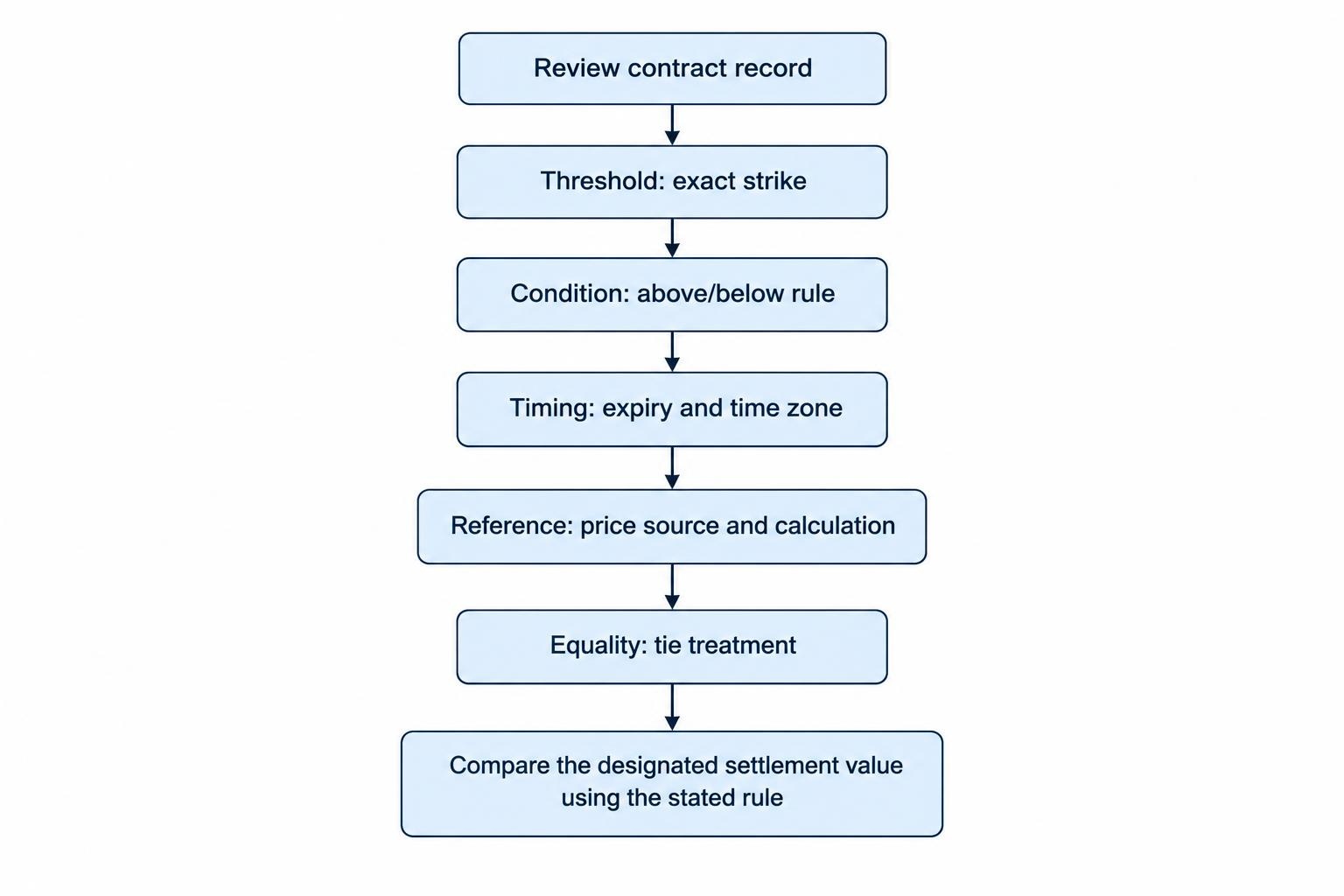
Keep those checks separate from the stake and advertised profit percentage. Where equality or rounding remains unclear, consult the contract terms alongside the explanation of binary options settlement and ties.
A strike price is a threshold, not a forecast, a stop loss or a guarantee. Read it with the condition, expiry and settlement method. Only then does “above or below” become a complete question.
This article was last updated on: October 22, 2026