Binary options worked examples make the arithmetic clearer: what leaves the account, what comes back, and what counts as profit. The examples below cover higher and lower contracts, ties, touch conditions, range contracts and a sequence of mixed results. Every price, payout and account balance is hypothetical.
For Australian readers: ASIC’s prohibition on issuing and distributing binary options to retail clients took effect on 3 May 2021 and has been extended until 1 October 2031. These are educational paper exercises, not instructions to access a trading platform. See ASIC’s binary options ban extension.
Calculation rules used in these examples
A binary option settles against a stated condition, rather than paying a profit proportional to the underlying asset’s price movement. It also does not give the holder a right to buy or sell that asset. The joint CFTC and SEC binary options investor alert describes this fixed outcome structure.
Unless an example says otherwise, all account amounts are in Australian dollars. An “80% payout” means a winning contract earns profit equal to 80% of its stake, with the stake also returned. A losing contract returns nothing. There are no fees, rebates, early exits or currency conversion charges.
For this model:
- Winning profit: stake × payout percentage.
- Total winning return: stake + winning profit.
- Losing result: minus the entire stake.
These definitions matter because “return” and “profit” are not interchangeable. Getting A$180 back after committing A$100 produces A$80 profit, not A$180. The original stake has come home; it has not earned itself a second time.
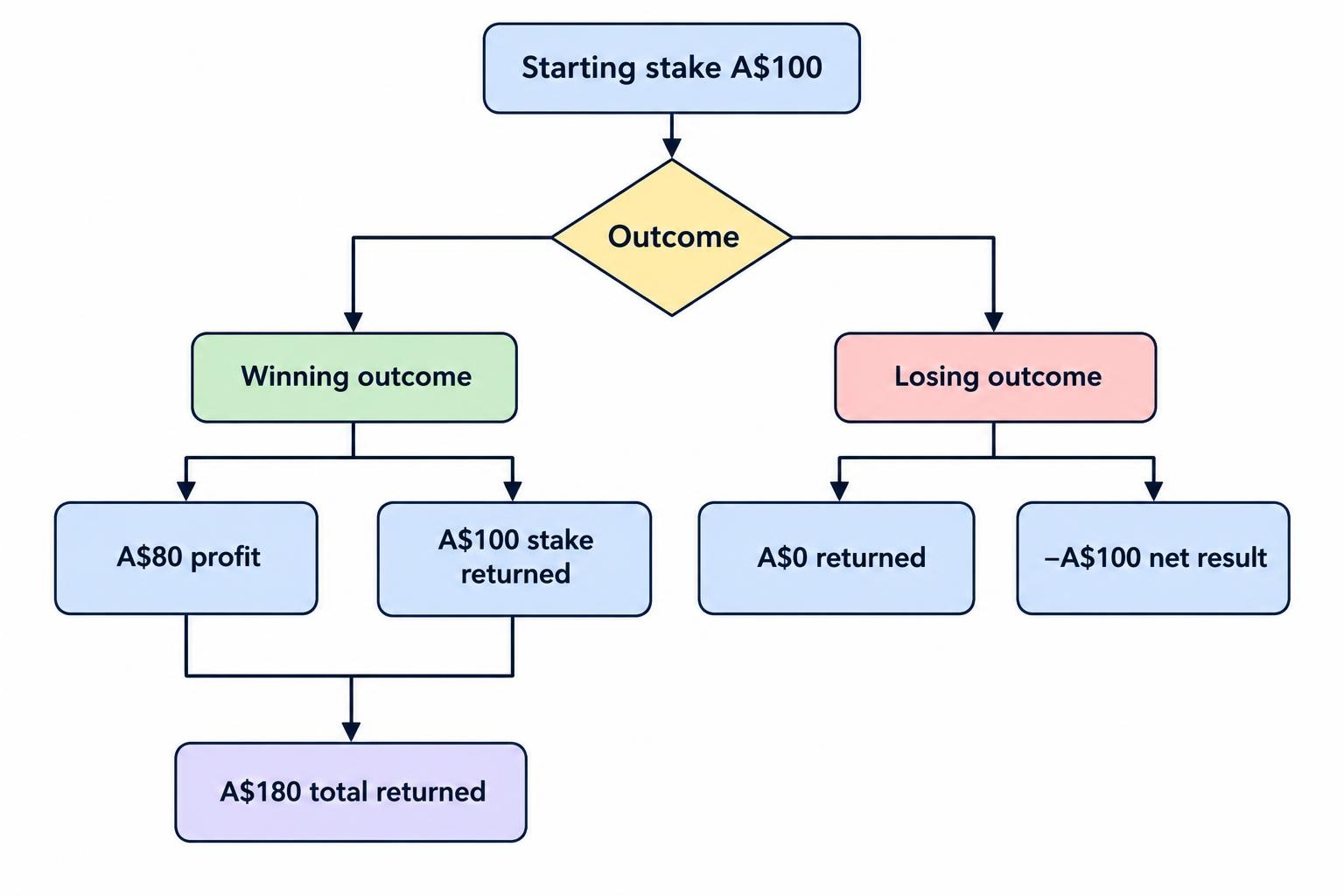
Example 1: A higher contract that wins
Suppose a paper contract asks whether AUD/USD will finish strictly above 0.65000 at 10:05 UTC. The hypothetical entry is at 10:00 UTC, the stake is A$100 and the profit payout is 80%.
At expiry, the contract’s designated settlement price is 0.65012. That satisfies the condition because 0.65012 is above 0.65000.
Profit = A$100 × 0.80 = A$80.
Total returned = A$100 + A$80 = A$180.
If the paper account started with A$1,000, committing the stake would leave A$900 available. Settlement would then credit A$180, taking the balance to A$1,080.
Under these terms, settlement at 0.65200 would produce exactly the same A$80 profit. A larger favourable move does not increase the payment. Conversely, finishing only slightly above the strike does not reduce it.
The exchange rate is the reference used to decide the outcome; it is not the account currency. There is no need to convert the A$100 stake into US dollars in this exercise. The separate guide to binary options payouts covers the distinction between profit percentages and total cash returned.
Example 2: A lower contract that loses
Now consider a paper contract requiring EUR/USD to finish strictly below 1.08000 at 14:30 UTC. The stake is A$75 and the profit payout is 80%.
During the contract, EUR/USD falls to 1.07970. It then rises, with the designated settlement price recorded at 1.08002.
The contract loses. Its condition concerns the price at expiry, not whether the market traded below the strike at some earlier moment.
Amount returned = A$0.
Net result = −A$75.
The loss is not calculated from the distance between 1.08000 and 1.08002. Under the assumed terms, a small miss and a large miss both lose the same A$75 stake.
This is also why a chart showing that the prediction was briefly correct does not establish a winning result. The condition must be satisfied at the time the contract specifies.
Example 3: The price finishes exactly at the strike
Take another A$100 higher contract with a strike of 0.65000 and an 80% profit payout. This time, the full precision settlement value is exactly 0.65000.
There is no complete answer until the equality rule is known. Consider two hypothetical versions of the contract.
Version A: Equality refunds the stake
The terms require a finish strictly above the strike to win, but separately state that an exact tie returns the stake.
Amount returned = A$100.
Net result = A$0.
This is neither an A$80 win nor an A$100 loss. A paper journal should record it as a refund, rather than forcing it into the win or loss column.
Version B: Equality is a losing outcome
The terms require a finish strictly above the strike and provide no tie refund. Equality does not satisfy the winning condition.
Amount returned = A$0.
Net result = −A$100.
Also separate displayed prices from settlement values. If a hypothetical chart rounds to five decimal places, two displayed numbers can look identical even when their full precision values differ. Record the applicable rule and precision before deciding the result. The guide to binary options settlement and ties examines these distinctions.
Example 4: A touch wins even though the price retreats
Suppose a paper one-touch contract uses gold as its reference market. The starting price is US$2,500 per ounce, the target is US$2,505, the stake is A$40 and the profit payout is 150%.
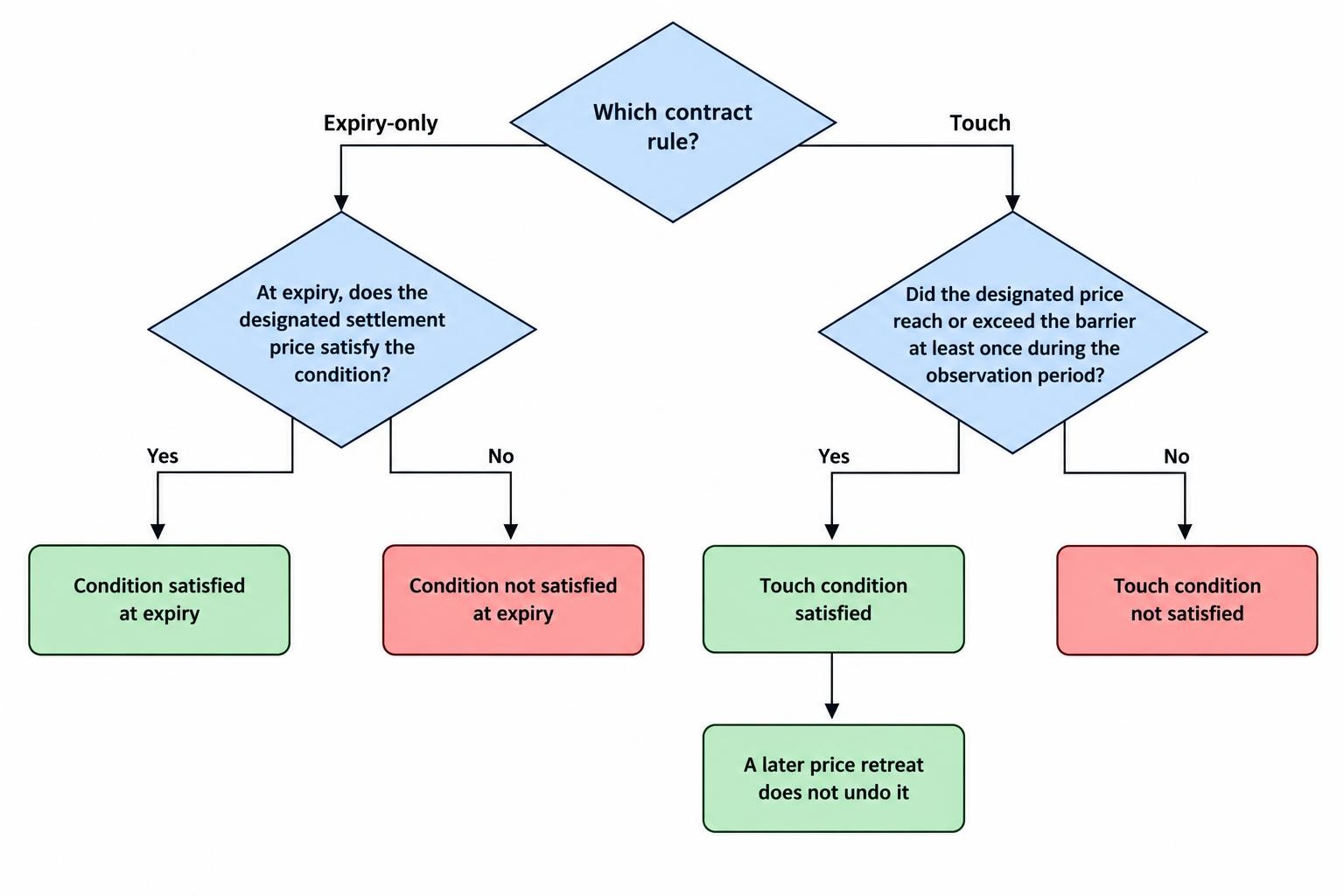
The assumed rule is precise: the designated price must reach or exceed US$2,505 at least once during the observation period.
Gold reaches US$2,505.20 halfway through the period, then finishes at US$2,501. The touch condition has been satisfied despite that retreat.
Profit = A$40 × 1.50 = A$60.
Total returned = A$100.
For a hypothetical no-touch contract using the same barrier and observation period, that same price path would lose because the barrier was reached. Its result would not be rescued by finishing below the barrier.
This contrasts with Example 2. An expiry-only condition asks where the price finishes; a touch condition asks whether a qualifying event occurred during the observation period. The broader guide to types of binary options compares these contract structures.
Example 5: An inside-range contract
Consider a paper contract that wins if an index settles strictly between 4,850 and 4,900 at expiry. The stake is A$60 and the profit payout is 70%.
The designated settlement value is 4,899.90. It falls inside the stated interval.
Profit = A$60 × 0.70 = A$42.
Total returned = A$102.
Suppose the index had briefly reached 4,910 earlier. That would not change this result because the assumed contract tests the range only at expiry.
A different contract requiring the index to remain inside the range throughout the observation period would fail on that same path. Those are different conditions, even though both might be described casually as “range” contracts.
Under this example’s strict boundaries, settlement at exactly 4,850 or 4,900 would also fail. Write down whether each boundary is included; do not leave the answer to the appearance of a shaded chart.
Example 6: The same prediction, but a smaller payout
Take two hypothetical A$100 contracts with identical winning conditions. Contract A offers an 80% profit payout. Contract B offers 65%.
If both win, Contract A earns A$80 and returns A$180. Contract B earns A$65 and returns A$165. The difference is A$15, even though the market outcome is identical.
Now assume a two-contract sequence containing one win and one loss, with equal A$100 stakes:
At 80%: A$80 − A$100 = −A$20.
At 65%: A$65 − A$100 = −A$35.
A 50% win rate loses money under both sets of terms. The smaller payout makes the loss larger.
For paper exercises, record the payout assigned before the outcome is known. Replacing it afterwards with a more attractive percentage changes the exercise rather than improving the result.
Example 7: Calculating the break even win rate
Continue with equal A$100 stakes, an 80% profit payout and complete stake loss on unsuccessful contracts. Exclude ties and fees.
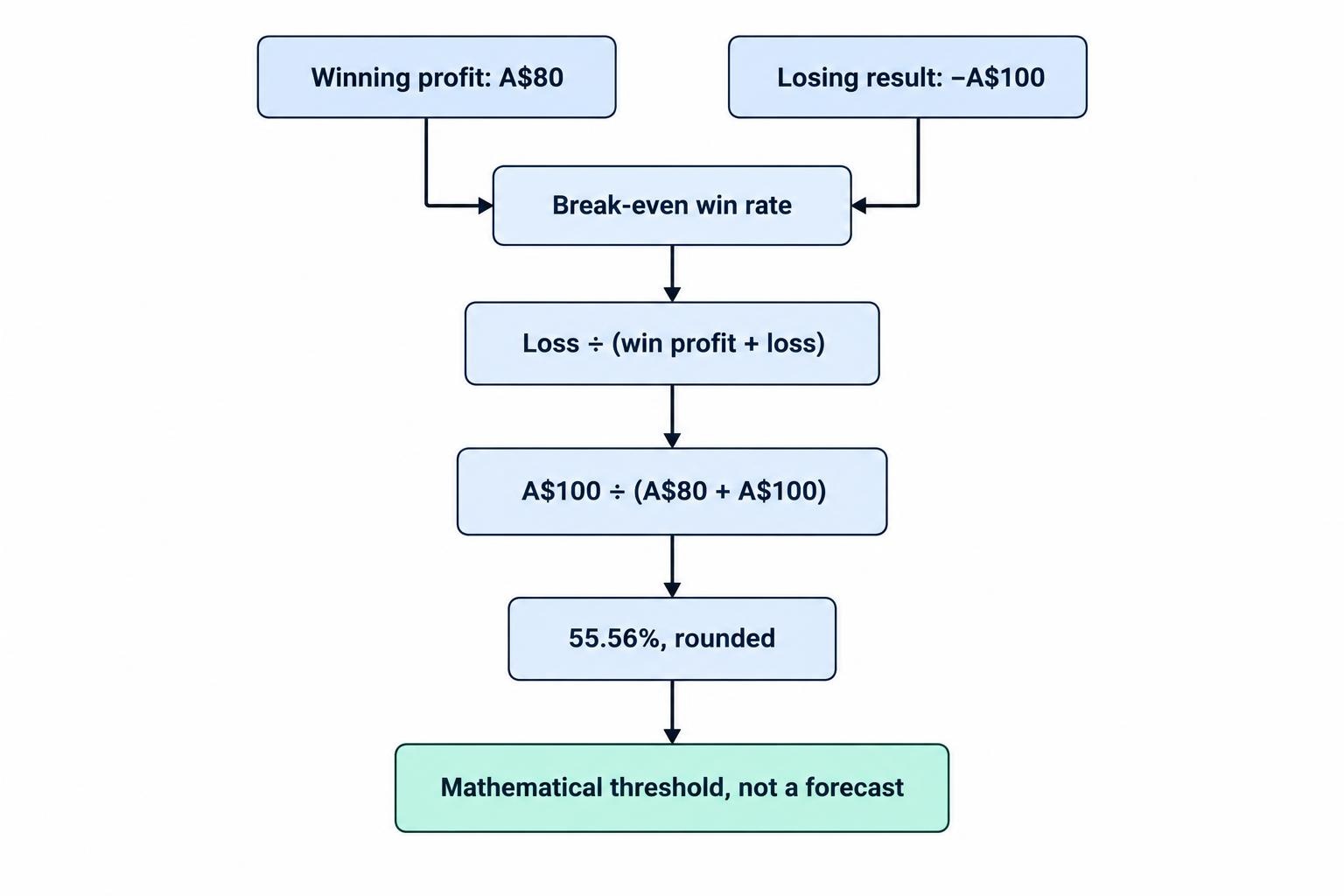
Each win adds A$80; each loss subtracts A$100. The break even calculation is:
Break even win rate = loss per losing contract ÷ (profit per winning contract + loss per losing contract).
A$100 ÷ (A$80 + A$100) = 55.56%, rounded.
That is a mathematical threshold, not a forecast of achievable accuracy. Nor does an 80% payout mean an 80% probability of winning.
Across ten hypothetical contracts, five wins and five losses produce:
(5 × A$80) − (5 × A$100) = −A$100.
Six wins and four losses produce:
(6 × A$80) − (4 × A$100) = +A$80.
If the true chance of winning were assumed to be 50%, the expected result per contract would be:
(0.50 × A$80) − (0.50 × A$100) = −A$10.
An individual contract cannot settle at minus A$10 under these assumptions. Expected value is the probability-weighted average, not a third settlement outcome. The guide to probability and expected value in binary options develops that calculation further.
Example 8: Following five contracts through an account
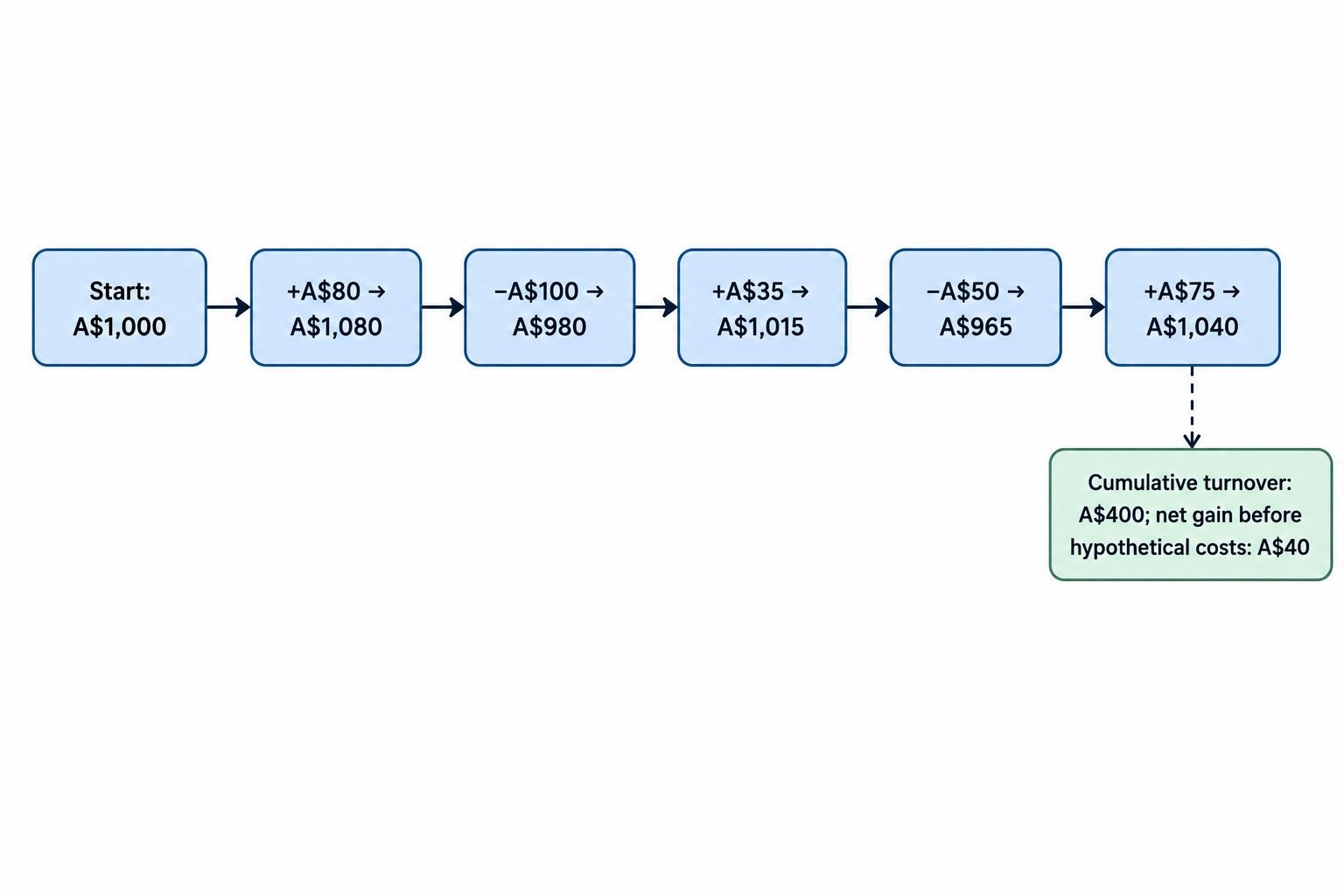
A paper account starts at A$1,000. Each contract settles before the next begins, there are no refunds or fees, and payouts are recorded as profit percentages.
| Contract | Stake | Payout | Outcome | Total returned | Net result | Closing balance |
|---|---|---|---|---|---|---|
| 1 | A$100 | 80% | Win | A$180 | +A$80 | A$1,080 |
| 2 | A$100 | 80% | Loss | A$0 | −A$100 | A$980 |
| 3 | A$50 | 70% | Win | A$85 | +A$35 | A$1,015 |
| 4 | A$50 | 70% | Loss | A$0 | −A$50 | A$965 |
| 5 | A$100 | 75% | Win | A$175 | +A$75 | A$1,040 |
The total amount staked is A$400. Total returns are A$440, leaving A$40 profit. The same answer comes from adding the net results: A$80 − A$100 + A$35 − A$50 + A$75.
Three of five contracts won, giving a 60% win rate. That percentage alone does not explain the account result because stakes and payouts varied. The 55.56% threshold from Example 7 cannot simply be applied to this mixed ledger.
Nor is A$400 the account loss. It is cumulative turnover: money committed across the sequence. Keep turnover, returned cash and net profit in separate columns.
Adding hypothetical account costs
Suppose the completed account cycle also incurs A$3 in currency conversion costs and an A$5 withdrawal charge. These are invented charges for the exercise, not quoted provider fees.
Result after those costs = A$40 − A$3 − A$5 = A$32.
Deduct each charge once at the level where it occurs. A single withdrawal fee should not be subtracted from every contract as well.
How to check a worked example
A useful exercise should let another reader reproduce the answer without guessing. Record the condition, strike or barrier, observation period, expiry time and time zone, settlement price rule, stake, payout and treatment of equality.
Then separate three questions: did the condition occur, what cash does that outcome return, and what is the net account change? Keeping those steps apart catches errors such as counting returned stakes as profit or treating an earlier favourable price as an expiry win.
You can repeat these calculations on paper or in a spreadsheet without depositing money. The binary options practice exercises provide a related route for checking the mechanics rather than treating a short winning sequence as proof of a profitable method.
Correct arithmetic does not establish that a platform is lawful or that a displayed balance can be withdrawn. Australian retail readers should keep these examples educational: Moneysmart’s binary options warning confirms the retail ban and warns that offers to trade may be scams.
This article was last updated on: October 22, 2026