A stop loss in binary options is not automatically the same tool as a stop order used for shares or other traded contracts. Some binary options provide an early exit facility; others must run to settlement. Even where an exit is available, the amount recovered depends on the contract terms and the executable closing price.
The practical rule is to budget for losing the full stake, not the smaller loss you hope to achieve through early closure. An exit plan can guide a decision. It cannot create an exit right that the contract does not provide.
For Australian readers, ASIC’s prohibition on issuing and distributing binary options to retail clients took effect on 3 May 2021 and extends until 1 October 2031. The examples below explain risk mechanics, not a route around the Australian retail binary options ban.
Can You Set a Stop Loss on Binary Options?
There is no universal binary options stop loss. Whether an automatic closing instruction exists, what triggers it and whether it can execute all depend on the product and its trading rules.
In share trading, a conventional stop order becomes a market order when its trigger price is reached. The trigger is not a guaranteed sale price. A stop limit order adds a price restriction, but may remain unfilled. These distinctions are covered in FINRA’s guidance on stop order execution risks; they do not establish that equivalent orders are available for a binary option.
For binary options, separate three different arrangements:
- A mental stop: a decision to attempt an exit when a condition occurs. Nothing executes automatically.
- A manual early close: a request to end the contract at an available closing quote.
- An automatic exit instruction: a supported order or platform function operating under its own trigger and execution rules.
A chart alert is not an exit order. Nor does a button labelled “sell” establish that a particular recovery amount is guaranteed. The useful question is not whether a platform mentions stop losses, but what happens after the trigger or request.
Why the Full Stake Remains the Planning Loss
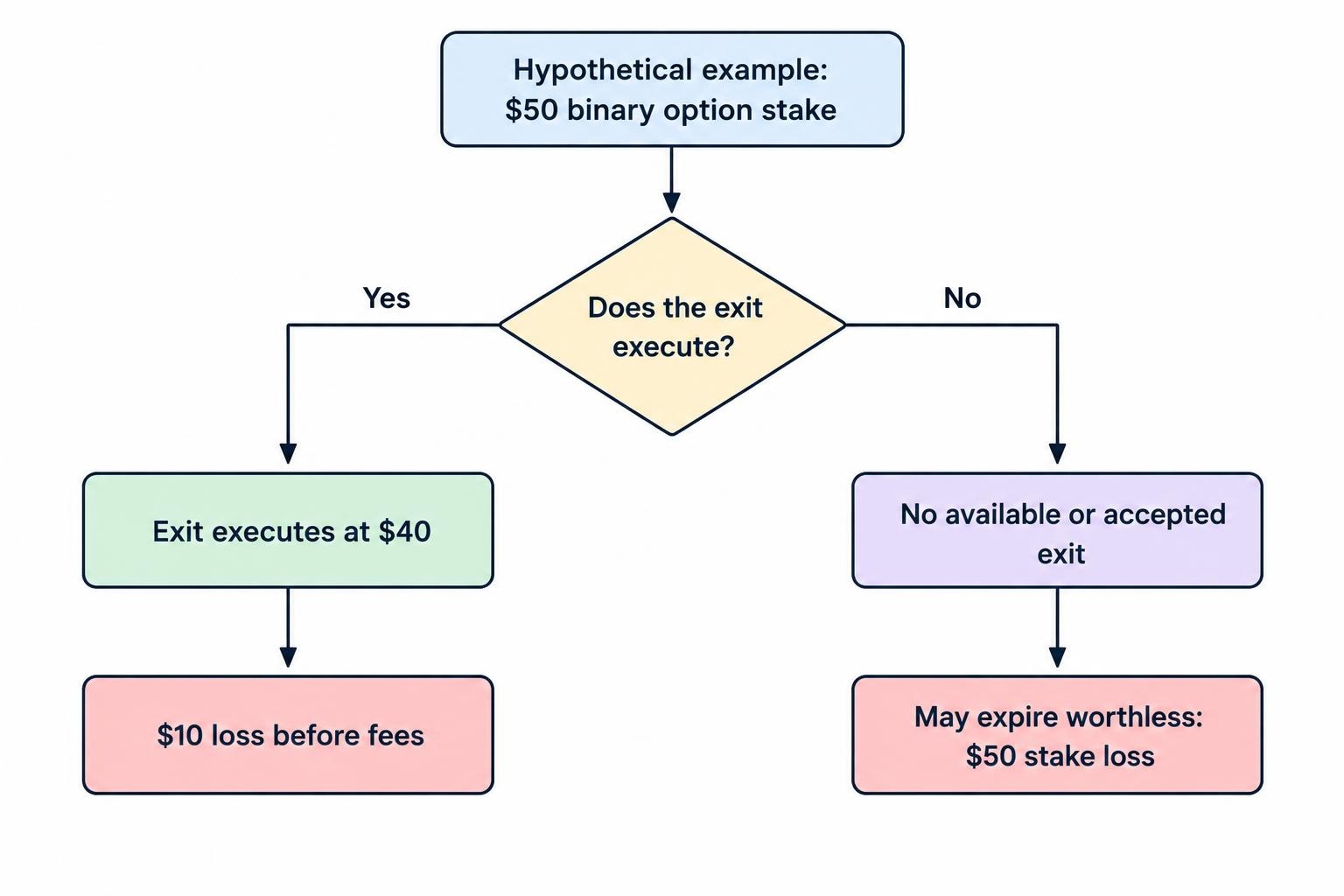
Consider a hypothetical $1,000 practice account and a $50 binary option stake. The plan is to close the position if its recoverable value falls to $40. That would produce a $10 loss, before any fees.
Calling this “1% account risk” assumes the exit succeeds at exactly that value. If no closing quote is available, or the request fails, the contract could instead expire worthless. The loss would then be $50, or 5% of the account.
Both figures have a purpose. The $10 amount describes the intended exit outcome; the $50 amount describes the stake exposed to a complete contract loss. They should not be substituted for one another.
This distinction belongs in any binary options stake sizing calculation. Position size should remain tolerable if the early exit assumption fails. Otherwise, a supposedly cautious plan depends on the least dependable part of the arrangement.
These examples concern purchased, fully funded contracts where the stake is the amount exposed to loss. Fees, different contract structures and other account positions require separate treatment.
What an Early Exit Actually Changes
An early exit exchanges the contract’s remaining conditional payoff for an amount available now. It may reduce a loss, realise a profit or recover the original stake. It does not reverse the original transaction without cost.
Some providers have offered continuous buying and selling prices, allowing a client to surrender the potential expiry payment in return for an earlier payment. This is an optional product feature, not a property of every binary option. The distinction appears in ESMA’s analysis of binary option closing prices and transaction costs.
Suppose a hypothetical contract costs $100 and returns $180 in total if successful: the original $100 plus $80 profit. A losing settlement returns nothing. With no separate closing fee, different early exit receipts produce the following results.
| Amount received on closure | Net trading result | Meaning |
|---|---|---|
| $40 | $60 loss | Some capital recovered |
| $75 | $25 loss | Most of the stake recovered |
| $100 | $0 | Break even before other costs |
| $130 | $30 profit | Profit realised below the successful expiry payoff |
The calculation is straightforward: net result = closing proceeds − original stake − separate closing charges. A $75 receipt with a $2 closing charge means a $27 loss, not a $25 loss.
Why the Chart Does Not Tell You the Exit Value
For a simple above-or-below contract, the underlying market price answers one question: where is the market relative to the strike? It does not, by itself, answer what the contract can be sold for.
A contract can be on the favourable side of its strike and still have a closing value below its purchase cost. There may be time for the market to reverse, and the offered price may contain a spread or other pricing adjustment. Being “in the money” describes the current relationship to the strike, not a guaranteed profitable exit.
In an OTC arrangement, the provider’s quote also matters. Providers control the pricing of their binary option products, a concern highlighted in ASIC’s warning about binary option app pricing. An independent chart is not a promise that the provider will close a contract at a matching value.
Keep three figures separate: the underlying market price, the displayed contract valuation and the proceeds actually available for an accepted closure. Only the last figure belongs in a realised profit or loss calculation.
Comparing Early Exit With Holding to Expiry
“At least I recovered something” is understandable, but it is not a complete test of an exit decision. The relevant comparison is between the net closing amount available now and the estimated value of keeping the contract.
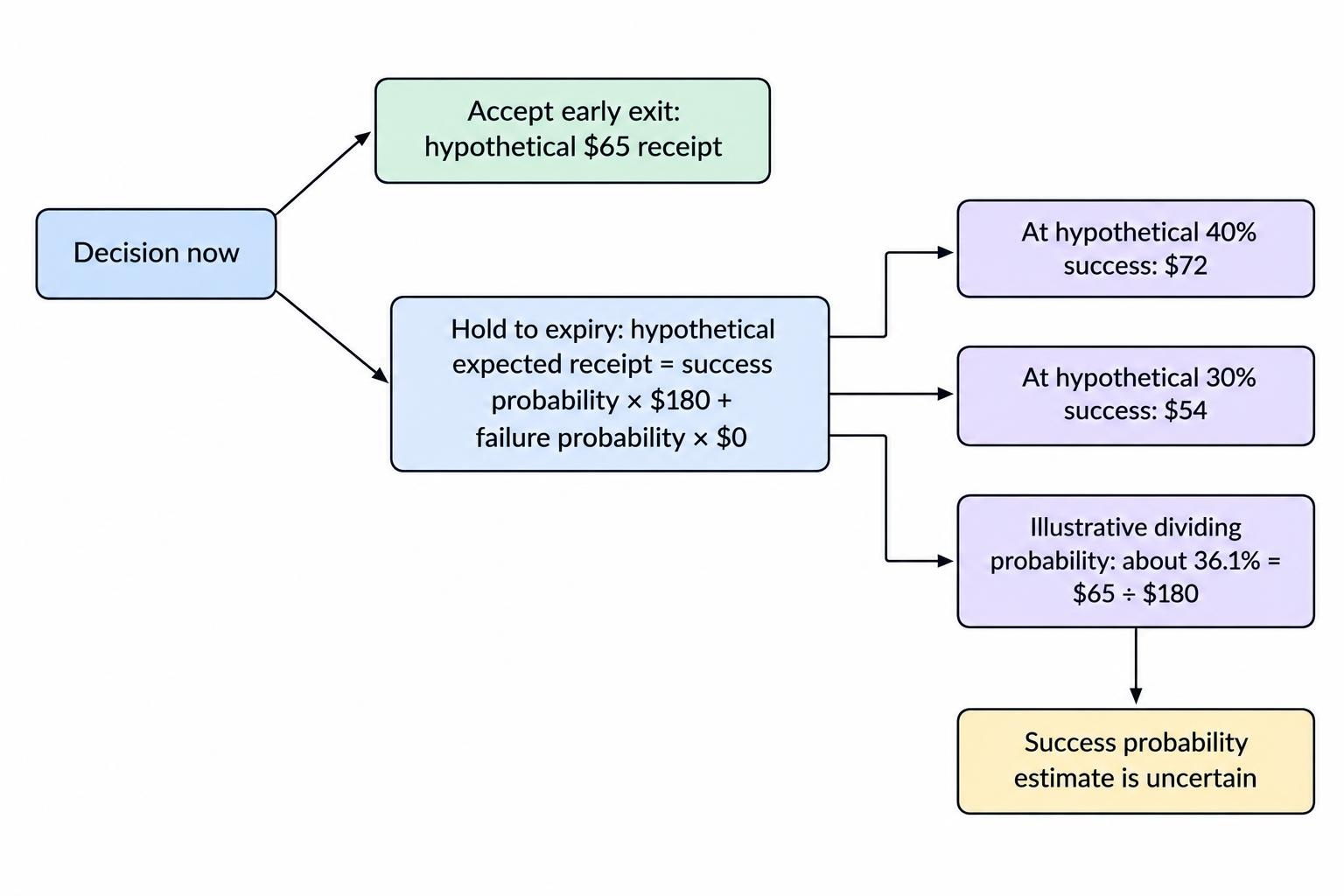
Return to the $100 contract with a $180 successful settlement and zero unsuccessful settlement. Assume an executable early exit would return $65 after closing charges.
If the estimated probability of success from this moment is 40%, the expected settlement receipt is:
0.40 × $180 + 0.60 × $0 = $72.
Under that assumption, holding has a higher expected receipt than taking $65. Relative to the original stake, the expected holding result is a $28 loss, compared with a certain $35 trading loss through the assumed executable exit.
If the estimated chance of success has fallen to 30%, the expected settlement receipt becomes $54. The $65 exit then has the higher expected monetary value.
The dividing point is $65 ÷ $180, or approximately 36.1%. This is an illustrative decision calculation, not a reliable forecasting method. The difficult input is the probability estimate, not the division. The relationship is covered further in probability and expected value in binary options.
The original stake remains relevant when measuring total profit or loss, but it has already been paid. From the current decision point, the comparison concerns what each available choice can return next. A wish to “get back to $100” does not improve either choice.
This simplified calculation assumes two settlement outcomes, no refund, no further costs and a closing quote that can actually be accepted. Tie rules, rebates and different payout structures change the arithmetic. A person may also prefer a certain receipt to an uncertain payoff even when the latter has a higher expected value.
Timing and Execution Can Defeat an Exit Plan
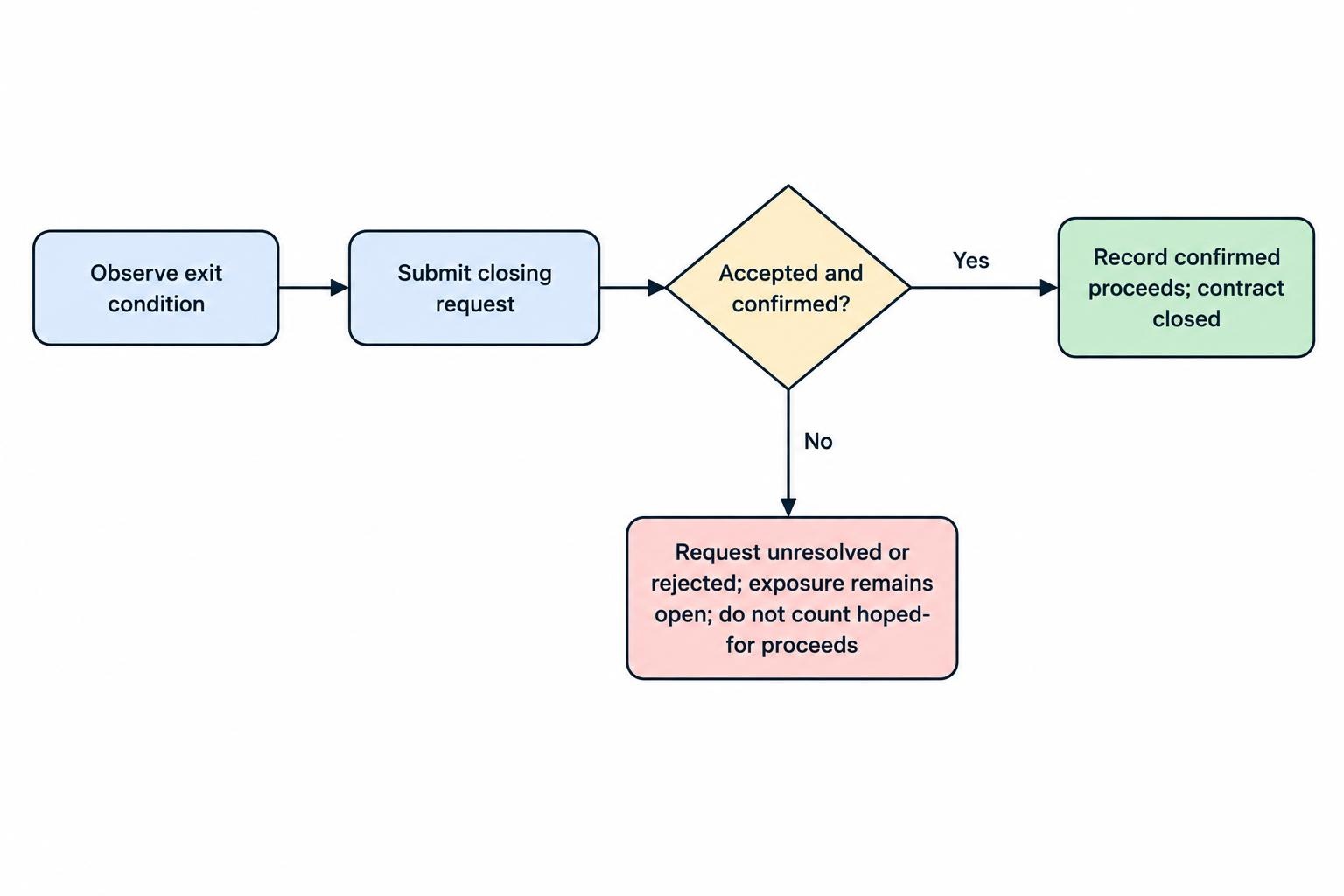
An exit rule is incomplete unless it accounts for the interval between observing a condition and receiving confirmation that the position has closed. During that interval, the quote may change or the closing request may remain unaccepted.
Consider a paper exercise with an intended maximum loss of $30 on a $100 stake. That requires net closing proceeds of at least $70. Seeing $70 on screen is not the same as receiving $70. If the accepted amount is $62, the realised loss is $38.
Before treating any exit facility as a risk control, check its written terms for eligibility, closing deadlines, quote validity and rejection procedures. Establish whether a request accepts the displayed price, asks for a fresh quote or submits an order awaiting execution. Do not assume all three processes are equivalent.
Short contract durations leave less time to detect a problem and respond. The separate guide to binary options execution and latency covers that timing problem in more detail.
For planning purposes, an unconfirmed closure should remain an open exposure. Record the request time and any response, but do not count the hoped-for proceeds as realised money.
Closing a Trade Does Not Remove Platform Risk
A completed early exit addresses the market exposure of that contract. It does not prove that the account balance is accurate or that money can be withdrawn.
Complaints involving binary option platforms have included denied withdrawals, refusal to credit accounts and software manipulation. These are documented in the joint CFTC and SEC binary options fraud alert. An attractive closing quote cannot compensate for a provider that fails to honour its obligations.
That distinction matters when assessing claims such as “you can always cash out.” Cashing out of a position and withdrawing money from an account are different events. Evidence of one does not establish the other.
If a platform disputes an exit, preserve the contract identifier, applicable terms, timestamps, displayed quote and confirmation messages. Avoid trying to repair an execution dispute by placing another trade. A second position does not resolve what happened to the first.
An Opposite Trade Is Not Necessarily an Exit
Buying an opposite binary option generally creates another contract unless the trading system expressly treats the transaction as closing the original position. Two open positions are not the same as one closed position.
Consider two hypothetical, strictly complementary contracts with the same strike, expiry and settlement rules. Each costs $50 and pays $90 in total when successful. If exactly one wins, the combined receipt is $90 against a combined cost of $100: a $10 loss.
That example assumes perfect alignment. Different strikes or expiry times can leave outcomes where both positions lose. Different tie provisions can also change the result.
The same distinction applies to rollover and double-up features. Changing an expiry or increasing a stake changes the exposure; it does not automatically reduce it. Judge the resulting obligations and possible losses, not the reassurance implied by the feature’s name.
Testing an Exit Rule Without Assuming It Works
A useful paper test compares a defined exit rule with a defined hold-to-expiry rule. Use the same starting trades for both. Otherwise, differences in entry selection can be mistaken for benefits from the exit.
Write the proposed trigger before observing the outcome. It might depend on contract value, an underlying price level or elapsed time. State which price feed supplies the trigger and what should happen when no executable closing quote exists.
Record intended closing proceeds separately from confirmed or realistically modelled proceeds. In a simulation, label an unverified quote as an assumption. Do not award the strategy a perfect exit simply because the chart crossed the chosen level.
Compare net results, average loss, average profit, total costs and failed exit attempts. Win rate alone is inadequate. A rule that repeatedly takes small profits while leaving occasional full stake losses untouched can look reassuring without improving the result.
Also keep unsuccessful closure attempts in the record. Removing them would test an imaginary facility that always works, rather than the arrangement being assessed.
Early exit belongs inside a broader binary options risk management framework, alongside stake size and total open exposure. Its role is conditional: it may change an individual outcome when the contract permits closure and the transaction executes. It should never be the assumption that makes an otherwise unaffordable stake appear acceptable.
This article was last updated on: October 22, 2026