A binary options price feed and settlement study asks whether a contract’s result can be reconstructed from its published rules and underlying price data. Two charts looking different is not enough to answer that question. The comparison must use the same instrument, price type, timestamp and settlement method.
Scope: This article reviews published institutional material and sets out a reproducible assessment method. It does not report original platform testing, measured error rates or broker rankings. All numerical examples are hypothetical. The focus is above/below contracts assessed at expiry, rather than touch contracts that require observations throughout a defined period.
For Australian retail readers, the legal position comes first. ASIC’s prohibition on issuing and distributing binary options to retail clients took effect on 3 May 2021 and was extended until 1 October 2031. The ASIC announcement extending the binary options ban sets out its scope. This research framework is not a recommendation to open or fund an account.
What the study should establish
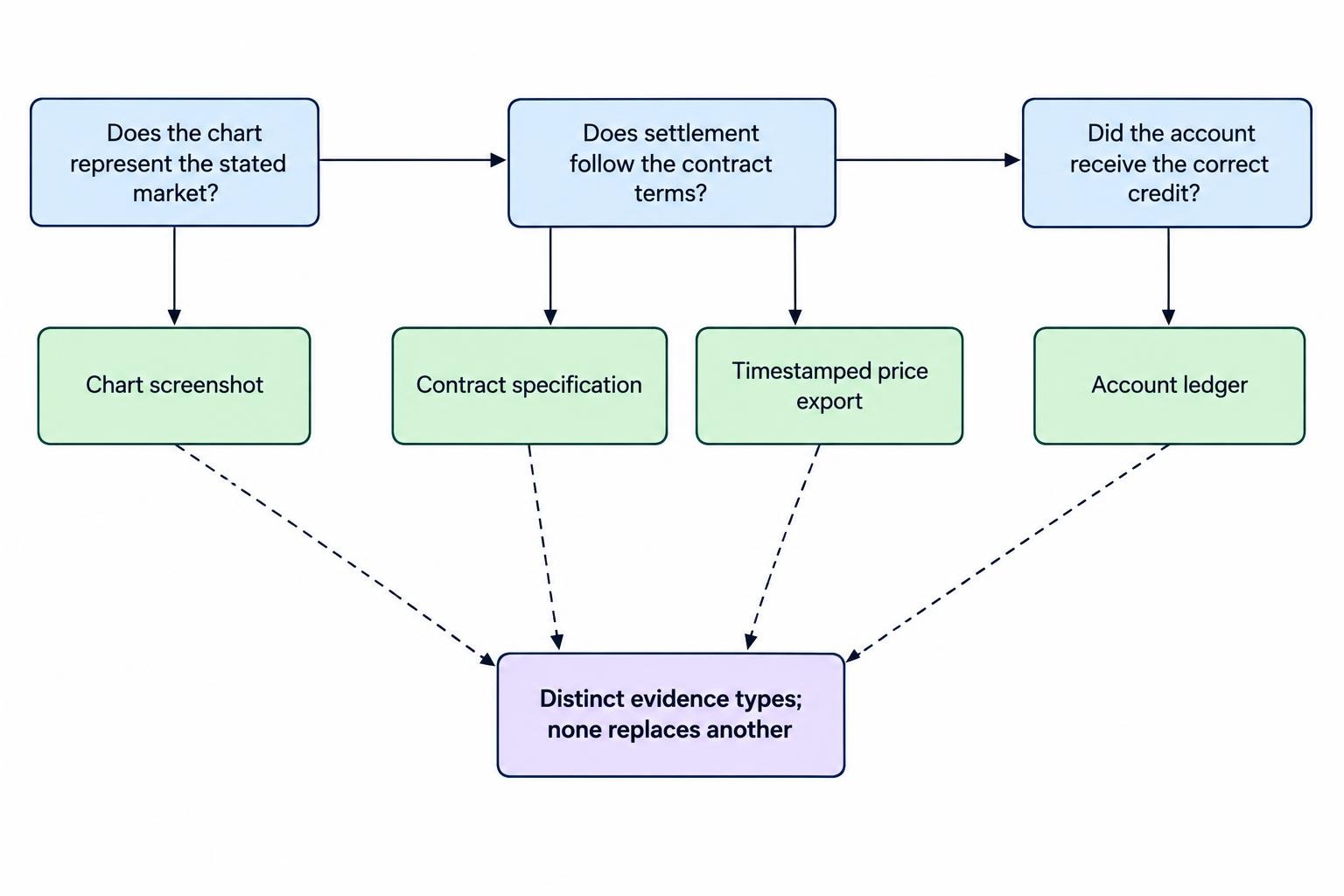
A useful assessment separates three questions. Does the displayed chart represent the stated market? Does the settlement calculation follow the contract terms? Does the account receive the correct credit after that calculation?
These questions require different evidence. A chart screenshot records what appeared on screen. A timestamped price export can help reconstruct the market observation. The contract specification establishes which observation should count, while the account ledger shows how the result affected the balance. None replaces the others.
The starting point is an exact description of the reference price, not an asset label such as “gold” or “EUR/USD”. Record the supplier, instrument identifier, quote type and any calculation applied. The guide to price feeds and benchmarks covers those distinctions separately; this study framework uses them to assess whether a result is reproducible.
Why two prices can disagree without either being wrong
Bid, ask and midpoint are different observations
A bid, an ask and their midpoint need not sit on the same side of a binary option’s strike. Comparing a bid-based settlement with a midpoint chart can therefore produce an apparent disagreement even when both records are internally consistent. The correct first question is which price the contract requires.
Official data also has a defined purpose. The RBA’s published exchange-rate methodology identifies a 4 pm Sydney fixing for its US dollar rate and describes its exchange rates as indications of market value that may differ from dealer quotations. Its exchange-rate definitions and sources also warn against relying on those data for regulatory or commercial purposes. An official daily observation is not automatically suitable evidence for a second-by-second expiry dispute.
Last price and settlement price are not interchangeable
Exchange publications distinguish between a last traded price and a calculated settlement price. CME’s settlement report field definitions identify separate “Last” and “Settle” fields and state that its public market data is reference material, not a validation of its real-time feed. That distinction concerns CME products; it does not establish the terms of an unrelated binary contract.
The methodological lesson is narrower: a label such as “close” does not identify a calculation. Before comparing records, establish whether each value represents a transaction, a quote, an average or a published settlement. Also confirm the instrument. A cash index, a futures contract and a platform’s derived price should not be treated as interchangeable without evidence connecting them.
Reconstruct the contract before assessing the result
Preserve the terms that applied when the contract was accepted. A later help-page revision cannot establish what the earlier agreement said. Save the accepted strike, expiry, direction, stake, payout terms and contract identifier alongside a dated copy of the settlement specification.
The specification should answer the following questions:
- Which supplier and instrument provide the settlement data?
- Does the calculation use a bid, ask, midpoint, transaction price or another value?
- Which timestamp or observation window determines the result?
- When does rounding occur, and at what precision?
- What happens after a tie, missing quote, outage or corrected observation?
Equality deserves particular attention. A condition requiring the price to finish strictly above a strike differs from one that includes equality. A displayed tie may also conceal extra decimal places used in the calculation. Apply the contract’s actual rule rather than assuming that equality produces a refund. The separate guide to binary options settlement and ties addresses those contract outcomes.
If the terms do not identify how the decisive value is selected, record that as a documentation gap. Do not fill it with a plausible assumption and then present the reconstruction as verified.
Worked comparison: one quote, different apparent outcomes
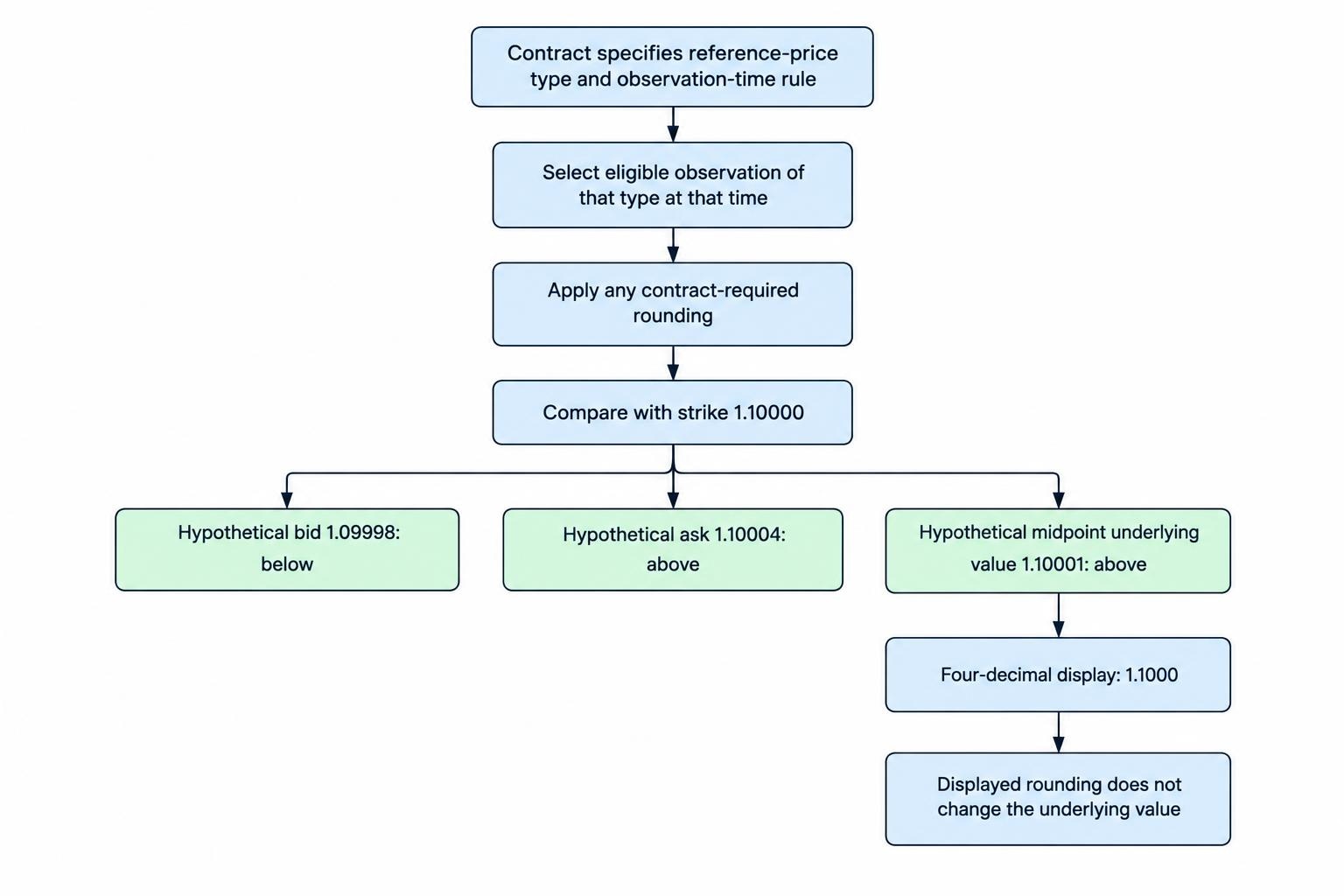
Consider a hypothetical EUR/USD contract that requires the settlement value to be strictly above a strike of 1.10000. At the relevant observation time, suppose the available bid is 1.09998 and the ask is 1.10004. Their arithmetic midpoint is 1.10001.
| Observation | Value | Relationship to strike |
|---|---|---|
| Bid | 1.09998 | Below |
| Ask | 1.10004 | Above |
| Calculated midpoint | 1.10001 | Above |
| Midpoint rounded to four decimals for display | 1.1000 | Appears equal; the unrounded value is above |
If the contract specifies the bid, the midpoint is the wrong comparator. If it specifies the unrounded midpoint, the four-decimal display cannot establish a tie. If the rules require rounding before the comparison, that rounding becomes part of the settlement calculation rather than a cosmetic display choice.
Timing creates another distinction. Suppose expiry is 14:00:00 UTC, with observations at 13:59:59.980 and 14:00:00.020. A “last observation at or before expiry” rule selects the earlier record. A “first observation after expiry” rule selects the later one. The study must apply the published selection rule, not whichever observation supports the preferred result.
Build a repeatable comparison sample
Choose observations before reviewing outcomes
For a retrospective study, define the sampling rule before inspecting individual wins and losses. One workable design is to include every eligible contract within stated dates and market hours. Another is to select expiry times independently of their outcomes. A collection containing only disputed losses can support case reviews, but not an estimate of how often settlement disagreements occur.
State the inclusion rules, exclusions and total records available. Keep ordinary weekday observations separate from weekend-labelled instruments or records whose underlying market cannot be identified. Mixing them creates a larger spreadsheet, not necessarily a better comparison.
Align clocks without hiding uncertainty
Convert timestamps to UTC while retaining the original timezone and offset. Record timestamp precision and identify what each time represents: the market event, supplier publication, local receipt or screen display. A timestamp printed to milliseconds does not, by itself, prove millisecond accuracy.
The related guide to binary options execution and latency separates order acceptance from display delays. For settlement research, distinguish those events from the expiry observation itself. A screen recording may show a late chart update without showing that the settlement engine used a late price.
Preserve the original evidence
Keep unedited exports, screenshots, correspondence and contract records alongside any cleaned analysis file. Document timezone conversions, duplicate removal and rounding steps. Where data licensing permits, preserve the underlying observations needed for another reviewer to reproduce the calculation.
Do not manufacture finer detail from coarse data. A one-minute candle cannot reveal which quote existed at an exact point within that minute. If the required observations are missing, classify the case as unresolved rather than estimating a decisive tick.
Measure price differences and outcome differences separately
A feed comparison and a settlement reconciliation answer different questions. The first measures how two comparable price series differ. The second checks whether the contract followed its nominated reference and rules. An independent feed can provide context without being the contractual settlement feed.
For matched observations, calculate the signed difference as the platform value minus the comparison value. Absolute differences show the size of deviations without allowing positive and negative values to cancel. Report the observation count and distribution, not just an average that can conceal brief departures.
For settlement reconciliation, calculate the expected result from the nominated reference, strike, direction, rounding and equality rules. Compare that result with the recorded outcome, then check the account credit separately. A correct result can still be paired with an incorrect ledger entry.
Give unresolved records their own category. State how many contracts were fully reconstructable and how many lacked usable terms, timestamps or price data. Excluding incomplete cases without reporting them makes the apparent agreement rate hard to interpret.
Also examine contracts near the strike separately from those finishing farther away. A small price difference can change a near-strike result while leaving another contract unaffected. Neither close price agreement nor a low average deviation establishes correct settlement in every case.
When a discrepancy deserves closer investigation
Software manipulation is a documented regulatory concern, not something that can be dismissed automatically as a charting issue. The joint SEC and CFTC investor alert on binary options fraud describes complaints alleging distorted prices and payouts, including expiry countdowns extended until winning positions became losses. Those are reported allegations; they do not prove misconduct by an unnamed platform.
A defensible review distinguishes an explained difference, an unresolved case and a rule-inconsistent result. An explained difference might come from comparing bid with midpoint. An unresolved case might lack the required timestamped feed. A rule-inconsistent result requires enough evidence to show that the recorded outcome conflicts with the applicable terms.
Repeated discrepancies that disadvantage customers warrant investigation, but pattern analysis still needs a suitable sample. Examine accepted strikes, timing, rounding and missing records before assigning a cause. Conversely, a provider’s refusal to identify the settlement source should not be treated as proof that the result was correct.
What a defensible study can conclude
The strongest report states exactly what was assessed: the contract specification, data source, observation period, sampling method and reconstruction rules. It separates verified matches from unexplained differences and records that could not be assessed. Findings should not extend beyond the products and periods actually examined.
Keep practice-account observations separate from real-money records. A demo versus live trading differences study addresses that comparison; evidence from one environment should not silently stand in for the other. Likewise, a settlement check does not establish profitability, withdrawal reliability or regulatory compliance.
Without a collected dataset, this review supports a method rather than a platform verdict. A useful settlement assessment follows a traceable chain: applicable terms, eligible price observation, reproducible calculation and matching account entry. If a link in that chain is missing, the appropriate finding is uncertainty—not reassurance, and not an accusation dressed up as research.
This article was last updated on: October 22, 2026