Binary options and vanilla options can reference the same share, currency or index, but they pay out differently. A binary option pays a preset amount when a stated condition is met. A vanilla option gives its holder a contractual right whose value depends on how far the underlying price moves beyond the strike price.
That difference changes the profit calculation, the risks and the reasons for using each product. Getting the market direction right does not necessarily make a vanilla option profitable. With a binary option, a larger favourable move does not necessarily earn you another cent.
For Australian retail clients, availability comes before strategy. ASIC’s prohibition on issuing and distributing binary options to retail clients took effect on 3 May 2021 and has been extended until 1 October 2031. This comparison is educational, not a route around the Australian retail binary options ban.
How Binary and Vanilla Option Payoffs Differ
Binary options: a fixed result from a stated condition
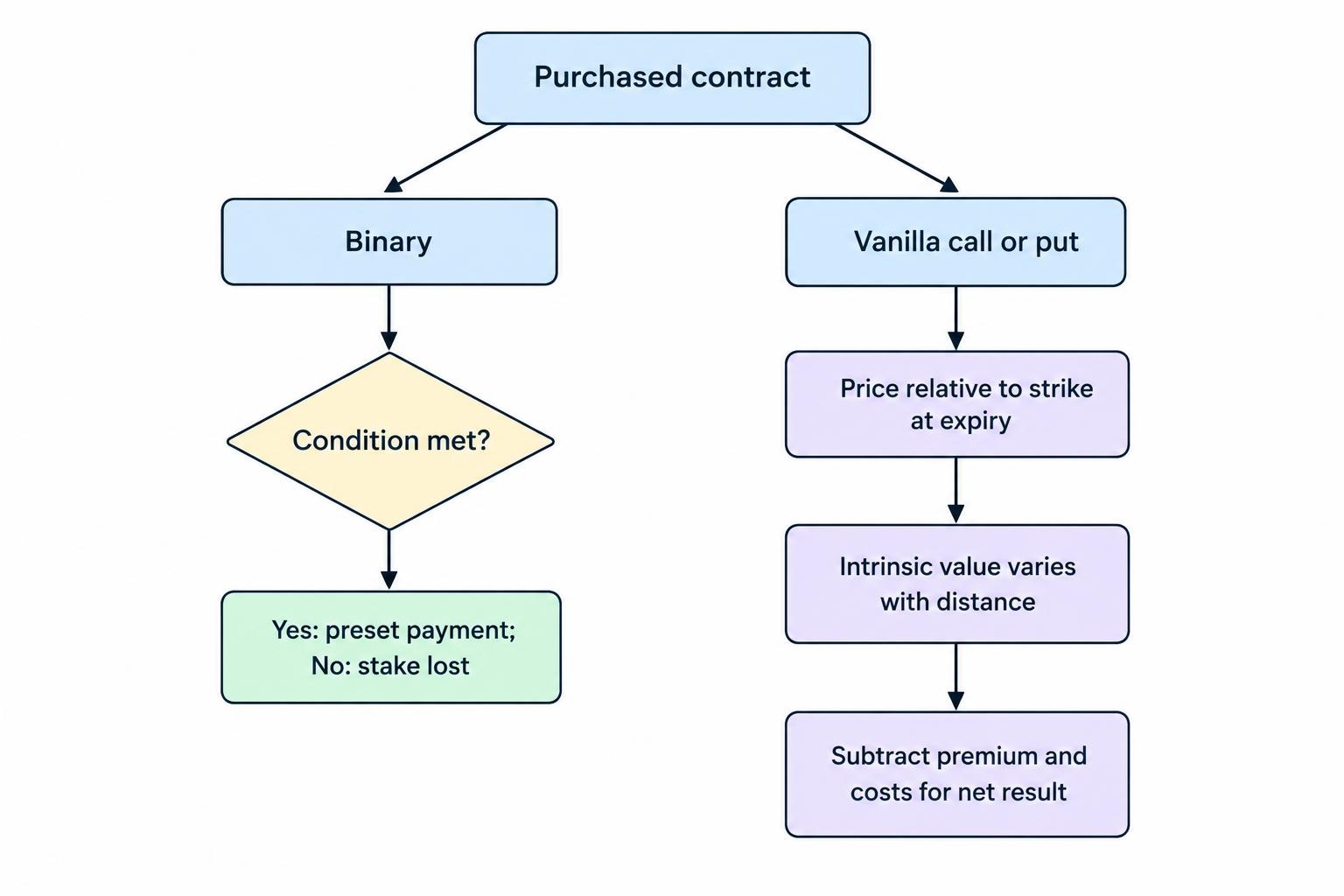
A simple high or low binary contract asks whether a reference price will finish above or below a threshold at expiry. If the chosen condition is met, the contract pays the agreed amount. If it is not, the stake is lost, subject to the contract’s settlement rules. The Moneysmart binary options warning describes this fixed payment structure and the risks surrounding offers to Australian retail investors.
The size of a favourable move does not increase the agreed payment. Finishing one cent above the threshold can produce the same result as finishing several dollars above it. The contract rewards the condition being met, not the distance travelled.
Vanilla options: a right with a variable value
A vanilla call gives its buyer the right to buy an underlying asset at the strike price. A vanilla put gives its buyer the right to sell it. The buyer pays a premium for that right, while the writer accepts the corresponding obligation. These buyer and seller roles are set out in the Options Industry Council’s equity options overview.
At expiry, a call’s intrinsic value increases as the underlying price rises above its strike. A put’s intrinsic value increases as the underlying price falls below its strike. Profit still requires deducting the premium and trading costs.
The comparison below focuses on buying a simple binary contract versus buying a standalone vanilla call or put. Writing vanilla options creates a different risk profile.
| Feature | Simple binary option | Purchased vanilla option |
|---|---|---|
| Contractual result | Preset payment if the condition is met | Right to buy or sell at the strike price |
| Effect of a larger favourable move at expiry | Does not increase the agreed payment | Increases intrinsic value |
| Initial payment | Stake or purchase price | Option premium |
| Loss on the purchased contract | Can consume the entire stake | Can consume the entire premium |
| Profit calculation | Successful payment less the initial stake and costs | Option value realised less the premium and costs |
| Main comparison question | Was the stated condition met? | Was the option’s realised value enough to cover its cost? |
Worked Example: The Same A$100 Initial Risk
Consider two hypothetical contracts linked to a share initially trading at A$100. Both have the same expiry. These are teaching assumptions, not available quotes or suggested trades.
For the binary contract, assume a A$100 stake pays A$180 in total if the share finishes strictly above A$100. That means A$80 profit plus the original A$100 stake. An unsuccessful outcome loses the stake.
For the vanilla contract, assume one call covers 100 shares, has a A$100 strike and costs A$1 per share. The total premium is A$100. Ignore fees and taxes, and compare the economic value of both positions at expiry.
Binary calculation
A successful result produces A$80 profit whether the share finishes at A$100.50 or A$103. The latter is a much larger rise, but the agreed payment remains A$180. An “80% payout” in this example means an 80% profit on the stake, not an 80% chance of winning. The distinction between profit and total returned is covered in the guide to binary options payout calculations.
Vanilla call calculation
The call’s expiry value is the amount by which the share exceeds A$100, multiplied by 100 shares. Subtract the A$100 premium to calculate the net result.
At A$100.50, the call has A$50 of intrinsic value, leaving a A$50 loss. At A$101, it has A$100 of intrinsic value and breaks even before costs. At A$103, its A$300 intrinsic value produces A$200 profit.
| Share price at expiry | Binary net result | Vanilla call net result |
|---|---|---|
| A$99.00 | −A$100 | −A$100 |
| A$100.50 | +A$80 | −A$50 |
| A$101.00 | +A$80 | A$0 |
| A$101.80 | +A$80 | +A$80 |
| A$103.00 | +A$80 | +A$200 |
The binary produces the better result for some small upward moves under these assumptions. The vanilla call produces the better result for larger upward moves. Neither column establishes which contract offers better value: that requires considering the likelihood of each outcome and the actual price charged.
Equal initial risk also does not mean equal exposure. Both positions can lose A$100, but their responses to the share price are different. Compare the payoff across a range of prices, not just the maximum loss printed on the screen.
Break-Even: Why Direction Alone Is Not Enough
For a purchased vanilla call held to expiry, the break-even share price is the strike plus the premium per share, before costs. For a purchased put, it is the strike minus the premium per share. In the example above, the call needs A$101, not simply a price above A$100.
A binary contract has a different break-even problem. With A$80 profit for a successful A$100 stake and a A$100 loss otherwise, the required success rate is:
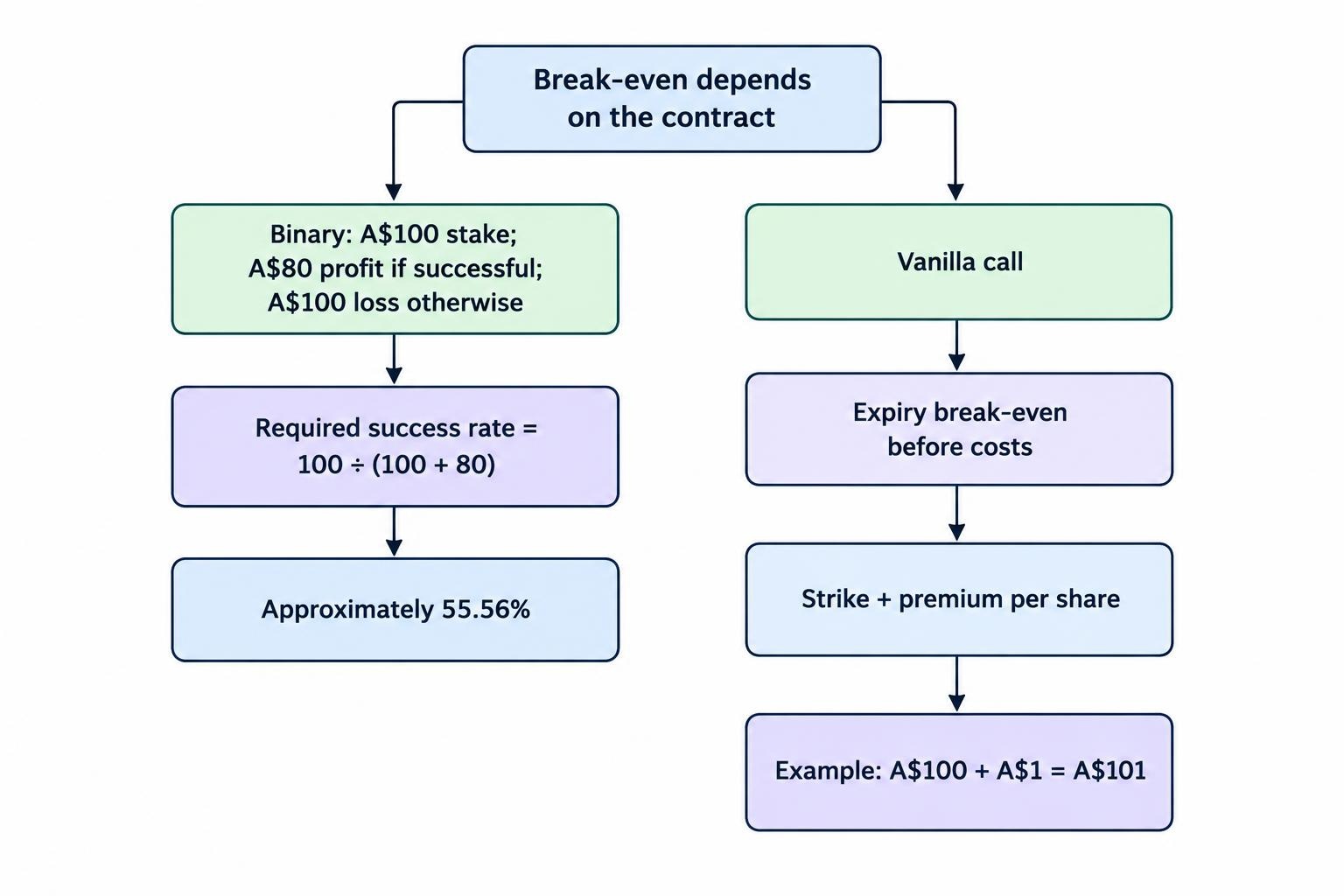
A$100 ÷ (A$100 + A$80) = approximately 55.56%.
Assuming unchanged terms, no ties and no extra costs, 50 successful trades out of 100 would earn A$4,000, while 50 unsuccessful trades would lose A$5,000. The net result would be a A$1,000 loss.
This is why a payout percentage cannot be assessed on its own. It must be compared with a defensible estimate of the chance of success. The guide to probability and expected value in binary options develops that calculation.
Vanilla options do not have one comparable required win rate. A small number of large gains might offset several lost premiums, or repeated modest gains might be overwhelmed by costs. The size of each gain and loss matters alongside how often it occurs.
What Changes Before Expiry?
The worked example uses expiry values. Before expiry, a vanilla option’s premium includes intrinsic value, if any, and time value. Its price also responds to factors including the underlying price, expected volatility and time remaining. These relationships are covered in the ASX explanation of option pricing.
This creates a common source of confusion. A call buyer might correctly predict a share price rise but still lose money because the rise was too small, arrived too late, or coincided with a fall in implied volatility. The purchase price already reflected expectations, not just the share’s starting price.
The expiry break-even formula is therefore not a rule for every earlier sale. Using the hypothetical A$100 call purchase, selling the contract before expiry for A$130 would produce A$30 profit before costs. That calculation uses the sale proceeds, regardless of whether the share has reached the A$101 expiry break-even price.
Keep two questions separate: what would the contract pay at expiry, and what could it be sold for now? They are related, but they are not interchangeable.
Expiry, Exercise and Settlement Are Different
Exercise means using an option’s contractual right. It is not the same as selling the option to close a position. American style options permit exercise on or before expiry; European style options permit exercise at expiry only. Those labels describe timing, not geography.
Settlement also varies. ASX equity options provide for delivery of the underlying security, while S&P/ASX 200 index options settle in cash. The applicable multiplier, exercise style and settlement method appear in the ASX options contract specifications.
This matters for the A$100 call example. Exercising a physically settled call over 100 shares at a A$100 strike involves a A$10,000 share purchase. The A$100 premium bought the right; it did not pay for the shares. A buyer who wants only the option exposure should not confuse an expiry payoff illustration with an instruction to exercise.
For any comparison, write down the final trading time, the settlement reference and what happens next. A chart price, an option’s last traded price and its settlement value need not represent the same thing.
Risk: Buying Options Is Not the Same as Writing Them
A fully paid standalone vanilla option buyer can lose the entire premium, plus costs. That does not mean every options position has the same loss boundary. Writers accept obligations, and some writing positions can expose them to losses far beyond the premium received. The SEC investor bulletin on options risks distinguishes the risks faced by holders and writers.
An uncovered call writer faces theoretically unlimited losses as the underlying share price rises. A put writer can face a large loss if the share price collapses. Margin and assignment obligations also require attention; collecting a premium is not the same as earning a deposit rate.
Selling an option you previously bought to close the position is different from opening a new written position. Check which action the order will perform. The same word, “sell”, can describe either reducing an existing exposure or creating an obligation.
The premium risk boundary also belongs to the option position itself. If exercise creates a shareholding, that holding introduces its own subsequent price risk. Assess the position you will have after exercise, not just the contract you initially purchased.
Trading Venue, Exit Costs and Practical Control
“Vanilla” describes a payoff structure, not a trading venue or a guarantee of safety. For listed options, the ability to close a position depends on the market available at the time. Spreads, transaction charges, liquidity and exercise procedures can affect the result. The OCC disclosure on standardized options covers these practical risks for US exchange traded contracts.
Suppose the example call costs A$100 and later sells for A$120. The A$20 difference is not the final profit if entry and exit charges total A$12; only A$8 remains. Small positions make this arithmetic particularly unforgiving.
Before comparing products, ask whether the exit price is executable, whether the position can be closed in full and what charges apply. A theoretical value is useful for analysis. It is not money received.
Which Structure Fits the Intended Purpose?
Start with the purpose rather than the product’s label. If the aim is exposure to a large upward move, a fixed payment and a variable call payoff answer different needs. If the aim is protecting a shareholding against falling prices, the hedge must be assessed against the amount and timing of the possible loss, not simply whether it pays something.
Do not treat “known maximum loss” as a complete assessment. Both purchased contracts in the example can lose every dollar committed. Position size, repeated losses and the ability to meet any settlement obligations still matter. A written binary options risk management framework helps separate those decisions from a forecast.
The practical distinction is straightforward: binary options attach a preset payment to a condition; vanilla options attach a variable value to a contractual right. Compare the full payoff, premium, costs and settlement obligations. For Australian retail clients, keep the binary options distribution ban at the front of that assessment, not in the small print.
This article was last updated on: October 22, 2026