Binary options signals are alerts suggesting a contract, direction and expiry to consider. They can reduce the time spent searching for a setup, but they do not establish that the suggested trade has a profitable edge. A precise timestamp is not proof of a sound forecast.
For Australian retail readers, the regulatory position comes first. ASIC’s prohibition on issuing and distributing binary options to retail clients began on 3 May 2021 and remains in force until 1 October 2031. Buying a signal subscription does not change that restriction. See ASIC’s binary options ban extension. The discussion below is for education and assessing promotional claims, not finding a way around the ban.
What a Binary Options Signal Should Contain
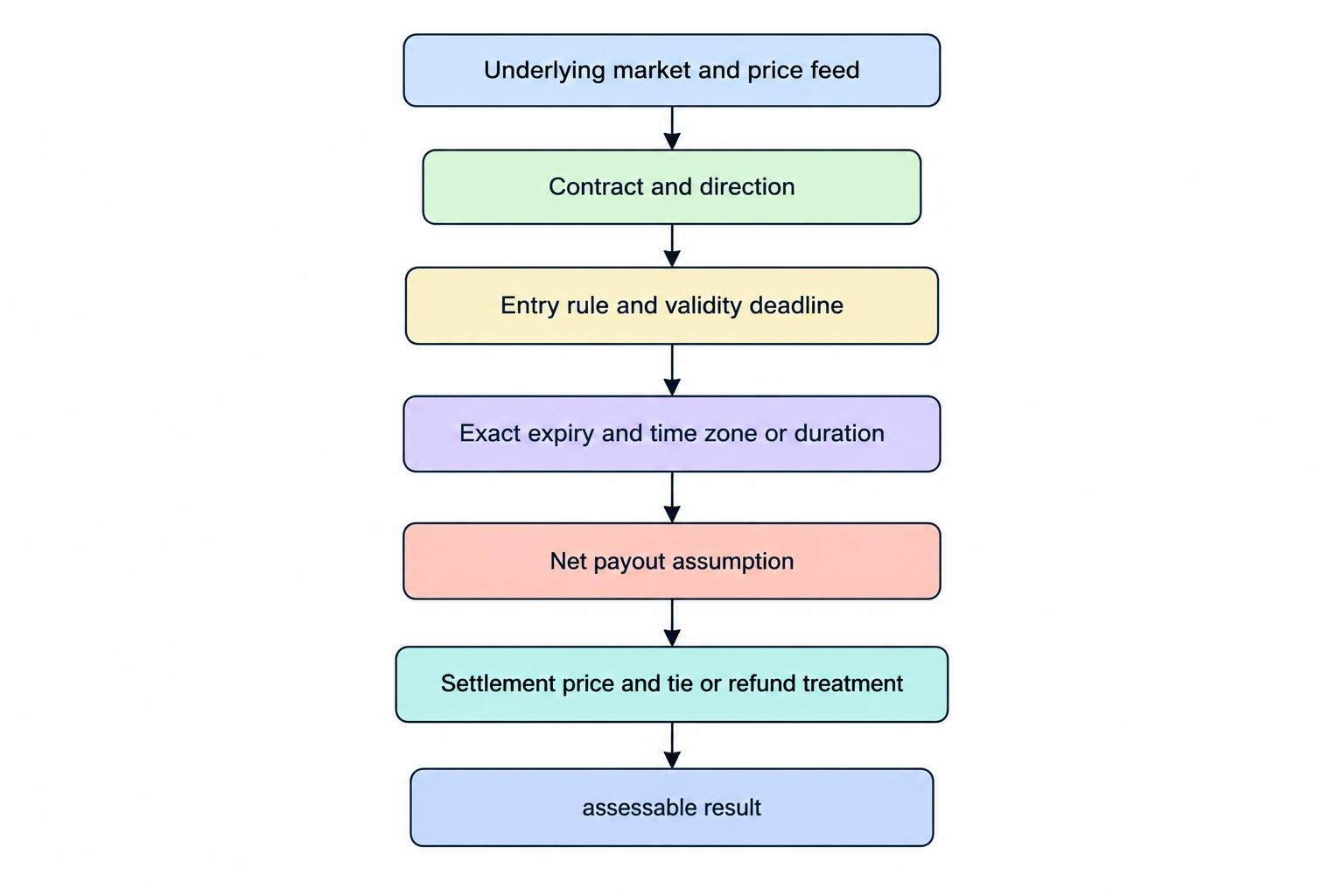
A usable signal needs more than an asset name and an arrow. It must identify the proposed contract clearly enough for someone to assess its outcome without filling in missing details after the event.
| Signal detail | What it should establish |
|---|---|
| Underlying market | The exact asset, instrument and relevant price feed, rather than a vague label such as “gold”. |
| Contract and direction | The condition being predicted, such as finishing above the entry strike at expiry. |
| Entry rule | The intended entry time or price condition, plus a deadline after which the alert is no longer valid. |
| Expiry | An exact settlement time and time zone, or a clearly defined duration measured from entry. |
| Payout assumption | The net profit available on a winning contract, distinguished from the return of the original stake. |
| Settlement terms | The price used to determine the result and the treatment of ties or refunds. |
“EUR/USD higher in five minutes” leaves several questions unanswered. Five minutes from publication, receipt or execution? Which quote sets the strike? What happens if the alert arrives late?
These are not administrative details. They determine which proposition was actually tested. A market can rise after an alert yet still finish below a later entry price, producing different results for the publisher and the recipient.
Manual Signals, Automated Alerts and Copy Trading
A manual signal comes from a person applying their judgement or trading rules. An automated alert comes from software when programmed conditions occur. Either can suggest a trade without placing it.
Copy trading goes further: another trader’s activity triggers transactions in a connected account. That introduces questions about account permissions, stake allocation and automatic execution, rather than just forecast quality. The separate guide to binary options copy trading covers those distinctions.
Keep the method of delivery separate from the method of analysis. Telegram, email, an app notification and a chart alert are communication channels. None tells you whether the underlying rules work. Nor does a fast notification establish that the proposed entry price remains available.
Free vs Paid Binary Options Signals
A subscription price is a cost, not evidence of accuracy. Assess both free and paid services against the same questions: who publishes the alerts, what records can be checked, and how does the publisher earn money?
For any service requiring registration with a named platform, ask whether the publisher receives referral payments. Also ask what triggers payment: registration, a funded account or trading activity. Do not assume that the publisher benefits only when subscribers make money.
A paid service should disclose its subscription terms, renewal arrangements, cancellation process and any other required purchases. Compare the incentives and costs in free vs paid trading signals, rather than treating a “premium” label as a quality certificate.
Why Signal Accuracy Is Not the Same as Profitability
The relevant question is not simply how often a signal wins. It is whether winning proceeds exceed losing stakes and all associated costs.
Consider a hypothetical contract with an A$10 stake. A win earns A$8 net profit and returns the stake; a loss forfeits A$10. With that 80% profit payout, the break-even win rate before fees is:
Break-even win rate = 1 ÷ (1 + 0.80) = 55.56%.
This calculation assumes equal stakes, a constant payout, no refunds and no other charges. It does not apply unchanged to every binary contract structure.
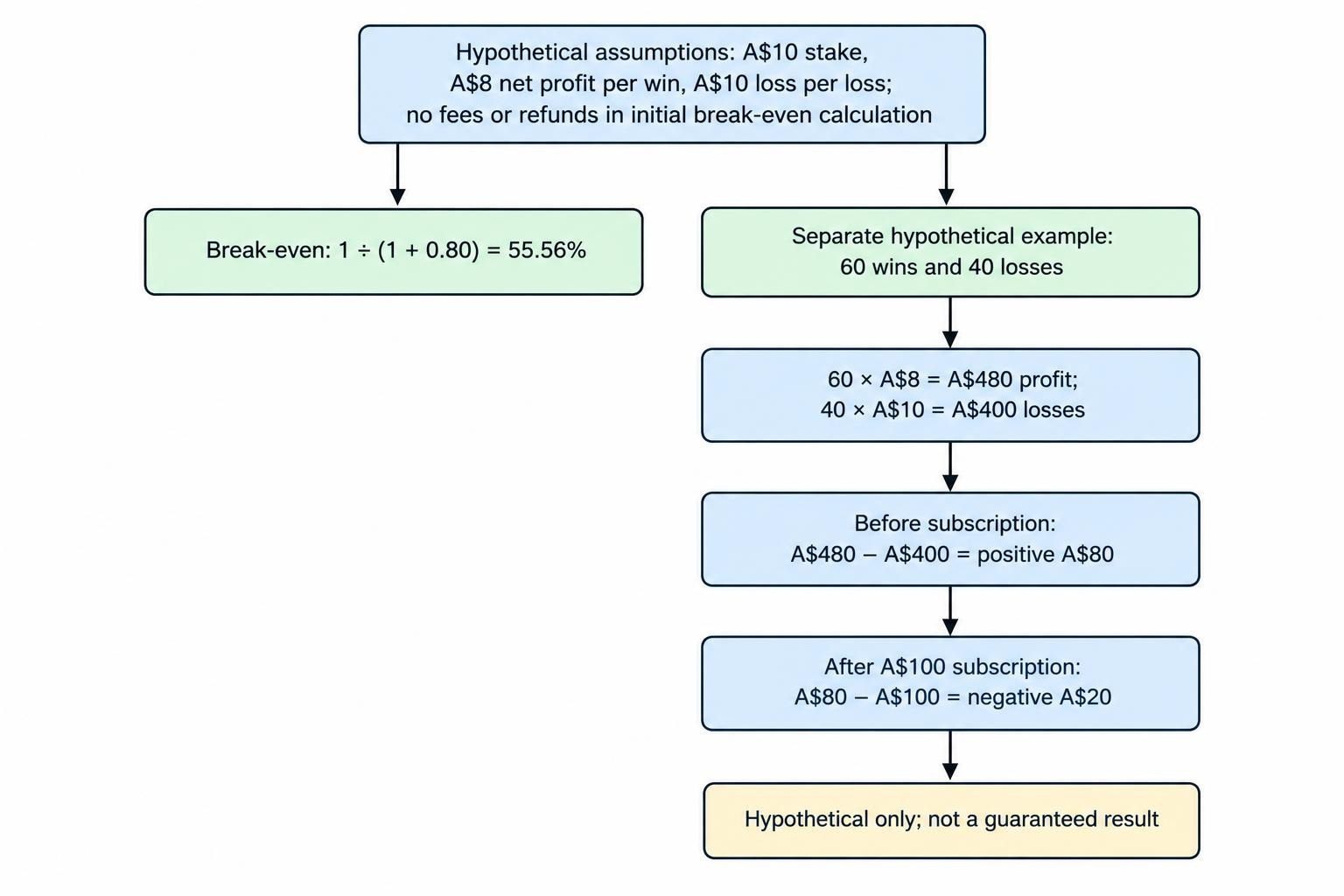
Now suppose a signal record shows 60 wins and 40 losses across 100 trades. The wins produce A$480 profit, while the losses cost A$400. The trading result is positive A$80. Add an A$100 subscription covering that period and the result becomes negative A$20.
Under those same assumptions, covering the subscription would require more than 61.11% winners, or at least 62 wins out of 100. The advertised 60% accuracy sounds respectable, the account still loses money.
Higher stakes are not a sensible fix for an unaffordable subscription. They increase the money exposed to each wrong forecast. Evaluate the service at a fixed hypothetical stake rather than changing stakes until the results look attractive.
How to Read a Signal Provider’s Track Record
Start by separating actual transactions, forward paper records and historical simulations. These answer different questions. A simulation tests rules against past data; it does not establish what a subscriber could have executed.
Historical results can depend on assumed entry prices, selected periods and omitted costs. Those weaknesses are addressed in the CFTC advisory on online trading systems. Its discussion concerns commodity futures and options, but the distinction between simulated and executed results is relevant when examining signal promotions.
Request a continuous record containing publication times, original instructions, outcomes and corrections. It should preserve losses, cancelled alerts and alerts that could not be followed. A screenshot is an advertisement, not an audit.
Check the denominator behind an accuracy percentage. Does “90% successful” count individual contracts or sequences of several attempts? If a losing A$10 trade is followed by a winning A$20 trade at an 80% payout, the sequence earns A$6 before costs. It still contains one losing contract and one winning contract.
That distinction matters when a publisher advertises a high success rate based on eventual recovery. The exposure required to reach that result may be missing from the headline.
For a fuller assessment, use the guide to evaluating trading signal track records. Do not infer a durable edge from a short run of winners, even when the individual entries appear genuine.
Timing, Price Feeds and Repainting
A forecast and an executable opportunity are not the same thing. Suppose an alert specifies entry at 14:00:00 UTC and settlement at 14:01:00 UTC. If it reaches the recipient at 14:00:12, only 48 seconds remain before the stated settlement.
Entering a fresh 60 second contract at that point would test a different expiry. Entering the original expiry could also produce a different strike. Either change makes a direct comparison with the publisher’s result unreliable.
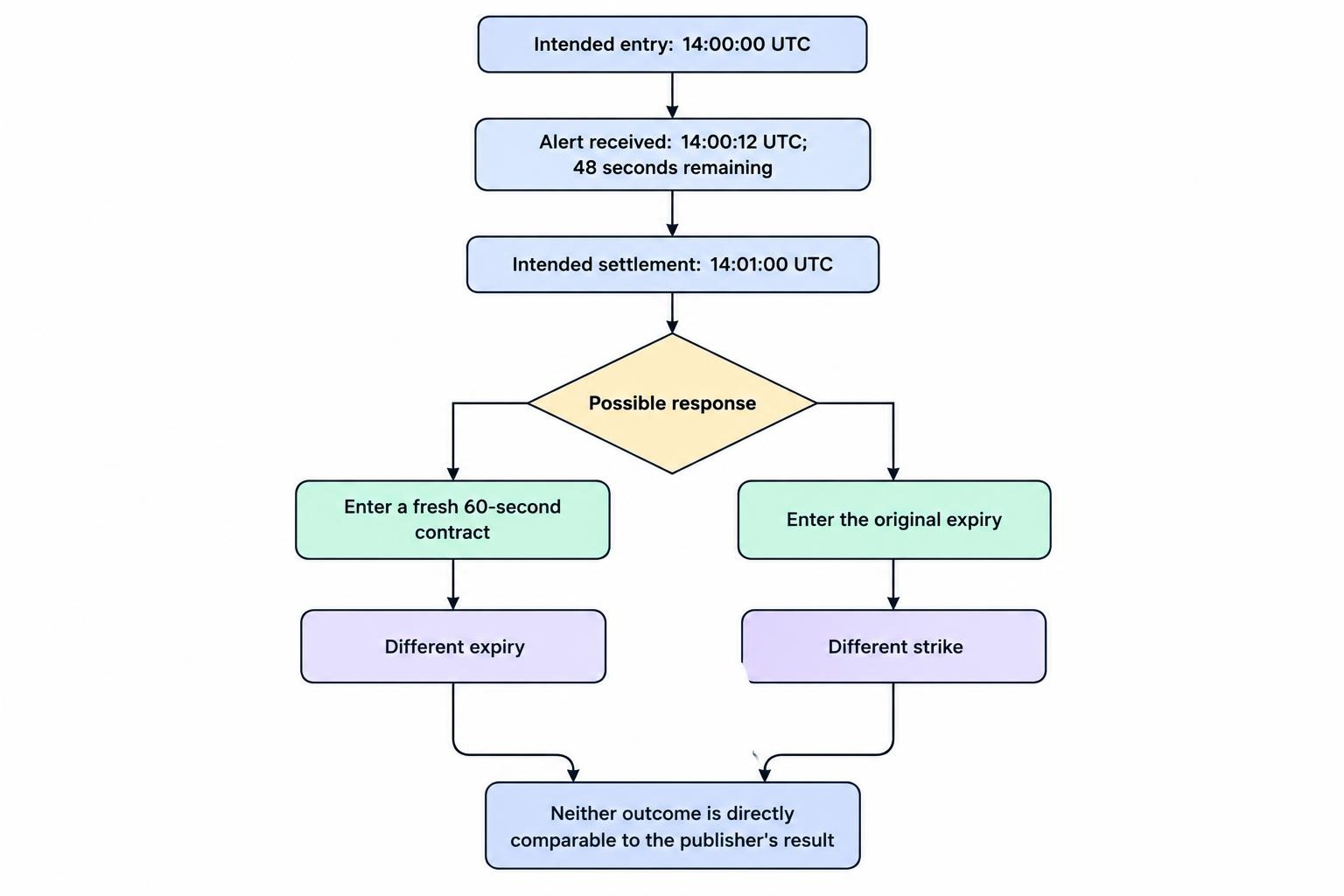
Chart behaviour needs scrutiny too. Repainting occurs when historical and real time calculations or plots behave differently. It can include ordinary updates on an unfinished candle, not just deceptive changes. The distinction is covered in TradingView’s documentation on repainting.
For assessment purposes, preserve what was visible when the alert appeared. Do not substitute the chart’s final appearance for the information available at the decision time. Ask whether alerts wait for a candle to close and whether markers can move or disappear later.
Price feed differences create another comparison problem. A reference chart cannot prove settlement on a contract using another quote stream. The guide to signal repainting and latency examines these issues without treating every discrepancy as fraud.
Assessing Signals Without Depositing Money
A paper record can help test whether a service publishes clear, timely instructions. It cannot prove that live execution, withdrawals or future performance would match the record.
Set the assessment rules before observing results:
- Preserve each original alert. Record its publication time, receipt time and any later edits.
- Use one interpretation. Decide how entry, expiry, payout and ties will be recorded before the first observation.
- Keep every observation. Label late, incomplete or unassessable alerts instead of removing them.
- Calculate net outcomes. Include the subscription and other required costs using a fixed hypothetical stake.
- Record exposure. Track losing runs and simultaneous positions, not just the percentage of winners.
Keep the publisher’s claimed outcome separate from the outcome your evidence supports. A record labelled “cannot verify” is more useful than a confidently invented win or loss.
There is no sample size that guarantees a strategy will keep working. More observations can improve an assessment, but repeated alerts around the same market move should not be treated as fully independent evidence.
AI Signals Still Need Verifiable Evidence
“AI powered” describes a claimed technology, not a verified trading advantage. Ask for the same original alerts, payout assumptions, costs and performance records that you would request from a human analyst.
Claims of guaranteed returns or perfect accuracy deserve particular scrutiny. Fraudsters have promoted bots and signal strategies using exaggerated AI claims, documented in the CFTC warning on AI trading bots and signal strategies.
Do not accept secrecy as a substitute for evidence. A provider may protect its formula while still disclosing how alerts are timestamped, how results are calculated and whether testing used information that was available at the time.
Australian Licensing and Provider Checks
Not every market observation is financial product advice. However, a recommendation intended to influence a decision about a financial product may be. Carrying on a financial services business generally requires an Australian financial services licence, representative authorisation or an applicable exemption. These distinctions are set out in ASIC’s guidance on discussing financial products online.
Assess the substance of the service rather than relying on an “education only” label. Check the legal entity behind the brand and whether any claimed authorisation covers the activity being promoted. A licence number displayed in a group description is something to verify, not a reason to stop checking.
Keep this assessment separate from the underlying product restriction. Establishing who operates a signal service does not make binary options available to Australian retail clients.
Warning Signs in Signal Groups
Guaranteed profits, pressure to act quickly and promises of high returns with little risk are recognised investment scam warnings. Professional branding and positive reviews do not establish legitimacy; see Moneysmart’s investment scam warning signs.
For a signal service, pause if the seller refuses to identify its operator, will not preserve losing alerts, or makes access conditional on an urgent deposit. Treat requests for passwords, remote access or money sent directly to an administrator as reasons to stop and independently verify the arrangement.
An apparently accurate forecast does not prove that the associated platform is genuine. Signal quality, custody of funds and withdrawal access are separate questions. For messaging group promotions and related warning signs, read about social media trading signal scams.
Are Binary Options Signals Worth Paying For?
A service is not worth paying for simply because its alerts are convenient. A defensible assessment needs clear instructions, a checkable record, realistic timing and positive results after costs. None guarantees future profits.
For Australian retail readers, the product ban remains the starting point. Signals are best examined as claims to test on paper, not as a shortcut to income or a reason to deposit with an offshore platform. If the evidence cannot be checked, there is no sound basis for treating the advertised accuracy as established.
This article was last updated on: October 22, 2026