Broker deposits and withdrawals deserve more attention than the deposit button usually gets. The amount a platform accepts, the balance it displays and the money you can actually withdraw are three different things. A quick deposit says little about how a withdrawal will work.
For Australian readers, the starting point is whether the product can lawfully be offered to them. After that, the practical questions concern account ownership, payment routes, verification, fees and evidence that a payment has genuinely been sent.
The Australian restriction comes before the payment method
The issue and distribution of binary options to Australian retail clients is prohibited under ASIC’s binary options product intervention order, extended until 1 October 2031. The ban first took effect on 3 May 2021.
A platform accepting an Australian address, an Australian dollar deposit or a familiar payment card does not establish that its offer complies with Australian law. A payment logo is not a licence.
This guide explains how to assess payment terms and deal with money already held in an account. It does not recommend funding an offshore binary options account or finding another payment route around a restriction. If a deposit is blocked, establish why before attempting anything else.
Deposited money is not the same as withdrawable money
Start by separating your own deposits, trading results, promotional credits and pending withdrawals. Do not assume the largest number on the dashboard is available to cash out.
Consider a hypothetical account containing a $200 deposit, a $50 promotional credit and $30 of trading profit. The displayed total is $280. If the promotional credit cannot be withdrawn, and no other restrictions apply, the withdrawable amount would be $230. Different promotional terms could change that result, so the arithmetic alone does not establish what the broker will release.
Ask for a statement that reconciles the opening balance, deposits, settled trading results, fees, credits and previous withdrawals. If the platform shows both an account balance and an available balance, request an explanation of the difference.
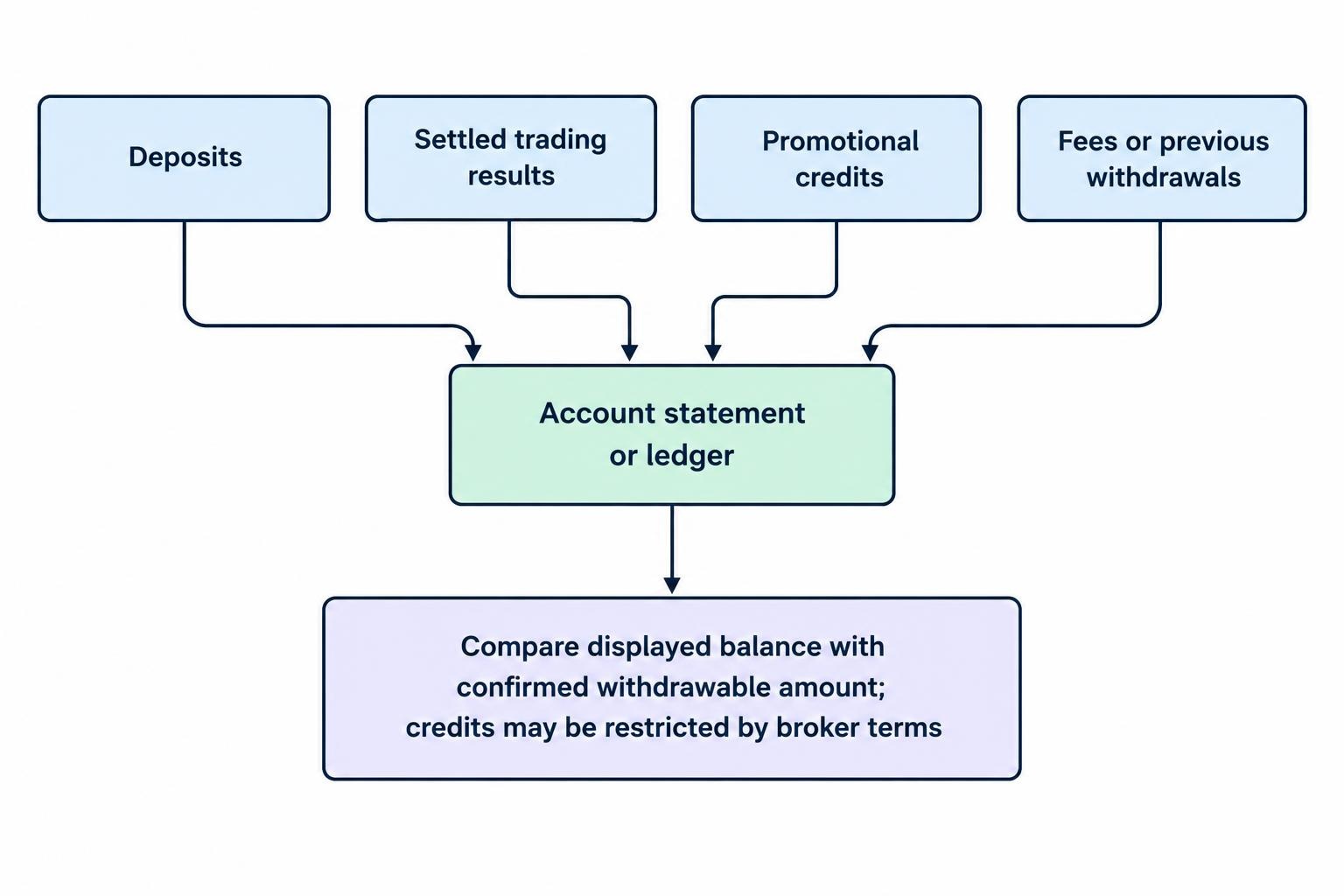
Also distinguish a trading payout from a withdrawal. A payout changes the trading ledger after a contract settles. A withdrawal moves money out of the account. A profitable result on screen is not evidence that money has reached your bank.
Check the withdrawal route, not just the deposit route
Do not assume that a method shown on the deposit screen is also available for withdrawals. Read both sets of terms, including any rules for returning deposited capital separately from profits. The broader binary options payment methods guide covers the payment channels themselves; the concern here is how the broker handles money moving through them.
| Payment route | Questions to resolve | Evidence to retain |
|---|---|---|
| Debit or credit card | Will the payment be a refund to the original card? How will any remaining balance be paid? | Card statement, payment receipt and refund reference. |
| Bank transfer | Which legal entity receives the deposit? What beneficiary details are required for a withdrawal? | Transfer confirmation, beneficiary details and payment reference. |
| Digital wallet | Must the wallet belong to the account holder? Can it receive the proposed withdrawal currency? | Wallet transaction record and account ownership evidence. |
| Cryptocurrency | Which asset, network and destination address apply? Is a destination tag or memo required? | Transaction hash, network, address, asset and amount. |
If the original card has expired or the bank account has closed, ask for the documented replacement procedure. Do not open another trading account or send money through a friend to work around the issue.
Where a broker requires deposits to be returned through their original routes, ask how it allocates withdrawals across multiple deposits. Get the answer in writing rather than relying on an account manager’s promise.
Verification and payment ownership
Identity checks are not, by themselves, evidence of misconduct. Australian reporting entities generally must identify and verify customers before providing designated services, subject to exceptions, and monitor the relationship afterwards. These obligations are covered in AUSTRAC’s customer due diligence guidance. That framework does not authorise an offshore business to offer a prohibited product.
For an existing account, request one written list of outstanding documents, the reason each is needed and the accepted submission method. Ask whether verification is complete for the account, the payment method or both. Those are separate questions.
Check that names and account details match across the trading account and receiving account. Where they differ because of a name change or another genuine reason, ask what supporting evidence is acceptable. Do not alter documents to make them match.
Before uploading anything, independently check the firm’s identity and the destination receiving your documents. Never provide a banking password, one time security code or remote access to your device. The broker account verification guide examines document checks separately from the payment process.
Read fees, minimums and currency terms together
Assess a withdrawal by the amount expected to arrive, not just the broker’s stated withdrawal fee. Check the account currency, the receiving currency, any conversion rate and any charges disclosed by the receiving institution or payment provider.
A “free withdrawal” should prompt a narrower question: free of which charge? Ask for a breakdown rather than assuming every stage costs nothing.
For a hypothetical calculation, suppose a withdrawal is US$300 and the stated fee is US$10. That leaves US$290. At an illustrative conversion rate of A$1.50 per US dollar, the amount becomes A$435 before any further deductions. The example is not a current exchange rate or a broker quote.
Minimum withdrawal amounts and daily or monthly caps also need checking. Ask what happens to a balance below the minimum, whether closing the account changes the procedure and whether a withdrawal cap applies per request or across the whole account.
Keep the fee schedule alongside the terms that applied when you deposited. The separate guide to deposit and withdrawal fees covers these cost categories in more detail. Do not place extra trades simply to reach a withdrawal threshold without first requesting a written explanation of your options.
Measure withdrawal time from request to receipt
Treat any advertised payment time as incomplete until you know when the clock starts. Does “24 hours” mean the time to review a request, approve it, send it or deliver it? Does it mean calendar hours or business hours?
Build a timeline with four separate stages:
- Requested: Record when you submitted the withdrawal and received its reference number.
- Under review: Record any document requests and when you answered them.
- Released: Ask when the broker actually sent the payment and through which provider.
- Received: Record when the money appeared in the destination account.
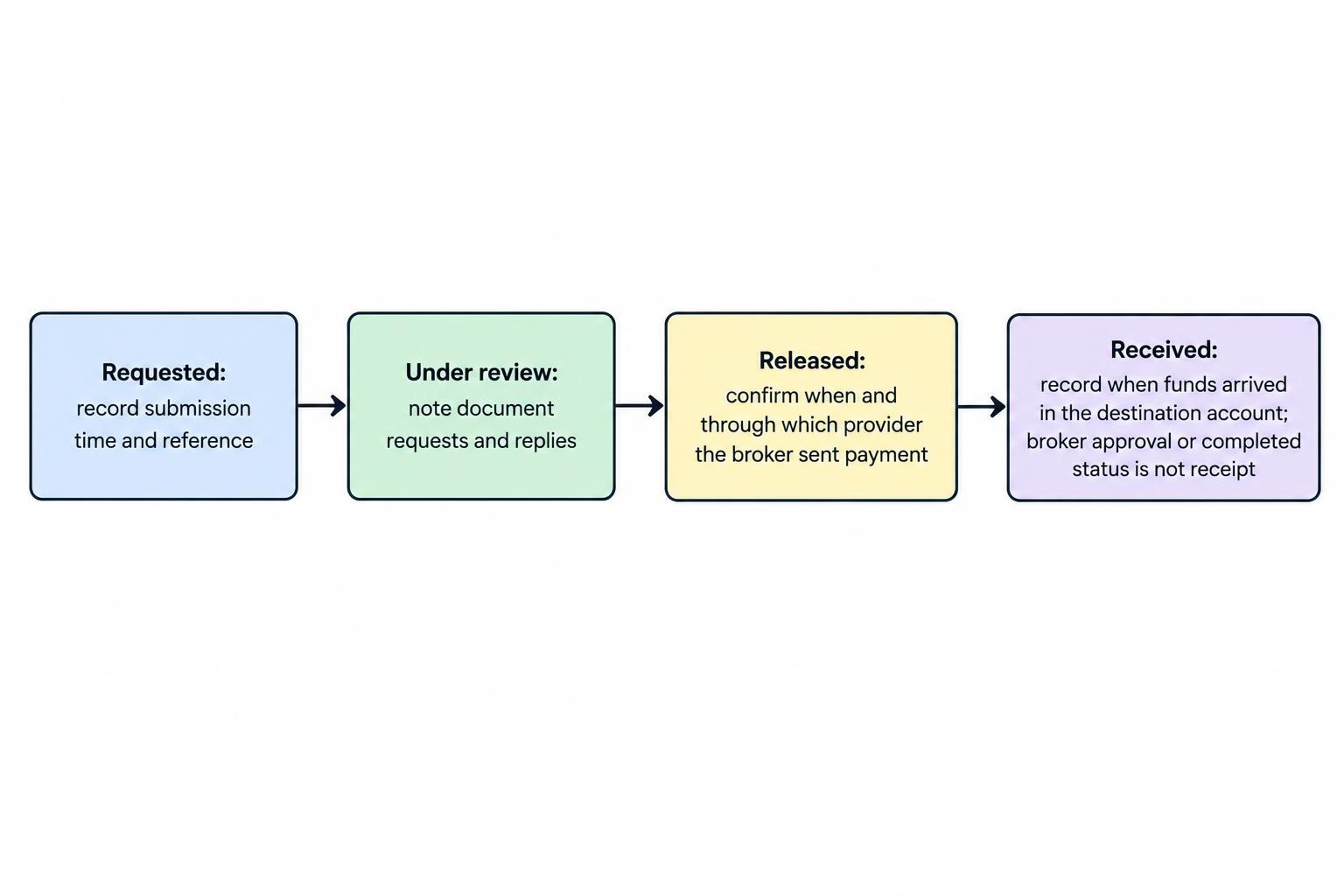
Do not rely on status labels alone. If a withdrawal says “completed”, ask whether that means internal approval or an outgoing payment. Request a traceable reference appropriate to the payment route.
A useful follow up identifies the amount, currency, request date and reference, then asks what remains outstanding and when the next stage is expected. “Where is my money?” is understandable. A dated request with a payment reference is easier to investigate.
Requesting money from an existing account
If you already have an account and want to withdraw, save the account statement and payment terms before submitting the request. Confirm the receiving details carefully, particularly where an address, network or account number must be entered manually.
Retain the confirmation showing the requested amount, currency, destination and date. Download correspondence rather than leaving the only copy inside the platform. Keep a short chronology of calls and messages, including the name or identifier used by each representative.
Do not treat a small successful withdrawal as proof that the remaining balance is safe. Investment scammers may make small profit payments to build trust, a tactic covered in Moneysmart’s investment scam guidance. Receiving one payment establishes only that one payment arrived.
If your aim is to remove your money, do not cancel the withdrawal because someone promises better returns, a higher account tier or preferential treatment after another deposit.
Separate an administrative delay from a demand for more money
Ask whether the explanation for a delay can be checked. An unresolved ownership mismatch can be investigated through documents. A claimed outgoing transfer can be investigated through its payment reference. A vague statement that “the finance department is working on it” gives you little to verify.
Warning signs deserve a different response: stop and independently check the demand. Be particularly cautious if the explanation keeps changing, the firm refuses a written response or a representative insists you must deposit more before receiving your existing balance.
A request for a new payment described as tax, account validation, insurance or a release charge can be part of advance fee fraud described by the US Securities and Exchange Commission. The pattern is straightforward: pay more money now to supposedly receive money later.
Do not confuse a disclosed transaction charge with an unexpected demand to send fresh funds to another bank account or crypto address. Ask for the contractual basis and verify any claimed regulatory involvement independently. A document carrying a regulator’s logo is not enough.
The binary options withdrawal problems guide examines refusal patterns and disputed balances in more detail. Once fraud is suspected, the priority changes from chasing an approval date to preventing further loss.
What to do when money is missing
Contact your bank, card issuer or payment provider promptly. Explain what happened accurately, including whether you authorised the original payment, what was promised and why you now suspect fraud or a failure to provide the agreed service.
Ask what action is available for that payment route. Provide the transaction dates, amounts, merchant descriptors, receiving details and correspondence. Follow Scamwatch’s steps after a suspected scam, including stopping further payments, protecting compromised accounts and reporting the incident.
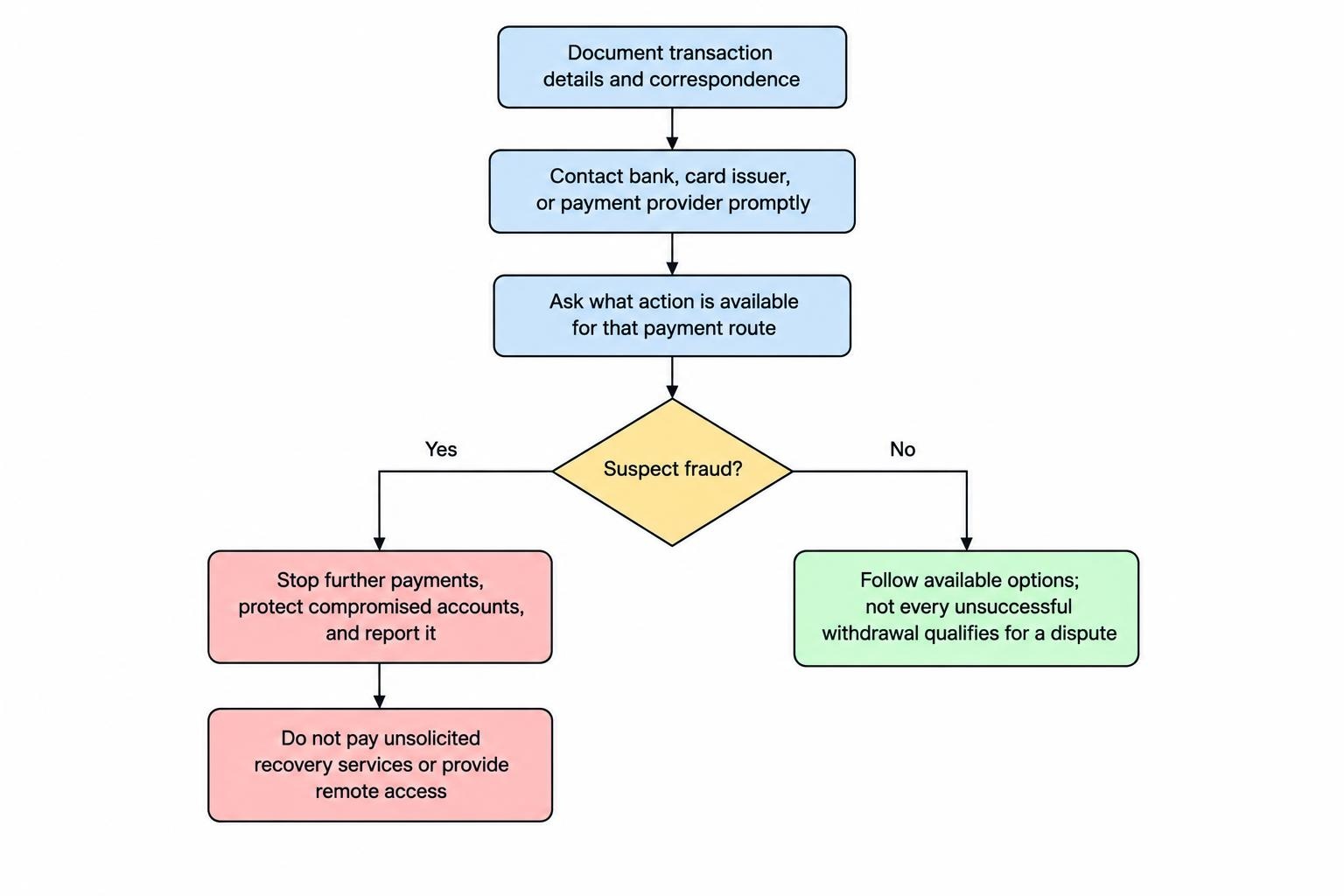
For a card payment, ask whether a dispute or chargeback can be considered and what evidence is needed. Do not assume every unsuccessful withdrawal qualifies. The ACCC’s guidance on payment reversals notes that chargebacks have time limits, so waiting indefinitely for the broker’s next promised date can be costly.
Separate the money you transferred from any profit displayed on the platform. Give the payment provider evidence of actual payments rather than treating the dashboard balance as a verified loss.
Be cautious of unsolicited recovery offers. Do not send another payment or give remote access to someone promising to retrieve the funds.
Complaints depend on the firm and the issue
Send a formal written complaint identifying the legal entity, disputed amount, payment history and remedy requested. Ask for the firm’s final written response. Preserve the account records even if access remains available.
For an Australian external complaint, check eligibility rather than assuming an offshore broker falls within reach. AFCA’s complaint eligibility requirements include membership of the financial firm, applicable time and monetary thresholds, and exclusions under its rules. A complaint about your bank’s handling of a payment is separate from a complaint against the broker.
Keep the objective clear: establish what money was paid, what remains unresolved and which organisation can consider the issue. More trading, another deposit or a more expensive account tier does not answer any of those questions.
This article was last updated on: October 22, 2026