Dividends, stock splits and other corporate actions can change a share’s quoted price without producing an equivalent change in shareholder wealth. For a share binary option, that distinction matters: the contract tests a price condition, not the shareholder’s total return.
A fall around a dividend date is not automatically a bearish signal. A sharp rise following a share consolidation is not automatically a rally. Before interpreting either move, establish what changed, when it took effect and how the contract treats it.
Australian retail restriction: ASIC’s order banning the issue and distribution of binary options to retail clients runs until 1 October 2031. The ASIC announcement extending the binary options ban sets out the restriction. The examples below explain market mechanics, not a route around that ban.
Share ownership and a binary contract are different exposures
A shareholder owns an interest in a company. A share binary option instead pays according to a stated condition, such as whether a reference price finishes above a strike at expiry. Taking that position does not itself make the holder a shareholder or create an entitlement to the company’s dividend.
This separates two questions that are easy to confuse:
- What does the corporate action do to the shares and their owners?
- What do the contract terms do to the strike, reference price and settlement process?
The broader guide to share binary options covers the underlying exposure. Here, the concern is whether a corporate action changes the basis of the price comparison. A correct prediction about a company can still be irrelevant if the comparison uses incompatible prices.
Dividends: focus on the ex-dividend date
A cash dividend distributes money to eligible shareholders. Its announcement, entitlement and payment happen at different points, so a calendar entry labelled “dividend date” is not enough.
The declaration date is when the company announces the dividend. The record date determines the registered shareholders entitled to receive it. The payment date is when the distribution is paid. The ex-dividend date marks when shares begin trading without the entitlement to that dividend.
For ordinary ASX cash dividends, buyers must purchase before the ex-dividend date to qualify. Buying on that date does not carry the upcoming dividend entitlement. These distinctions appear in the ASX explanation of dividend dates and entitlements.
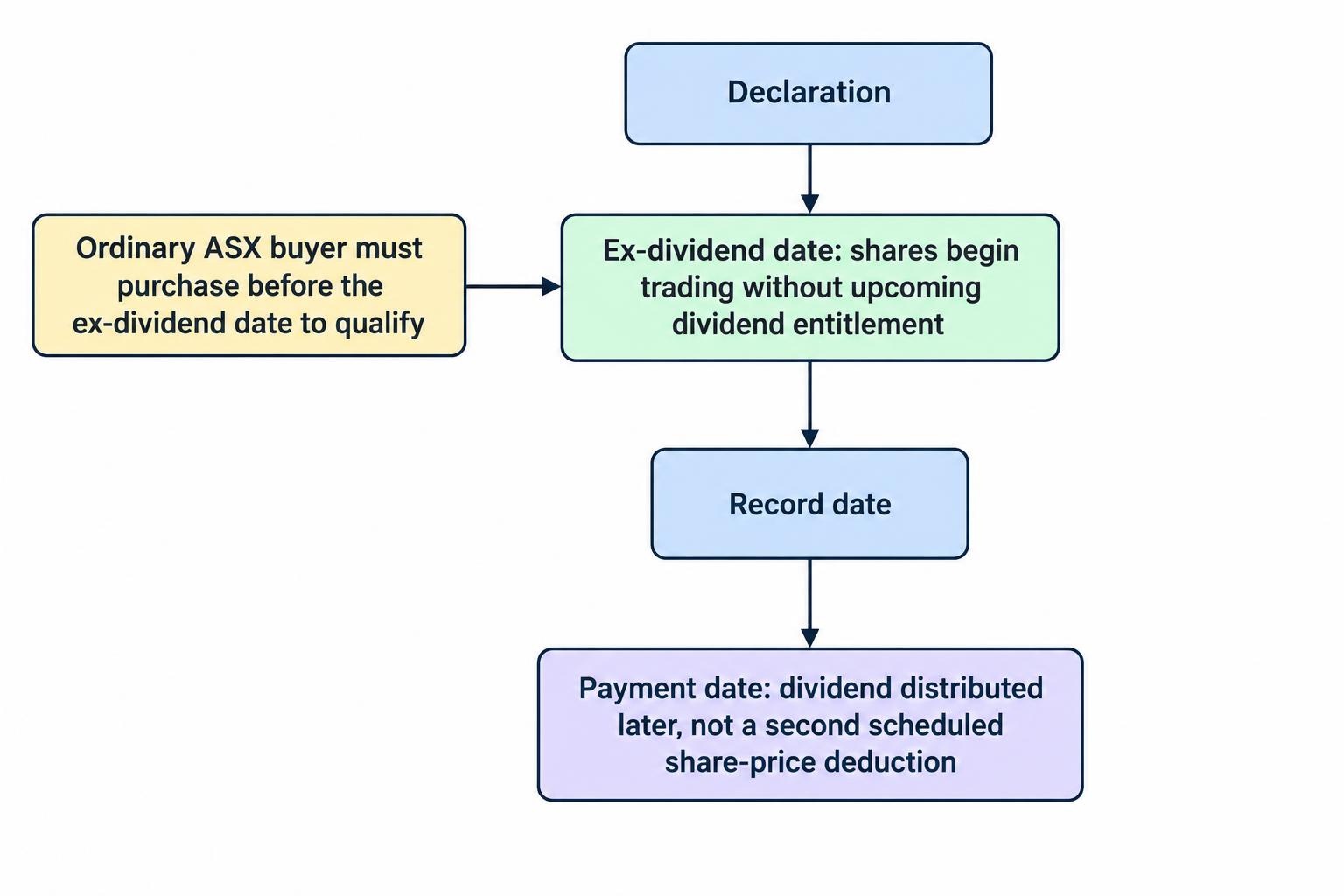
For price analysis, the ex-dividend transition is usually more relevant than the later payment. Do not treat the payment date as a second scheduled deduction from the share price.
A hypothetical dividend price adjustment
Suppose a share closes at A$40.00 before going ex-dividend for a A$1.00 cash distribution. Holding every other influence constant, A$39.00 is a simple theoretical ex-dividend reference: the incoming buyer no longer receives the A$1.00 payment.
An eligible shareholder who held one share across that transition would have a share worth A$39.00 plus a A$1.00 dividend entitlement. Ignoring tax, costs and other price movements, that adds to the original A$40.00. The lower share quote alone does not represent the shareholder’s total economic result.
A hypothetical binary contract with an unchanged A$39.80 strike presents a different question. Comparing A$39.00 with that strike could satisfy a “below” condition, but only if the contract remains valid on that basis. That is an illustration of the problem, not evidence that such a contract would be offered or settled unchanged.
The theoretical deduction is also not a forecast of the actual opening price. Other buying and selling can outweigh it. If the share opens at A$40.20 despite going ex-dividend, the dividend mechanism has not disappeared; other price influences have more than offset it.
Why the date does not create an automatic trading edge
Separate a contract spanning the ex-dividend transition from one beginning after it. In the second case, both its opening reference and expiry price may already be on the ex-dividend basis. Yesterday’s dividend entitlement does not create another deduction during that later observation period.
Check overseas schedules independently. In US markets, cash dividends worth 25% or more of the stock’s value have different ex-dividend timing: the ex-date is deferred until one business day after payment. The SEC guidance on ex-dividend dates and large distributions covers this exception. Do not apply that US rule to an Australian share.
For any unusual distribution, use the published event timetable rather than calculating the date from memory.
Stock splits change the unit, not the business
A forward stock split increases the number of shares while reducing the price represented by each share proportionately. In a four-for-one split, one old share becomes four new shares. A theoretical A$120.00 price therefore becomes A$30.00, before any unrelated market movement.
The arithmetic does not create a 75% investment loss. There are four shares where there was previously one. TradingView’s stock split documentation also describes how it recalculates historical chart prices following a split.
| Event | Holding before | Holding after | Theoretical holding value |
|---|---|---|---|
| Four-for-one split | 10 shares at A$120.00 | 40 shares at A$30.00 | A$1,200 before and after |
| One-for-ten consolidation | 1,000 shares at A$1.20 | 100 shares at A$12.00 | A$1,200 before and after |
A consolidation, also called a reverse stock split, runs in the opposite direction. It reduces the share count and increases the theoretical price per share. Neither operation, by itself, changes the value of the business. Same company, different unit size.
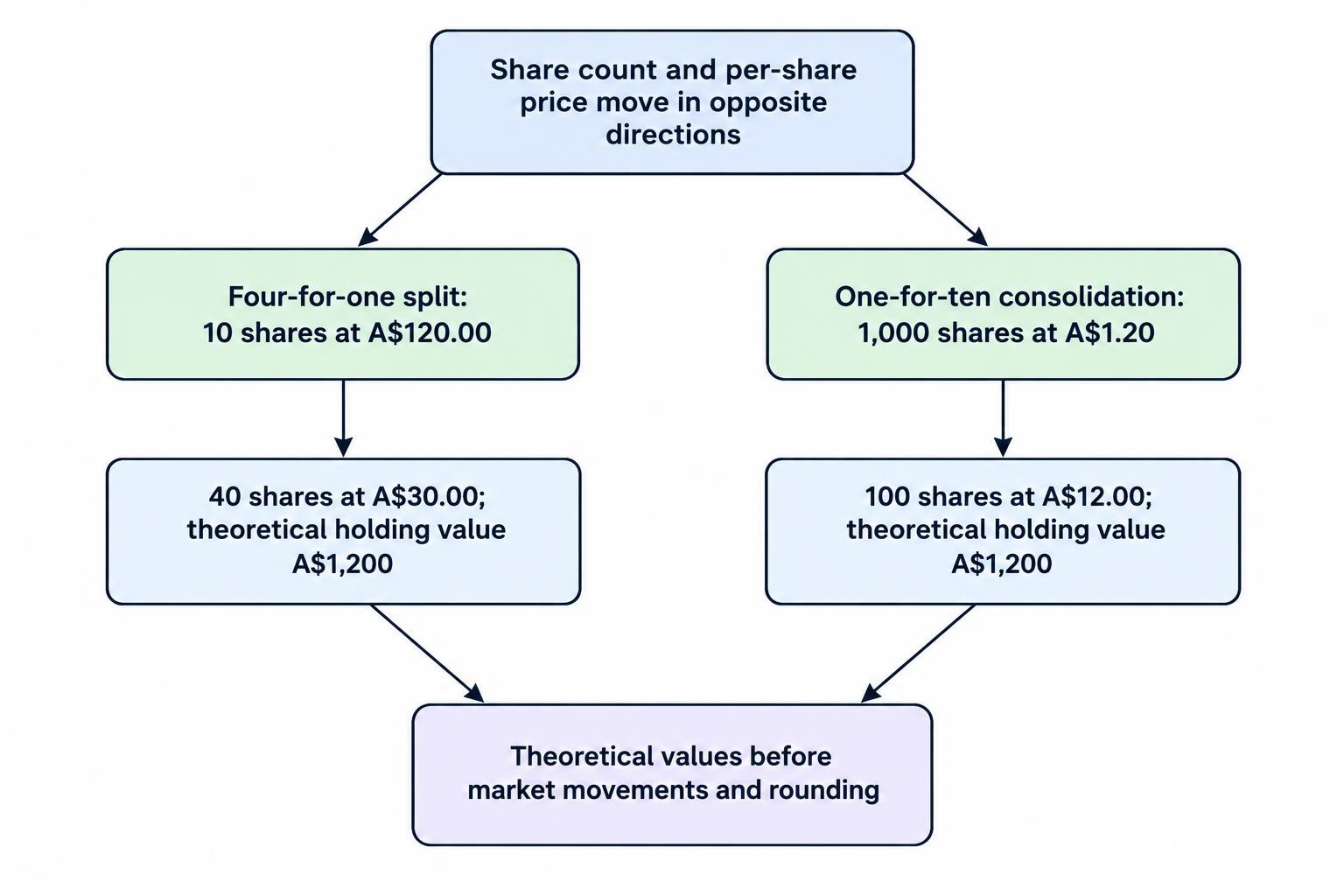
A reverse split also does not repair weak earnings or remove financing problems. Companies may use one to raise their quoted share price, including to regain compliance with an exchange’s minimum price requirements. Fractional holdings may receive separate treatment, including cash payments, as covered in the SEC explanation of reverse stock splits.
Keep the strike and settlement price on the same basis
Consider a hypothetical “above” contract with a A$118.00 strike before a five-for-one split. A proportionate restatement would put that strike at A$23.60.
If the post-split settlement price were A$24.10, comparing it with A$23.60 would preserve the intended price relationship. Comparing it with the old A$118.00 strike would mix two different units.
This calculation illustrates consistency, not a universal binary option adjustment rule. Do not assume that a platform will divide an existing strike by the split ratio, keep the expiry unchanged or preserve the original payout.
The same caution applies to touch levels and range boundaries. Restating one threshold while leaving another on the old basis would not produce a coherent comparison. Record every relevant level, not just the number displayed most prominently on the order screen.
Other corporate actions can change the reference asset
Rights issues, capital returns, demergers and takeovers deserve the same attention. Their consequences are not always captured by multiplying a share price by a simple ratio.
A rights issue can give eligible shareholders an opportunity to subscribe for new shares. A demerger can separate a business and distribute another company’s shares. A capital return distributes capital, while a takeover may replace the original holding with cash, shares or a combination.
For a price-based contract, ask whether the original security still provides the intended reference. A hypothetical A$20.00 parent share becoming an A$16.00 parent share plus a A$4.00 entitlement cannot be assessed sensibly from the parent’s quote alone.
Established exchange options have their own adjustment procedures. The ASX explanatory note on option adjustments and terminations covers these events and distinguishes ordinary dividends from adjustment events. Those procedures govern the products within their scope; they are not a promise about an unrelated binary contract.
What the contract must say
A corporate action announcement answers what the company intends to do. It does not, by itself, answer how a separate derivative will settle.
Read the contract’s corporate action and market disruption provisions. Look for clear answers about the reference security, adjustment authority, effective time, price source and treatment of an event that interrupts normal quotation.
Possible provisions to look for include threshold adjustments, substitution of a reference asset, cancellation, early settlement or a fallback valuation. These are questions for the documentation, not assumptions about what every provider does.
A trading interruption needs particular care. A last traded price from before the event is not automatically an appropriate expiry price after it. Nor does a chart continuing to display an old quote prove that a fresh transaction occurred.
The broader mechanics of binary option settlement and ties still apply, but a corporate action adds another check: are the strike and final observation expressed on the same basis, under the same documented rules?
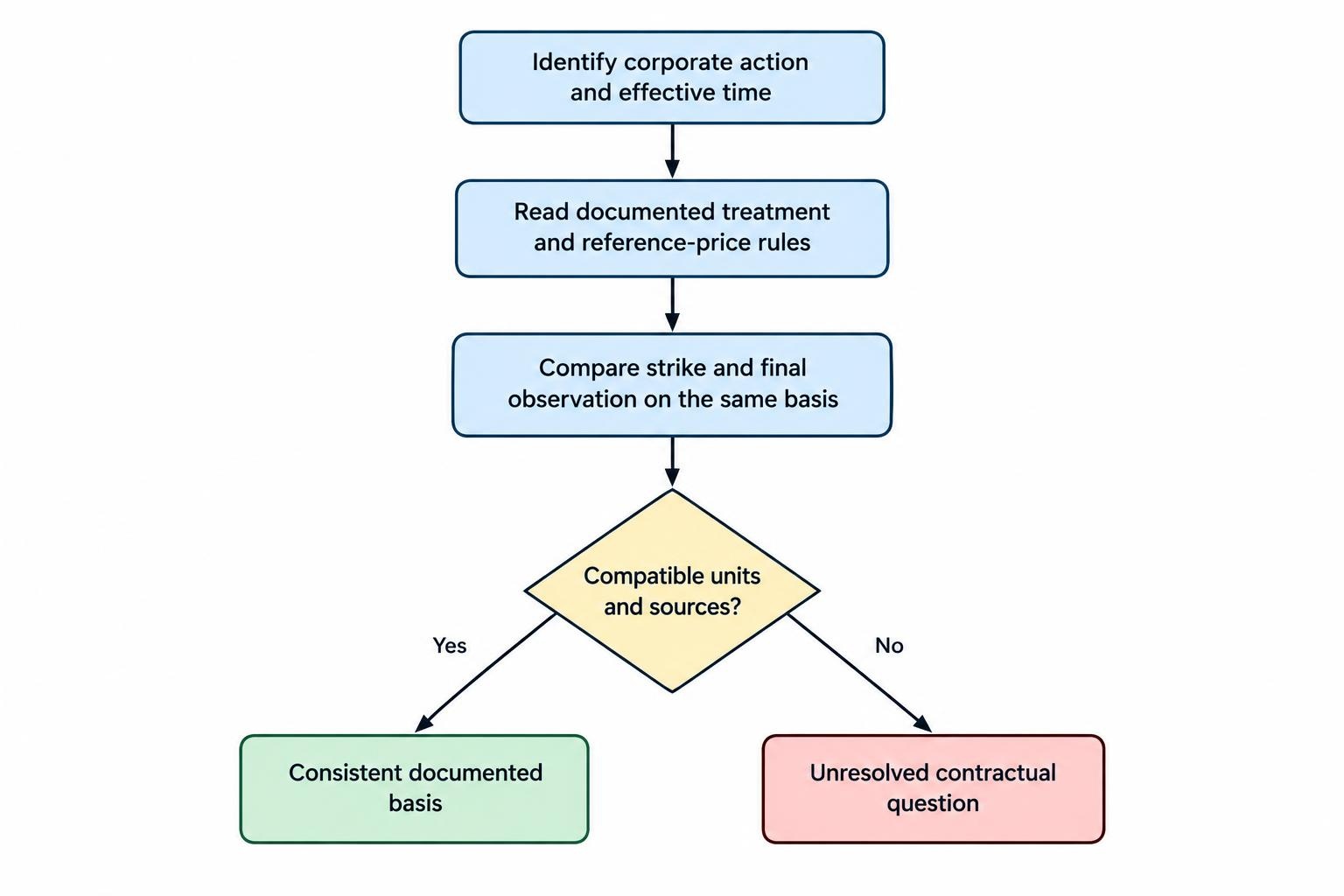
If the terms do not answer that question, the unresolved issue is contractual rather than analytical. More indicators will not fill the gap.
Adjusted charts can hide the original price comparison
A historical chart is not always a record of the prices exactly as they appeared at the time. Corporate action adjustments can restate earlier observations to make prices comparable across an event.
Dividend adjustment and split adjustment serve different purposes. Split adjustment addresses a change in share units. Dividend adjustment can present performance that includes distributions rather than price movement alone. TradingView’s documentation on dividend-adjusted data describes its dividend-adjusted chart as a total-return view.
That view may suit a shareholder performance question. It does not, on its own, reproduce the historical settlement test of a binary contract.
Suppose an archived contract records a A$50.00 strike, but a later split-adjusted chart displays that period near A$10.00. The mismatch does not establish an incorrect strike or settlement. First check whether the chart has restated earlier prices and whether the archived contract has been restated too.
Save the chart’s adjustment setting alongside any screenshot or data export. Also record its symbol, exchange, session and timestamp. A chart and contract can refer to the same company while using different observations. The guide to price feeds and benchmarks covers those differences in more detail.
A practical review before interpreting an event
Use the company’s announcement to establish the event, then use the contract documentation to establish its treatment. Keep those tasks separate. A correctly identified split does not prove that a contract was adjusted correctly, and an adjustment notice does not prove that the underlying timetable is unchanged.
A compact review should answer five questions:
- What changed? Identify the dividend amount, split ratio, distribution or replacement security.
- When did it change? Distinguish announcement, ex-date, effective date, record date and payment date.
- Does the observation period cross the event? Compare exact timestamps, including the relevant market’s time zone.
- What treatment is documented? Preserve the original terms and any event notice.
- Are the data comparable? Match price units, adjustment settings and reference sources.
For historical research, retain the original strike, expiry, event details and settlement observation. Do not replace a missing record with a convenient chart reading. Mark the example unresolved if the evidence cannot establish a consistent comparison.
In binary option backtesting, separate observations that cross corporate actions from ordinary sessions. Test them only when the dataset and contract treatment can reproduce the original comparison. Otherwise, a supposed trading advantage may be a mismatch between old thresholds and restated prices.
The useful habit is straightforward: identify the corporate action before interpreting the move. A lower quote can reflect a distribution, a higher quote can reflect fewer shares, and neither tells you how a separate contract must settle.
This article was last updated on: October 22, 2026