Binary options and share dealing can involve the same company’s share price, but they give you very different financial exposure. A binary option pays a preset amount if a condition is met within a defined period. Share dealing means buying an ownership interest in a company, with returns driven by changes in its value and any dividends received.
For Australian retail clients, there is also a legal distinction: ASIC prohibits the issue and distribution of binary options to retail clients. The prohibition began on 3 May 2021 and has been extended until 1 October 2031 under ASIC’s binary options product intervention order. The comparison below explains the products; it is not a route around that restriction.
Binary options vs share dealing: the main differences
Here, share dealing means buying ordinary shares outright with cash. It does not mean trading share CFDs, borrowing to buy shares or selling shares short. Those arrangements change both the exposure and the risks.
| Feature | Binary options | Cash share dealing |
|---|---|---|
| What you hold | A contract tied to a stated event or price condition | An ownership interest in a company |
| How profit arises | A preset profit if the contract condition is satisfied | A higher selling price, dividends or both |
| Effect of price movement | The settlement condition determines the result, not necessarily the size of the move | The size of the price move affects the holding’s value |
| Holding period | Defined by the contract’s expiry and exit terms | Chosen by the investor, subject to market access and company events |
| Loss exposure | A losing contract can consume the entire stake | Shares can lose some or all of their value |
| Company benefits | No ownership rights in the underlying company | Potential dividends and voting rights, depending on the shares and holding arrangement |
| Australian retail position | Issue and distribution prohibited under ASIC’s order | Available through appropriately authorised share dealing services |
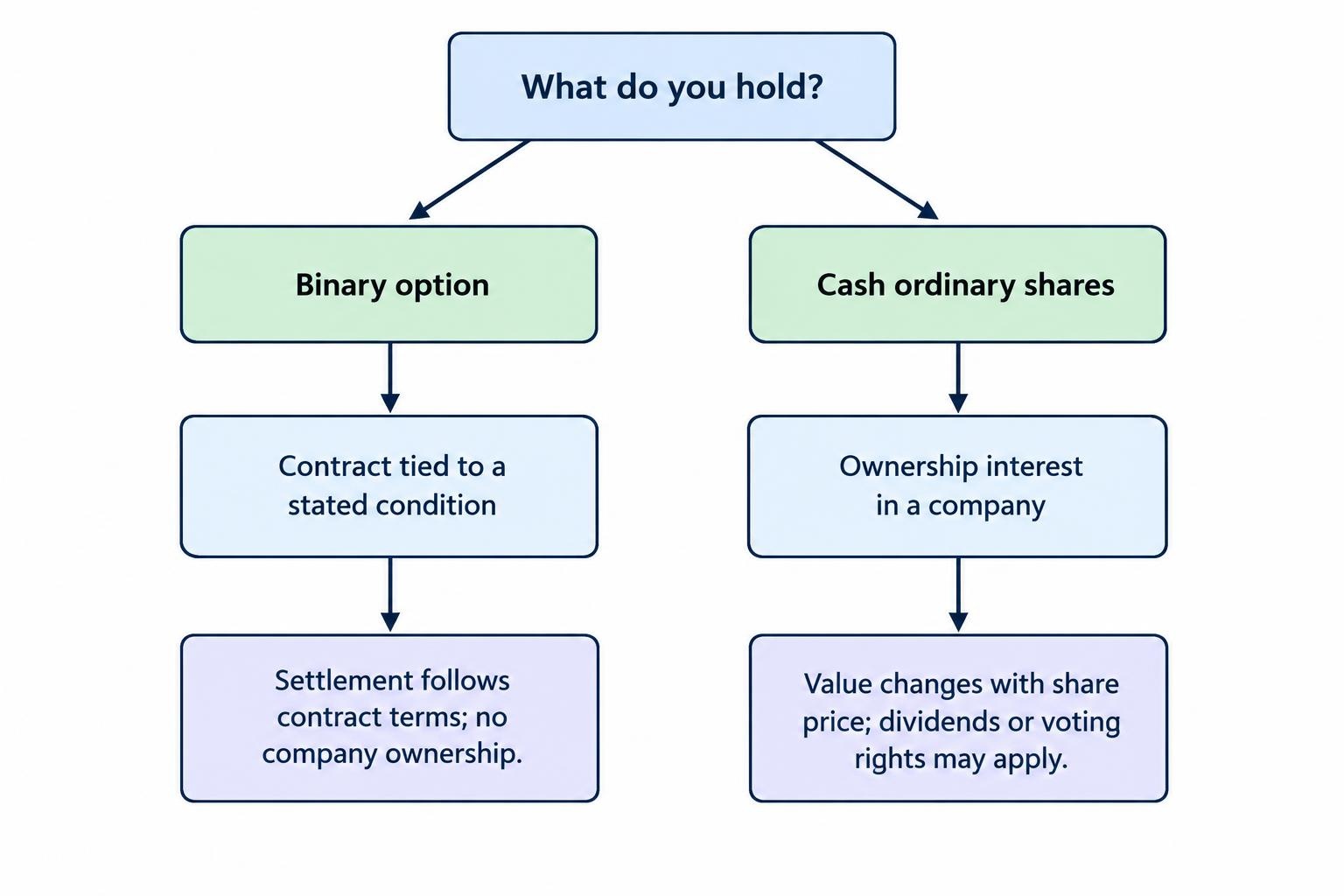
Ownership changes what you are buying
A binary option referencing a company’s share price does not make you a shareholder. You hold a contractual claim against the product issuer. The company could increase its profits, declare a dividend or announce an acquisition, but your contract still pays according to its own conditions.
Buying ordinary shares gives you an interest in the business instead. You can continue holding that interest after an afternoon’s price movement has passed. Your financial outcome remains exposed to the company rather than ending with one contract’s settlement.
The holding structure matters too. In Australia, shares may be registered directly through CHESS or an issuer sponsored holding. Alternatively, a custodian may hold legal title while you hold a beneficial interest. ASX’s explanation of share ownership structures sets out these distinctions. A trading app’s account balance alone does not tell you which arrangement applies.
Before opening an account, check whose name appears on the relevant register, who holds the assets and how transfers work. Direct registration and custody are different arrangements, not interchangeable marketing labels.
Also check the product itself. A familiar company ticker on a screen does not prove you are buying shares. A derivative can use the same ticker without transferring ownership. If the account offers share price exposure rather than shares, the comparison between binary options and CFDs addresses that different decision.
Returns: a fixed result versus a changing asset value
The clearest difference appears when the same share price moves by different amounts.
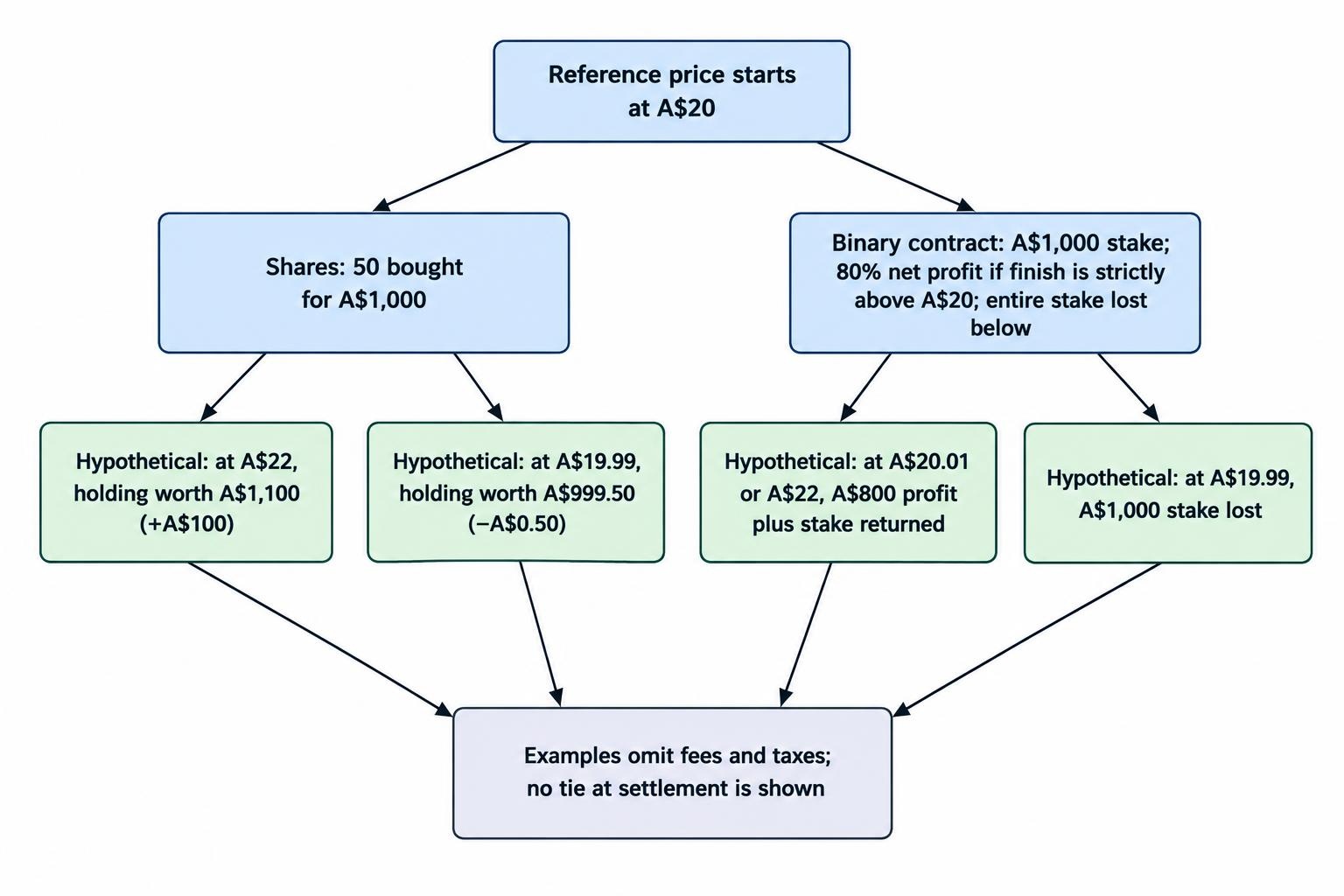
Consider two hypothetical positions involving a fictional company trading at A$20. These examples explain the arithmetic, not appropriate investment amounts. Ignore fees, taxes and any tie at settlement.
Buying the shares
You buy 50 shares at A$20, spending A$1,000. If their price rises to A$22, the holding is worth A$1,100: a A$100 gain before costs. If it falls to A$18, the holding is worth A$900: a A$100 loss.
A smaller movement produces a smaller change in value. At A$19.99, those 50 shares are worth A$999.50. You have lost 50 cents on paper, not the entire purchase amount.
You still own the shares unless you sell them or a company event changes the holding. Keeping them leaves you exposed to further gains and losses. It does not guarantee that an initial loss will reverse.
Taking a binary position on the same price
Now consider a hypothetical A$1,000 binary contract that pays an 80% net profit if the reference price finishes strictly above A$20 at expiry, but loses the entire stake if it finishes below A$20.
A settlement price of A$20.01 produces A$800 profit and the return of the A$1,000 stake. A settlement price of A$22 produces the same A$800 profit. The larger price rise does not increase the contractual payout.
At A$19.99, the contract loses A$1,000. That is the same reference price that produced a 50 cent fall in the shareholding’s value. The difference comes from the contract structure, not a different market forecast.
These percentages are not comparable investment returns over a common period. The binary contract has a deadline and a discontinuous result; the shares have continuing market value.
Why the payout percentage needs a second look
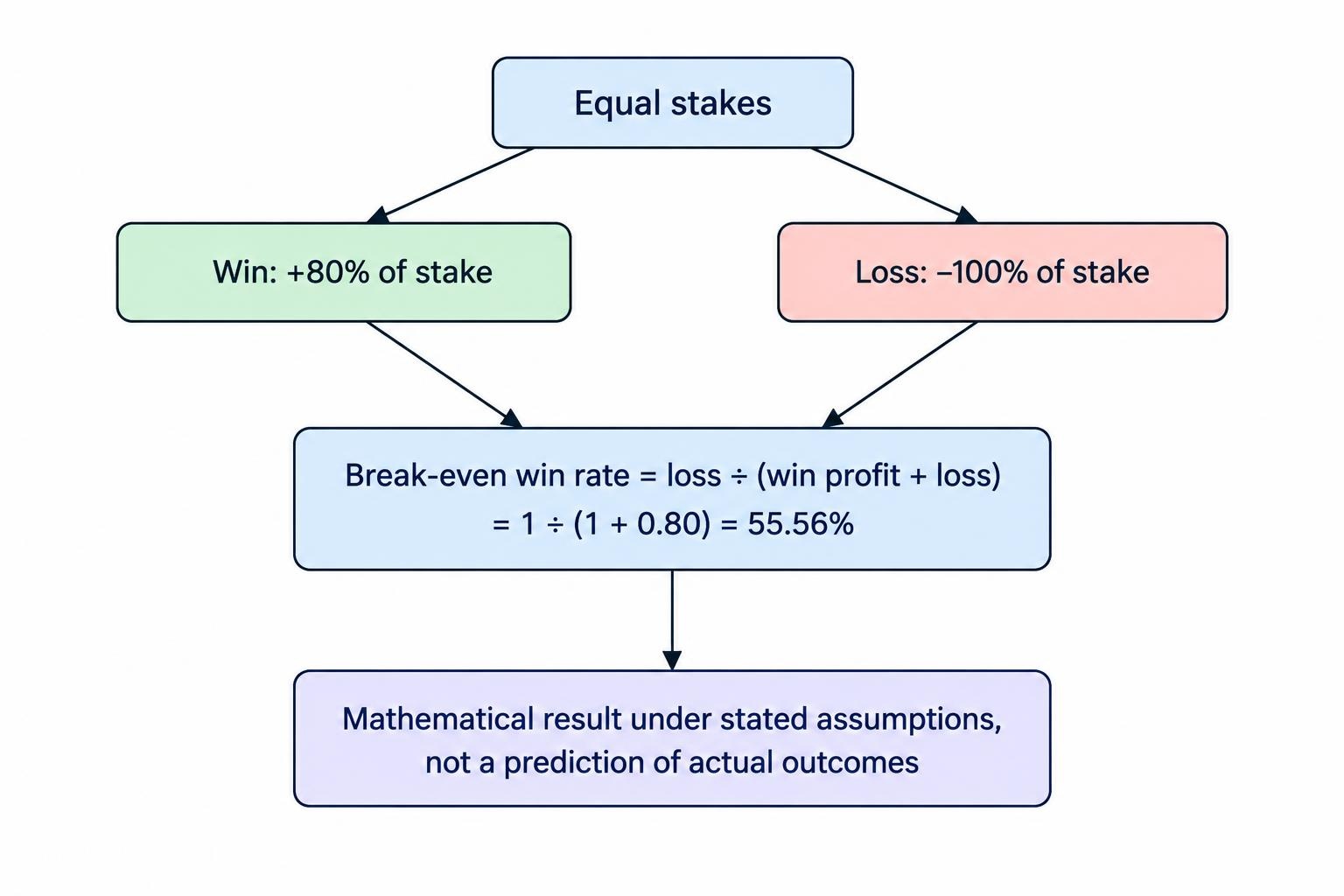
An 80% net profit payout does not mean an 80% chance of winning. With equal stakes, an 80% profit on winning contracts and a 100% loss on losing contracts, the mathematical break even win rate is:
1 ÷ (1 + 0.80) = 55.56%
Winning half the time would lose money under those assumptions. Fifty A$100 wins earn A$4,000, while fifty A$100 losses cost A$5,000. The result is a A$1,000 loss before any other charges.
This relationship between the reward, loss and required success rate is covered in probability and expected value in binary options. Share dealing has no equivalent universal win rate: the size of gains, losses, dividends and costs all affect the result.
Timing and control over the exit
A binary forecast must satisfy the contract’s condition at the relevant time. A prediction that proves correct later may still lose. If the contract expires below its threshold and the share price rises afterwards, that later recovery does not rewrite the settlement.
Cash shares normally have no contractual expiry. You can plan to hold for days, months or years, then reassess when the company’s prospects or your circumstances change. That flexibility is useful, but it also permits a familiar mistake: turning an unsuccessful short trade into an indefinite investment without a fresh reason to hold it.
Selling shares also requires an executable order. On ASX, brokers submit orders and buy orders are matched with sell orders, as set out in the ASX guide to share order execution. A price displayed on a screen is not a promise that you can sell any quantity at that price.
A limit order controls the lowest price you will accept when selling, but may remain unfilled. A market order prioritises execution at available prices rather than a guaranteed price. Thin trading, a trading halt or a sharp move can interfere with an intended exit.
The practical distinction is therefore flexibility, not complete control. Shareholders can choose when to request a sale; they cannot dictate the market that receives it.
Which has more risk?
There is no useful answer without defining the position. A small binary stake and a large shareholding do not become comparable because both reference the same company.
For a conventional fully paid binary contract, the stake identifies the amount exposed to that contract’s losing outcome. That clarity can be mistaken for safety. Knowing exactly how much can disappear does not make the chance of losing it acceptable, particularly if the stake is repeatedly replaced.
Cash shares have different risks. A company can disappoint, cut its dividend or fail, leaving shareholders with little or nothing. Spreading holdings across businesses can reduce dependence on one company, but does not remove market risk. These are central points in Moneysmart’s guidance on share returns and risks.
Compare the amount committed, not just the apparent simplicity of each transaction. A A$1,000 binary stake can be lost because the settlement condition narrowly fails. A A$1,000 shareholding can also become worthless, but an ordinary small price decline does not mechanically erase the whole holding.
Neither structure makes money available on demand at its original value. Money needed for rent, repayments or an approaching purchase should not depend on a favourable exit.
Dividends and the purpose of holding shares
Share dealing can support an income or business ownership objective that a binary contract does not provide. A shareholder may receive dividends while retaining the shares, although companies can reduce or stop those payments.
Capital growth and dividends should be assessed together. A dividend payment does not automatically turn a falling investment into a successful one, and a company that pays no dividend is not automatically a poor investment. The relevant question is what the holding produces after changes in its value, costs and tax.
For example, a hypothetical holding that earns A$40 in dividends but loses A$150 in market value has a negative A$110 result before other adjustments. Looking only at the cash payment misses most of the outcome.
A binary payout, by contrast, is settlement of a contract. It is not a distribution of the underlying company’s profits and creates no continuing stake in that company.
Costs: compare more than the commission
Share dealing costs can include brokerage, platform charges and currency conversion fees for overseas purchases. Dividends and realised gains can also have tax consequences. Moneysmart’s share dealing cost guidance identifies these charges and obligations. The actual amounts depend on the service, market and investor.
Costs matter most when viewed against the trade’s value and expected return. Suppose a hypothetical service charges A$10 to buy and A$10 to sell. On a A$1,000 purchase, that A$20 round trip consumes 2% of the initial investment before considering any spread or other charge.
If the shares rise 3%, the A$30 gross gain becomes A$10 after that brokerage. Repeated small trades make this arithmetic harder to ignore.
A binary contract advertised with no commission still needs an economic assessment. In the earlier example, the imbalance between an 80% winning profit and a 100% losing stake creates the required win rate. “No commission” does not mean “no disadvantage”.
Compare net outcomes after all relevant costs, not a fee label in isolation. Do not assume that binary contract losses and share investment losses receive identical tax treatment.
Choosing an approach that matches the objective
Start with what the money is supposed to achieve. “I think this share will rise” is a forecast, not yet a plan.
- For company ownership: assess the business, its valuation and the risks of holding it.
- For potential income: assess dividend sustainability rather than treating past payments as a commitment.
- For short term speculation: define the amount at risk, exit conditions and trading costs before entering.
- For near term spending: consider whether market exposure fits the need to preserve accessible cash.
Then assess the portfolio, not just the next transaction. Buying several companies from the same industry can leave much of the money exposed to one economic pressure. Position size, concentration and the ability to tolerate losses belong in a broader risk management plan.
For Australian retail clients, binary options and share dealing are not two equally available account choices. Review the Australian binary options regulatory position before acting on any platform’s availability claims.
The central distinction remains straightforward: share dealing acquires an interest in a business; a binary option settles a defined proposition. Cash shares offer continuing ownership and a choice of holding period, but still require sound selection, sensible sizing and acceptance of losses. A simpler payoff screen does not remove those financial decisions.
This article was last updated on: October 22, 2026