Dow Jones binary options are contracts whose payout depends on a defined condition involving a Dow related price, such as whether it finishes above a strike at expiry. They do not give you ownership of the index’s shares. The practical questions are which price the contract uses, when it measures that price and how much a correct prediction pays.
For Australian retail clients, the regulatory position comes first. ASIC’s ban on issuing and distributing binary options to retail clients took effect on 3 May 2021 and extends until 1 October 2031. The ASIC announcement extending the binary options ban sets out that restriction. The examples below are educational, not instructions to open or fund an account.
What the Dow Jones Industrial Average Measures
The Dow Jones Industrial Average, or DJIA, is a price weighted index of 30 large US companies. It covers several sectors rather than industrial businesses alone. Its weighting method matters: a higher share price gives a constituent more influence, rather than a larger stock market valuation. These construction rules appear in the S&P Dow Jones Indices methodology for the Dow averages.
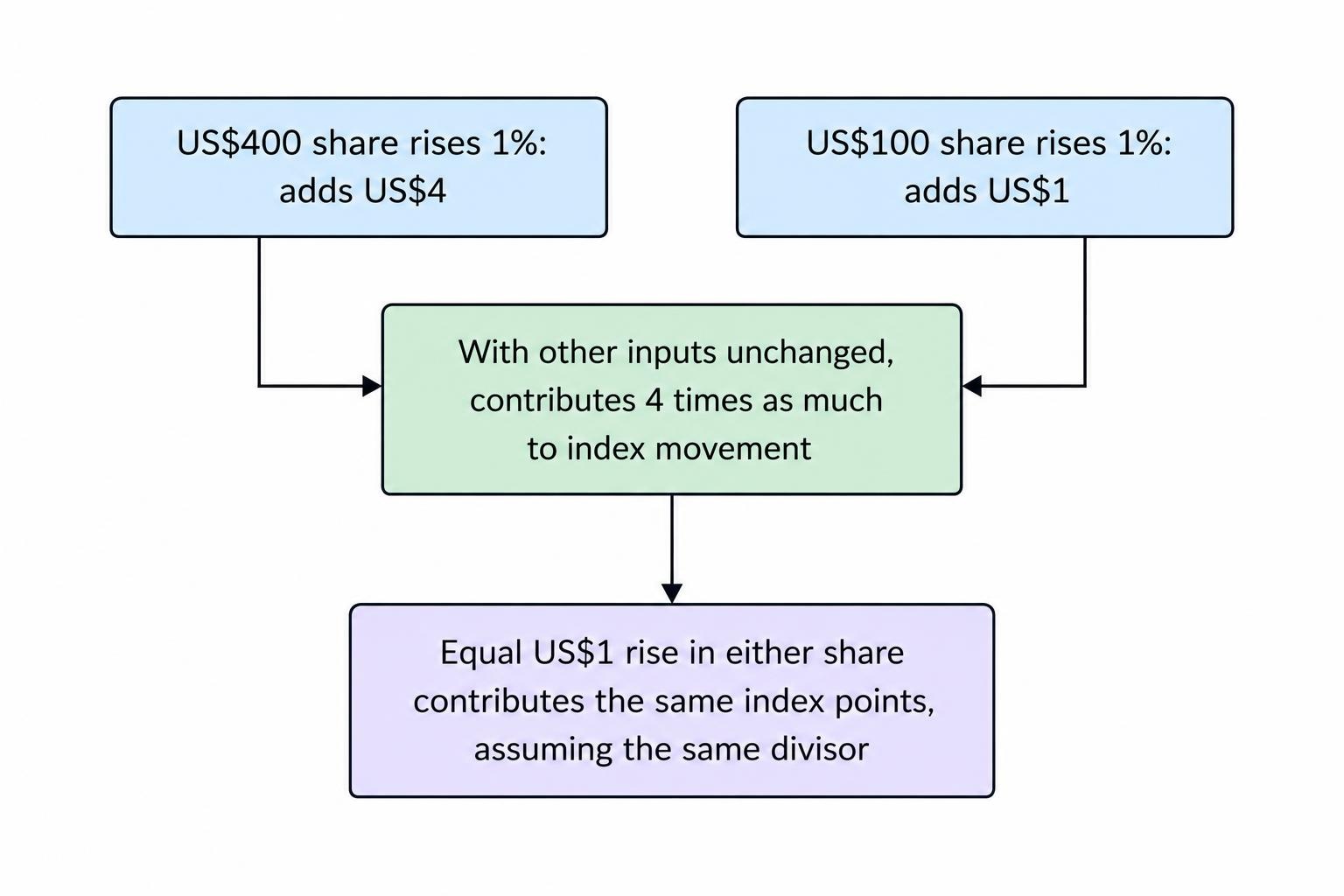
Consider two hypothetical constituents, one priced at US$400 and another at US$100. A 1% rise adds US$4 to the first share price but US$1 to the second. With other inputs unchanged, the first stock contributes four times as much to the index’s movement.
By contrast, a US$1 rise in either stock contributes the same number of index points, assuming the same divisor. “Higher priced stocks matter more” therefore refers to their weight and the effect of equal percentage moves, not a different value assigned to each dollar of movement.
For market analysis, this creates a useful distinction. Counting how many constituents rise is not enough to explain the Dow’s direction. A smaller group of higher priced shares can outweigh a larger group moving the other way. Treat the index as a weighted calculation, not a vote among 30 companies.
How a Dow Binary Options Contract Settles
A simple higher or lower contract compares its settlement price with an agreed strike at an agreed time. The expiry condition matters more than whether the index spent most of the preceding period moving in your predicted direction.
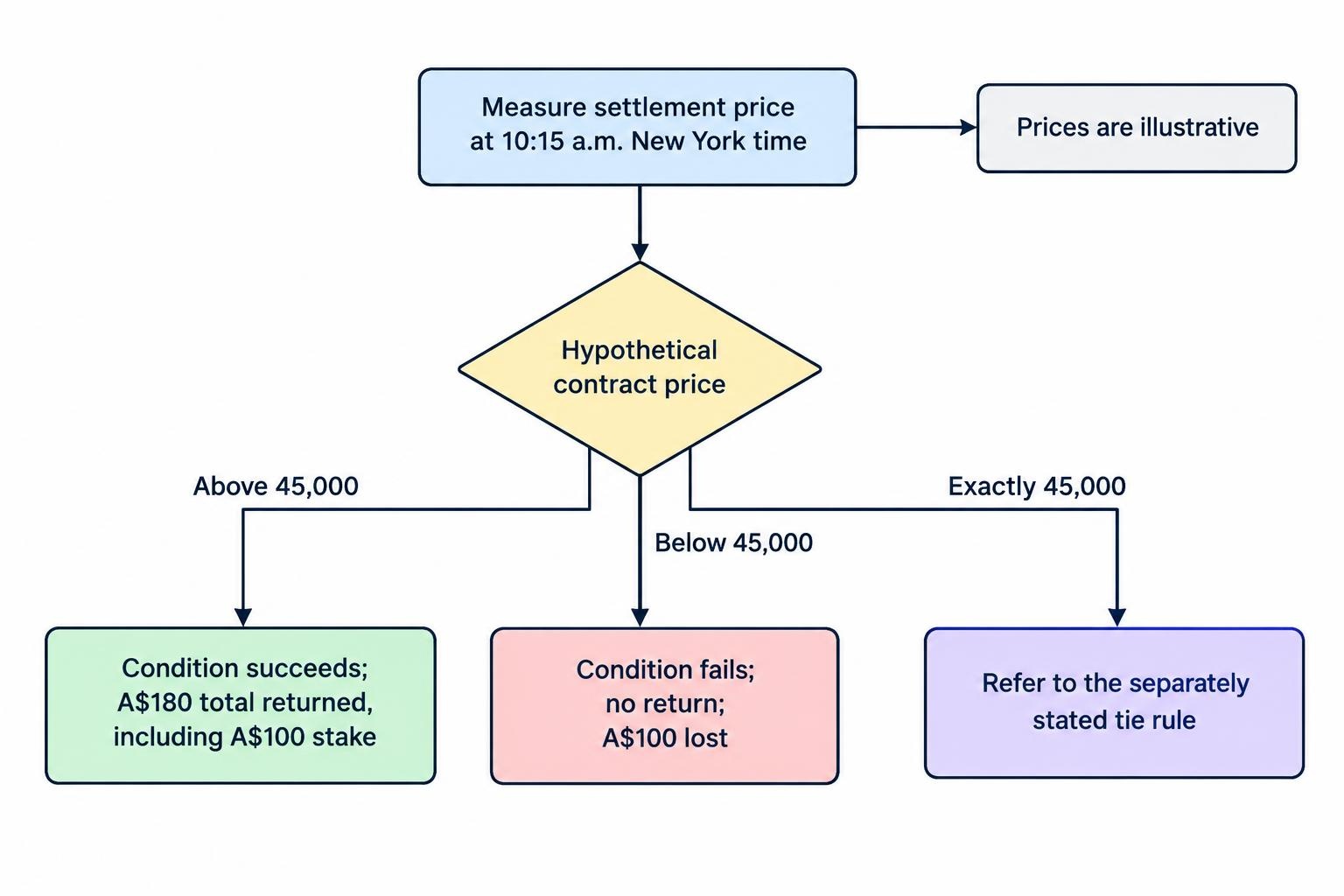
Take this hypothetical contract, using invented prices rather than a current market quote:
| Contract term | Illustrative value |
|---|---|
| Condition | Settlement price strictly above 45,000 at 10:15 a.m. New York time |
| Stake | A$100 |
| Successful outcome | A$180 total returned, including the A$100 stake; A$80 net profit |
| Unsuccessful outcome | No return; A$100 lost |
If the settlement price is 45,001, the condition succeeds. At 44,999, it fails. A finish at 45,150 pays no more than a finish at 45,001 under these terms. The size of the move does not increase the stated payout.
An exact finish at 45,000 needs a separate rule. A contract may treat equality as a loss, refund the stake or apply another stated outcome. The phrase “strictly above” excludes equality, but it does not establish whether a separate refund provision exists. Check the complete terms rather than guessing from the button marked “Higher”.
The same care applies to rounding. A chart displaying whole points might hide decimal precision used in settlement. The guide to binary options settlement and ties covers these distinctions. For a Dow contract, record the actual reference feed and precision alongside the strike.
Why a US30 Quote May Not Be the Cash Dow
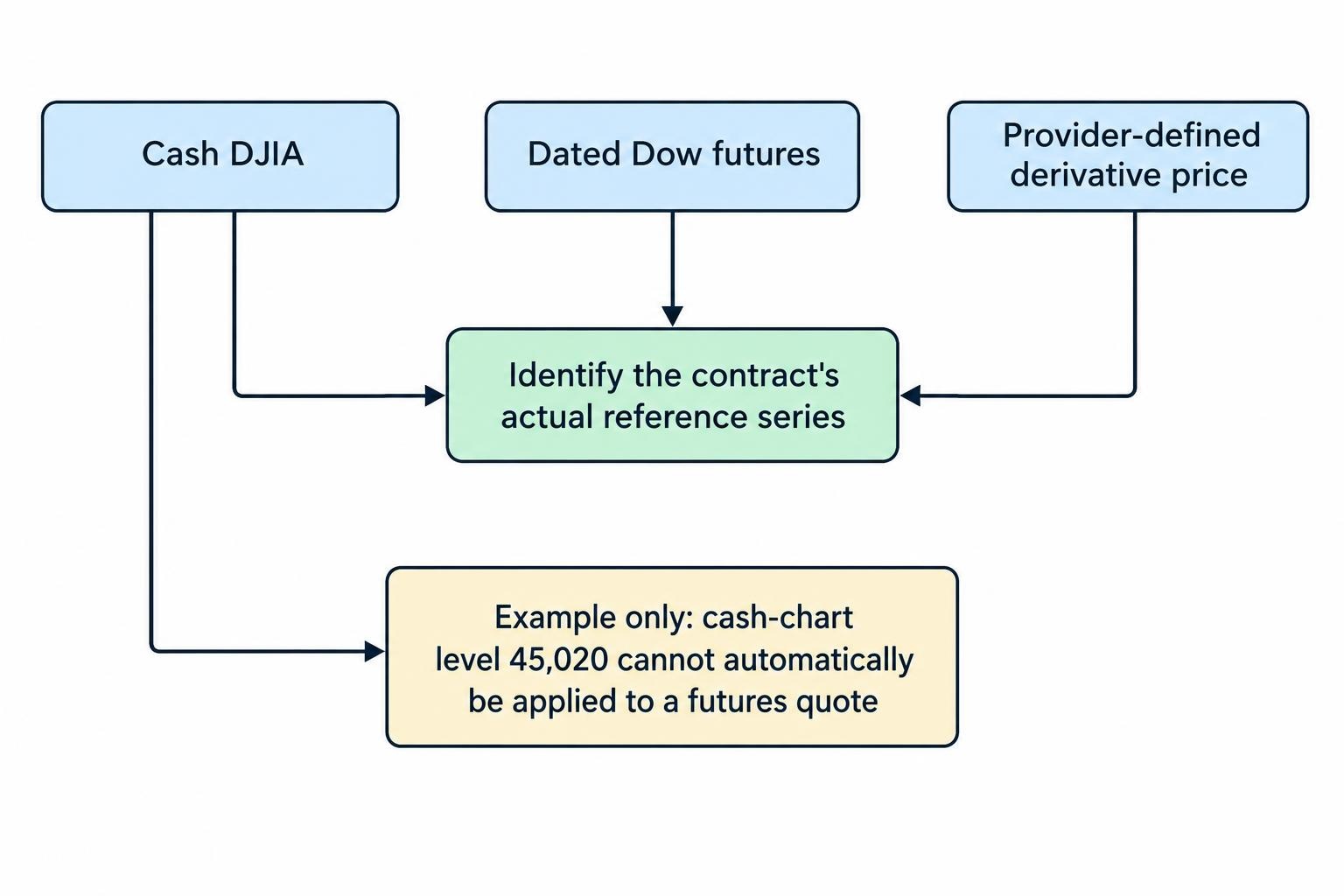
A familiar market label does not identify the underlying instrument. If a screen uses a name such as US30, Dow30 or Wall Street, establish whether it refers to the cash DJIA, a dated futures contract or a provider defined derivative price.
Exchange traded Dow futures are separate contracts with their own specifications. Micro E-mini Dow futures use the code MYM and a US$0.50 multiplier per index point. Their trading schedule extends beyond the regular US share session. The CME Group FAQ on Micro E-mini equity index futures documents these contract features.
Those specifications do not transfer to a binary option just because both products reference the Dow. A binary contract with an A$100 stake does not acquire MYM’s dollar value per point. Nor does the futures exchange necessarily determine that binary contract’s settlement.
For an illustrative mismatch, suppose a cash index feed shows 45,000 while a futures feed shows 45,060. Drawing resistance at 45,020 on the cash chart and applying that level directly to the futures quote mixes two price series. The futures price sitting above that line would not, by itself, establish a breakout in the cash index.
Also distinguish a dated futures chart from a continuous chart assembled from successive contracts. Before using historical levels, check whether the chart adjusts earlier prices when it changes contracts. Otherwise, a level identified in a backtest may not represent the price available at the time.
The practical rule is simple: analyse the series that matches the contract. Our comparison of cash index prices and futures prices covers the wider differences. A changing quote outside the cash session needs an explanation, not an assumption that the official index is trading continuously.
Dow Market Hours and Australian Time Zones
The NYSE core share trading session runs from 9:30 a.m. to 4:00 p.m. US Eastern Time, subject to the exchange calendar. Its opening and closing auctions also form part of the session structure. Check the NYSE trading hours and calendar resources rather than treating every weekday as an ordinary full session.
For Australian readers, convert the relevant New York date into your own city’s local time. Do not use a single “Australian market open” time throughout the year. Daylight saving changes can alter the conversion, and the local calendar date may differ from the US trading date.
Keep three clocks separate in any observation record: the exchange session, the chart’s displayed time zone and the contract’s expiry clock. A chart set to Sydney time and a contract ticket set to New York time can describe the same moment with different dates. That is an administrative problem, not a trading signal.
Session boundaries also change the question being studied. A contract expiring shortly after the opening auction measures a different interval from one expiring near the close. Do not combine their results without recording that distinction.
If a quoted contract remains available after the core session, return to its specifications. Availability alone does not tell you whether it uses futures, an adjusted quote or another reference price.
What to Examine Before Interpreting a Dow Move
Separate scheduled news from the price response
A useful Dow observation record separates broad US economic announcements from company news. Inflation data, employment reports and interest rate decisions are subjects to monitor, but the announcement’s label is not a directional forecast.
Release timing matters before the share market opens. The US Bureau of Labor Statistics CPI release schedule lists publication dates and scheduled 8:30 a.m. releases. Check the live calendar rather than assuming that every report follows the same date pattern.
As an analytical framework, compare the published result with expectations, then examine the price response. A stronger economic number might support an earnings argument while weakening an argument for lower interest rates. Neither interpretation guarantees the next index move. The useful question is which explanation the observed market behaviour supports, and for how long.
Account for constituent influence
Company announcements deserve attention through the Dow’s weighting method. When a higher priced constituent moves sharply, check its contribution before describing the entire US market as stronger or weaker.
For a paper exercise, compare two sessions: one where many constituents move together and another where a few shares account for much of the index change. Record whether your proposed signal treats them differently. This tests the reasoning without assuming that either pattern produces a profitable binary contract.
Match the forecast to the expiry
“The Dow should rise this week” does not answer whether a reference price will finish above a strike in five minutes. Direction, distance and deadline are separate parts of the question.
A useful forecast states all three: the reference series, the condition and the measurement time. Without them, a prediction can sound correct while remaining impossible to assess fairly.
Payouts Determine the Required Accuracy
Recognising the Dow’s direction is not enough when a winning contract pays less than a losing contract costs. Using the earlier A$100 stake and A$80 net profit, a 50% success rate loses money before any additional costs.
Across 100 hypothetical contracts, 50 wins produce A$4,000 in profit while 50 losses cost A$5,000. The result is a net loss of A$1,000. The calculation does not change because the underlying index has a familiar name.
With no ties, refunds or additional costs, the break even win rate is:
Required win rate = 1 ÷ (1 + net profit payout rate)
At an 80% payout, that is 1 ÷ 1.80, or approximately 55.56%. If the payout falls to 70%, the required rate rises to approximately 58.82%. These figures are mathematical thresholds, not evidence that either accuracy level is achievable.
The guide to probability and expected value in binary options develops the calculation further. For Dow research, retain the payout attached to every observation. Combining results from different payouts into one headline win rate can hide the economics of the sample.
Keep stake size separate from forecasting quality. Increasing the amount after a loss does not improve the next prediction or repair a negative expected return.
A Dow Focused Paper Trading Exercise
A written exercise can test whether your analysis is consistent without depositing money or selecting a live provider. Choose one clearly identified price series and one observation window. Keep the setup narrow enough that another person could reproduce it from the same data.
- Define the reference. Record the full instrument name, data provider, time zone and whether the data is live or delayed.
- Write the condition in advance. Specify the strike, observation time, expiry and treatment of equality before viewing the outcome.
- Record the context. Note the session stage, scheduled announcements and any constituent move relevant to your reasoning.
- Score every qualifying observation. Include losses, ambiguous records and occasions when the required data was unavailable.
Suppose your hypothesis concerns a move above the opening range. Define the range duration and the confirmation rule before starting. “A convincing breakout” is too elastic: it allows yesterday’s losing example to become an exception after the fact.
Then fix the expiry rule. Measuring every outcome ten minutes after a signal is different from measuring every outcome at 11:00 a.m. One gives each observation the same duration; the other gives them the same clock deadline. Choose deliberately rather than switching between them when results disappoint.
Our guide to paper trading binary options provides the broader method. A paper result remains hypothetical: chart observations alone do not establish executable prices, available payouts or actual settlement outcomes.
Set aside a later period to test the unchanged rules. If you repeatedly revise the setup until the historical results look attractive, you are measuring how well the rules fit that history. You have not yet shown that they work on observations they were not built around.
Assess the Contract Before the Direction
The Dow’s name answers less than it appears to. It identifies an index family, but it does not establish a binary contract’s reference price, expiry rules, payout or legal availability.
Before drawing a directional conclusion, be able to explain which series you are observing, why that series matches the proposed condition and which timestamp determines the result. If any answer depends on an unexplained platform label, the research is unfinished.
The broader guide to stock index binary options places these questions alongside other index markets. For the Dow, the most useful habits are to account for price weighting, separate cash and futures quotes, and measure results against the payout rather than accuracy alone.
For Australian retail readers, that analysis belongs within an educational context. A well known benchmark does not remove the binary product restriction, and a clean chart does not make an unfavourable contract favourable.
This article was last updated on: October 22, 2026