Retail and wholesale client classifications determine which Australian financial services protections apply to a trading account. They are legal categories, not measures of trading ability, and they are not the same as a platform’s “VIP”, “premium” or “professional” account labels.
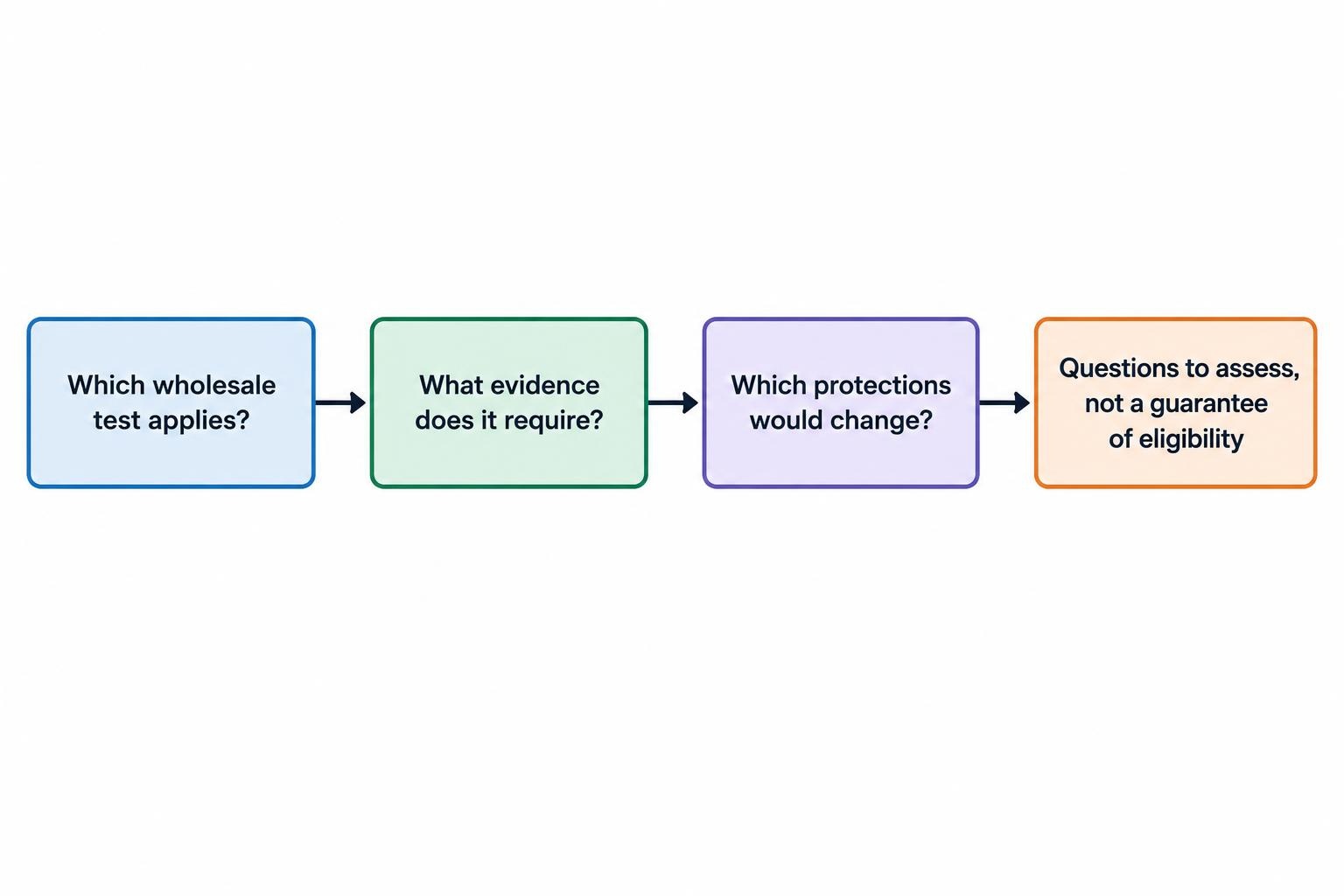
For binary options, the distinction has particular weight: ASIC’s product intervention order prohibits issuing and distributing these products to retail clients. A request to become a wholesale client therefore deserves more scrutiny than an ordinary account upgrade. Before signing anything, establish which legal test applies, what evidence supports the classification and which protections would no longer apply.
Why client classification matters for binary options
Australia’s prohibition on issuing and distributing binary options to retail clients took effect on 3 May 2021. It has been extended until 1 October 2031. The restriction concerns retail clients; it is not a blanket approval of wholesale binary options businesses or their products. These dates and the scope of the restriction are set out in ASIC’s announcement extending the binary options ban.
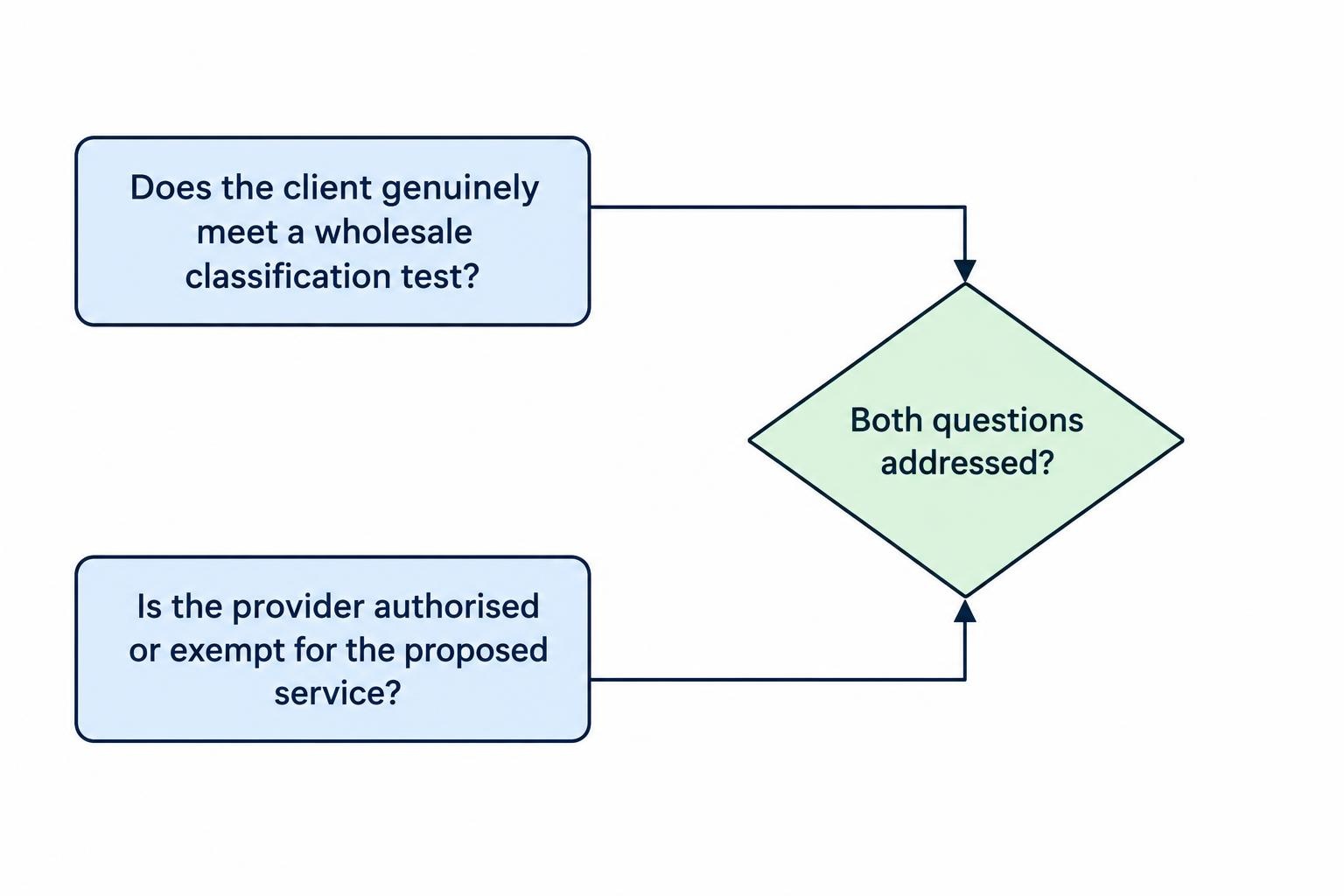
Two separate questions follow. Does the client genuinely qualify for wholesale treatment? And can the provider lawfully supply the proposed service? A satisfactory answer to one does not settle the other.
This distinction also explains why accepting Australian customers, displaying a foreign registration number or offering a wholesale application form is not enough to establish lawful access. The broader framework is covered in our guide to binary options regulation in Australia. Here, the focus is the client classification itself.
What retail and wholesale clients mean
For most financial products and services, retail treatment is the starting point unless a wholesale test applies. Retail does not mean inexperienced. A person can have years of trading experience and still receive services as a retail client.
Wholesale treatment can arise through several routes, including certified wealth, relevant experience or professional investor status. “Professional investor” has a statutory meaning: examples include an AFS licensee or a person controlling at least A$10 million, subject to the definition’s requirements. It does not simply mean someone who trades for a living. ASIC’s guidance on determining client status summarises these distinctions.
A useful way to approach an application is to separate three matters: the test being relied on, the evidence needed for that test and the consequences of applying it. Avoid treating “wholesale” as a permanent personal badge that answers every future account question.
The main routes to wholesale classification
The accountant’s certificate: assets or income
For eligible products and services outside business use, the individual wealth route generally requires a qualified accountant’s certificate confirming either:
- Net assets of at least A$2.5 million; or
- Gross income of at least A$250,000 in each of the preceding two years.
These are alternatives, not cumulative requirements. The certificate can generally be relied on for up to two years after issue, subject to the applicable conditions. The accountant must satisfy the legal requirements for a qualified accountant. A bank balance screenshot or a declaration written by the applicant is not the certificate required for this route. See ASIC’s requirements for accountant’s certificates.
Consider a hypothetical applicant earning A$300,000 in one year and A$240,000 in the other. Those figures do not meet the income threshold in both years, although another wholesale test might apply. Averaging the two figures would answer the wrong question.
Also separate eligibility from suitability. A person with substantial property wealth may have little experience assessing derivatives. Before requesting a certificate, ask the accountant to explain what it establishes. Do not assume it represents an assessment of the proposed trading strategy, platform or likely returns.
The experience based sophisticated investor test
Section 761GA provides a separate route for eligible products and services not provided for business use. The AFS licensee must have reasonable grounds to conclude that the client’s previous experience allows them to assess the product’s merits, value and risks, their own information needs and the adequacy of the information supplied.
The licensee must provide written reasons, and the client must sign the required written acknowledgement before or when the product or service is provided. The provisions sit alongside the other classification rules in sections 761G and 761GA of the Corporations Act.
When reviewing that assessment, look for a connection between your actual experience and the provider’s reasons. A list of products you have heard of is less informative than a clear account of products used, decisions made and risks assessed. Do not supply invented experience or accept answers written for you.
Business use requires its own assessment
The Act also contains a wholesale route where a product or service is provided for use in connection with a business that is not a small business. Simply opening an account through a company does not establish that this test is met.
Keep the identity of the applicant clear. An individual, a company and a trustee are not interchangeable names on an application. If the proposed account involves a trust or superannuation money, obtain advice on that arrangement rather than copying the classification used for a personal account.
The product value test
A separate route concerns the price or value of a financial product, generally using an A$500,000 threshold. It requires care with derivatives: the regulations contain valuation rules based on face value or notional amount, rather than simply the cash deposited. They also exclude contracts for difference from this route. The relevant provisions appear in regulations 7.1.18 to 7.1.22AA on product price and value.
Do not interpret an A$500,000 figure as an instruction to deposit that amount, increase a stake or accept a larger contract. Ask the provider to identify the applicable provision and explain its calculation for the actual product. A threshold is a classification rule, not a recommended trading budget.
Which protections change?
Wholesale treatment removes access to several protections attached to retail financial services. The exact consequences depend on the product and service. The following comparison draws on ASIC’s analysis of wholesale client tests and statutory protections.
| Area | Retail treatment | Wholesale treatment |
|---|---|---|
| Disclosure | PDS and financial services disclosure requirements apply where required by law. | The same retail disclosure requirements generally do not apply. |
| Personal advice | Retail advice duties and documentation requirements may apply. | The same retail advice framework does not apply. |
| Product distribution | Design and distribution obligations apply to covered retail products. | These retail distribution protections do not apply in the same way. |
| Dispute resolution | Retail licensees must have compliant dispute arrangements and AFCA membership. | There is no equivalent statutory requirement to provide external dispute resolution access. |
A wholesale client may still have potential access to AFCA where the financial firm is a member. However, AFCA can exclude wholesale complaints. Neither “wholesale clients can never complain” nor “our AFCA membership covers everything” is a safe assumption.
Before agreeing, request a written comparison of the protections that would change for your account. Ask about practical consequences, not just document names: what information will you receive, who will consider a dispute and what process will apply?
Wholesale status does not authorise the provider
Client eligibility and provider authorisation are separate checks. Providing financial services generally requires an Australian financial services licence, authorisation under one, or an applicable exemption. Wholesale treatment does not itself supply that authorisation. ASIC’s AFS licensing requirements cover activities such as financial product advice, dealing and market making.
Ask for the full legal name of the entity entering the contract, not just the brand displayed above the trading screen. Request its licence details or a clear explanation of the exemption it claims to use. Check that the explanation addresses the proposed service rather than an unrelated activity.
Our guide to checking a broker’s licence sets out the separate verification process. Keep copies of the results with the application documents.
It also helps to keep two folders, whether digital or on paper: one for your classification evidence and another for the provider’s identity and authorisation. That simple separation makes it harder for an impressive looking certificate in one folder to distract from a missing answer in the other.
How to assess a request to become wholesale
Start by asking why the classification is being proposed. The answer should identify the intended service and the legal basis for supplying it. “Better access” is a sales description, not a complete explanation.
Then request the documents before signing. For an experience based assessment, ask for the provider’s written reasons. For a wealth based assessment, review the certificate’s applicant name, date and intended use. Read any acknowledgement separately from the main account agreement, especially where the application presents several documents behind one acceptance button.
Pause the application if the process involves any of the following:
- Instructions to exaggerate income, assets or trading history.
- Suggested answers intended to secure a passing assessment.
- A request to sign an acknowledgement without receiving the supporting reasons.
- Pressure to deposit before classification questions are answered.
- Refusal to identify the contracting entity or explain its authorisation.
Treat these as reasons to obtain independent advice, not as problems to fix by supplying more money. There is little value in completing an application quickly if you cannot later explain what you agreed to.
Can you remain retail or ask for a review?
If you do not want wholesale treatment, say so before supplying certificates or signing acknowledgements. Ask whether the provider can offer the proposed service on a retail basis and request a written answer. Do not assume the business must offer every product under both classifications.
For binary options, retaining retail treatment does not create access to products covered by the retail ban. The sensible response to an unavailable service is not to make the application say something untrue.
If you already hold a wholesale account, ask the provider to identify the classification basis currently recorded and whether it can review your status. Include the date of the original assessment and any concerns about its accuracy. Ask what a change would mean for existing positions, future services and the account agreement before taking further action.
Independent advice is particularly useful where the disagreement concerns an old certificate, a company or trust account, or an assessment based on experience you believe was overstated.
What to do if you believe you were misclassified
Build a dated record before making the complaint. Preserve the application, questionnaires, certificate, written reasons, acknowledgements, account terms and relevant messages. Include screenshots showing how the classification was presented, but retain the underlying documents too.
Write to the provider and explain the issue precisely. Identify the test it relied on, why you dispute that assessment and what review you want. Distinguish a classification complaint from a complaint about trading losses: explain the alleged assessment error rather than relying only on the fact that trades lost money.
Request a written response and keep track of correspondence. For the next steps, including checking whether AFCA can consider the matter, use our guide to broker complaints and AFCA. Do not assume a disputed classification guarantees compensation or that a signed acknowledgement settles every question.
The decision is not whether “wholesale” sounds preferable. It is whether the classification is legally supported, whether you accept its consequences and whether the provider can lawfully supply the service. Resolve those questions before funding the account, not after a dispute begins.
This article was last updated on: October 22, 2026