Stake sizing is the process of deciding how much money to put at risk on each binary options contract. It determines the financial damage from a losing trade, the effect of consecutive losses and how much exposure builds up when several contracts remain open.
A stake rule cannot turn an unprofitable strategy into a profitable one. Its purpose is narrower: control how much capital a trading decision can consume. The correct amount may be zero, particularly when the contract terms, expected return or legal position are unclear.
Australian retail restriction: ASIC’s prohibition on issuing and distributing binary options to retail clients took effect on 3 May 2021 and has been extended until 1 October 2031. The ASIC binary options ban extension applies regardless of any stake management method. The examples below are for paper trading and product risk analysis, not a recommendation to access offshore providers. All dollar figures are hypothetical Australian dollars.
What Counts as the Stake?
For a contract where a losing outcome returns nothing, the stake is the amount committed to that contract. A $20 stake can produce a $20 trading loss, even if the advertised winning profit is only $16.
That distinction matters. The potential profit is not the amount at risk. The joint CFTC and SEC binary options alert describes the asymmetric structure: a winning contract pays a stated return, while a losing contract can consume the entire amount committed.
For sizing purposes, use the maximum contractual loss rather than an expected loss or hoped-for early exit value. Add any unavoidable transaction charge that would sit outside the stake. Do not assume that an early close feature will always be available at a useful price.
A refund for an exact tie does not normally reduce the amount at risk on an outright losing result. Read those outcomes separately. “Sometimes refunded” is not the same as “partly protected.”
Set the Bankroll Before Choosing a Percentage
A percentage only makes sense once its denominator is clear. Here, the bankroll means the amount allocated to the exercise, not total household savings, a credit limit or the largest balance an account has ever reached.
Exclude money needed for rent, bills, debt repayments and emergencies. Borrowing does not create spare capital: the loan and interest remain payable after a trading loss. Moneysmart’s guidance on borrowing to invest sets out that continuing repayment obligation. A stake percentage does not remove it.
For paper trading, choose a balance that reflects the amount being evaluated. Practising with a fictional $100,000 balance and large stakes tells you little about whether the same rules work with $500. Contract minimums and rounding can change the result substantially.
Also distinguish the bankroll from a replenishment budget. If a simulation loses $200 and you immediately add another fictional $200, the restored balance hides the cumulative loss. Record every addition separately and retain the original performance history.
Stake sizing belongs within a broader binary options risk management plan. A per-trade rule needs companion limits for open exposure, session losses and the point at which the exercise stops altogether.
Calculate the Stake From the Current Balance
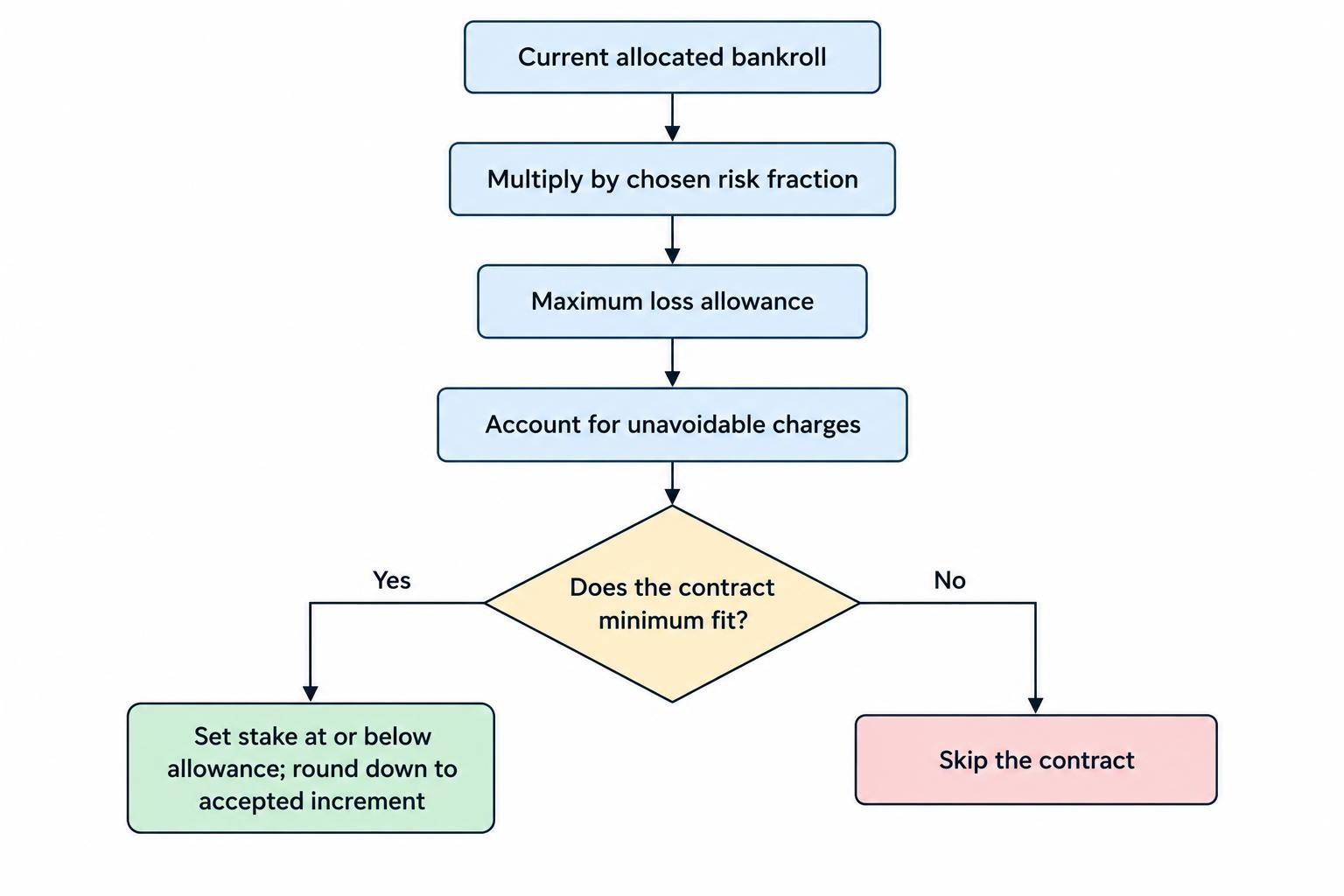
The basic calculation is straightforward:
Maximum loss allowance = current bankroll × chosen risk fraction
With a $2,000 bankroll and an illustrative 0.5% fraction, the maximum loss allowance is $10. If there are no additional charges and the full stake can be lost, the maximum stake is also $10.
These figures are examples, not a claim that 0.5% is safe or suitable. No percentage makes binary options safe, and no universal percentage fits every financial situation or contract.
For this simple calculation, assume there are no unresolved positions. Use the balance after settled gains and losses, excluding bonuses, promised deposits and anticipated winnings. If the balance falls to $1,900, the same 0.5% rule produces a $9.50 allowance. Continuing to stake $10 would mean the percentage has increased.
Where stakes must follow a set increment, round down rather than up. A calculated allowance of $9.50 does not justify a $10 stake if $9 is an accepted amount. Any charge outside the stake must also fit inside the allowance.
What if the Minimum Stake Is Too Large?
Suppose a paper trading scenario uses a $500 bankroll and a 0.5% allowance. The calculated amount is $2.50. If the hypothetical minimum stake is $10, that contract requires four times the intended exposure: 2% of the bankroll.
The rule has failed the contract minimum check. The response is to skip the simulated contract or revise the exercise, not quietly replace the chosen percentage with whatever the platform accepts. Depositing more money solely to satisfy a minimum is not a substitute for deciding how much capital can be lost.
Fixed Cash Stakes Versus Percentage Stakes
A fixed cash method uses the same amount each time, such as $10 per contract. It makes a paper trading record easy to compare because each result has the same starting stake. Its weakness is that the amount becomes a larger share of the bankroll after losses.
At $2,000, a $10 stake represents 0.5%. At $1,000, it represents 1%. The cash amount has not changed, but the remaining bankroll now carries twice the proportional exposure.
A fixed percentage method recalculates the stake from the current balance. Stakes shrink after losses and grow after gains. That keeps the chosen proportion stable, although actual results will differ slightly when stake increments require rounding.
A percentage method can also include a cash ceiling. For example, a paper policy might permit the smaller of 0.5% of the balance or $10. At $2,400, the percentage calculation gives $12, but the ceiling holds the stake at $10. At $1,800, the percentage calculation reduces it to $9.
Choose the calculation method before reviewing results. Switching between methods because one produces a larger next stake defeats the purpose of having a rule.
Account for Payouts Without Increasing Risk
A quoted 80% winning return usually refers to profit on the stake, not the total amount returned. Under that assumption, a winning $10 contract produces $8 profit and returns the $10 stake, giving a total credit of $18. A losing result costs $10. Check the wording rather than relying on the percentage alone; the binary options payouts guide separates profit from total return.
With no fees, refunds or ties, the break-even calculation is:
Break-even win rate = 1 ÷ (1 + net profit rate)
An 80% profit rate requires a win rate of about 55.56% just to break even. A 90% profit rate requires about 52.63%. Those are mathematical thresholds, not estimates of what a strategy will achieve.
Consider an assumed 55% win probability with an 80% profit rate. For each $10 stake, the expected result is:
(0.55 × $8) − (0.45 × $10) = −$0.10
Reducing the stake reduces the expected dollar loss per contract under those assumptions. It does not change its negative sign. Increasing the stake magnifies it. The relationship between the winning return and the chance of winning belongs in probability and expected value calculations, separate from the decision about how much capital to expose.
A lower payout is therefore not a reason to stake more to maintain the same dollar profit target. It is a reason to reassess the contract’s economics.
Stress-Test the Size Against Consecutive Losses
A useful stake test asks what happens if several trades lose consecutively. The table below starts with $2,000 and recalculates each stake as a fixed percentage of the remaining balance. It assumes full stake losses, no fees and no rounding.
| Stake fraction | First stake | Balance after ten losses | Drawdown |
|---|---|---|---|
| 0.5% | $10 | $1,902.22 | 4.89% |
| 1% | $20 | $1,808.76 | 9.56% |
| 2% | $40 | $1,634.15 | 18.29% |
| 5% | $100 | $1,197.47 | 40.13% |
The difference is not subtle. At 5%, ten losses remove about two-fifths of the starting balance. Recovering from that position requires approximately a 67% gain on the remaining money, not a 40% gain.
The general calculation is:
Remaining balance = starting balance × (1 − stake fraction)number of losses
This is a stress scenario, not a prediction that ten losses will occur or a suggestion that ten is the longest possible sequence. A fuller assessment of losing streaks in binary options also needs assumptions about win probabilities and whether results depend on each other.
Work backwards from the damage you are evaluating. If roughly a 10% reduction after ten full losses already exceeds the exercise’s tolerance, a 2% stake fails that test. A smaller stake may pass this particular test without passing a longer losing sequence, a payout change or a platform failure.
Percentage sizing can leave a positive mathematical balance after many losses. In practice, the exercise can become unworkable much earlier when the calculated stake drops below the contract minimum.
Cap Open Positions and Session Losses
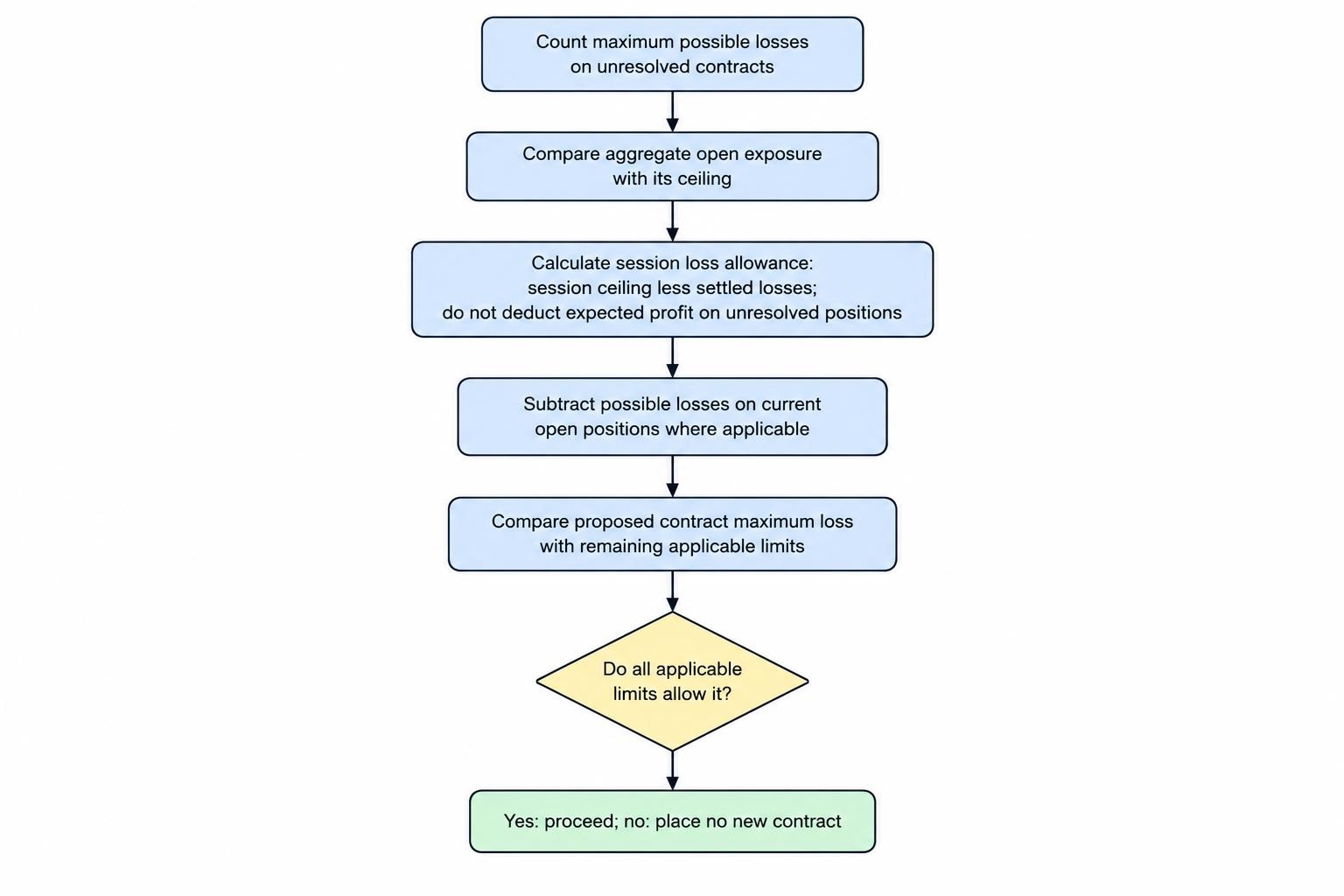
A 0.5% stake rule does not mean only 0.5% is at risk when several contracts remain open. Four positions, each risking 0.5% of the same reference balance, create 2% of open maximum loss exposure.
Count the full possible loss on unresolved contracts before adding another. Do not subtract a position’s expected profit because it currently appears to be winning. Until settlement, that profit remains uncertain.
Also group positions by the event or market view they depend on. Several contracts can express the same prediction even when their asset names differ. Two currency positions that both require a weaker US dollar should not automatically be treated as independent opportunities. The guide to correlation and trading risk covers that distinction.
A paper policy might therefore have three separate controls: a per-contract allowance, a total open exposure ceiling and a session loss ceiling. None replaces the others.
Suppose the session ceiling is $60, measured from the opening balance, and settled losses have reached $52. Only $8 remains before that ceiling. A new contract capable of losing $10 would breach the plan even if it passed the usual percentage calculation.
If existing open positions can still lose $6, only another $2 fits within the remaining session allowance. Where the minimum stake is higher, no new contract fits.
Define the session accounting in advance, including how settled profits affect the calculation. Do not enlarge the ceiling after a good start or deposit more money to reset it. A stop rule governs new exposure; it cannot reverse losses on contracts already open.
Why Loss Recovery Systems Break the Plan
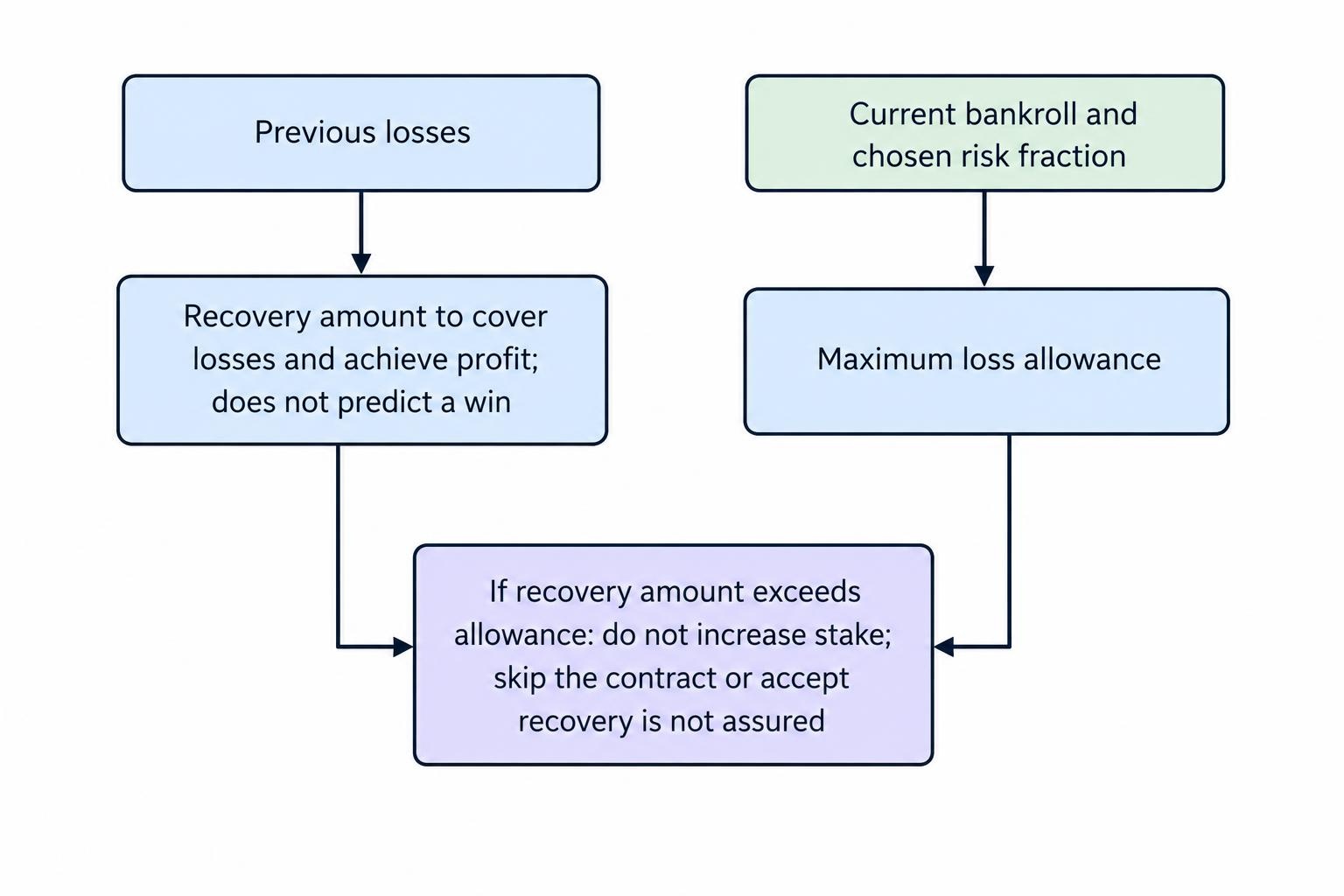
Increasing stakes after losses replaces a capital-based rule with a recovery target. The next amount depends on the previous disappointment rather than the bankroll’s remaining capacity.
Simple doubling also behaves differently when winning profit is less than 100% of the stake. With an 80% profit rate, a sequence of $10, $20 and $40 stakes produces only $2 net profit if the first two lose and the third wins: $32 profit minus $30 of earlier losses.
After four losses of $10, $20, $40 and $80, the cumulative loss is $150. A winning $160 contract produces $128 profit at the same payout, leaving the sequence $22 down.
To recover $30 of losses and make an additional $8 at an 80% profit rate, the next winning stake would need to be $47.50. That calculation describes the amount required if the contract wins. It says nothing about whether it will win.
The arithmetic behind Martingale in binary options trading deserves separate treatment. For stake sizing, the governing rule is simpler: a previous loss does not justify breaching the next contract’s allowance. A recovery requirement and a risk ceiling can conflict; the ceiling must take priority.
Why Kelly Sizing Depends on a Reliable Edge
The Kelly criterion calculates a fraction intended to maximise expected logarithmic growth under a probability model. Classical Kelly assumes the outcome probabilities are known; research on Kelly allocation with uncertain probabilities addresses the separate problem of not knowing that distribution.
For a two-outcome contract with a full stake loss:
Kelly fraction = (b × p − q) ÷ b
Here, b is net winning profit per dollar staked, p is the win probability and q is the loss probability, equal to 1 − p.
Assuming an 80% profit rate and a genuine 60% win probability gives a 10% fraction. That is a model output, not a sensible default stake recommendation.
Change the assumed win probability to 55% and the calculated fraction becomes negative. In a model allowing only a positive stake or no trade, that means no stake.
The practical problem is estimating the probability well enough. A historical win rate is not a known future probability. Taking half or a quarter of an overstated Kelly result reduces its size but does not repair the mistaken assumption. A calculation cannot establish the edge it was given as an input.
Write a Paper Trading Stake Policy
A useful policy produces the amount before the result is known. It should not require a fresh negotiation with yourself after every loss.
Keep the document short enough to apply consistently. Include:
- Balance definition: the capital used in the calculation, with additions and withdrawals recorded separately.
- Stake rule: the percentage or cash amount, any cash ceiling, and the rounding method.
- Exposure limits: maximum unresolved losses across all contracts and related market views.
- Stopping conditions: session and cumulative loss ceilings, plus rules for missing or unclear contract information.
- Review schedule: when the policy will be assessed, without changing it to accommodate a recovery trade.
Record the calculated allowance and the actual simulated stake in a trading journal. Include the quoted profit rate, maximum loss, open exposure and whether the trade complied with the policy.
Separate execution compliance from financial outcome. A winning contract placed above the allowance remains a rule breach. A losing contract placed within the allowance does not prove that the sizing calculation was wrong.
When comparing stake methods, use the same underlying sequence of contract outcomes. Otherwise, differences may come from different trades rather than the sizing method. Record rejected trades too, including those excluded by minimum stakes or exposure ceilings.
Separate Trade Risk From Account Risk
Stake sizing controls contractual trading exposure. It does not protect the rest of an account from an operator refusing withdrawals or interfering with settlement. The SEC investor alert on binary options fraud documents complaints involving withheld funds and software manipulation.
A $10 stake therefore does not establish that only $10 of money held with an operator is exposed to every kind of risk. Contract loss and access to the account balance are different questions.
A workable stake policy uses a clearly defined bankroll, counts the full possible loss, respects aggregate exposure and refuses increases driven by recovery targets. It also accepts a result that trading promotions tend to overlook: sometimes no stake fits the rules, and the amount to commit is zero.
This article was last updated on: October 22, 2026