Boundary and range binary options ask whether a price will finish inside or outside two preset levels. Some contracts instead require the price to stay between those levels throughout an observation period. That difference can turn the same price movement into a win under one contract and a loss under another.
Australian retail restriction: ASIC’s ban on issuing and distributing binary options to retail clients took effect on 3 May 2021 and continues until 1 October 2031. The ASIC announcement extending the binary options ban confirms its scope and duration. This article explains contract mechanics, not a route around that restriction.
How Boundary and Range Binary Options Work
A range contract uses a lower boundary and an upper boundary. Together, they define a price interval. The contract then sets a condition involving that interval, an expiry time or observation period, and a payment if the condition is satisfied.
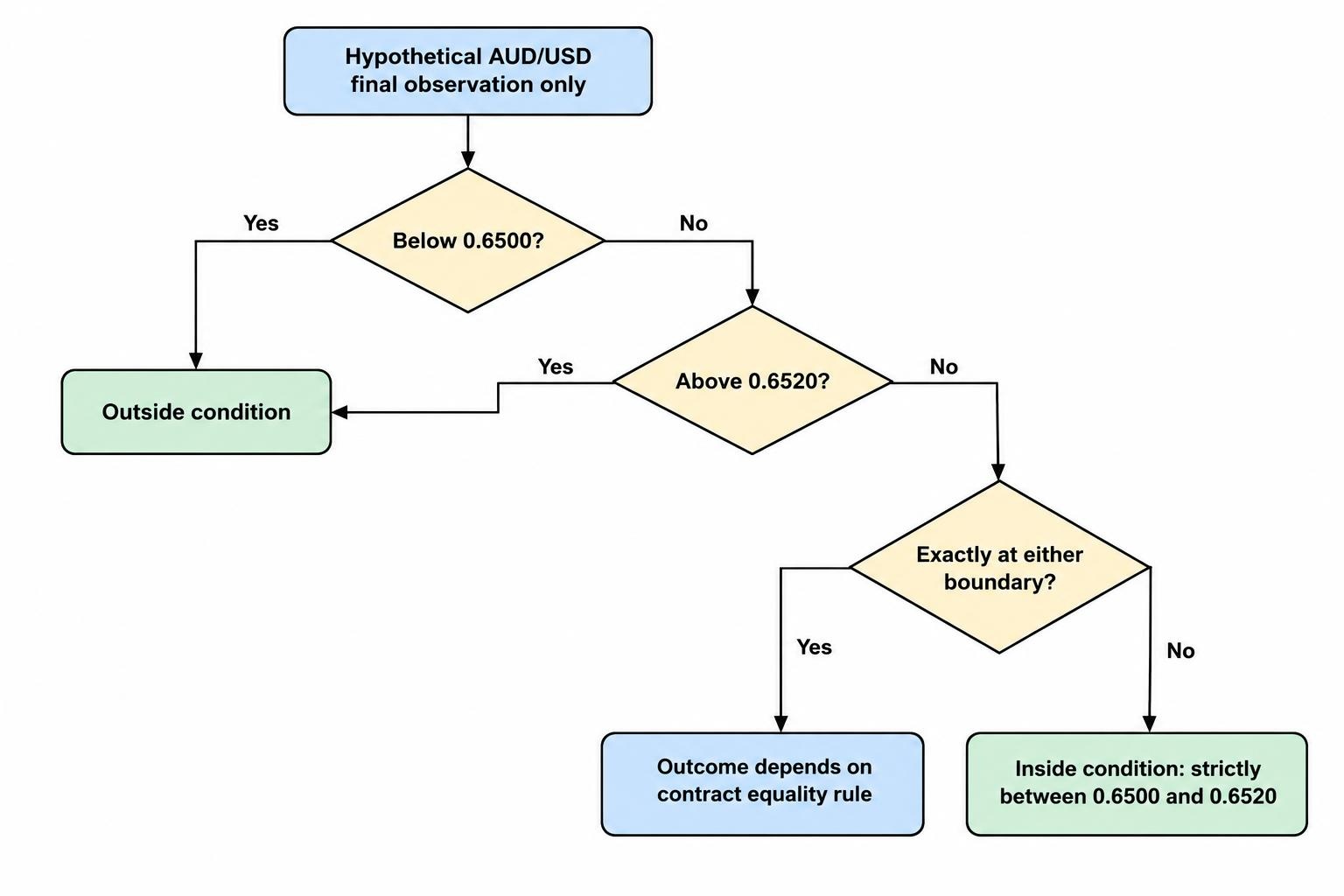
Consider a hypothetical AUD/USD range between 0.6500 and 0.6520. An inside contract might pay if the settlement price finishes between those levels. An outside contract might pay if it finishes below 0.6500 or above 0.6520. Equality at either boundary needs its own rule.
Unlike a directional contract, the question is not simply whether the price rises or falls from its starting point. A price can rise and still finish inside the range. It can fall and finish inside too. The different types of binary options separate these conditions: direction, touching a level, remaining within boundaries, or finishing relative to several levels.
An expiry-based range binary pays according to the final observation rather than the entire price path. The FpML European range digital example specifies payment when the exchange rate at expiry is below the upper trigger and above the lower trigger.
“Finish Inside” Is Not the Same as “Stay Inside”
The most consequential wording is often the least dramatic: at expiry, throughout, or at any time. Do not treat these phrases as interchangeable.
Expiry-based inside and outside contracts
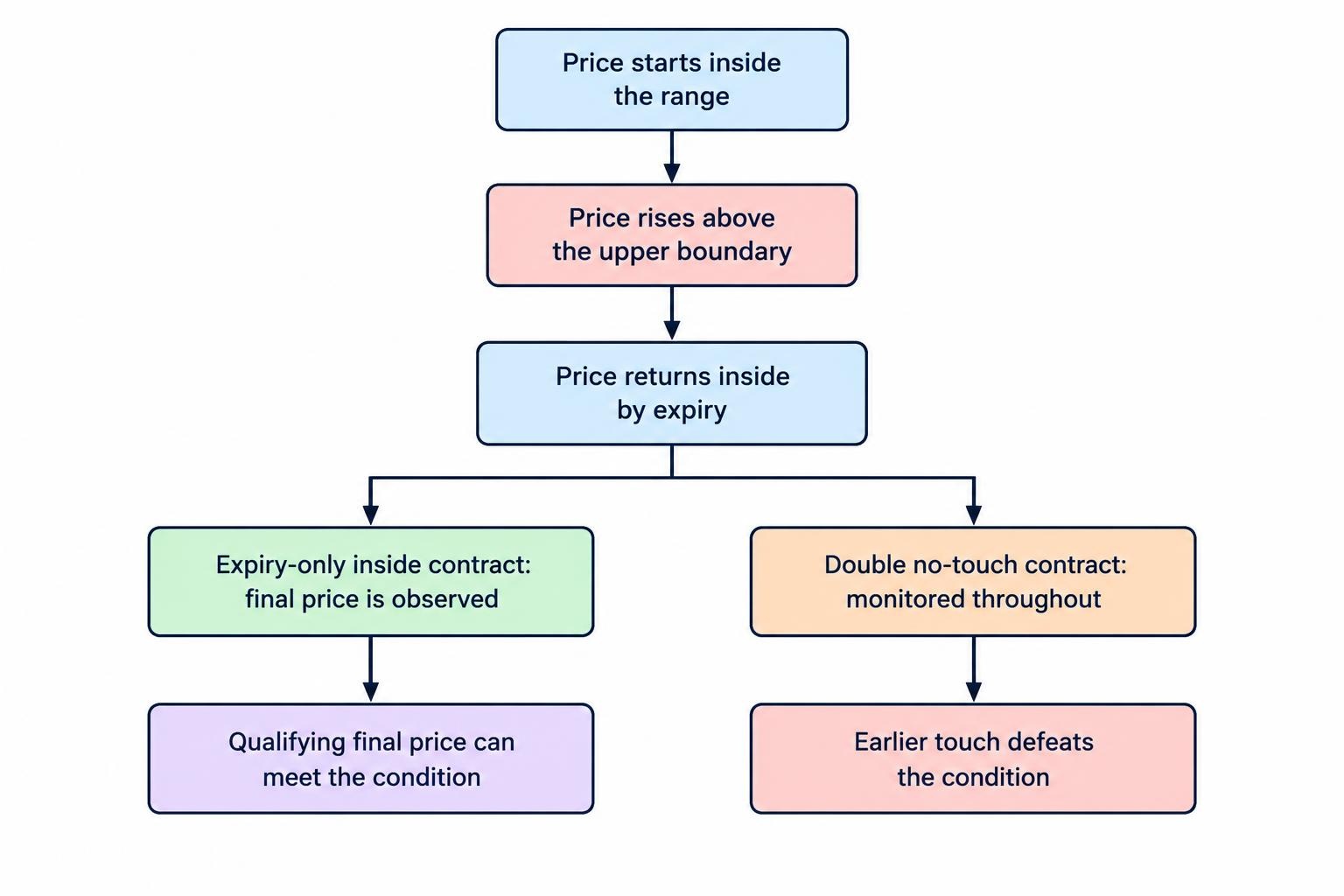
For an expiry-only inside contract, earlier excursions beyond the boundaries do not decide the result. If the contract requires a final price strictly between 0.6500 and 0.6520, a temporary move to 0.6525 does not prevent a win if the settlement price later returns to 0.6510.
Conversely, crossing a boundary early does not secure a win on an expiry-only outside contract. The price must still satisfy the outside condition at the final observation.
Contracts monitored throughout a period
A double no-touch structure requires the price to avoid both boundaries during the stated observation period. Touching either boundary can defeat the condition even if the price returns to the middle before expiry. The research paper Robust Pricing and Hedging of Double No-Touch Options defines this payoff using the highest and lowest prices reached over the contract’s life.
A touch-based outside structure asks a different question again: did the price reach either boundary during the observation period? Its result can be established before expiry, although payment timing is a separate contractual matter.
The distinction overlaps with one-touch and no-touch binary options. A product labelled “range” does not, by itself, tell you whether the final price or the whole observation period controls settlement.
Worked Examples: The Same Range, Different Results
The following examples are hypothetical. They do not represent a current product offer or an available Australian retail service.
Assume an AUD/USD contract has a lower boundary of 0.6500, an upper boundary of 0.6520 and an expiry at 10:30 UTC. For the inside version, winning requires a settlement price strictly above the lower boundary and strictly below the upper boundary. For the outside version, winning requires a price strictly below the lower boundary or strictly above the upper boundary.
| Price movement | Inside at expiry | Outside at expiry |
|---|---|---|
| Price stays within the range and settles at 0.6512 | Win | Loss |
| Price settles above the range at 0.6523 | Loss | Win |
| Price reaches 0.6524, then settles at 0.6510 | Win | Loss |
| Price settles exactly at 0.6520 | Requires the equality rule | Requires the equality rule |
The third row exposes the main trap. An earlier boundary crossing does not matter to these expiry-only conditions. Under a double no-touch contract covering the same period, that crossing would defeat the requirement to avoid both boundaries.
Now add the money. Suppose the inside contract costs A$100 and offers an A$80 net profit on a win, with no refund on a loss. A winning result returns A$180: the A$100 stake plus A$80 profit. A losing result returns nothing, producing an A$100 loss.
For a separate outside example, assume a winning A$100 contract offers A$75 net profit. A settlement price of 0.6497 satisfies the outside condition, returning A$175. A much larger move to 0.6450 would not increase that fixed payment. Once the condition is satisfied, the size of the move does not add to the agreed payoff.
Boundary Touches, Equality and Settlement Prices
A price landing exactly on a boundary is not automatically a tie, a refund or a win. “Above” differs from “at or above”. The same applies to “below” and “at or below”. Written terms must assign the equality outcome or explain what happens when neither stated condition is satisfied.
For that reason, inside and outside contracts are not necessarily perfect opposites. They only divide all outcomes between them if their definitions cover every possible settlement price, including equality. The wider rules around binary options settlement and ties matter at both ends of the range.
The price reference also needs attention. A chart displaying one quote does not establish that the contract settles against that quote. The reference might use a named market feed, a fixing, or another defined observation. FpML’s FX digital option documentation includes trigger conditions and an information source for the market rate.
When reviewing hypothetical terms, identify these points before assessing the forecast:
- Boundary treatment: whether equality counts as inside, outside, a failed condition or another result.
- Observation timing: one final observation, scheduled checks, or monitoring throughout a period.
- Price reference: the named rate, quote type and any rounding rule.
- Clock: the expiry timestamp, time zone and observation window.
- Exceptions: the treatment of missing prices, market disruption and cancelled contracts.
A rounded display can hide a difference that matters to settlement. If a screen shows four decimal places but settlement uses greater precision, a displayed boundary match may not be an exact match under the contract.
How Range Width, Starting Price and Expiry Affect the Condition
Range width is the distance between the two boundaries. In the AUD/USD example, the interval from 0.6500 to 0.6520 spans 0.0020, or 20 pips. Width alone, however, says little without the starting price and observation period.
At 0.6510, the price sits in the centre, ten pips from either boundary. At 0.6519, it is only one pip below the upper boundary. Both contracts have the same width, but the remaining distance to the nearest boundary differs sharply.
Holding the price process, expiry and other terms unchanged, widening an inside range cannot remove a final price that already qualified as inside. It adds qualifying outcomes or leaves them unchanged. Narrowing the range does the reverse. For an outside-at-expiry condition, the relationship reverses.
This is a statement about which outcomes qualify, not proof that a wider range offers better value. You must still compare the payment with the probability of satisfying the condition. An easier condition can come with a smaller profit relative to the amount at risk.
Expiry needs more care than the slogan “more time means more risk”. For an expiry-only contract, extra time can allow a price to leave the range, return to it, or move elsewhere. Without assumptions about price behaviour, the probability of finishing inside does not have to change in one direction.
For a stay-inside condition, extending the same observation window adds opportunities for a disqualifying touch. A price path that has already failed cannot become successful because the window runs longer. That logical difference is another reason not to combine expiry-only and touch-based results in one set of practice statistics.
Payouts and the Break-Even Win Rate
A range forecast can be correct more often than not and still lose money. The payment must compensate for the full stake lost on unsuccessful contracts.
Assume each contract risks the same amount, a loss forfeits the entire stake, and there are no refunds or fees. If a win earns a net profit equal to 80% of the stake, the break-even calculation is:
Break-even win rate = 1 ÷ (1 + 0.80) = 55.56%.
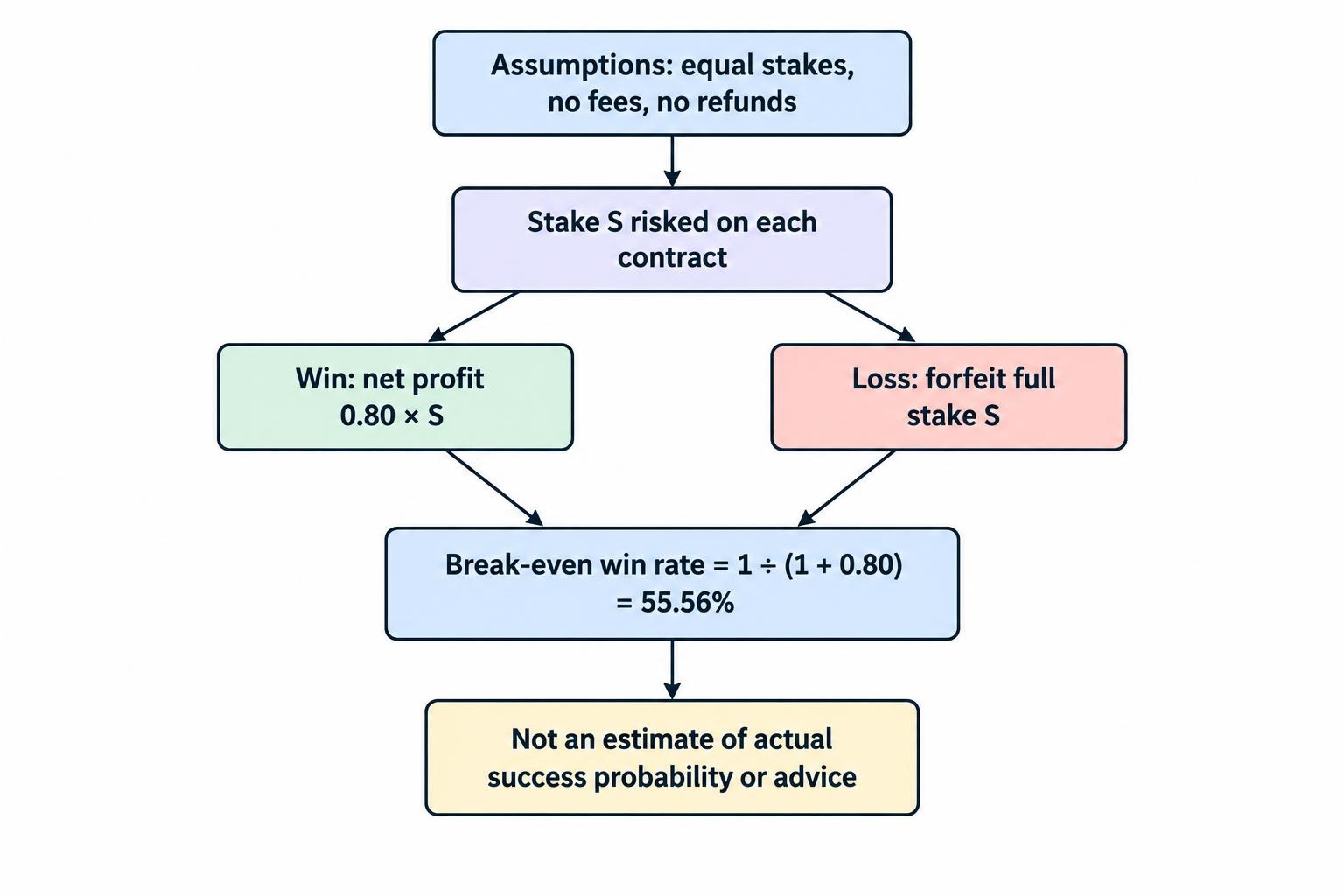
Across 100 hypothetical A$100 contracts, 55 wins would earn A$4,400. The remaining 45 losses would cost A$4,500. Despite winning a majority, the result would be an A$100 loss.
Expected value makes the same point per contract. At a hypothetical 60% success probability and an A$80 winning profit:
Expected net result = (0.60 × A$80) − (0.40 × A$100) = A$8.
At a 55% success probability, the expected result becomes minus A$1. Neither calculation establishes the true success probability; that is the difficult input, not something the payout percentage supplies.
These simplified calculations also assume the same payment on every contract. If the offered profit changes with the range or expiry, each observation needs its own payoff. The broader treatment of probability and expected value in binary options covers the distinction between winning frequency and financial return.
A Sideways Chart Does Not Prove a Range Contract Has Value
A chart that has traded sideways provides a description of past movement. It does not guarantee that the price will stay between two contractual boundaries until a future timestamp.
Keep the chart pattern and contract condition separate. A support area drawn around recent lows is not automatically the contract’s lower boundary. A resistance area around recent highs is not automatically its upper boundary. Even a reasonable forecast of continued consolidation can fail if the contractual interval is narrower than the movement being forecast.
The timing must match too. A view that the price will remain broadly unchanged over a day does not establish where it will be in ten minutes. Nor does a correct forecast of a temporary breakout establish an outside-at-expiry win if the price later returns.
For a paper exercise, write the proposition before looking at the outcome: “The settlement price will be strictly between these two levels at this timestamp.” If the proposition instead says “neither boundary will be touched”, record that as a different contract category. This prevents a good-looking chart from doing the job of a properly defined forecast.
Contract Risk Is Separate From Platform Risk
Clear arithmetic does not establish that a platform will honour its terms or release money. A correctly settled winning contract and a successful withdrawal are different events.
The joint SEC and CFTC alert on binary options fraud documents complaints involving withheld customer funds, identity theft and software manipulation intended to generate losing trades. Those risks sit outside the range calculation. A favourable historical win rate cannot offset a counterparty that does not pay.
Keep product analysis separate from provider claims. A payout display, account balance or promotional screenshot does not demonstrate that the underlying contract has positive expected value.
Practising the Mechanics Without Funding an Account
A written exercise is enough to learn the distinction between finishing inside and staying inside. Choose a historical price series, state the boundaries and observation rules, then record the outcome without changing the rules afterwards.
For expiry-only contracts, record the defined final observation. For touch-based contracts, use data capable of showing whether either boundary was reached during the observation period. A closing-price series alone cannot establish what happened between its observations.
Record the hypothetical winning profit alongside the outcome. Otherwise, the exercise measures only how often a condition was satisfied, not whether those wins would cover the losses. Keep equality cases and missing data visible rather than dropping awkward observations.
A structured binary options paper trading record can keep those assumptions consistent. It does not test live execution, withdrawal reliability or regulatory permission.
The central question remains precise: does the contract require the price to finish inside the boundaries, finish outside them, or avoid touching them throughout a period? Establish that before analysing the chart. Two lines may look simple; the settlement wording decides what they mean.
This article was last updated on: October 22, 2026