Binary options brokers can make money through the gap between winning payouts and losing stakes, transaction fees, or a combination of both. Where the provider takes the other side of a contract and retains the risk, customer trading losses can become its trading revenue. That does not mean every losing trade is pure profit, or that every provider uses the same business model.
The useful distinction is between a company selling contracts from its own book and an intermediary arranging trades between other participants. The label “broker” does not settle that question. When assessing binary options brokers, follow the contract and the money rather than the marketing description.
For Australian readers, the legal position comes first: ASIC’s prohibition on issuing and distributing binary options to retail clients took effect on 3 May 2021 and has been extended until 1 October 2031. This article explains the economics, not a route around that restriction. The dates and scope appear in ASIC’s announcement extending the retail binary options ban.
The main revenue model: taking the other side
In an over the counter contract, the customer deals directly with the issuer rather than buying an option from another customer through an exchange order book. If the issuer retains that exposure, its trading result moves in the opposite direction to the customer’s result, before expenses and any external hedges.
A losing customer forfeits the stake under the contract terms. A winning customer receives the agreed settlement, which includes the profit and, under the convention used here, the original stake. Across a group of contracts, the issuer’s gross trading result is the stakes collected minus the settlements owed. This relationship between retained risk and revenue from customer losses is documented in ASIC’s regulatory analysis of OTC binary options.
That creates a conflict of interest: a provider retaining the exposure benefits financially when its customers lose in aggregate. It does not establish that every trade is manipulated. A payout structure can favour the issuer without anyone changing a price or interfering with an expiry.
How the payout gap creates a margin
Consider a hypothetical contract with a $100 stake and an 80% profit rate. A win returns $180: the original $100 plus $80 profit. A loss returns nothing, so the customer loses $100.
The unequal amounts matter. One win and one loss leave the customer down $20, despite predicting the outcome correctly half the time. “No commission” does not remove that imbalance. The economic cost sits inside the contract rather than appearing as a separate charge.
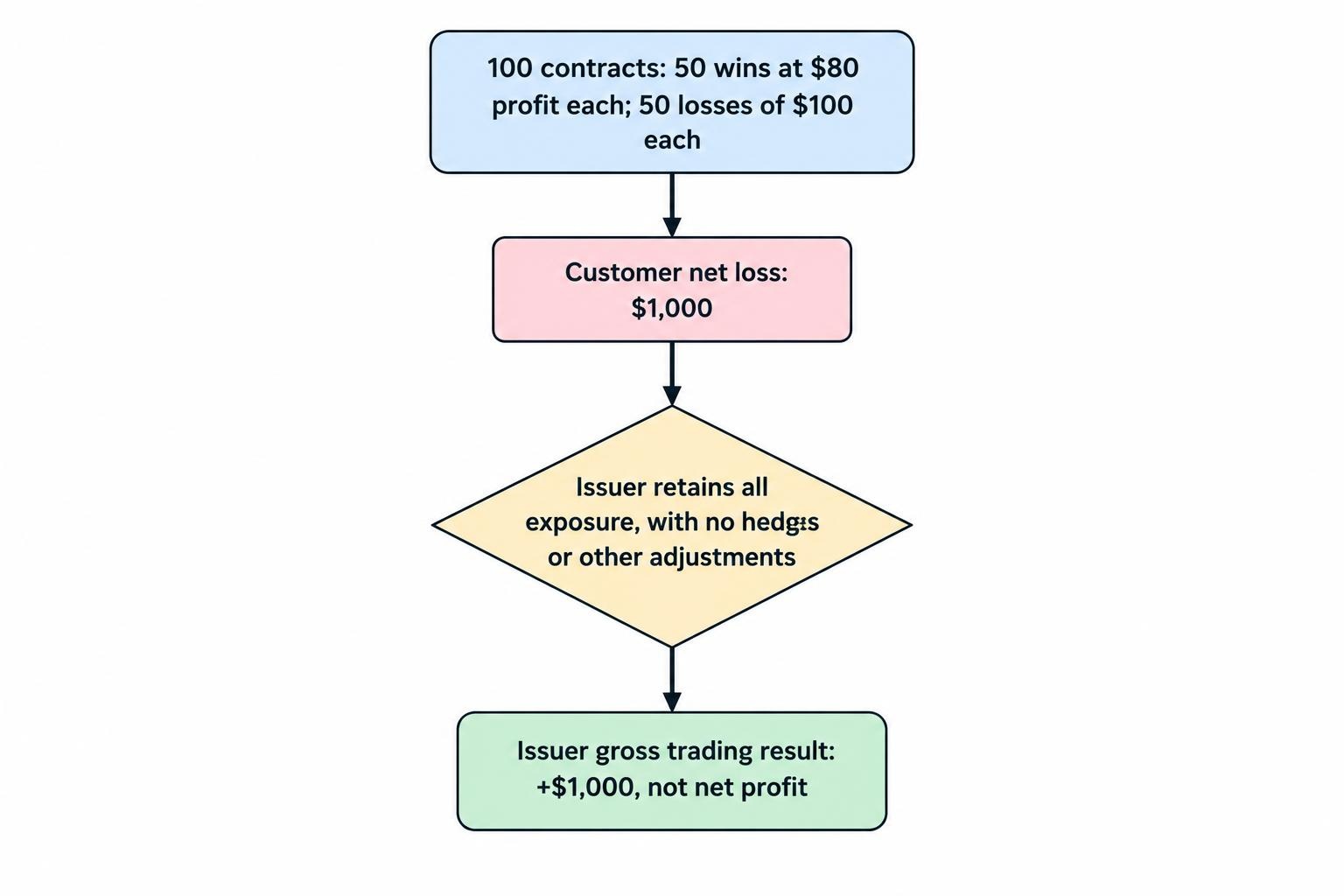
Now suppose a customer completes 100 contracts at that same stake and profit rate, winning exactly 50 and losing exactly 50:
- Winning contracts produce 50 × $80 = $4,000 profit.
- Losing contracts produce 50 × $100 = $5,000 losses.
- The customer’s net trading result is a $1,000 loss.
If the issuer retained all the exposure, with no hedges or other adjustments, the opposite result would be $1,000 of gross trading revenue. That is 10% of the $10,000 staked across those contracts. It is not 20%: the $20 difference between one win and one loss applies to $200 of combined stakes.
The customer needs more than a 50% win rate
For contracts with a complete loss on an unsuccessful trade, no ties and no extra fees, the break even win rate is:
Break even win rate = 1 ÷ (1 + profit rate)
| Profit rate on a winning contract | Profit from a $100 winning stake | Break even win rate |
|---|---|---|
| 60% | $60 | 62.50% |
| 70% | $70 | 58.82% |
| 80% | $80 | 55.56% |
| 90% | $90 | 52.63% |
These are calculations, not estimates of anyone’s trading ability. They assume an unchanged stake and profit rate. Refunds, fees and different settlement rules change the result.
A higher advertised profit rate also does not automatically mean a better contract. A contract with a lower chance of success can offer a larger reward and still be poorly priced. The comparison requires both the payment and the probability, which is the focus of probability and expected value in binary options.
Revenue is not profit, and deposits are not revenue
The $1,000 in the example is a trading result before business expenses. It is not the amount the owners can necessarily take home.
Suppose the hypothetical provider spends $700 attracting customers, $200 on technology and $150 on payment processing during the same period. Those $1,050 of expenses would turn the $1,000 gross trading result into a $50 loss. The figures are illustrative, but the distinction is basic: a favourable contract margin does not guarantee a profitable company.
Deposits need separate treatment too. If someone deposits $500 and leaves it untouched as withdrawable cash, that balance remains an amount owed to the customer. Receiving the cash is not, by itself, the same as earning $500 from trading.
Nor should “deposits minus withdrawals” automatically be treated as profit. That calculation can include money customers have not yet traded or withdrawn. A meaningful assessment must account for outstanding customer balances and unsettled contracts, not just cash entering and leaving a payment account.
Opposing positions and hedging change the result
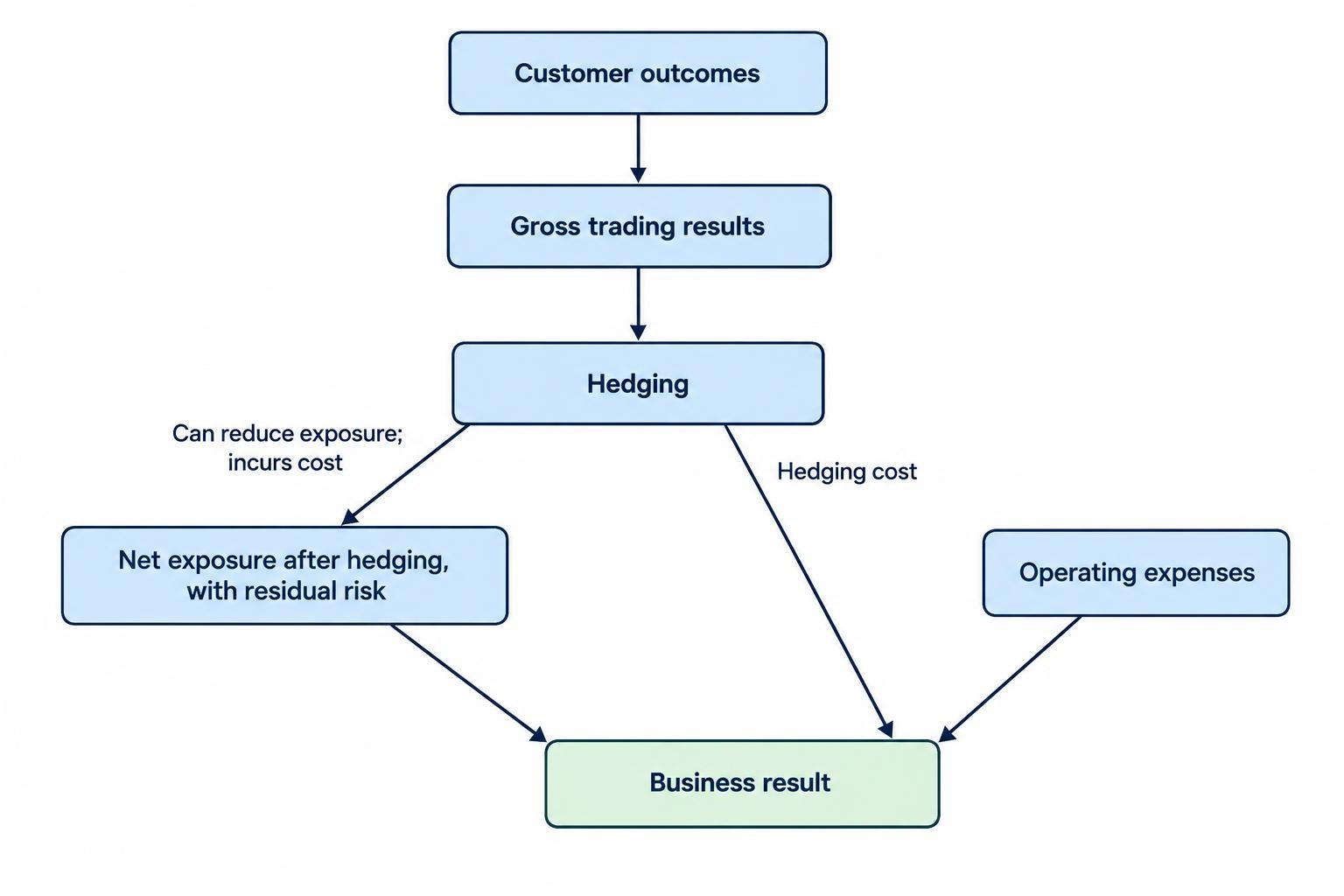
An issuer does not necessarily carry every customer position as a separate, unprotected bet. Opposing customer exposures can offset economically, while an external hedge can transfer some market risk elsewhere.
Take two hypothetical customers who each stake $100 on opposite outcomes of the same event. Both receive an 80% profit rate. Assume the contract terms guarantee exactly one winner and one loser, with no tie or refund.
The issuer collects $200 and owes $180 to the winner. It retains $20 before expenses whichever customer wins. This is an illustration of offsetting exposure, not evidence that a provider matches customers one for one.
The position is different when customers concentrate on the same outcome. If ten customers each stake $100 on that outcome and all win, the issuer owes $1,800 against $1,000 of stakes. Its trading loss is $800 before any hedge. A margin that looks favourable over many outcomes still leaves exposure on an individual event.
An external hedge can reduce that exposure, but it has a cost and may not reproduce the customer contract exactly. Differences in timing, settlement prices or contract design can leave residual risk.
The practical result is that customer losses do not always flow unchanged into the provider’s profit. Its net exposure, hedge results and operating costs also matter. Claims that every lost dollar goes straight into the owner’s pocket skip most of the accounting.
How an exchange or agency model earns money
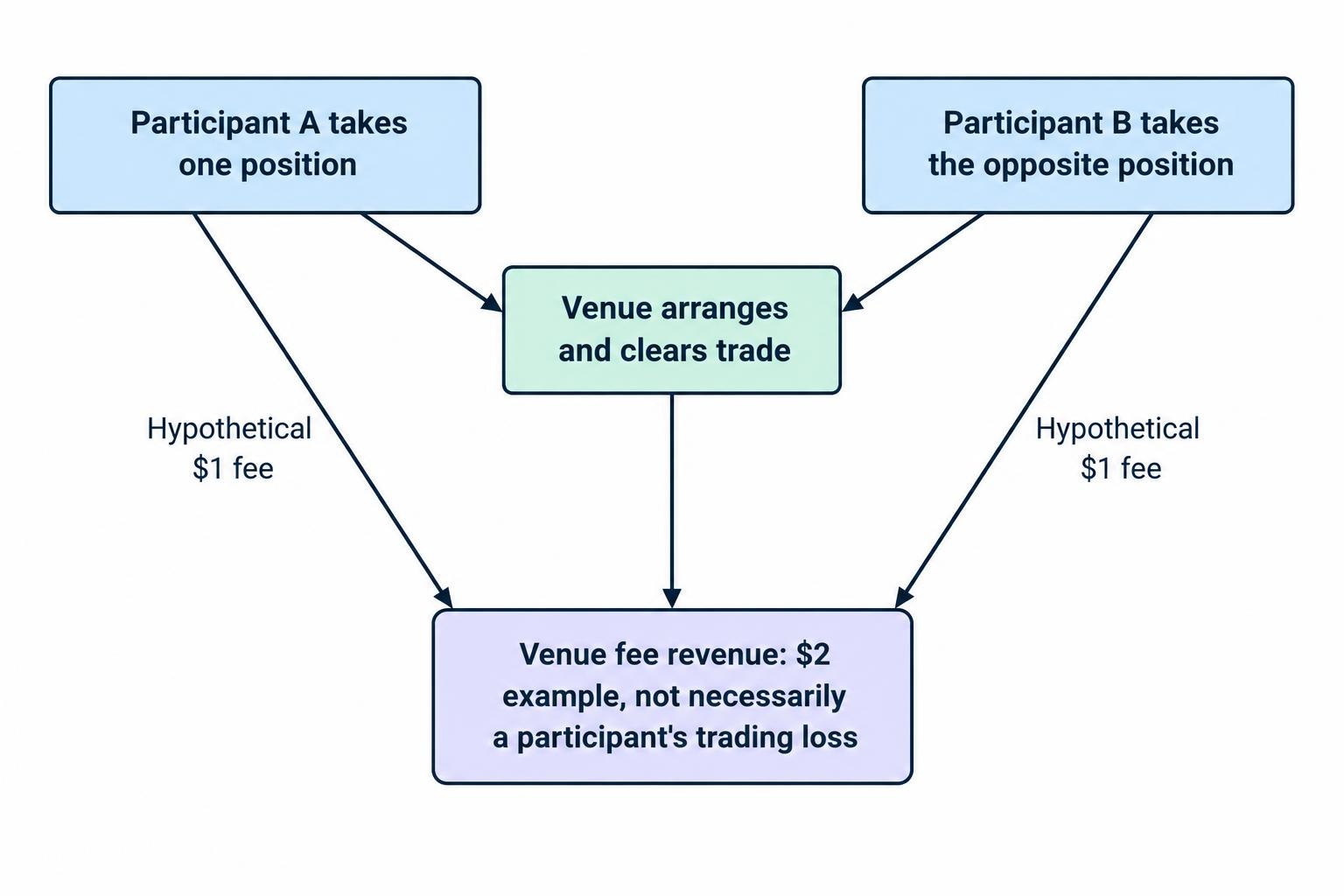
A different arrangement separates the trading parties from the venue or intermediary. Participants take opposing positions, while the venue or broker charges for arranging, executing or clearing transactions.
Transaction charges are a separate revenue source from taking directional exposure. For a real example of this distinction, CME Group’s clearing and trading fee information sets out how exchange fees vary by product, transaction type, venue and customer status. It should not be read as a fee schedule for offshore fixed payout platforms.
Consider a hypothetical binary contract that settles at $100 or zero. A buyer pays $60, putting $60 at risk for a possible $40 profit. The opposing seller has the reverse exposure: a possible $60 profit against a $40 loss. If the intermediary charges each participant $1, it collects $2 without needing either participant in particular to lose.
This does not make the trade costless or risk free. It changes where the provider’s revenue comes from. The order confirmation and contractual documents should establish whether the company acts as an agent, issuer, venue or another participant—not a badge saying “exchange technology”.
Fees and other charges
Explicit charges can sit alongside the payout margin. When reviewing a fee schedule, separate trading commissions from account charges, currency conversion and payment processing costs. They affect the customer’s result differently.
A conversion charge may contain a provider’s markup, a third party’s cost, or both. A withdrawal charge may be passed to a payment service rather than retained entirely by the trading company. The amount charged to the customer and the amount earned by the provider are not necessarily identical.
Early exit quotes also deserve attention where that feature exists. A customer accepting less than the contract’s fair economic value gives up value even if the screen shows no separate exit commission. Assessing that requires a defensible valuation, not just comparing the exit payment with the original stake.
Keep the main comparison focused on the complete deal: the stake at risk, winning payment, losing payment and extra charges. The guide to broker payouts and contract terms covers those contract checks in more detail.
Why turnover and bonuses matter to the business model
Turnover means the total amount staked, not the amount deposited. A customer can deposit $200 and generate much more than $200 of turnover by repeatedly staking money returned from earlier contracts.
If each additional contract has a negative expected return for the customer, more turnover creates more expected customer losses. Under a fee model, more transactions can also create more fee revenue. Neither relationship requires a larger initial deposit.
Bonus conditions can encourage this repeated activity. Some offers require a minimum amount of trading before funds can be withdrawn, a restriction highlighted in the CFTC warning about offshore binary options platforms and bonus conditions.
As a hypothetical example, a $100 bonus with a requirement to trade 30 times the bonus creates a $3,000 turnover condition. That does not mean the customer must lose $3,000. It means the customer must expose funds to repeated contract outcomes to meet the condition.
The arithmetic explains why a promotional credit should not be valued like withdrawable cash. Before assigning it any value, establish what must be traded, which balances are restricted and whether accepting it changes access to the original deposit.
White label platforms: several businesses can share the proceeds
The brand on the screen may not own the trading software. A white label arrangement lets one business supply technology and related services while another markets the customer facing brand.
This can split the commercial proceeds between the operator and its suppliers. The technology company might receive a setup payment, a recurring charge or a payment linked to the operator’s business performance. That payment is an expense for the operator and revenue for the supplier; it should not be counted twice when describing the operator’s earnings.
A documented historical example appears in the SEC’s April 2021 complaint concerning Spot Option’s white label business. The complaint alleged that partners paid an initial fee and a monthly fee generally calculated from customer deposits minus money returned during that month. It also described supplied technology, payment connections and marketing support. These allegations concern that business, not every white label platform.
The commercial question is therefore broader than “who owns the brand?” It includes who issues the contract, who controls settlement and who receives payments tied to customer activity.
Affiliate payments are a cost, not an extra source of broker revenue
A promoter who sends customers to a trading platform may receive payment for those referrals. From the operator’s perspective, that is an acquisition expense. From the promoter’s perspective, it is income.
Payment for funded accounts is documented in enforcement records. In the SEC’s January 2022 announcement of the Montano affiliate marketing settlement, the underlying allegations included broker payments for each investor who opened and funded an account after viewing misleading campaigns. The defendant settled without admitting or denying the allegations.
The incentive is straightforward: if payment depends on a funded account, the promoter benefits when the reader deposits. That incentive does not establish whether the reader will receive useful information or achieve a positive trading result.
A revenue sharing arrangement creates a different question. If a promoter’s compensation is linked to revenue generated from referred customers, establish how that revenue is defined. Where it includes retained customer losses, the financial conflict follows directly from the formula.
Ask how a reviewer, signal seller or account introducer gets paid. A displayed trading result does not answer that question, and a service described as “free” may still have a commercial purpose.
Pricing conflicts are not the same as proof of manipulation
An issuer that retains customer exposure has a reason to price contracts in its favour. That commercial conflict deserves scrutiny, but it is different from changing an agreed outcome after the trade.
The contract’s settlement benchmark matters because an apparently tiny price difference can decide whether the customer receives a payment. A chart from another application is not automatically the contractual benchmark. Different instruments, timestamps or quote conventions can produce different displayed prices without establishing wrongdoing.
The useful check is whether the provider clearly identifies the benchmark and applies the agreed method consistently. See price feeds and settlement benchmarks for the distinction between a chart used for analysis and the price used to settle a contract.
Risk management also needs a clear boundary. Reducing future exposure through pricing or position controls is not the same as secretly altering an accepted trade’s expiry, outcome or payment. A provider should not be allowed to hide that distinction behind technical language.
Fraud is not another ordinary revenue model
Keeping money through dishonest withdrawal refusals or secretly changing trade results is not simply a more aggressive version of earning a payout margin. It is a separate conduct problem.
The joint CFTC and SEC alert on binary options fraud records complaints involving refusal to reimburse funds, identity theft and software manipulation designed to generate losing trades. Those warnings support scrutiny of the conduct; they do not justify assuming that every losing contract was rigged.
A displayed account profit is also not evidence that money is available for withdrawal. Treat a new demand for payment to “release” an existing balance as a separate issue requiring investigation, rather than another trading decision.
The distinction matters when responding to a problem. A poor payout requires economic analysis. A disputed settlement requires records and contract terms. Suspected deception requires a different response, covered in the guide to binary options scams.
Questions that reveal how the business gets paid
A useful review should answer these questions before discussing indicators, signals or advertised returns:
- Who is the contractual counterparty? Identify the legal entity, not just the brand or software supplier.
- Who carries the trading exposure? Distinguish retained risk, external hedging and transactions arranged between participants.
- What is the complete payment structure? Include losing outcomes, winning profit, refunds and explicit charges.
- Who benefits from more deposits or turnover? Include the operator, technology supplier and promoter where relevant.
- Can the provider lawfully offer the product to this customer? Commercial explanations do not establish regulatory permission.
For Australians, a licence claim must be checked against the actual entity and service, without treating it as an exception to the retail binary options prohibition. The practical steps are covered in how to check a broker’s licence.
The central point is simple: “commission free” describes one possible charge, not the whole business model. Follow the difference between stakes and settlements, then account for fees, hedges, suppliers and customer balances. That shows who can earn money, what risks they retain and where their interests may conflict with the customer’s.
This article was last updated on: October 22, 2026