Binary options profits are not automatically capital gains. Nor does trading outside a business automatically make those profits tax free. Australian tax treatment depends on the contract, the purpose of the transaction and how the activity is carried out.
The distinction matters because income gains, capital gains and recreational gambling outcomes can produce different results, particularly when losses arise. You cannot choose whichever category gives the smallest tax bill. This guide focuses on classification for individuals; the broader guide to binary options tax in Australia covers the surrounding reporting issues.
Tax treatment also sits apart from product legality. ASIC’s prohibition on issuing and distributing binary options to retail clients took effect on 3 May 2021 and has been extended until 1 October 2031. These dates are confirmed in ASIC’s binary options ban extension. Reporting a transaction for tax purposes does not authorise a provider to offer it.
What income and capital treatment mean
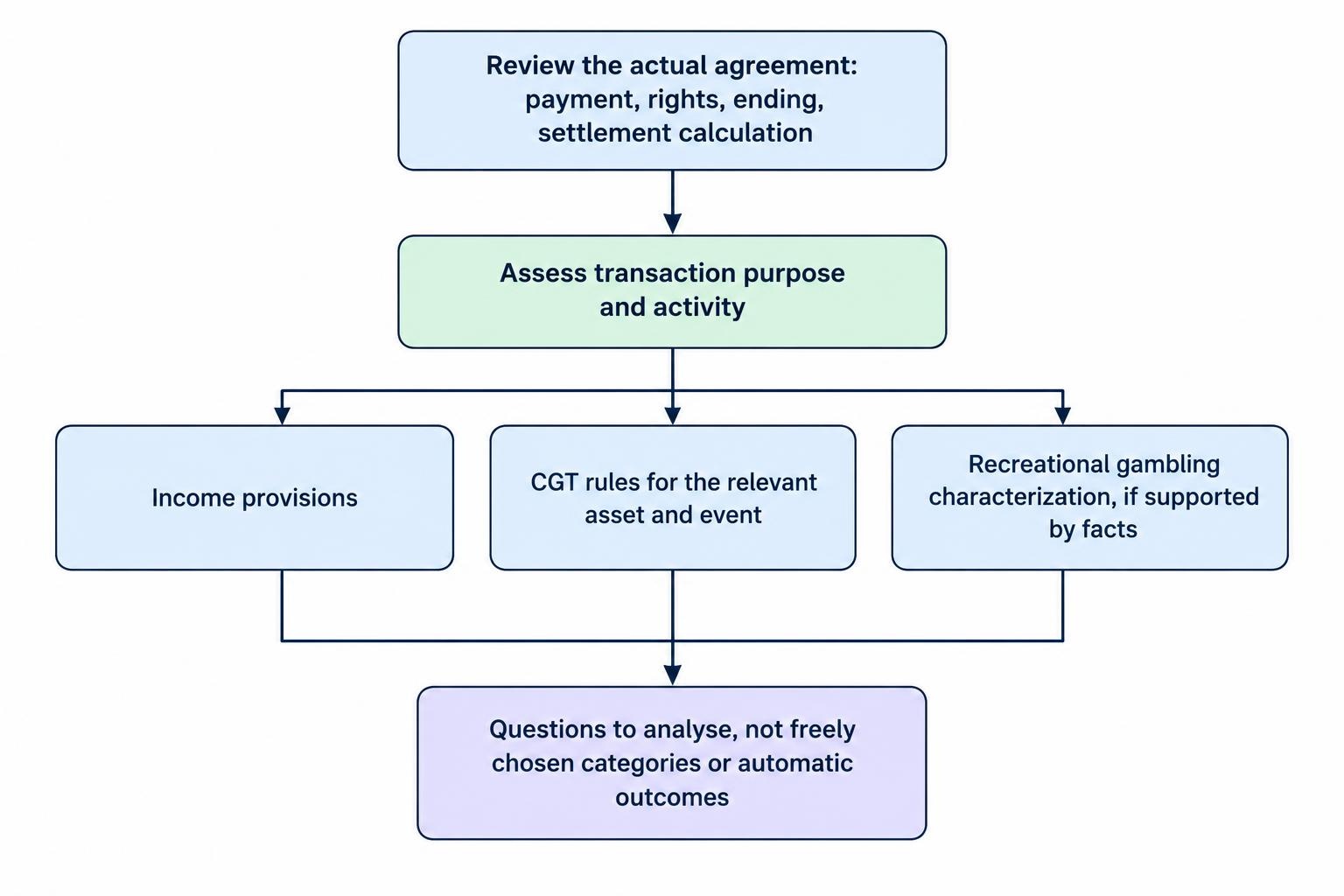
Revenue treatment means considering a gain under the income provisions rather than treating it solely as a capital gain. Section 6-5 covers ordinary income. Section 15-15 separately addresses profits from a profit-making undertaking or plan, subject to exclusions, including profits already assessable as ordinary income. These provisions appear in the Income Tax Assessment Act’s income and deduction provisions.
Capital treatment means applying the capital gains tax rules to the relevant asset and event. It is not simply another name for money earned outside employment. A contractual right can require a CGT analysis even though it is not a share, property or other familiar investment.
The practical question is therefore not “Did I invest money?” It is “Which provisions apply to the gain or loss arising from this arrangement?” Calling an account an investment account does not answer that question.
Start with the actual agreement. Identify what the payment buys, what rights arise, how the contract ends and how the settlement amount is calculated. Marketing descriptions such as “digital trading” or “fixed return investing” are poor substitutes for contractual terms.
When profits may be assessable income
A commercial transaction can produce income without a business
A common mistake is to assume that only full-time traders can have income gains. The income analysis is broader than that.
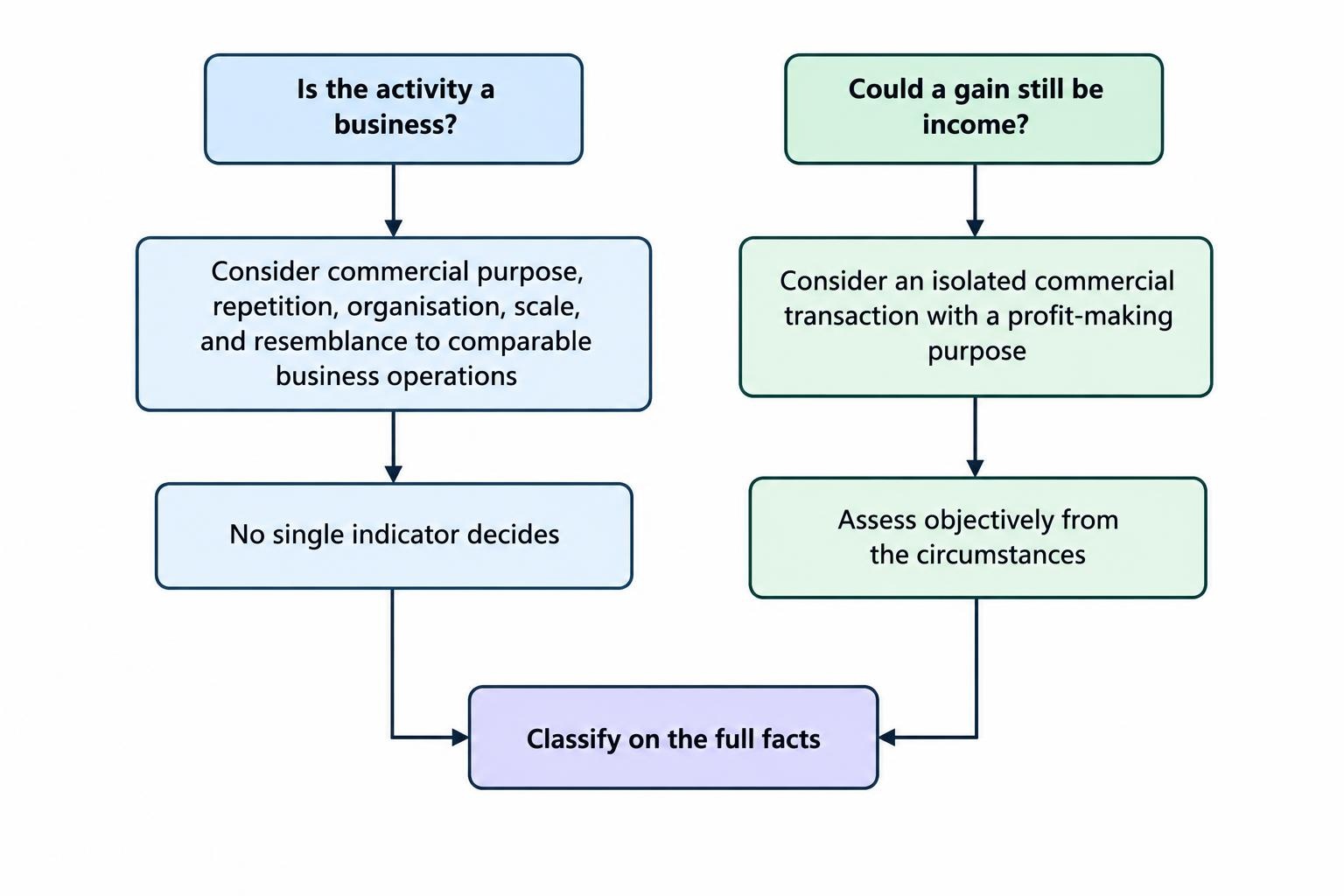
A profit from an isolated transaction can be ordinary income where the taxpayer entered it with a profit-making purpose and the transaction was a business operation or commercial transaction. Purpose is assessed objectively from the circumstances, rather than accepted solely from the taxpayer’s description. The relevant framework is set out in ATO Taxation Ruling TR 92/3 on isolated transaction profits.
For a binary options transaction, that makes the surrounding evidence worth examining. What was the intended source of profit? How was the transaction selected? Was it part of a documented commercial plan? What did the trader do before committing money?
Consider someone who makes a small number of substantial transactions after preparing a commercial analysis. “Only three trades” is not a complete classification argument. Equally, wanting a favourable outcome does not, by itself, settle whether a transaction has the required commercial character. Both parts of the analysis matter.
A trading business requires a wider factual assessment
Business classification involves weighing the activity as a whole. Relevant considerations include commercial purpose, repetition, organisation, scale and whether the activity resembles the way a comparable business operates. No single indicator decides the result. These indicators are discussed in ATO Taxation Ruling TR 97/11 on carrying on a business.
Useful evidence might include an operating plan, regular transaction records, a defined research process and accounts that distinguish trading results from personal spending. These documents should reflect what actually happened, not a business narrative assembled after a losing year.
For example, compare two account holders with the same annual turnover. One follows a documented process and reviews financial performance. The other places irregular trades without records beyond account screenshots. The matching turnover figure does not make their circumstances identical.
Keep the business question separate from the broader income question. An activity that falls short of a business still needs analysis under the other income principles. The separate guide to trading as a business examines business status in more detail.
Why capital treatment needs a positive basis
“I am not running a business” is not enough to establish capital treatment. A defensible capital position should identify the contractual asset, the relevant CGT event and why the income provisions do not determine the result.
Capital treatment also does not guarantee a discount. The usual discount framework requires the relevant asset to have been acquired at least 12 months before the CGT event, alongside other conditions. Keeping a platform account open for several years does not make every newly acquired contract several years old.
Two other rules matter. A net capital loss cannot be deducted against ordinary income, and section 118-20 can reduce a capital gain where an amount is otherwise included in assessable income. That prevents treating the income and CGT calculations as entirely independent tax charges on the same economic gain. The relevant rules sit in the Act’s capital gains, discount and anti-overlap provisions.
For an adviser reviewing an account, the useful starting document is a transaction-level schedule, not a statement saying “capital gains: $8,000”. The schedule allows the adviser to test the classification before accepting the calculation.
A short contract duration is relevant to checking any proposed holding period concession. It is not, on its own, a substitute for deciding whether the gain belongs on revenue or capital account.
Can binary options results be treated as gambling?
Do not assume that an uncertain outcome, a fixed payout or a high chance of losing makes a financial contract tax-free gambling.
The ATO’s ruling on financial contracts for differences distinguishes profit-making activity from transactions entered into for recreation by gambling. It addresses income and deduction treatment, and the CGT gambling exemption, within that distinction. However, Taxation Ruling TR 2005/15 on financial contracts for differences concerns CFDs. It should not be presented as a blanket ruling determining every binary options contract.
Its practical relevance is the need to examine purpose and contractual character rather than rely on the word “bet”. Applying its reasoning to a different product requires care.
If you believe your transactions were recreational gambling, explain the facts supporting that position to your adviser. Include the contract terms and a candid description of your activity. Do not omit a written profit plan or organised trading process because it makes the recreational description less comfortable.
A tax position should explain the evidence, not edit it.
Worked examples: the same cash result can require different analysis
The following examples are hypothetical. They illustrate the classification process rather than determine the treatment of any reader’s account. Assume all amounts are Australian dollars, the transactions have settled and there are no currency conversion issues.
Example 1: separating profit from returned stake
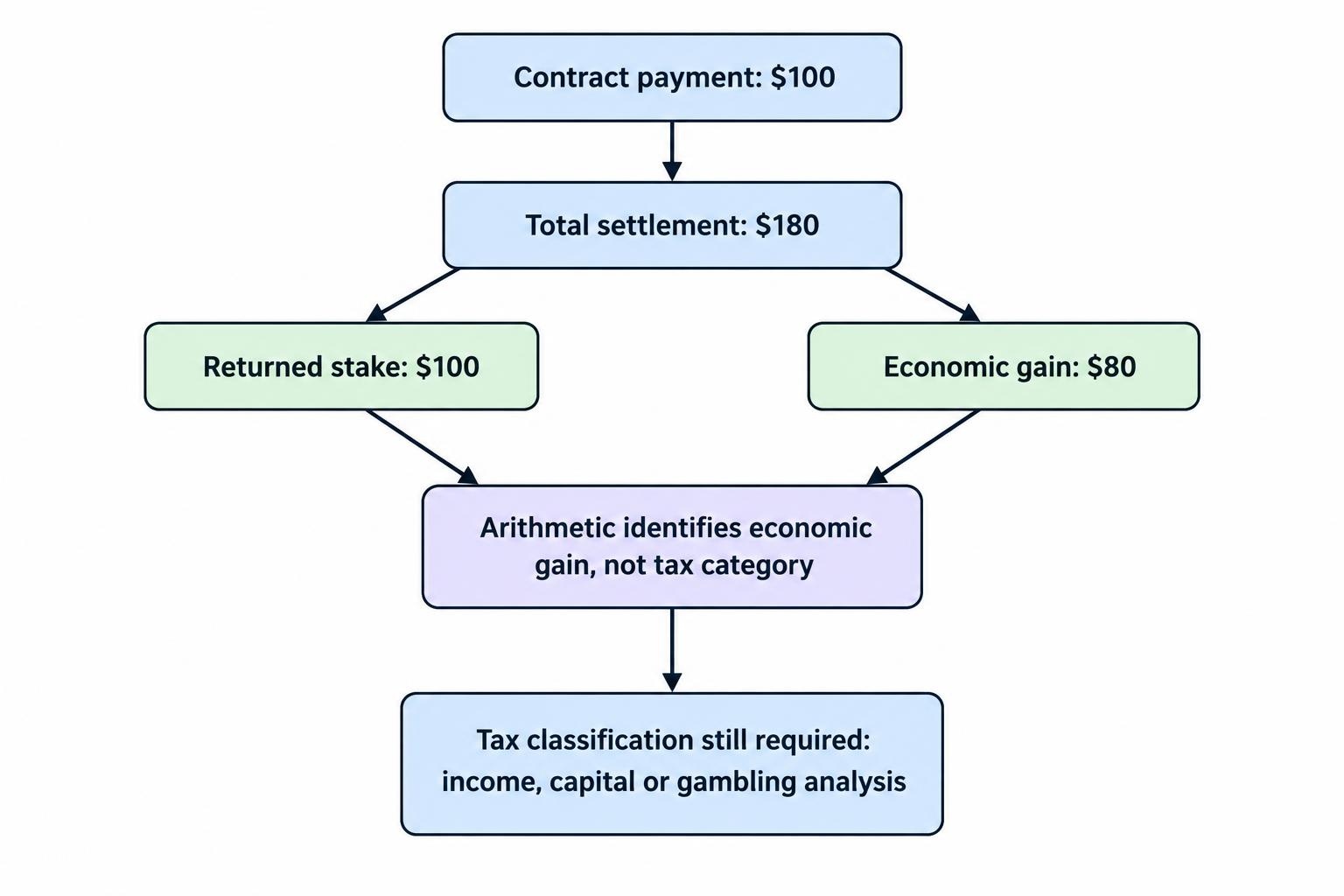
A trader pays $100 for a contract. Successful settlement returns $180, comprising the original $100 and an $80 gain.
The economic gain is $80, not $180. Before preparing the tax calculation, the trader should preserve records showing both the amount paid and the settlement received. A statement headed “payout” may not make that distinction clear.
| Transaction amount | Amount |
|---|---|
| Amount paid | $100 |
| Total settlement received | $180 |
| Economic gain before other costs | $80 |
This arithmetic does not determine whether the gain is income, capital or part of a recreational gambling outcome. It establishes the amount that needs to be analysed.
Example 2: reviewing an annual profit
Suppose an account records $14,000 of gains on successful contracts and $9,000 of losses on unsuccessful contracts. The economic result before other costs is a $5,000 profit.
The preparer should not jump straight to entering $5,000 in a capital gains field. First, establish whether the contracts belong on revenue account, whether the losses qualify for deduction and whether anything affects their timing. If a capital analysis is appropriate, prepare that calculation using the applicable CGT rules instead.
A useful adviser instruction would be: “Here are the contracts, the activity history and the transaction schedule. Please confirm the classification and then calculate the return entries.” That is more useful than asking an adviser to approve a category already selected.
Example 3: an account with a net loss
Reverse the figures: $9,000 of gains and $14,000 of losses produce a $5,000 economic loss before costs.
Do not assume this automatically reduces employment income by $5,000. The result depends on classification, deductibility and any restrictions that apply. Nor should a trader classify winning years as gambling and losing years as business activity simply because the tax outcomes differ.
The guide to the tax treatment of binary options losses examines loss claims separately. The point here is that a negative balance does not remove the need to classify the underlying activity.
Revenue treatment does not guarantee an immediate loss deduction
For an individual carrying on a business, the non-commercial loss rules may defer a business loss rather than allow it to offset other income immediately. Broadly, the framework considers an income requirement, prescribed tests, exceptions and the Commissioner’s discretion. The structure is summarised in ATO guidance PCG 2022/1 on non-commercial business losses.
This creates two separate questions: does the activity produce a deductible revenue loss, and can that loss be used in the current year? Do not collapse them into one.
For the hypothetical $5,000 loss above, ask the adviser to show the treatment clearly: claimed now, deferred under an applicable rule, carried forward under another provision or not deductible. Each answer needs its own basis.
Prepare evidence before selecting a tax category
A practical review file should contain enough detail to reconstruct the arrangement without relying on the platform’s current dashboard. Save the agreement and settlement terms that applied when the transactions occurred.
Prepare a short factual account of your purpose and method. Describe how often you traded, how decisions were made, what records you maintained and whether the activity changed during the year. Avoid dressing ordinary account activity in business language that the records cannot support.
For the numerical schedule, keep these categories separate:
- Amounts paid for contracts and amounts received on settlement.
- Gains, losses, fees and adjustments.
- Deposits, withdrawals and transfers between accounts.
- Unsettled positions and disputed account entries requiring review.
Use the guide to trading records for tax purposes to organise the supporting material. A reconciliation should explain the account movements, not force the numbers to match a preferred tax result.
When to request advice or a private ruling
Obtain advice before lodging if the contract’s character is unclear, you propose capital or gambling treatment, or a substantial loss claim depends on business status. Give the adviser the original documents rather than a summary copied from an online tax discussion.
Where material uncertainty remains, a private ruling can address how a tax provision applies to a stated arrangement. A ruling binds the Commissioner where it applies to the taxpayer and is relied upon; material differences between the stated arrangement and the actual facts can undermine that protection. The conditions are addressed in ATO Taxation Ruling TR 2006/11 on private rulings.
Someone else’s published private ruling is not your personal clearance. Ask for advice that identifies the contract, explains the applicable provisions and shows how both gains and losses should be treated. That produces a position you can document and defend, rather than a label chosen because it sounds convenient.
This article was last updated on: October 22, 2026