IQCent and RaceOption have more similarities than their branding suggests: small advertised trade sizes, browser platforms, copy trading and deposit bonuses. IQCent has the higher published binary options payout ceiling, while RaceOption lists a lower deposit requirement for its Gold account. Neither difference settles the more important questions about regulation, withdrawals and access from Australia.
For Australian retail clients, neither broker is an appropriate recommendation for binary options trading. This comparison examines published account terms and regulatory records. It is not a funded-account test, and advertised processing times should not be mistaken for verified withdrawal performance.
The Australian restriction comes first
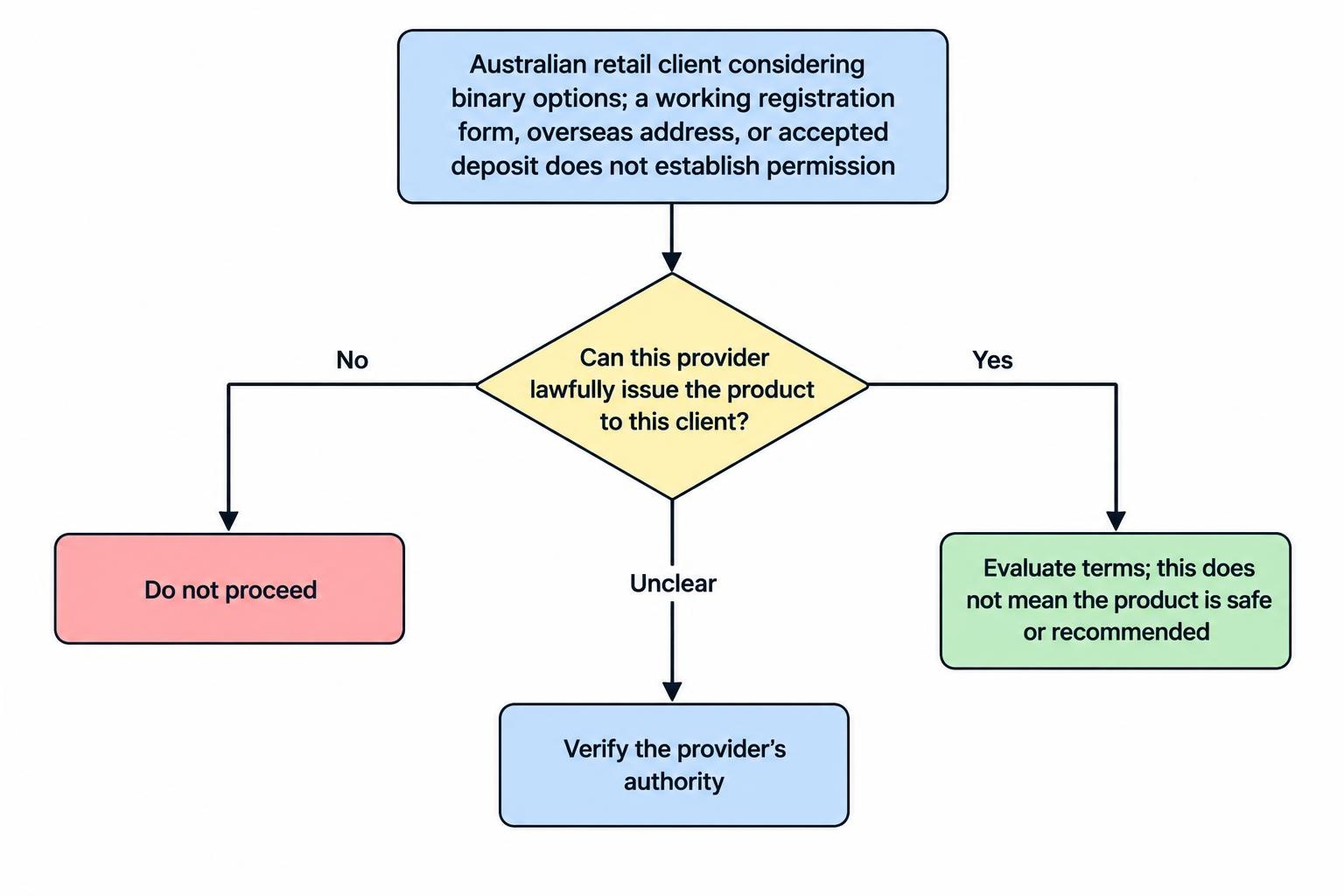
Australia’s ban on issuing and distributing binary options to retail clients took effect on 3 May 2021 and extends until 1 October 2031. The ASIC announcement extending the binary options ban sets out the restriction and the product risks behind it.
A working registration form does not establish permission to serve Australian retail clients. Nor does an overseas company address or cryptocurrency funding option override the restriction. The relevant question is whether the provider can lawfully issue the product to that client, not whether its payment page accepts a deposit.
Keep that distinction in mind throughout this comparison. A higher payout, lower account threshold or faster-looking platform cannot resolve a regulatory barrier.
IQCent vs RaceOption: published account differences
The table compares published review figures, rather than executable offers. Dollar amounts shown are US dollars. Account terms, payment availability and individual contract payouts require confirmation; a review figure is not a guaranteed funding quote.
| Comparison point | IQCent | RaceOption |
|---|---|---|
| Bronze account deposit schedule | US$250 | US$250 |
| Published minimum trade | US$0.01 | US$0.01 |
| Advertised binary payout ceiling | Up to 98% | Up to 95% |
| Published account tiers | Bronze, Silver, Gold and VIP | Bronze, Silver and Gold |
| Gold account deposit schedule | US$5,000 | US$3,000 |
| Platform features | Browser platform, TradingView charts and copy trading | Browser platform, TradingView charts and copy trading |
| Demo access | Available, but reported as dependent on funding | Available, but reported as dependent on funding |
| Monthly inactivity charge | US$10 without a trade during the calendar month | US$10 without a trade during the calendar month |
Where IQCent has a published advantage
IQCent’s higher payout ceiling is its clearest numerical advantage in this snapshot. If two otherwise identical contracts offered different profit rates, the higher rate would improve the result of a winning trade and reduce the win rate needed to break even.
That does not establish that IQCent offers the better rate on the market, expiry and account being compared. “Up to” describes a ceiling, not a standing offer. A useful comparison needs matching contracts at the same time, without mixing promotional rates, account upgrades or different settlement conditions.
Where RaceOption differs
RaceOption’s lower published Gold threshold means its account schedule asks for less money at that tier. It does not make the account safer, and it is not a reason to deposit several thousand dollars for perks.
Account names are marketing categories, not common standards. Gold at one provider need not mean the same service or contractual rights as Gold elsewhere. Compare the written benefits and withdrawal conditions rather than the colour of the badge.
The table also removes one easy misconception: cent-sized trading is not, on these published figures, an advantage exclusive to IQCent. A tiny minimum stake and a substantial account deposit can exist at the same time.
Regulatory warnings and the companies behind the brands
Historical regulatory records identify Wave Makers LTD with IQCent. Portugal’s securities regulator stated that this entity was not authorised to conduct financial intermediation in Portugal in its CMVM warning concerning Wave Makers LTD and IQCent, reproduced by Spain’s CNMV.
That warning concerns Portugal. It should not be presented as an Australian enforcement decision or stretched into a finding about every transaction. Its relevance is narrower but still material: a financial regulator identified the named entity and challenged its authority to provide services in that jurisdiction.
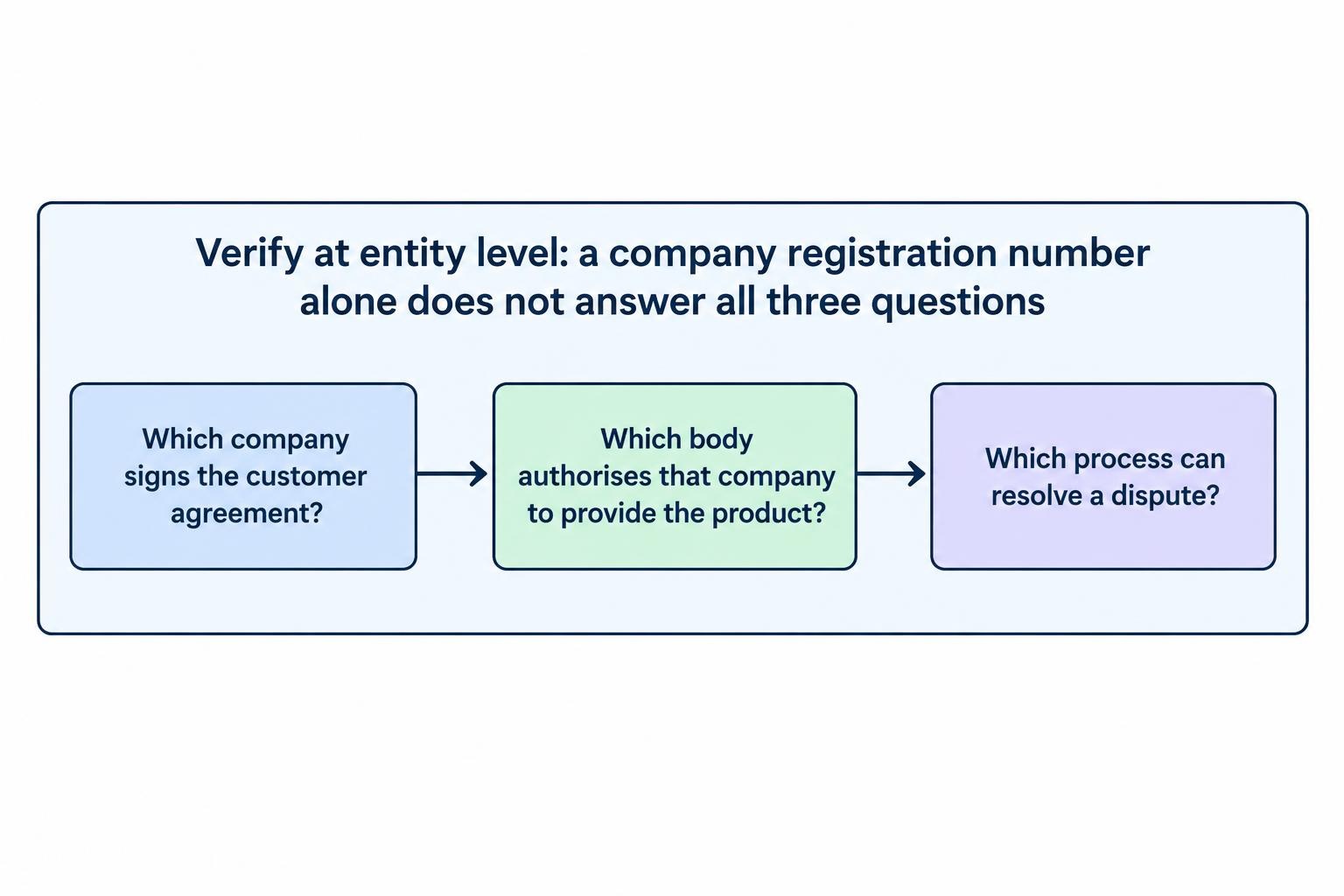
For either brand, separate three questions: which company signs the customer agreement, which body authorises that company to provide the product, and which process can resolve a dispute. A company registration number alone does not answer all three.
A separate CMVM warning concerning Makerun Corp and RaceOption, dated 12 February 2021 and hosted by Norway’s financial regulator, states that the named entity was not authorised to carry out financial intermediation in Portugal.
These records name different entities. They do not establish present ownership, prove that the businesses are independent, or confirm that historical contracting details remain unchanged. Similar interfaces and account structures are not enough to prove common ownership either.
Do not turn “there is a company behind it” into “the account has regulatory protection.” The practical checks belong at entity level, including the exact domain, licence permissions and complaint arrangements. Our guide to checking a broker’s licence covers that process separately.
Payouts: compare the contract, not the headline
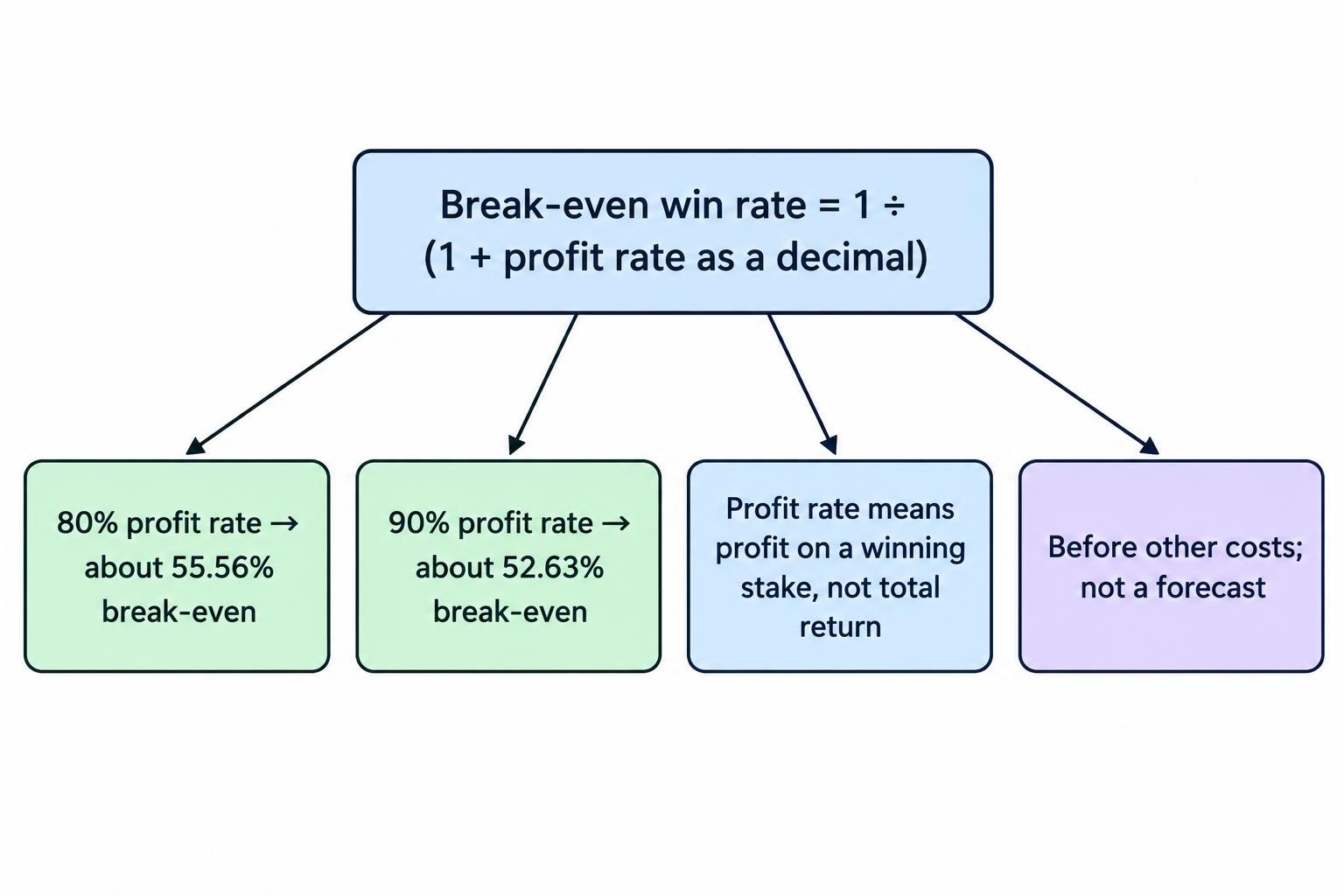
A binary payout percentage usually describes the profit on a successful stake, with the stake returned separately. With a hypothetical US$10 stake and an 80% profit rate, a win produces US$8 profit and returns the US$10 stake. A losing contract ordinarily loses that US$10, subject to its settlement rules.
This imbalance explains why a winning majority can still lose money. Consider 100 hypothetical trades of US$10 each, with 55 wins and 45 losses:
| Profit rate on wins | Profit from 55 wins | Loss from 45 losses | Net result |
|---|---|---|---|
| 80% | US$440 | US$450 | US$10 loss |
| 90% | US$495 | US$450 | US$45 profit |
The calculation assumes equal stakes, no ties, no refunds and no other costs. It is an illustration, not a forecast for either broker.
Before those other costs, the break-even win rate is 1 divided by 1 plus the profit rate expressed as a decimal. At 80%, that means approximately 55.56%; at 90%, approximately 52.63%. The relationship between payouts, probability and expected value matters more than a platform’s largest advertised percentage.
For an IQCent versus RaceOption assessment, record the underlying market, expiry, displayed profit rate, stake, tie treatment and settlement benchmark. Without matching those conditions, declaring a payout winner is guesswork dressed as a comparison.
Withdrawals matter more than deposit convenience
This document-based comparison does not establish a measured withdrawal winner. Published processing promises are not evidence that a customer received cleared funds within that period.
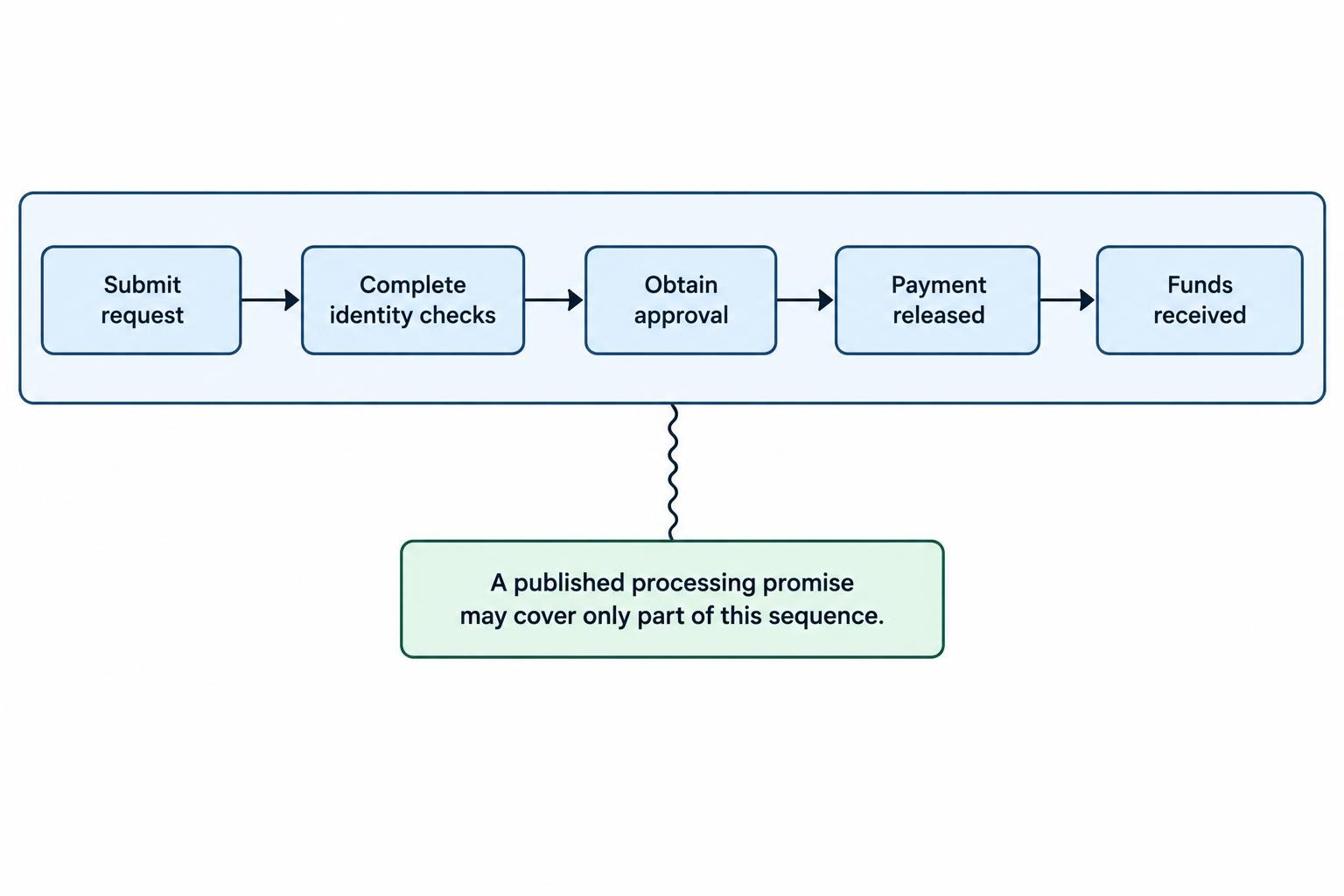
A withdrawal involves several separate events: submitting the request, completing identity checks, obtaining approval, releasing the payment and receiving it. A processing claim may cover only part of that sequence. The clock on the marketing page and the clock at the receiving bank need not measure the same thing.
Assess the route back to the account holder, not just the route into the platform. The questions worth answering include:
- What minimum withdrawal and payment-method restrictions apply?
- Does any turnover condition apply without accepting a bonus?
- Which documents must be supplied before release?
- Can fees or account restrictions reduce the amount available?
- What complaint process applies if approval or payment stalls?
A dashboard balance is not the same as money available in a bank account. Keep account statements, payment receipts, transaction identifiers and written responses rather than relying on a balance screenshot.
Where a withdrawal is already disputed, sending more money is not a sensible way to test reliability. Request a written explanation identifying the contractual provision being applied. The broader guide to broker deposits and withdrawals separates payment processing, verification and account restrictions.
Bonuses and account upgrades can distort the comparison
Both published account schedules include promotional benefits. Compare those benefits only after separating withdrawable cash, promotional credit and any conditions affecting profits.
A bonus balance should not be counted as extra withdrawable capital unless the agreement expressly permits that treatment. The useful number is not the larger balance displayed after acceptance; it is the money the customer can withdraw, under what conditions and at what cost.
Turnover also needs a precise definition. In a hypothetical offer requiring three times the combined deposit and bonus, a US$250 deposit plus US$250 bonus creates a US$1,500 turnover requirement. That is trading volume, not a requirement to earn US$1,500 profit. This example does not assert that either broker applies that formula to every account.
The same discipline applies to upgrades. Calculate how much extra money must be exposed to obtain a payout improvement, then ask whether that benefit justifies the exposure. A small percentage improvement is not automatically worth a much larger balance at the provider.
Do not place an otherwise unwanted trade just to avoid an inactivity fee. Saving a fee by taking an unnecessary trading risk is questionable arithmetic.
Platforms, copy trading and demo access
The published platform features do not provide a decisive reason to favour either brand. Charting tools and copy trading may change how someone uses an interface, but they do not establish the quality of settlement or withdrawal handling.
For a binary contract, the important operational questions concern the accepted strike, expiry timestamp, settlement price and treatment of an exact tie. A polished chart cannot answer those contractual questions on its own.
Copy trading adds another decision layer. A return percentage without the underlying stake sizes, losing periods, open exposure and withdrawal history is insufficient for judging a trading record. Copying an account does not remove the risk of its decisions.
Deposit-dependent demo access also deserves caution. Practice should not require treating a real deposit as a harmless entry ticket. Even a useful simulation cannot establish how a live account will handle disputed execution or payments; the distinction is covered in demo versus live binary options trading.
Which is better: IQCent or RaceOption?
There is no defensible binary options winner for Australian retail clients. The Australian restriction takes priority over the advertised feature differences.
Within the published schedules, IQCent has the higher payout ceiling and RaceOption has the lower Gold account threshold. Both show cent-sized minimum trades and broadly similar platform features. Those are account comparisons, not evidence of stronger customer protection.
For readers assessing an existing account, focus on the contracting entity, applicable terms, withdrawable balance and documentary record. For readers considering a new deposit, neither a promotional payout nor an upgraded account tier resolves the regulatory and withdrawal questions. The better decision may be not to fund either account.
This article was last updated on: October 22, 2026