A demand to pay tax, a clearance charge or a security deposit before withdrawing money from a binary options account is a serious scam warning. Do not send another payment until you have checked the demand independently. A larger balance on a trading screen does not prove that the money exists or that paying a fee will release it.
Fake trading platforms use withdrawal requests as another opportunity to collect money. They may claim that profits cannot be paid until you settle a tax bill or transfer an additional withdrawal fee. This pattern appears in ASIC’s warning about online trading platform scams.
The immediate priority is to stop further losses. You do not need to resolve every question about the account before refusing another payment.
How fake withdrawal fees work
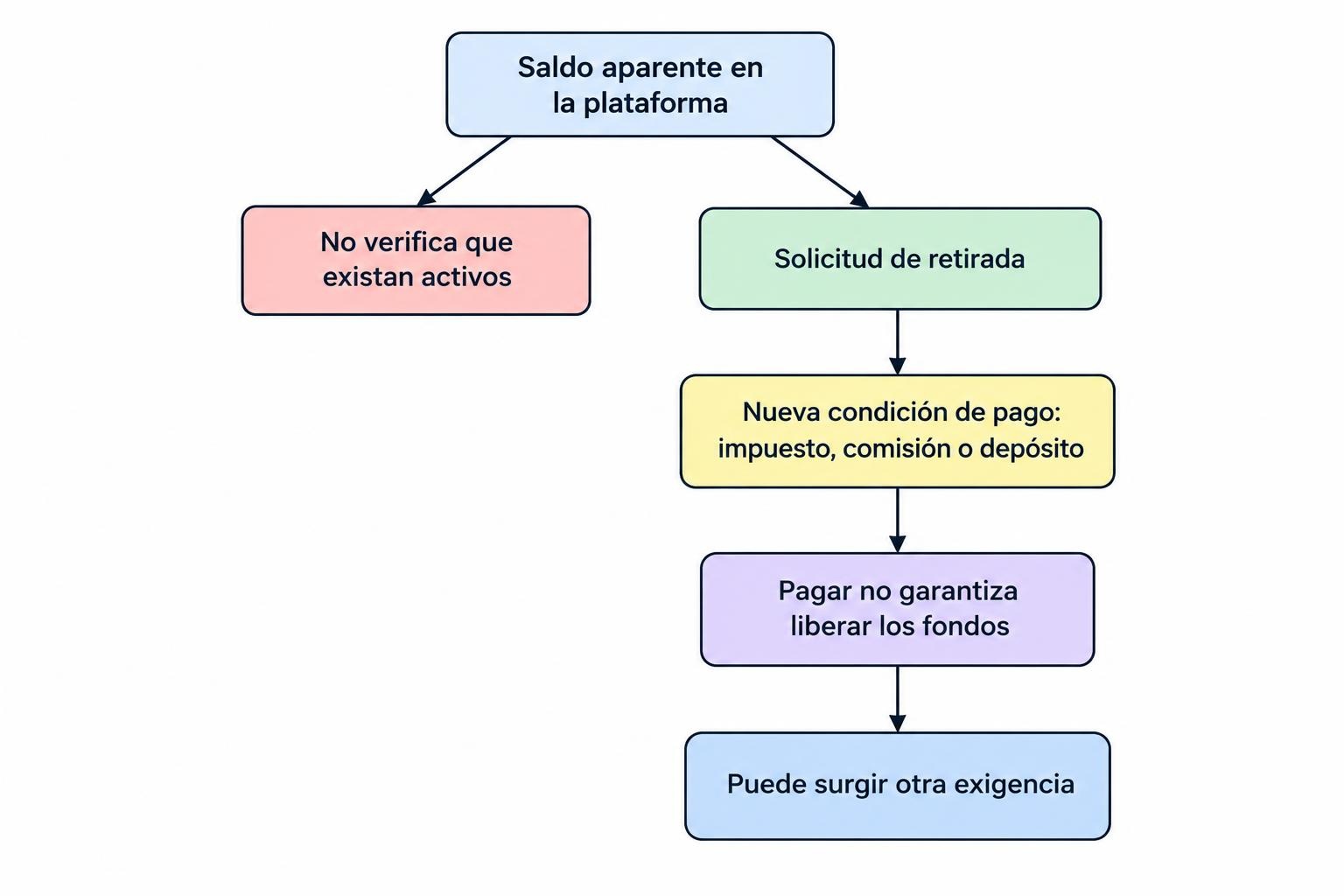
The scam turns an apparent asset into a reason to send more cash. You see a profitable account, request a withdrawal, then encounter a new condition: pay first, receive your money afterwards.
That condition changes the decision you think you are making. Instead of questioning whether the platform is genuine, you start weighing a smaller payment against a much larger promised withdrawal. The displayed balance becomes the bait.
Successful small withdrawals do not settle the question. Scammers can allow early payments to build trust, then block a larger withdrawal. Fake account data and selective withdrawals are both covered in Scamwatch’s investment scam warning.
Treat each demand as a new request for your money, not the final step in recovering an existing balance. Previous deposits do not make the next payment safer. Nor does a helpful account manager, a professional dashboard or a withdrawal status marked approved.
Tax, clearance and security labels to question
Focus on what the payment does, rather than what the platform calls it. An official sounding label cannot establish a debt, prove a tax calculation or demonstrate that funds are waiting in a bank account.
| Claimed charge | Reason to stop and check |
|---|---|
| Tax on trading profits | The platform demands a separate transfer without an independently verifiable tax basis or recipient. |
| Anti money laundering clearance | A compliance label is used to justify paying money before funds can move. |
| Refundable security deposit | You must increase your exposure to obtain money supposedly already available. |
| Withdrawal activation or account upgrade | Access to your existing balance depends on buying another service or adding capital. |
| International transfer certificate | The demand relies on an official looking document rather than verification through the named institution. |
These are labels to investigate, not a list of recognised government charges. A demand does not become valid because it includes a reference number, signature or payment deadline.
Government branding deserves particular caution. Scammers use AUSTRAC logos and documents, including supposed compliance certificates, to appear genuine. A message claiming to come from AUSTRAC and demanding a fee or tax to authorise the release of funds is not genuine, as set out in AUSTRAC’s fraud and scam guidance.
A worked example: paying to release an imaginary profit
Consider this hypothetical example, with all amounts in Australian dollars.
A person deposits $2,000 into a supposed binary options account. The dashboard later shows $18,000, suggesting a $16,000 profit. When they request a withdrawal, the platform demands $3,200, described as tax at 20% of that apparent profit.
The person pays because $3,200 seems manageable beside an $18,000 withdrawal. The platform then requests another $900 for clearance, promising that both payments will be refunded with the account balance.
If both payments are made, the person has sent $6,100: the original $2,000 deposit, the $3,200 tax payment and the $900 clearance charge. The $18,000 display is not evidence that any corresponding assets exist.
The invented 20% rate in this example is not an Australian tax rule. It illustrates how a plausible calculation can make an unsupported demand look orderly.
The useful question is not whether the fee seems small compared with the balance. It is whether there is independent evidence of the money, the liability and the payment recipient. Arithmetic can be correct while the entire premise is false.
Is every withdrawal charge a scam?
No. A fee or delay alone does not establish fraud. But a previously undisclosed demand for fresh money, especially one tied to tax or government clearance, needs much more scrutiny than an ordinary processing charge.
Separate three questions: who holds the funds, what agreement authorises the charge, and who receives the payment. An answer supplied entirely by the same account manager is not independent verification.
For a suspected scam, gather the account terms, original fee schedule and withdrawal correspondence already available to you. Do not pay to obtain those documents. Compare the demand with the terms that applied when you deposited, rather than accepting a replacement policy sent after your withdrawal request.
Also avoid the reverse shortcut: a charge is not automatically genuine because the platform offers to deduct it from the displayed balance. A fake platform can alter its own numbers.
Where the issue involves processing times, account restrictions or verification rather than a new payment demand, see the separate guide to binary options withdrawal problems. The distinction matters, but neither situation justifies sending money under pressure.
How to check a claimed tax bill
Keep tax verification separate from the platform’s withdrawal process. Ask a registered tax agent to assess your actual transactions and records, rather than treating a dashboard’s profit figure as a tax calculation.
Do not accept the platform’s tax rate, deadline or payment address simply because they appear on a certificate. If an Australian Taxation Office connection is claimed, verify it through the ATO using contact details you obtain independently.
The ATO provides a scam checking number, 1800 008 540, and advises people not to engage with suspicious contact. Its guidance on checking suspicious ATO contact also recommends accessing online services directly rather than through links in unexpected messages.
Do not share your myGov password, security codes or tax file number with an account manager offering to arrange clearance. A request to discuss tax does not justify access to your government accounts.
If a foreign authority is named, use the same approach: find the authority independently and ask whether the demand is genuine. A phone number printed on the disputed document cannot verify that document.
Do not assume that refusing a suspicious payment resolves your tax affairs. Equally, do not assume that withdrawing money is the only event relevant to tax. Obtain separate advice about genuine transactions, money received and any losses.
The Australian binary options restriction still matters
ASIC’s product intervention order bans the issue and distribution of binary options to retail clients until 1 October 2031. The ban first took effect on 3 May 2021. These dates are confirmed in ASIC’s announcement extending the binary options ban.
For Australian retail clients, a platform’s claim that it is an approved binary options provider therefore needs scrutiny before any discussion of withdrawal charges. Do not let a certificate distract you from checking the underlying offer.
Start with the legal entity and the permissions relevant to the product, not just the brand name. Our guide to checking a broker’s licence covers that separate verification process.
What to do if you have already paid
Stop sending money, including any reduced fee offered as a compromise. You do not need the platform’s agreement before contacting your bank.
Contact your bank or card provider immediately, describe the suspected scam and ask whether any transactions can be stopped. This is the first action in Scamwatch’s guidance for people who have been scammed. Explain both the original deposit and the later tax or release payments.
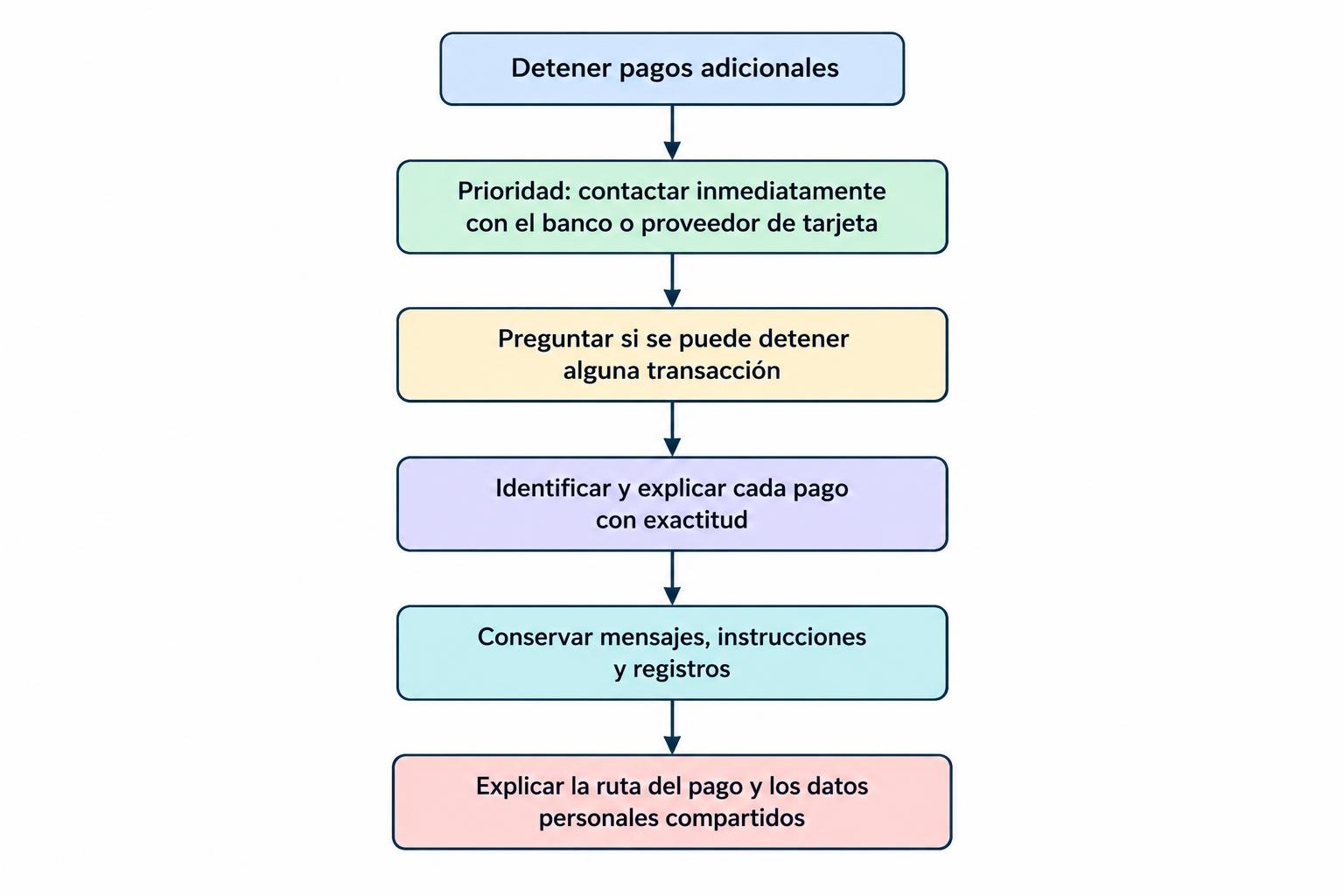
- Identify every payment. Record dates, amounts, currencies, recipient details and transaction references. Tell the provider how you authorised each payment; do not describe an authorised transfer as unauthorised.
- Preserve the demand. Save messages, emails, invoices, withdrawal requests and screenshots showing the account balance and payment instructions. Keep originals where possible.
- Explain the payment route. If you bought cryptocurrency before transferring it, distinguish that purchase from the later transfer to the suspected scammer. Give the relevant provider the transaction details and ask what action is available.
- Record what else was shared. Note whether you supplied identity documents, passwords, security codes or remote access. Ask for help addressing those risks as well as the money lost.
For your own records, keep actual transfers separate from claimed profits. If you deposited $2,000 and later sent a $3,200 release payment, those are documented outflows. A screen showing $18,000 is evidence of what the platform represented, not proof that you owned $18,000.
Prepare a short timeline while the details are fresh. Include when you requested the withdrawal, what condition appeared, who supplied the payment instructions and what happened after you paid.
Do not delay contacting your payment provider while building a perfect evidence file. Start with the facts you have, then add supporting records. The broader guide to what to do after a binary options scam covers reporting and account protection beyond the release fee itself.
Why negotiating a smaller fee is not a safe test
A discount does not verify the original demand. If a supposed tax bill drops when you object, that does not establish that the revised amount is legitimate. The same applies to instalments, a manager’s contribution or a promise that this really is the last payment.
Assess the next transfer on its own merits. Would you send it if there were no profitable dashboard and no previous deposit to recover? If the answer is no, the displayed balance may be driving the decision rather than evidence.
Do not borrow, sell assets or ask relatives to fund a disputed release charge. Bring a trusted person into the decision and show them the actual messages, not just the account balance.
Watch for a second demand disguised as recovery
After a withdrawal dispute, another caller may offer to retrieve the money for an upfront payment. They may present themselves as an investigator, lawyer or recovery service. The ACCC has warned about criminals targeting previous scam victims with paid recovery offers, including impersonation of trusted organisations.
Knowing your platform name or loss amount does not establish that a caller is independent. Do not provide banking access or pay a tracing charge simply because someone claims to have located the funds.
Check any professional through independently obtained contact details and question guarantees of recovery. The separate guide to trading fund recovery scams covers those follow up approaches.
You do not need to prove that the displayed profits are fictional before stopping payments. A withdrawal request should not become an open ended commitment to send more money.
This article was last updated on: October 22, 2026