Binary options risk management means controlling how much can be lost, how quickly losses can build and whether a contract or provider should be used at all. Stake size matters, but so do payout terms, overlapping positions, settlement rules and access to your money.
For Australian retail clients, the first boundary is regulatory. ASIC banned the issue and distribution of binary options to retail clients from 3 May 2021 and extended that prohibition until 1 October 2031. The ASIC announcement extending the binary options ban sets out its scope. The examples below are educational calculations using hypothetical balances, not a recommendation to open or fund an account.
What Risk Management Can and Cannot Do
Risk controls can reduce the amount exposed to a losing outcome. They cannot make an unfavourable payout profitable, guarantee a forecast or protect money held by a fraudulent business. Keeping these problems separate prevents a common mistake: treating discipline as proof that a product is suitable.
The historical losses were substantial. In the 13 months before the Australian ban, 74–77% of active retail binary options clients lost money. Changing client classification is not a sensible workaround: wholesale clients do not receive the same consumer protections as retail clients. Moneysmart’s binary options warning covers both the loss figures and the risks of accepting wholesale classification simply to gain access.
A useful framework separates three questions. Can the activity lawfully be offered to you? Do the contract terms support the assumptions behind your analysis? Can the financial consequences be absorbed without affecting ordinary living costs? An unacceptable answer to any one is enough to stop.
Start With the Payout, Not the Win Rate
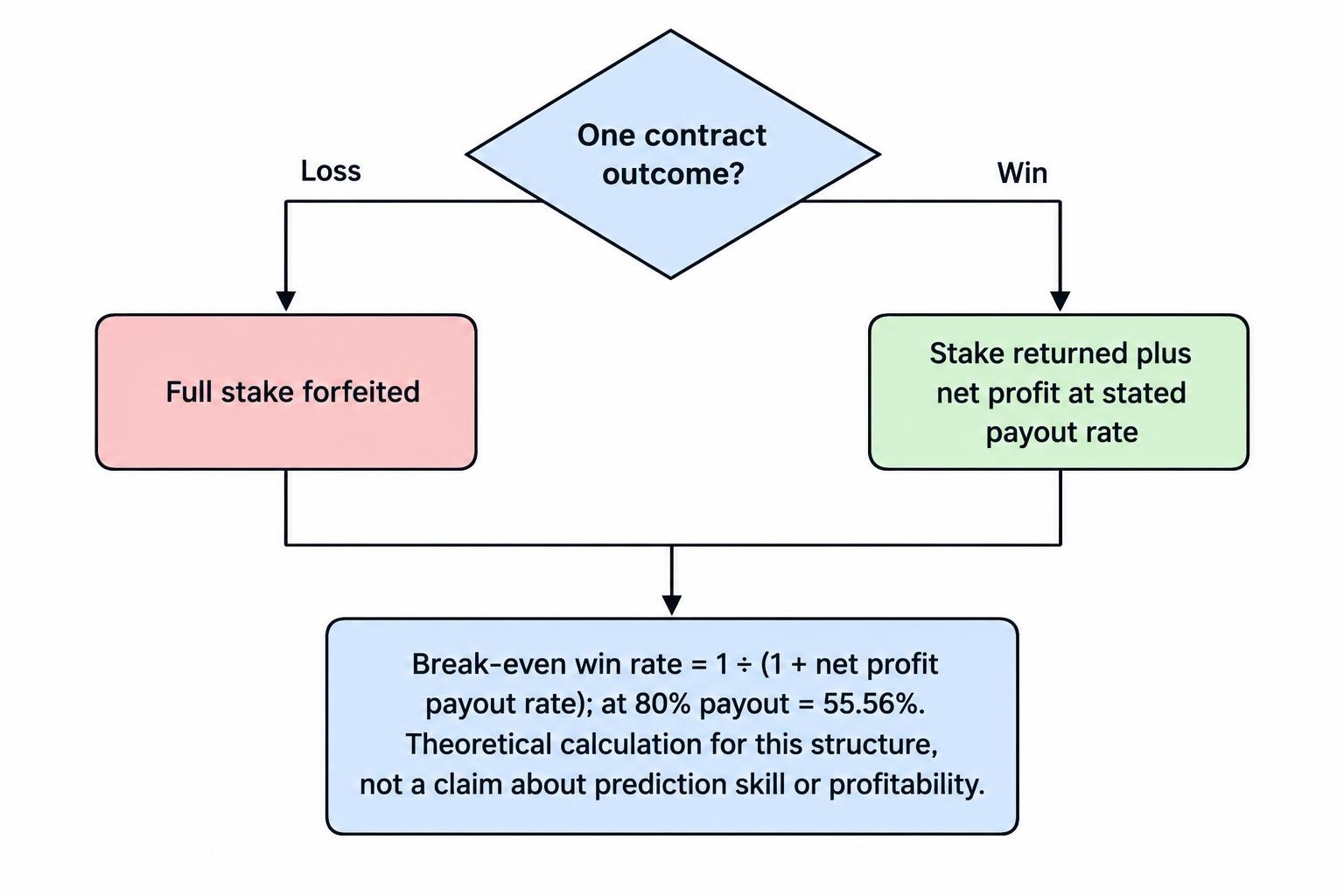
A binary option can lose money over a series of trades even when half the predictions are correct. If a losing contract forfeits the full stake but a winning contract earns less than that stake in profit, the outcomes are financially uneven. This asymmetry is covered in the SEC and CFTC investor alert on binary options.
Suppose a hypothetical contract risks A$10 and pays 80% net profit when successful. A win earns A$8, with the original A$10 also returned. A loss costs A$10. Ten wins and ten losses therefore produce A$80 in profits and A$100 in losses: a net loss of A$20.
For this contract structure, the break-even win rate is:
Break-even win rate = 1 ÷ (1 + net profit payout rate)
| Net profit payout | Profit on an A$10 winning stake | Break-even win rate |
|---|---|---|
| 70% | A$7 | 58.82% |
| 80% | A$8 | 55.56% |
| 90% | A$9 | 52.63% |
These calculations assume full stake losses, constant stakes and payouts, no fees and no ties or refunds. They do not apply unchanged to every binary contract structure.
A claimed 56% win rate means little without its payout history. It would sit above the theoretical break-even point at an 80% payout but below it at 70%. The guide to probability and expected value in binary options develops this relationship. A smaller stake can slow a losing strategy down. It cannot repair it.
Separate the Learning Budget From the Stake
The total amount allocated to an activity and the amount risked on one contract are different decisions. A small stake does not make an oversized total budget affordable, especially if repeated deposits keep replenishing losses.
For any hypothetical exercise, exclude rent, mortgage payments, emergency savings, debt repayments and other committed money. Do not build a plan around recovering those funds later. Borrowed money also creates a repayment obligation that survives the trading loss.
Within a paper account, calculate stake size against the current balance rather than an earlier, higher balance. At a simulated A$1,000 balance, a 1% stake is A$10. At A$800, it is A$8. Keeping the stake at A$10 after the balance falls increases the percentage exposed.
That percentage is an illustration, not a safe trading recommendation. No universal percentage makes binary options safe. The stake sizing guide compares the mechanics without treating any setting as a guarantee.
Contract minimums also matter. If a platform’s minimum stake exceeds a hypothetical risk allowance, rounding up defeats the allowance. In a practice exercise, record that the contract fails the sizing rule rather than changing the rule to accommodate it.
Plan for Losing Streaks Before They Happen
A win rate is an average, not a timetable. Even a sequence with more wins than losses can contain several consecutive losses. A plan that depends on losses arriving neatly between wins is not much of a plan.
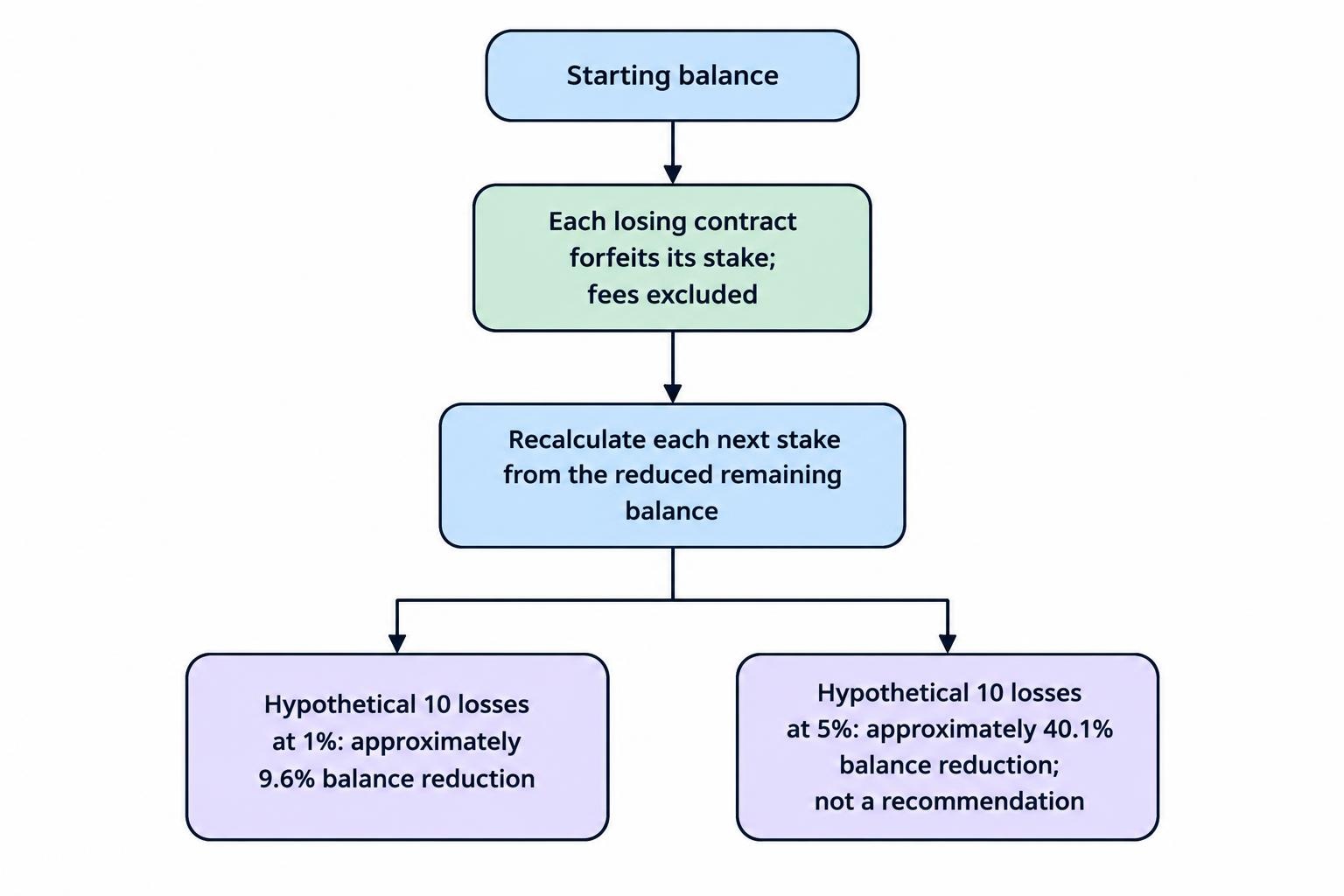
Consider ten consecutive losses with the stake recalculated after each result. Risking 1% of the remaining balance each time reduces it by approximately 9.6%. Risking 5% reduces it by approximately 40.1%. Both calculations exclude fees and assume each losing contract forfeits its stake.
Recovery is also uneven. After a 20% fall, the remaining balance needs a 25% gain to return to its starting value. This is why trading drawdown deserves its own limit rather than being treated as an inconvenience that more trades will fix.
Increasing stakes after losses compounds the problem. At an 80% net profit payout, losing A$10, A$20 and A$40 creates a cumulative A$70 loss. A subsequent A$80 winning stake earns A$64 profit, leaving the sequence A$6 behind. Doubling does not even guarantee recovery when a win pays less than the amount risked.
Set review thresholds before a simulated session starts. Decide what balance decline triggers a pause and what evidence would justify changing the method. “Continue until back to even” is not a loss limit; it removes the limit precisely when it is needed.
Count Combined Exposure, Not Just Individual Trades
Several small positions can create one large loss. Four open contracts risking A$10 each expose A$40 in total, even if each contract looks modest on its own. The useful question is what happens if they all settle unsuccessfully.
Different market labels do not necessarily provide independent exposure. Positions on two currency pairs might both depend on the same currency weakening. Several share index contracts might depend on the same broad market move. Treat these as potentially connected rather than automatically diversified.
The guide to correlation and trading risk examines this overlap. For a practice plan, record both the total open stake and the common event or market assumption behind the positions.
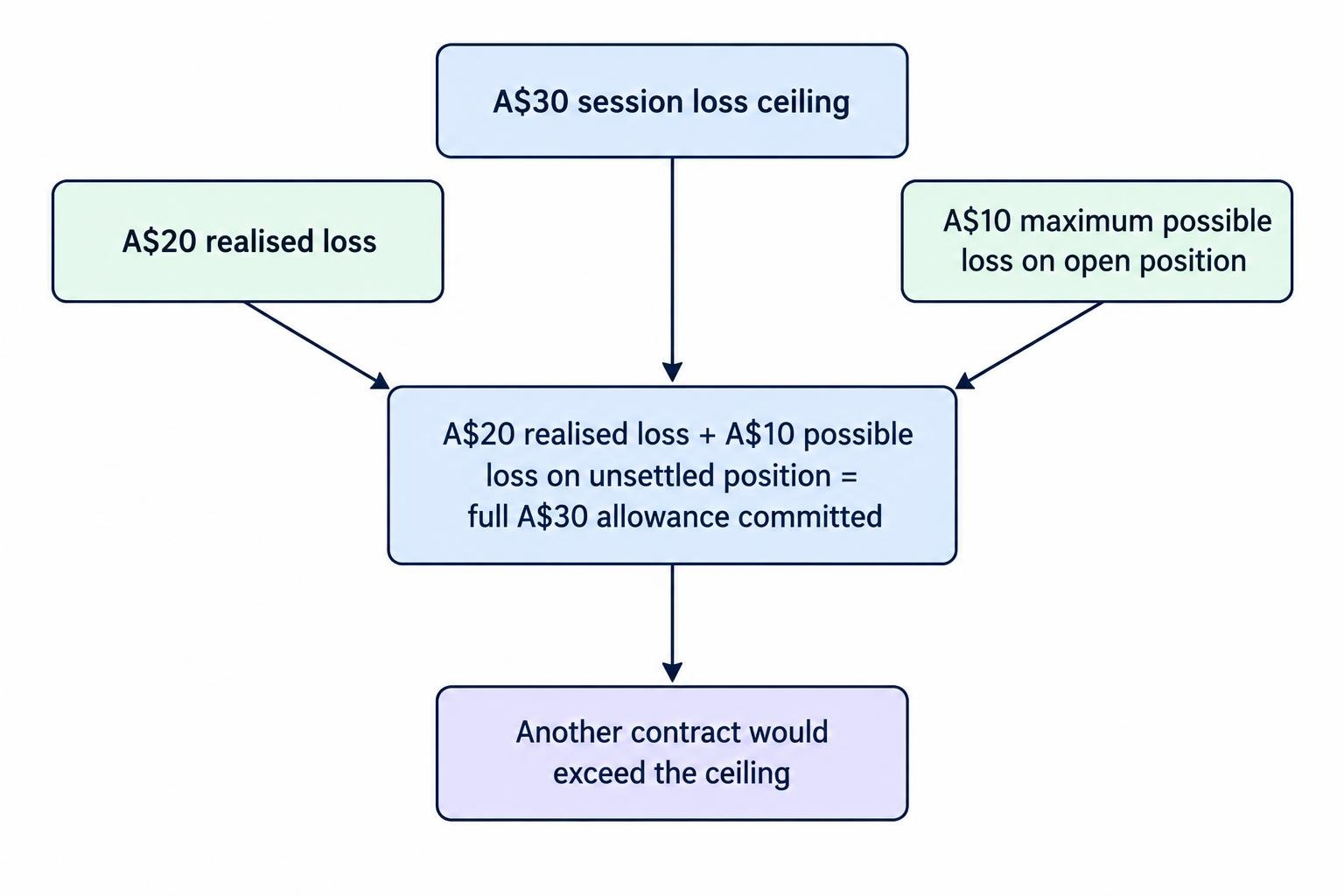
Session limits must include unsettled contracts. If a hypothetical loss ceiling is A$30, realised losses are A$20 and an open position can still lose A$10, the full allowance is already committed. Opening another contract would exceed it, even though the displayed realised loss remains below A$30.
Check Expiry, Settlement and Exit Assumptions
For a high-low contract, being right about the eventual direction is not enough. The contract settles against its stated condition at its stated expiry. A move that arrives after settlement does not rescue an earlier loss.
Before recording a simulated trade, identify the strike, expiry time, time zone, settlement price source and treatment of an exact tie. Also establish whether the quoted payout is net profit or the total amount returned. An unclear term is a reason to reject the example, not fill in the gap with a convenient assumption.
Do not assume a conventional stop loss is available. A fixed expiry contract may require the holder to accept the settlement outcome unless its terms provide an early exit. Where an exit feature exists, its availability and price still need checking. The stop losses and early exit guide covers those distinctions.
Keep the original maximum loss in the exposure calculation until a position has actually closed. A proposed exit, an unaccepted request or a button that appeared in a demonstration is not the same as a completed transaction.
Treat Platform Risk as a Separate Problem
Market analysis cannot establish whether an account balance is genuine or withdrawable. Complaints involving binary options platforms include denied withdrawals, hidden fees, overstated returns and manipulated historical charts. These practices appear in the CFTC warning about off-exchange binary options platforms.
This creates two different exposures: the stake committed to a contract and the money entrusted to the provider. Reducing the first does not remove the second. A hypothetical A$10 position does not describe the full financial exposure if much more money remains in an account whose withdrawals cannot be relied upon.
Do not treat a profitable demonstration, a polished interface or a screenshot of somebody else’s withdrawal as proof that funds are protected. None answers the questions that matter about your own money.
If an existing account develops withdrawal problems, stop adding funds and preserve transaction records, messages and the applicable terms. Contact the payment provider promptly to discuss available options. Do not send more money simply because someone promises that another deposit will release the balance.
Use Practice to Test Rules, Not Just Predictions
Paper trading can test calculations and decision rules without putting money at stake. It cannot establish that a provider will execute or settle live contracts fairly, and a simulated profit is not evidence that a method will remain profitable.
Build the exercise around rules that can fail clearly. “Be careful” cannot be measured. A written exposure ceiling, a defined expiry and a record of the quoted payout can.
- Before the session: record the simulated balance, stake rule, maximum open exposure and stopping conditions.
- Before each entry: record the contract terms, payout, reason for entry and possible overlap with other positions.
- After settlement: record the financial result and whether the original rules were followed.
- At review: separate forecasting errors, payout problems, execution assumptions and rule breaches.
A trading journal should include skipped opportunities and rejected contracts, not only completed trades. Otherwise, the record can hide the decisions that prevented losses or reveal only the examples that looked good afterwards.
Review results in money as well as wins and losses. Include changing payouts and any relevant costs. Keep the original rules intact during a test period; repeatedly adjusting them after seeing the result makes it difficult to tell what was actually tested.
Know When the Correct Decision Is to Stop
Stop an exercise when its assumptions no longer hold: the payout changes, settlement cannot be verified, exposure exceeds the written ceiling or the next decision is driven by recovering the last loss. Restarting should require a review, not simply a fresh balance.
Risk management is not a promise that enough caution will make binary options profitable. It is a process for identifying unacceptable exposure and refusing it. For Australian retail clients, that begins with respecting the prohibition on providers issuing and distributing these products. Beyond that boundary, no stake formula replaces sound contract terms, reliable evidence or the ability to leave money uncommitted.
This article was last updated on: October 22, 2026