Binary options practice exercises should test more than whether you guessed a price move correctly. Useful drills check whether you can read a contract, calculate its return, apply settlement rules and keep an honest record. You can complete every exercise below with a calculator and spreadsheet. No deposit needed.
For Australian readers, the legal position comes first: ASIC’s prohibition on issuing and distributing binary options to retail clients took effect on 3 May 2021 and extends until 1 October 2031. These exercises are educational simulations, not a route around ASIC’s binary options product intervention order.
All prices, contracts and account balances below are hypothetical. Dollar amounts represent Australian dollars unless stated otherwise. Try each task before reading its answer, then record both the result and the reasoning that produced it.
Prepare Your Practice Worksheet
Create one worksheet for contract calculations and another for observation exercises. Give every attempt an identification number, including attempts you abandon because the terms are incomplete. Deleting awkward cases makes the record tidier, not better.
For each simulated contract, record the underlying market, direction, strike, decision time, expiry time and time zone. Add the stake, net profit rate, settlement rule and price source. Keep separate columns for your answer, the checked answer and the reason for any error.
Use the same assumptions throughout a batch. Unless an exercise says otherwise, a loss costs the entire stake, a win returns the stake plus the stated profit, and there are no fees or partial refunds. The percentage shown is a net profit percentage, not the total amount returned.
If you need help setting up a simulation without opening an account, start with the guide to paper trading binary options.
Exercise 1: Read the Contract Before Reading the Chart
A binary option pays according to a stated event rather than simply rewarding any favourable price movement. A correct outcome produces a fixed payment; an incorrect outcome can lose the money committed. That payoff structure is covered in Moneysmart’s binary options warning.
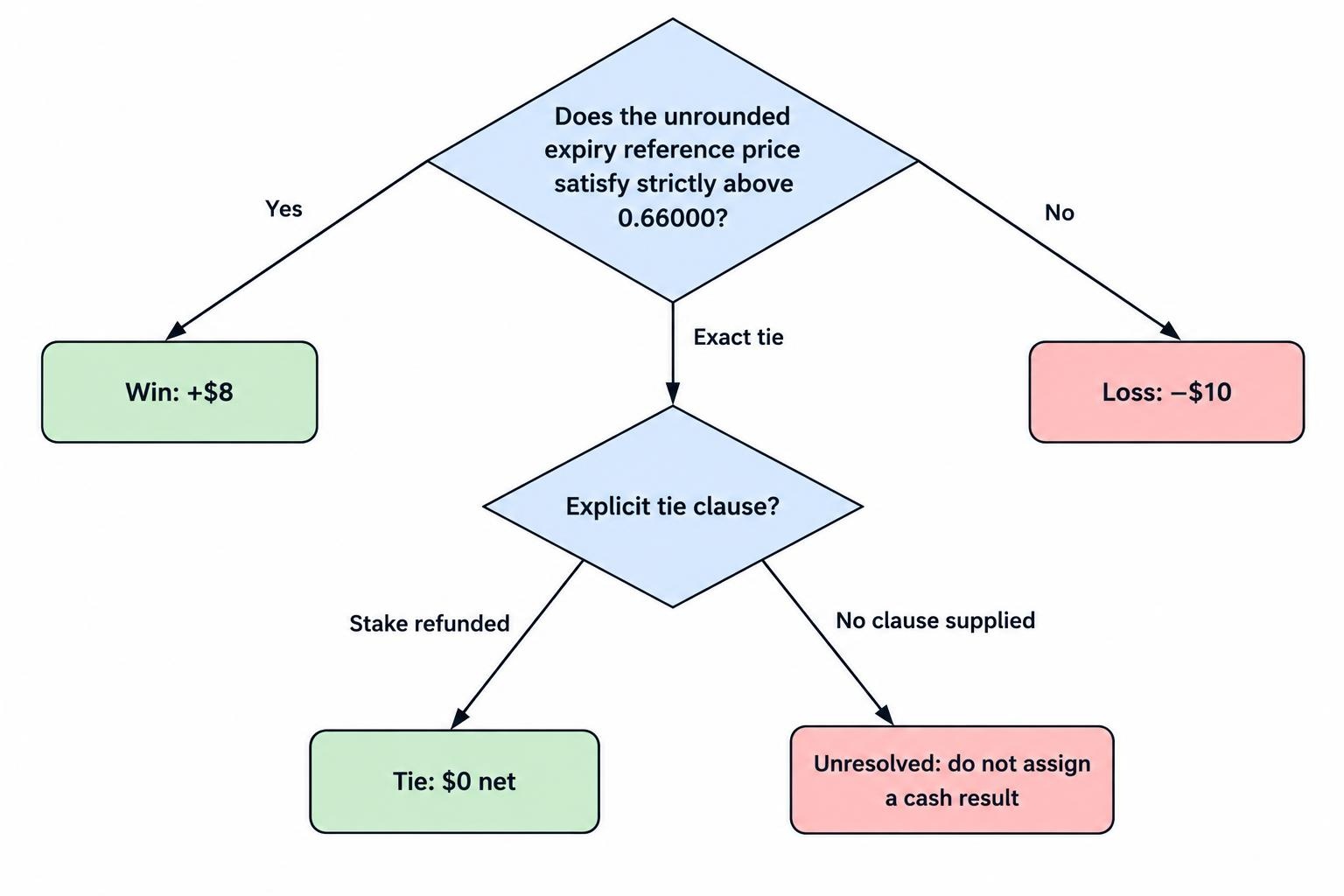
Task: Assess this fictional contract: “AUD/USD strictly above 0.66000 at 10:05:00 UTC.” The stake is $10, the net profit rate is 80%, and an exact tie refunds the stake. For this exercise, the settlement price is the unrounded reference price recorded at expiry.
| Settlement price | Contract result | Net profit or loss |
|---|---|---|
| 0.66012 | Win | +$8 |
| 0.65998 | Loss | −$10 |
| 0.66000 | Tie: stake refunded | $0 |
Check your reasoning: A price of 0.66001 and a price of 0.66500 both satisfy the condition. The larger move does not increase the $8 profit. A price of exactly 0.66000 is not strictly above the strike; its treatment follows the refund clause supplied for this exercise.
Now remove that clause. Can you still assign a cash result to the tie? No. Record the outcome as unresolved until the contract terms establish its treatment. Do not borrow the rule from another example.
Exercise 2: Separate Profit From Money Returned
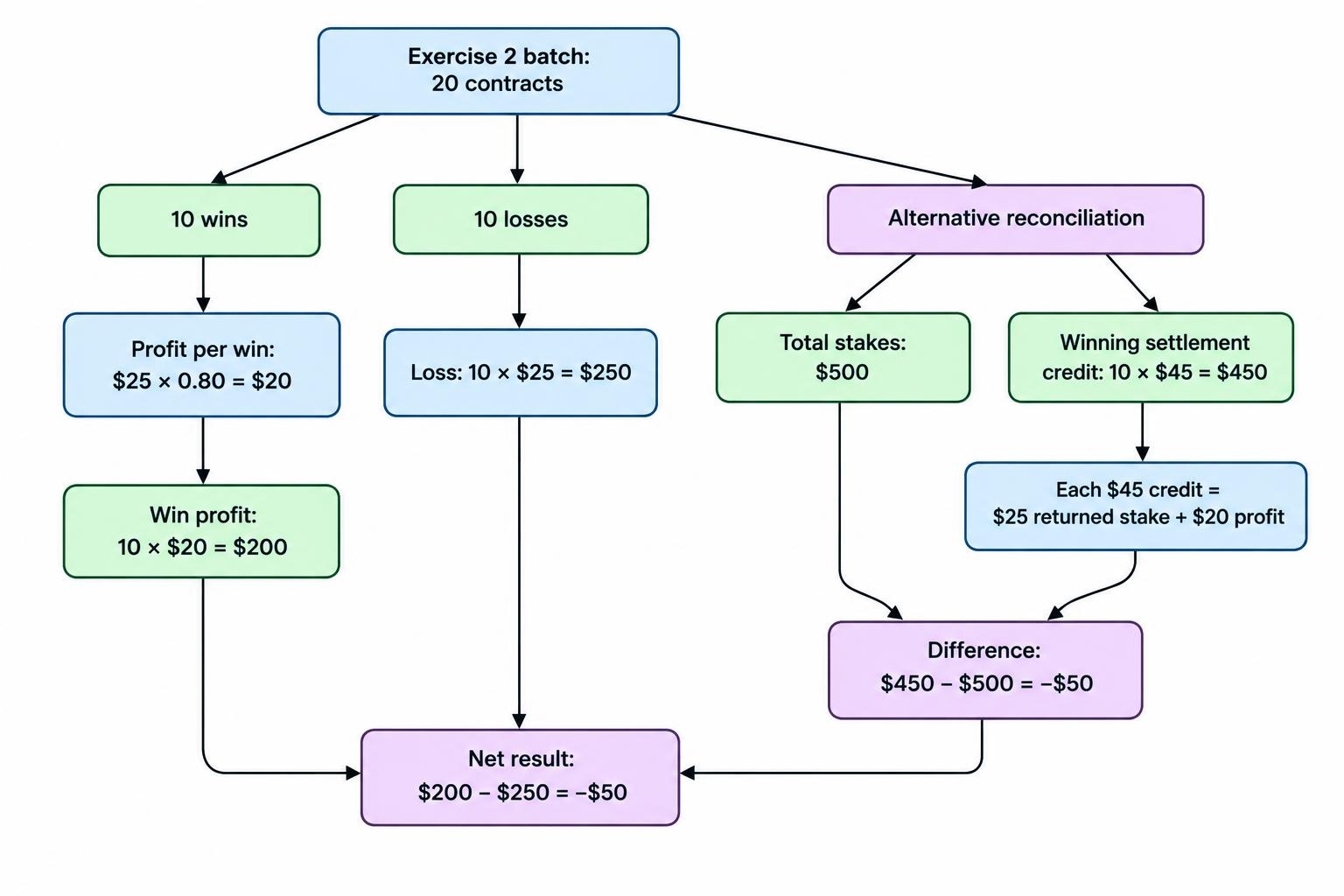
Task: A simulated contract has a $25 stake and an 80% net profit rate. Calculate the profit on a win, the total settlement credit on a win and the loss on an unsuccessful outcome.
Then calculate the combined result of 20 contracts with identical terms: ten wins and ten losses. Assume no ties or fees.
Answer: A win earns $20 profit: $25 × 0.80. The settlement credit is $45, comprising the returned $25 stake and $20 profit. A loss returns nothing and reduces the balance by $25.
Across the batch, winning contracts earn $200 and losing contracts cost $250. The net result is a $50 loss, despite a 50% win rate.
You can reconcile this another way. Total stakes paid equal $500, while settlement credits equal $450. The difference is still −$50. Use either accounting method consistently; do not count the returned stake as profit or subtract it twice.
Repeat the exercise at 70% and 90% net profit rates. The batch results become −$75 and −$25 respectively. The guide to binary options payouts covers the terminology behind these calculations.
Exercise 3: Calculate Break-Even and Expected Value
Task: Work out the break-even win rate for contracts paying 80% net profit when successful and losing the full stake when unsuccessful. Exclude ties, refunds and fees.
Use this formula, expressing the profit rate as a decimal:
Break-even win rate = 1 ÷ (1 + net profit rate)
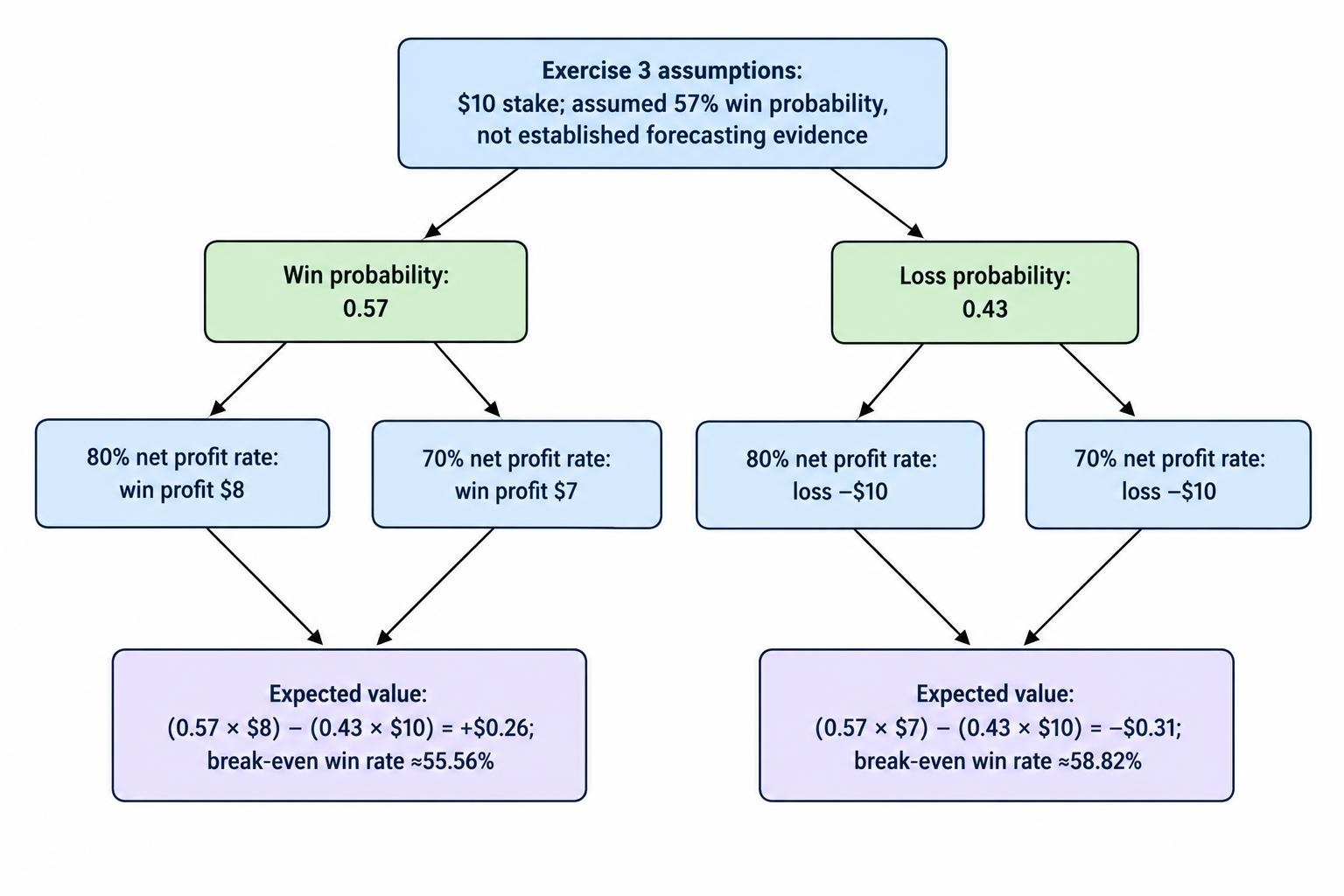
Answer: At 80%, the calculation is 1 ÷ 1.80 = approximately 55.56%. A win rate above that threshold produces a positive result under these assumptions; a rate below it produces a negative result.
Now suppose the true probability of winning were 57%. With a $10 stake, the expected value would be:
(0.57 × $8) − (0.43 × $10) = +$0.26 per contract.
Change only the profit rate to 70%. Expected value becomes:
(0.57 × $7) − (0.43 × $10) = −$0.31 per contract.
The direction forecast has not changed, but the economics have. At 70%, the break-even win rate rises to approximately 58.82%.
The hard part is not entering 57% into a calculator. It is establishing whether that probability is justified. A worksheet assumption is not evidence of forecasting ability, and a small positive expected value does not promise a profitable session. Use the probability and expected value guide for further calculations.
Exercise 4: Match Expiry, Strike and Settlement
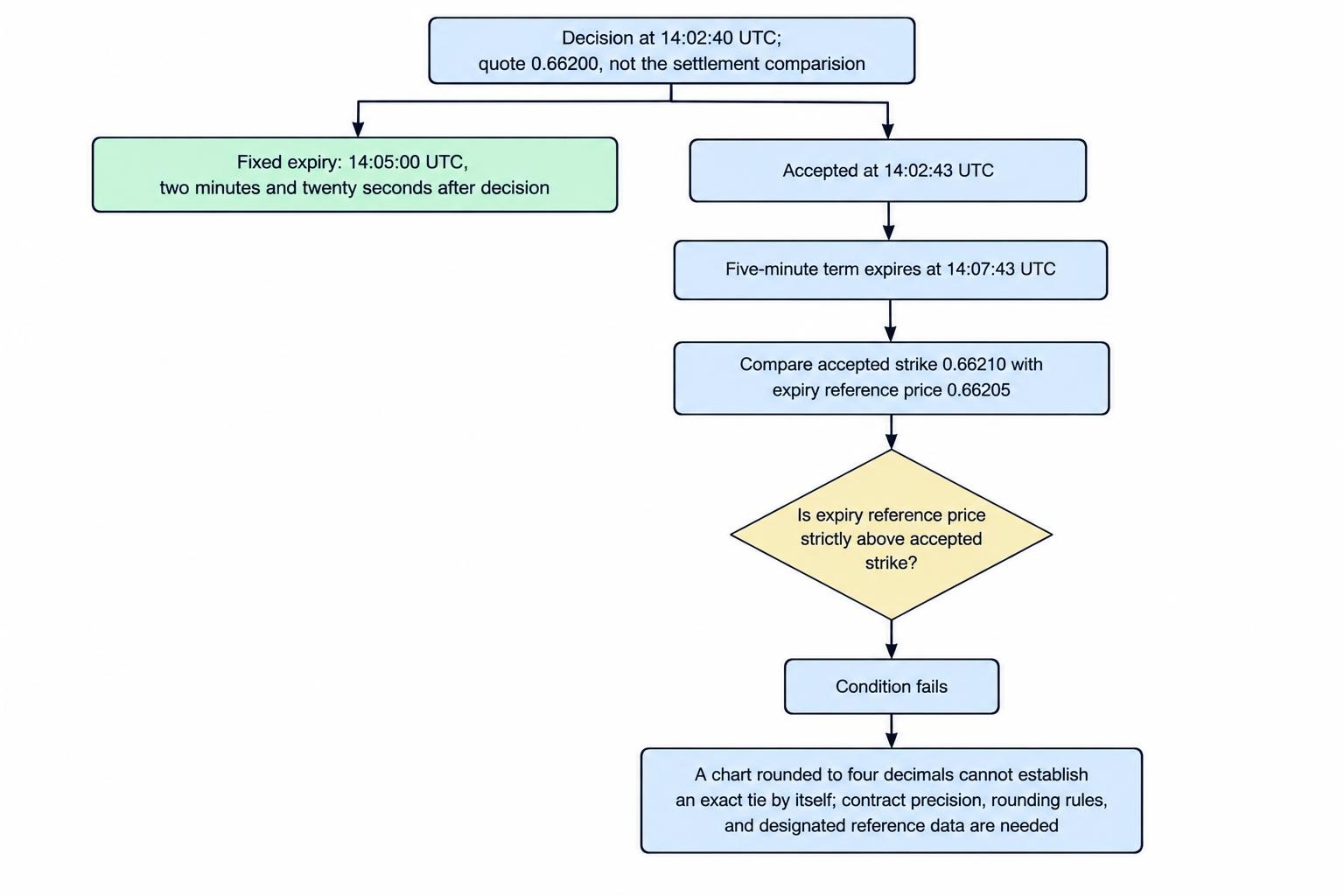
Task: You make a simulated decision at 14:02:40 UTC. Compare a contract expiring at the fixed time of 14:05:00 with a contract lasting five minutes from acceptance at 14:02:43.
Answer: The fixed expiry leaves two minutes and twenty seconds from your decision. The five-minute contract expires at 14:07:43. They are not interchangeable, even if the interface places both under a “five-minute” label.
Now consider these fictional records:
- Decision-time quote: 0.66200.
- Accepted strike: 0.66210.
- Expiry reference price: 0.66205.
- Condition: strictly above the accepted strike.
Question: Does the contract win because the final price exceeds the decision-time quote?
Answer: No. The expiry price is below the accepted strike, so the condition fails. Comparing settlement with the earlier quote would answer a different question.
Finally, suppose a chart displays both the strike and settlement as 0.6621 because it rounds to four decimal places. That display does not establish an exact tie. You need the contract’s precision and rounding rules, plus its designated reference data.
Repeat the task with a “below” condition. Keep the reference price unchanged and reverse only the comparison. Further edge cases belong in the guide to binary options settlement and ties.
Exercise 5: Measure Losses and Open Exposure
Task: Start with a fictional balance of $1,000 and use a fixed $10 stake. Calculate the balance after six consecutive losses and the percentage gain needed to recover.
Answer: Six losses cost $60, leaving $940. The decline is 6% of the starting balance. Recovery requires $60 ÷ $940, or approximately 6.38%, because the recovery percentage uses the smaller remaining balance.
Next, assume three $10 contracts are open simultaneously. What amount remains at risk before any settlement?
Answer: $30 under the exercise’s full-loss assumption. Do not subtract a possible winning payment from that exposure before the result is known.
For the final part, impose a practice rule: no more than $20 of unsettled exposure. With two $10 contracts already open, the correct action is to reject a third simulated entry.
Count that rejection as correct execution, whatever the third contract would later have done. Otherwise, the exercise rewards breaking a rule whenever hindsight makes the breach look clever. These amounts are training inputs, not recommended stakes or safe risk levels.
Exercise 6: Make Decisions Without Seeing the Ending
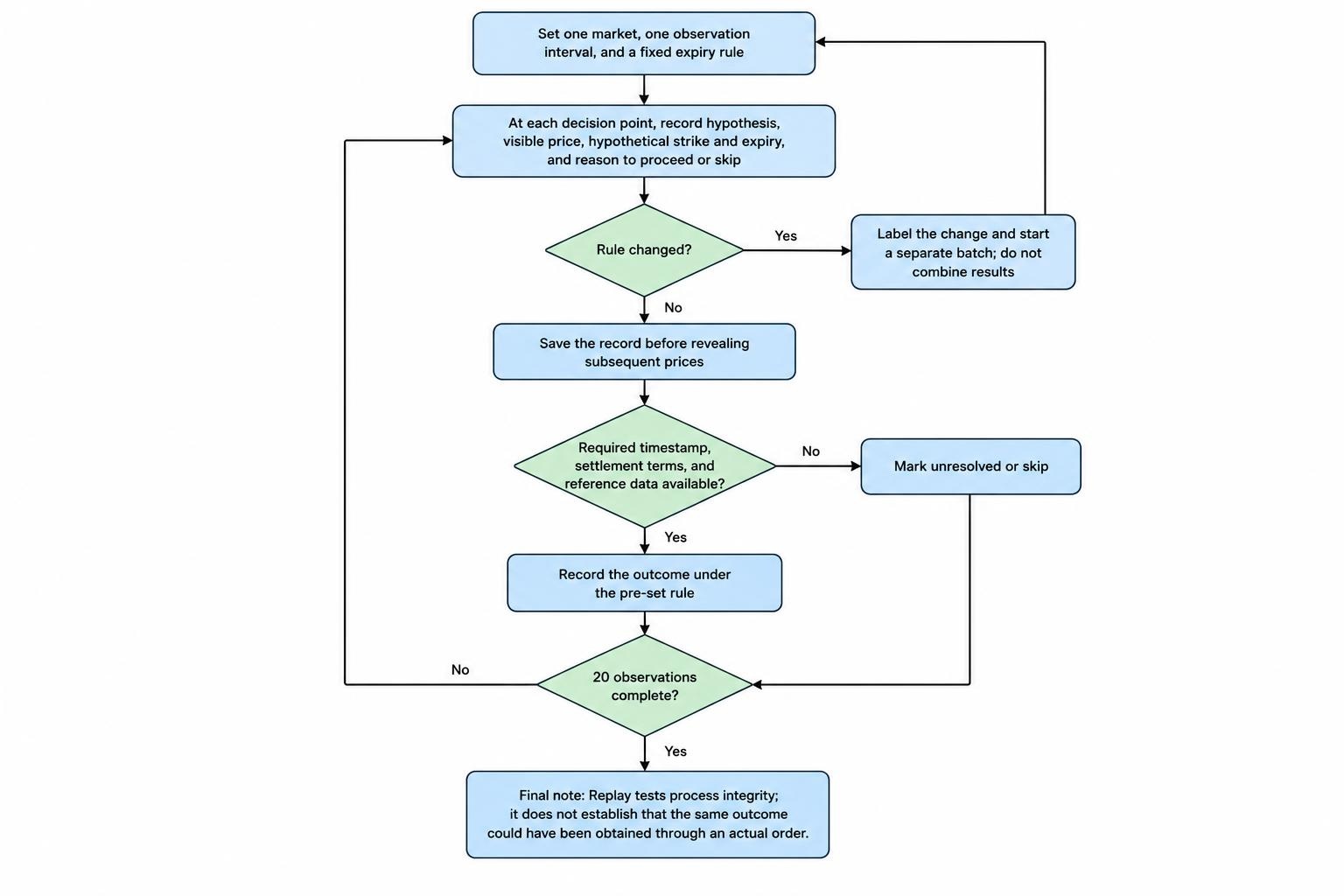
Task: Use a chart replay or a price record revealed one interval at a time. Before starting, choose one market, an observation interval and a fixed expiry rule. Write down the condition you intend to examine without claiming it has predictive value.
At each decision point, record your hypothesis, the visible price, the hypothetical strike and expiry, and your reason for proceeding or skipping. Save the entry before revealing subsequent prices.
Complete 20 observations. This is a manageable exercise size, not a statistically validated minimum. Do not replace losing observations, move an expiry after seeing the result, or introduce a new filter halfway through.
Check your work: Review whether every entry used only information available at the recorded decision time. If you changed a rule, label the change and begin a new batch rather than combining the results.
Include deliberate “no decision” cases: a missing timestamp, unclear settlement terms or unavailable reference data. The correct response is to mark the case unresolved or skip it, not invent the missing input.
A replay drill tests the integrity of your process. It does not establish that the same outcome could have been obtained through an actual order.
Exercise 7: Audit a Profitable Practice Record
Task: Review a fictional batch of 20 contracts, each with a $10 stake and 80% net profit rate. There are 12 wins and eight losses. Calculate the result, then examine the two halves separately.
Answer: The wins earn $96 and the losses cost $80, producing a $16 profit.
Suppose the first ten observations contain eight wins and two losses. That half earns $44. The remaining ten contain four wins and six losses, losing $28. Together they still produce $16, but the split shows why one profitable batch deserves examination rather than celebration.
Audit every row against its original record. Check for duplicate entries, missing expiry times, assumed payouts and results entered after the ending was visible. A row with missing evidence needs a flag, not a confident reconstruction.
Then list what the simulation did not test: actual order acceptance, real financial pressure and the ability to recover money from a provider. Hypothetical results do not represent actual trading and cannot fully reproduce the effects of financial risk, a distinction addressed in NFA’s notice on hypothetical performance.
Keep your raw observations alongside the calculations. A reusable trading journal should make errors visible rather than turn every session into a success story.
Exercise 8: Separate Practice Results From Provider Safety
Task: Evaluate this fictional message: “Your demo account has made $900. Deposit $500 now to activate withdrawals. Send your card image to your account manager.”
Identify what the demo result proves and what it does not prove.
Answer: It shows only that the displayed simulation balance increased under the platform’s rules. It does not establish that the balance is withdrawable money, that settlement is fair, that the operator is authorised or that a future withdrawal will be paid.
Refusal to return funds, identity theft and software manipulation have all featured in complaints described in the SEC and CFTC investor alert on binary options fraud. Those complaints concern alleged misconduct; they are not proof that every discrepancy has the same cause.
For this exercise, the correct response is to stop the deposit process and withhold card images. Do not send money to test whether the promise is genuine. Record the message and distinguish the safety question from the arithmetic question: flawless payout calculations cannot make an operator trustworthy.
Review Your Errors, Not Just Your Score
Give each exercise two marks: one for the correct answer and one for a clear explanation. For the observation drill, award marks for following the written process, not for producing winning predictions. This scoring method is a learning aid, not an industry assessment.
Group mistakes into arithmetic, contract interpretation, timing, recordkeeping and judgement. Repeat the relevant drill with changed inputs. Someone who calculates profit correctly but keeps using the wrong strike needs more settlement practice, not another indicator.
Keep the original answers so you can see whether the same errors return. If you want a repeatable schedule, use the binary options practice plan to organise later sessions.
Completing these exercises does not establish trading readiness, future profitability or legal access. The useful outcome is narrower: you can identify what a contract requires, calculate what it pays and recognise when the evidence is too weak to support an answer.
This article was last updated on: October 22, 2026