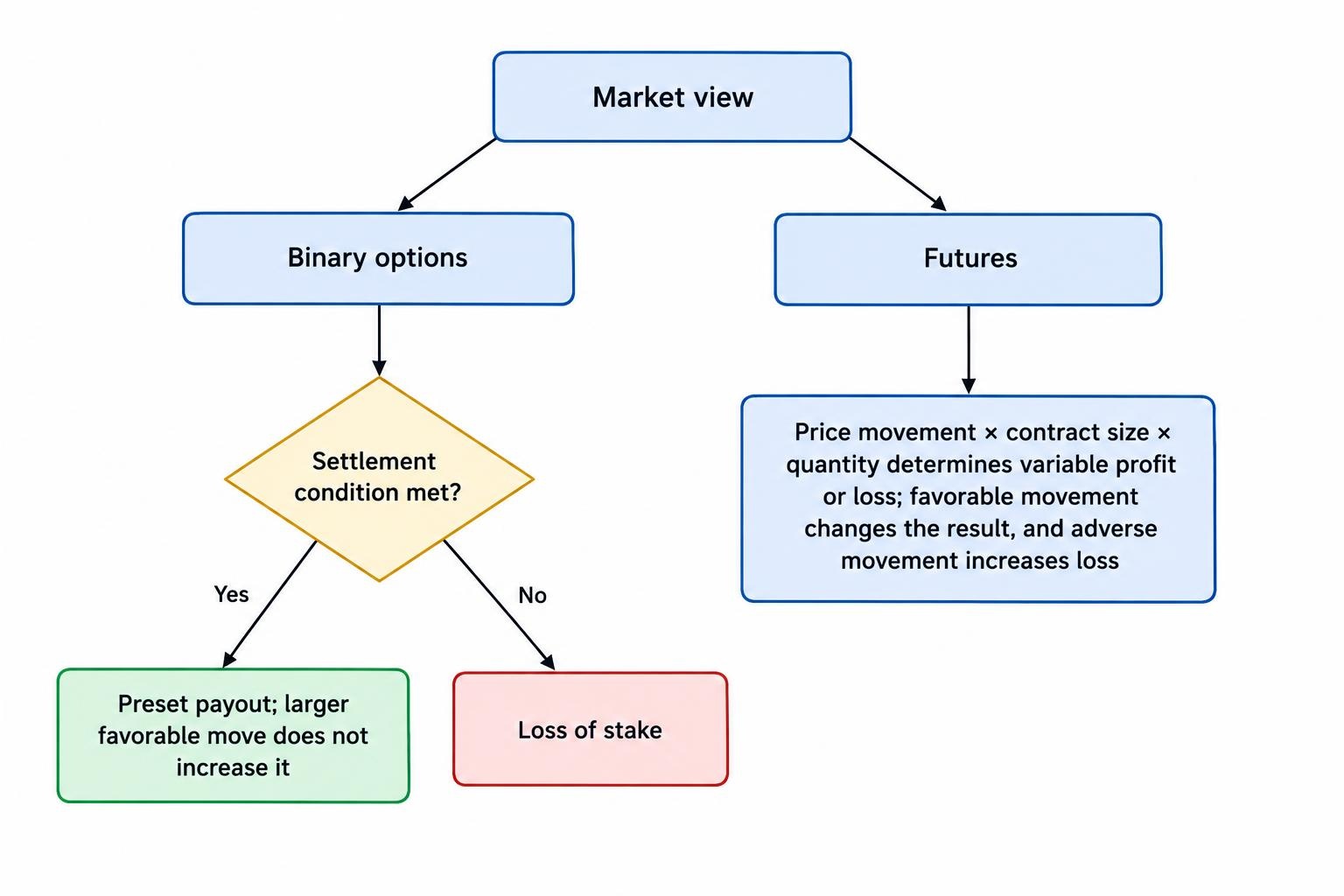
Binary options and futures can both express a view on market prices, but they turn that view into very different financial outcomes. A binary option pays a preset amount if its condition is met. A futures position gains or loses value as the contract price moves, with the result determined by the size of that movement and the number of contracts held.
For Australian retail clients, the comparison also has a firm regulatory boundary. ASIC banned the issue and distribution of binary options to retail clients from 3 May 2021 and extended the order until 1 October 2031. The ASIC announcement extending the binary options ban confirms those dates. The binary examples below explain the product; they are not instructions to access it offshore.
Binary Options vs Futures: The Main Differences
This comparison focuses on broker-issued binary options with a fixed payout and standard exchange traded futures. A CFD referencing a futures price is still a CFD, not an exchange traded futures contract.
| Feature | Binary options | Futures |
|---|---|---|
| Trading proposition | Whether a defined condition will be met | Exposure to changes in a contract’s price |
| Profit calculation | Preset payout when the contract wins | Price movement multiplied by contract size and quantity |
| Contract loss | Usually the stake committed to that contract | Can exceed the initial margin deposited |
| Capital committed | Stake paid for the contract | Margin supporting a larger market exposure |
| Exit before expiry | Depends on the provider’s contract terms | Usually possible through an offsetting trade, subject to trading conditions |
| Settlement | Determined by the stated event and settlement rules | Cash settlement or delivery, depending on the contract |
| Market structure | Commonly an over the counter contract with its issuer | Standardised exchange contracts with central clearing |
The practical distinction is between a conditional payout and continuing price exposure. With a binary option, moving further beyond the winning threshold normally does not increase the payout. With futures, each additional favourable price movement increases the trading profit before costs. The same relationship applies in reverse when the market moves against the position.
How Profits and Losses Work
Binary options: the condition decides the result
Consider a hypothetical binary option requiring a reference price to finish above 6,000 at a stated expiry. The stake is A$100, and a winning contract returns that stake plus A$80 profit. A losing contract returns nothing.
If the settlement price is 6,000.25, the profit is A$80. If it is 6,050, the profit is still A$80. A much larger favourable move produces no extra reward under those terms.
If the price finishes below the threshold, the A$100 stake is lost. A settlement exactly at the threshold needs separate treatment: the contract rules determine whether equality wins, loses or produces a refund. “Above” and “at or above” are not interchangeable.
The payout also affects the win rate required to break even. With A$80 profit on a win and A$100 lost on a loss:
Break-even win rate = 100 ÷ (100 + 80) = 55.56%.
Across 100 identical contracts, 55 wins and 45 losses would produce A$4,400 in profits against A$4,500 in losses. That is a A$100 loss before other charges. Winning more often than losing does not necessarily mean making money. The binary options payouts guide covers the distinction between profit percentages and total amounts returned.
Futures: the size of the move matters
For a long futures position, the basic calculation is:
Gross profit or loss = (exit price − entry price) × contract multiplier × number of contracts.
For a short position, reverse the entry and exit prices in that calculation.
CME’s Micro E-mini S&P 500 futures contract, identified by MES, has a multiplier of US$5 per index point. Its minimum price increment is 0.25 points, worth US$1.25 per contract. These values appear in the CME Micro E-mini S&P 500 contract specifications.
Suppose one MES contract is bought at a hypothetical futures price of 6,000 and sold at 6,012. The 12 point increase produces US$60 gross profit. A sale at 5,988 instead produces a US$60 gross loss. Two contracts would double either result.
At the assumed entry price, one contract represents US$30,000 of notional exposure: 6,000 multiplied by US$5. That is not the amount necessarily deposited as margin, nor is it a statement of current margin requirements.
Unlike the binary example, the futures position has no preset US$60 winning payout. Its result continues to change until the position is closed or settled. These examples demonstrate mechanics, not equal risk: they use different currencies and different exposure structures.
A Binary Stake Is Not the Same as Futures Margin
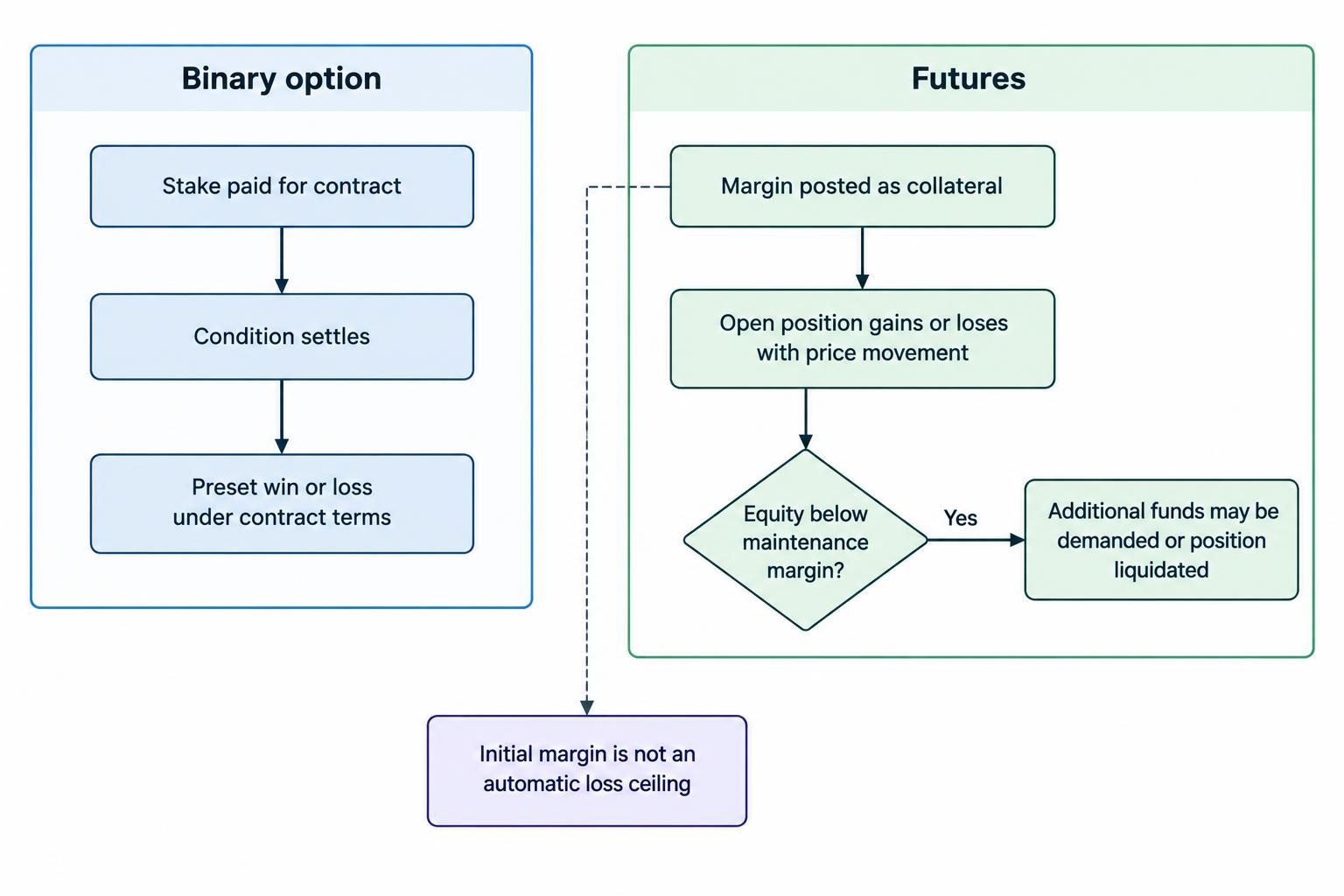
A binary stake pays for the contract’s defined outcome. In the example above, the A$100 stake is the amount exposed to the contractual loss. Money elsewhere in the account is a separate issue, including any risk attached to the provider holding it.
Futures margin serves a different purpose. It is collateral supporting obligations on an open position, not a purchase price or an automatic loss ceiling. Initial margin is required to establish a position. Maintenance margin is the minimum account equity required to support it. Falling below that level can trigger a demand for more funds or liquidation. Margin requirements can also change with market conditions, as covered in the CME guide to initial and maintenance margin.
This makes comparisons based on the smallest advertised deposit misleading. A low entry requirement does not mean a small position. The contract multiplier determines how much money each price movement gains or loses.
Suppose a hypothetical futures position requires US$1,500 in margin. If the position loses US$500, that is a trading loss against the account, not a fee deducted from a prepaid US$1,500 contract. Nor does the original margin amount promise that losses will stop there.
Futures losses can exceed the initial investment, and a broker may close a position when a margin call is not met. The Moneysmart explanation of futures risks makes both points explicit. Having enough money to open a position is therefore a different question from having enough money to withstand its price movements.
Before considering an order, calculate the currency value of an adverse move and the effect on account equity. The deposit figure alone cannot answer either question.
Expiry, Early Exit and Settlement
A binary option’s expiry is part of the condition being purchased. A view that a market will rise “eventually” does not resolve whether it will finish above a threshold at 10:05 am. A price can move in the predicted direction after expiry and still leave the expired contract as a loss.
Some binary contracts offer early closure, but that facility must be checked rather than assumed. Its availability and quoted value depend on the provider’s terms. A button labelled “close” does not necessarily offer the same freedom as selling a position in an exchange market.
A futures contract also expires, but the contract’s expiry date and the trader’s intended holding period are separate. A trader can generally close an open position with an opposite transaction in the same contract month before expiry, provided the market is available and the order can be filled.
Contracts held through expiry need closer attention. Some settle in cash; others can create an obligation to make or take delivery. The ASX explanation of futures settlement distinguishes these arrangements. Never assume that every commodity future behaves like a cash settled index contract.
Rolling a position means closing exposure in one contract month and opening it in another. It is not a free extension of the old trade. The two months can trade at different prices, and both transactions can incur costs.
For someone holding a directional view for several weeks, those expiry and rollover mechanics matter more than the colour of the platform’s buy button.
Price References Must Match the Contract
Two products carrying the same market name do not necessarily use the same price. An index binary might settle against a named reference feed. An index future trades as its own contract, with a price for a particular expiry month.
That difference matters when assessing whether a trade “should” have won. A cash index chart, a futures chart and the settlement reference named in a binary contract are not automatically interchangeable.
Consider a hypothetical cash index reading of 6,000 while a futures contract trades at 6,018. Comparing both products against a 6,010 threshold without checking their references would mix two different measurements. The apparent disagreement does not, by itself, establish a pricing error.
Check the instrument, contract month, timestamp and settlement method before comparing chart values. The guide to cash index prices versus futures prices explains this distinction without treating either quote as universally correct.
The same discipline applies to strategy testing. A signal tested on one price series cannot simply inherit the execution prices or settlement outcomes of another product.
Execution Control and Trading Costs
Futures offer more control over when to attempt an exit, but an instruction to trade is not a guarantee of a particular execution price. Market orders prioritise execution, while limit orders restrict the acceptable price and may remain unfilled.
A stop order also needs careful treatment. Fast movement, gaps or poor liquidity can produce a worse result than the planned exit. A stop limit order can remain unfilled if no acceptable price is available. The CFTC advisory on trading systems and execution assumptions warns that stop orders may execute at different prices or fail to execute, and that spreads, commissions and data costs affect reported results.
This distinction separates a planned risk from a guaranteed maximum loss. A hypothetical ten point stop on one MES contract represents US$50 before costs if it fills at the intended level. It does not promise that every exit will cost exactly US$50.
For futures, examine the full round trip: entry and exit commissions, exchange and clearing charges, the bid and ask spread, and any slippage. Data subscriptions, platform charges and currency conversion may also apply, depending on the account.
For binary options, examine the relationship between the amount won and the amount lost, rather than judging the product solely by a “no commission” claim. In the earlier example, ten wins generate A$800 profit while ten losses cost A$1,000. The A$200 shortfall exists without a separately itemised dealing commission.
Neither a fixed payout nor a transparent fee schedule creates a profitable strategy. Both must be included in the arithmetic.
Central Clearing Changes Counterparty Risk, Not Market Risk
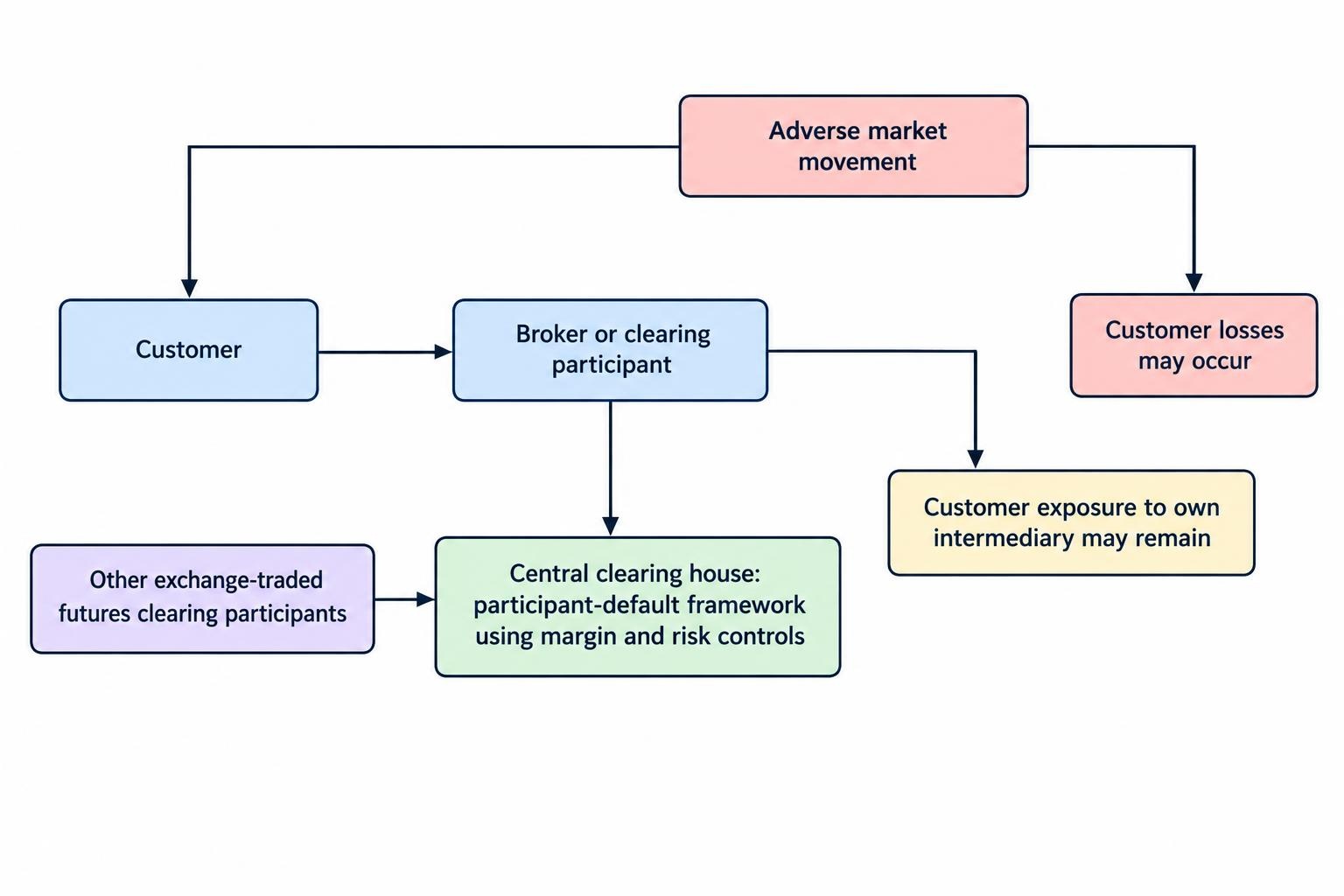
With a broker-issued binary option, the contract is commonly between the customer and the issuer. Its terms govern the payout obligation and settlement process.
Exchange traded futures use a different structure. Central clearing places a clearing house between clearing participants and supports the process with margin and other risk controls. That provides a framework for managing participant default; it does not remove losses caused by an adverse market move.
It also does not erase every risk between a customer and their broker or clearing provider. ASX Clear (Futures) describes the scope of its counterparty protection, including the point that novation does not remove a client’s exposure if their own clearing participant defaults.
The practical lesson is to separate three questions: what happens if the market moves against the position, what happens if an intermediary fails, and what happens if the platform or connection stops working. “Exchange traded” answers none of those questions on its own.
For an Australian customer, checking the contracting legal entity and its authorisations remains part of that assessment. The process for checking a broker’s licence should come before funding an account, not after a withdrawal problem.
Which Product Fits Which Purpose?
Futures can serve both speculation and hedging. A producer can use futures to offset part of an unwanted price exposure, while a trader can use them to take a directional position. Whether the hedge works well depends on how closely the contract matches the exposure, including its size and timing.
A binary option answers a narrower question: did the stated event occur? Its fixed payout does not grow with the scale of an underlying loss. That makes it an imperfect substitute for a futures hedge intended to respond point by point to market movement.
For directional trading, futures allow profit targets and attempted exits that are separate from the contract’s final expiry. The trade-off is an open exposure requiring enough capital, active monitoring and a clear grasp of the contract multiplier.
Binary options may look simpler because the displayed stake and potential payout are easy to read. That simplicity does not resolve the payout disadvantage, expiry risk or issuer risk. For Australian retail clients, it also does not change the prohibition on their issue and distribution.
The sensible decision need not be “choose futures instead”. If the exposure is too large, the margin obligations are unclear or the money is needed for living costs, neither product is an appropriate shortcut.
Assess the Exposure Before the Entry Requirement
Before considering a futures position, put the proposed trade into currency terms:
- Identify the exact contract: exchange, symbol, expiry month, multiplier and tick value.
- Calculate the exposure: notional value, expected price movement and the effect of holding more than one contract.
- Check funding obligations: current margin requirements, liquidation terms and the cash available after an adverse move.
- Plan the exit: intended order, possible execution failure and the deadline for avoiding unwanted settlement obligations.
Position size should follow that assessment, not the maximum quantity a platform permits. The guide to stake sizing covers the broader principle of matching exposure to an affordable loss, although futures require the extra distinction between collateral and money at risk.
Binary options and futures are not interchangeable versions of the same trade. Binary options tie the result to a defined condition and payout. Futures tie it to continuing price exposure, with margin obligations that can extend beyond the original deposit. For Australian retail readers, the binary options ban settles the access question; the remaining task is deciding whether futures risk is suitable at all.
This article was last updated on: October 22, 2026