Binary options on US shares link a fixed cash outcome to the price of an individual company’s stock. The question might be whether a share finishes above a stated price at a stated time. You are not buying the shares, and a correct view of the company’s prospects does not guarantee a winning contract.
For Australian readers, the regulatory position comes first. ASIC’s ban on issuing and distributing binary options to retail clients took effect on 3 May 2021 and extends until 1 October 2031. The examples below explain the product; they are not instructions for accessing an offshore provider.
What a US share binary option actually tracks
A share binary option refers to a stock price, but its value to the holder depends on the contract’s settlement condition. In a basic high-low contract, that condition asks whether the reference price finishes above or below the strike at expiry. Other structures can ask whether a price touches a barrier or stays within a range.
The distinction from share ownership matters. A binary option does not give its holder the right to buy or sell the underlying asset, a point covered in the SEC and CFTC investor alert on binary options. Holding the contract does not make you a shareholder or entitle you to the company’s dividends.
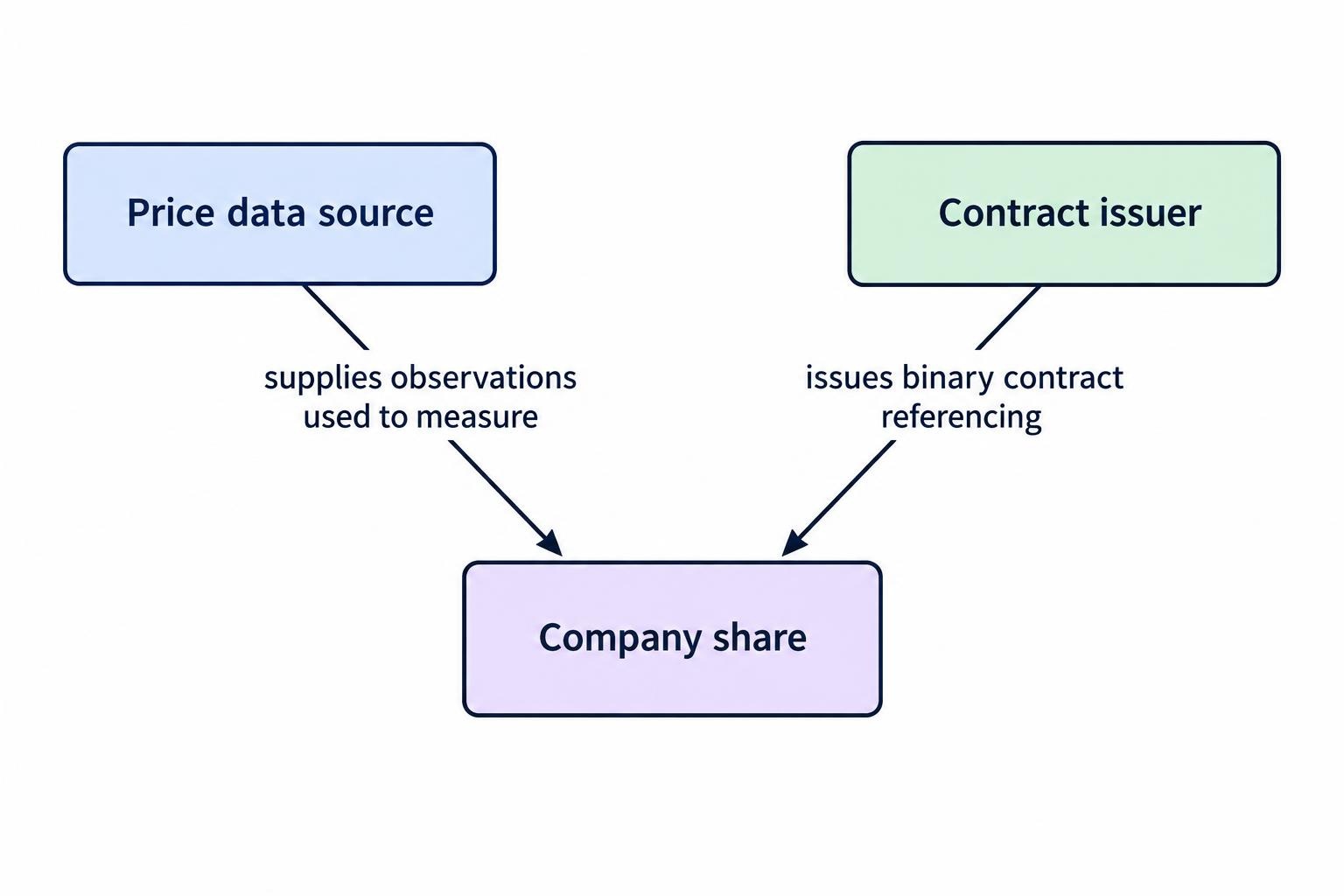
Separate three identities when examining a product: the company whose shares provide the reference price, the organisation supplying the price data, and the legal entity issuing the binary contract. A recognisable company name tells you nothing about the issuer’s permission to offer that product.
Also distinguish an individual share from an index, an exchange traded fund or a derivative referencing that share. Similar names on a trading menu do not make these interchangeable. The broader guide to share binary options covers the asset category; here, the focus is the practical effect of US market sessions, company announcements and settlement data.
A worked example: the stock can rise and the contract can lose
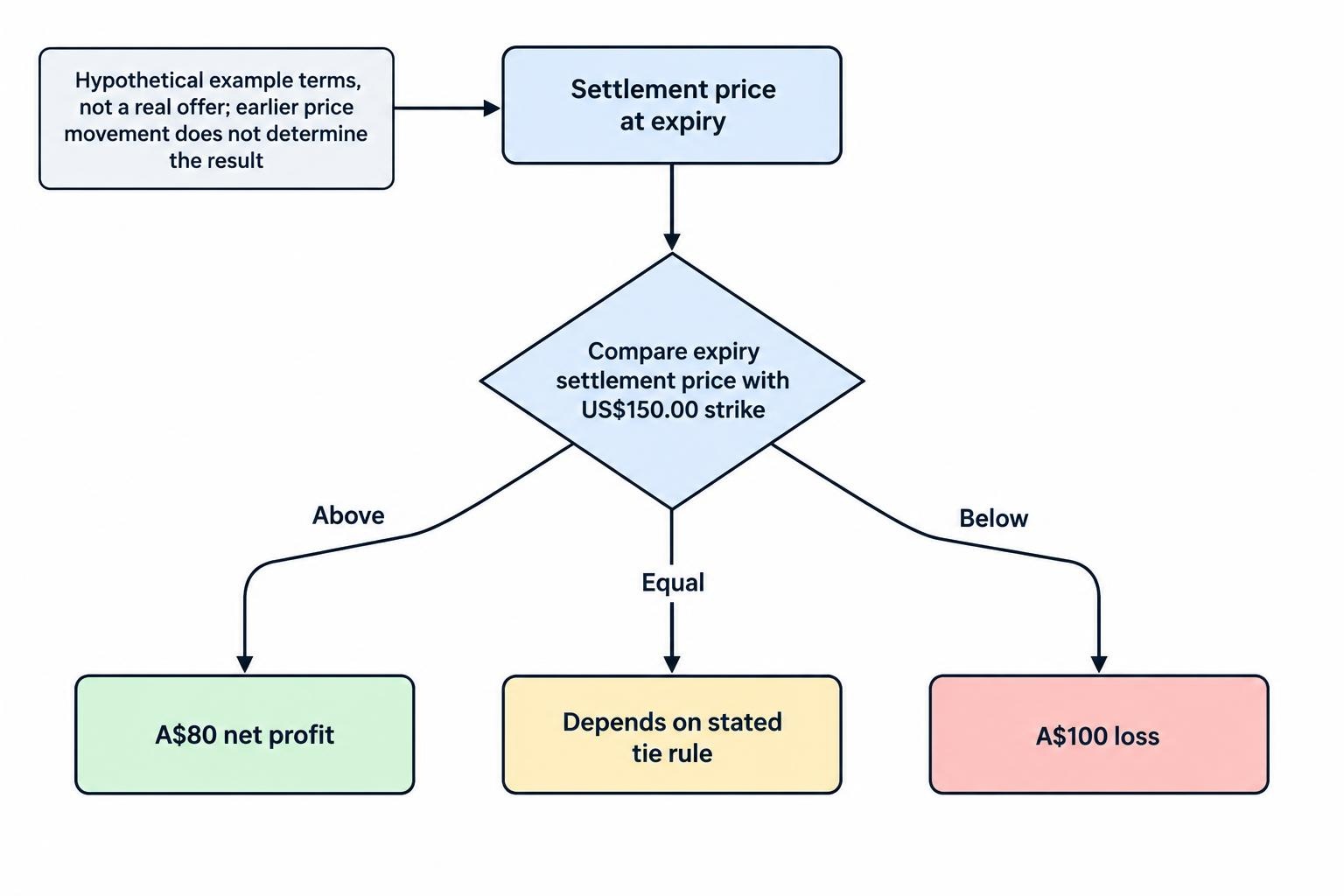
Consider a hypothetical contract on Company A with a strike of US$150.00 and an expiry of 3:00 pm New York time. The condition is that its settlement price must finish strictly above the strike. Assume an A$100 stake, an 80% net profit on a win and a full stake loss on a loss. These figures are illustrative, not a quoted offer.
| Settlement price | Contract outcome | Net result |
|---|---|---|
| US$150.01 | Above the strike | A$80 profit |
| US$155.00 | Above the strike | A$80 profit |
| US$149.99 | Below the strike | A$100 loss |
| US$150.00 | Exactly equal to the strike | Depends on the stated tie rule |
A five dollar rise produces no greater expiry payout than a one cent rise in this example. Equally, the stock could climb from US$148.00 to US$149.99 during the observation period and still leave the above-strike contract losing. The forecast must match the strike and expiry, not just the direction.
The payout also sets the arithmetic hurdle. With an 80% net winning return and a 100% losing stake, the break-even win rate is 100 ÷ 180, or about 55.56%, before costs and excluding ties. Fifty wins and fifty losses on equal A$100 stakes would lose A$1,000.
This is why recognising a familiar stock is not an analytical advantage by itself. The relevant question is whether the probability of satisfying the contract condition justifies its terms. The guide to probability and expected value in binary options develops that calculation without confusing a winning percentage with profitability.
US trading hours and the Australian clock
The NYSE trading hours and holiday calendar lists its core equity session as 9:30 am to 4:00 pm Eastern Time. It also identifies exchange holidays and scheduled early closes. Use the calendar for the actual observation date rather than assuming every weekday has a full session.
For Australian research, record both the New York timestamp and your local timestamp. Use a date-aware time conversion rather than saving one permanent Australian opening time. The date is part of the record, not decoration: “Monday evening” locally may refer to a different market date from the one shown in a US announcement.
A contract’s availability window also needs separating from the underlying market session. Check whether its reference data comes from regular trading, an extended session or another stated pricing method. An active countdown does not establish that the underlying shares are trading on the expected venue.
For a paper exercise, choose an observation period that sits wholly within one identified session. This removes an avoidable variable before examining contracts that cross an opening, closing auction or session boundary.
Extended hours change the pricing conditions
Trading outside regular hours can involve lower liquidity, wider spreads, greater volatility and prices that differ between trading systems. These risks appear in FINRA’s extended hours trading risk disclosure. For a binary contract, the concern is how those conditions affect the reference price used to decide the outcome.
Suppose the last transaction is above a strike, but the current bid is below it. A last-trade condition and a bid-based condition could produce different results. Neither should be substituted for the other when checking settlement.
Do not treat every price outside the core session as artificial, either. Establish the venue, session and data type before drawing a conclusion about what the quote represents.
The reference price matters more than the chart’s appearance
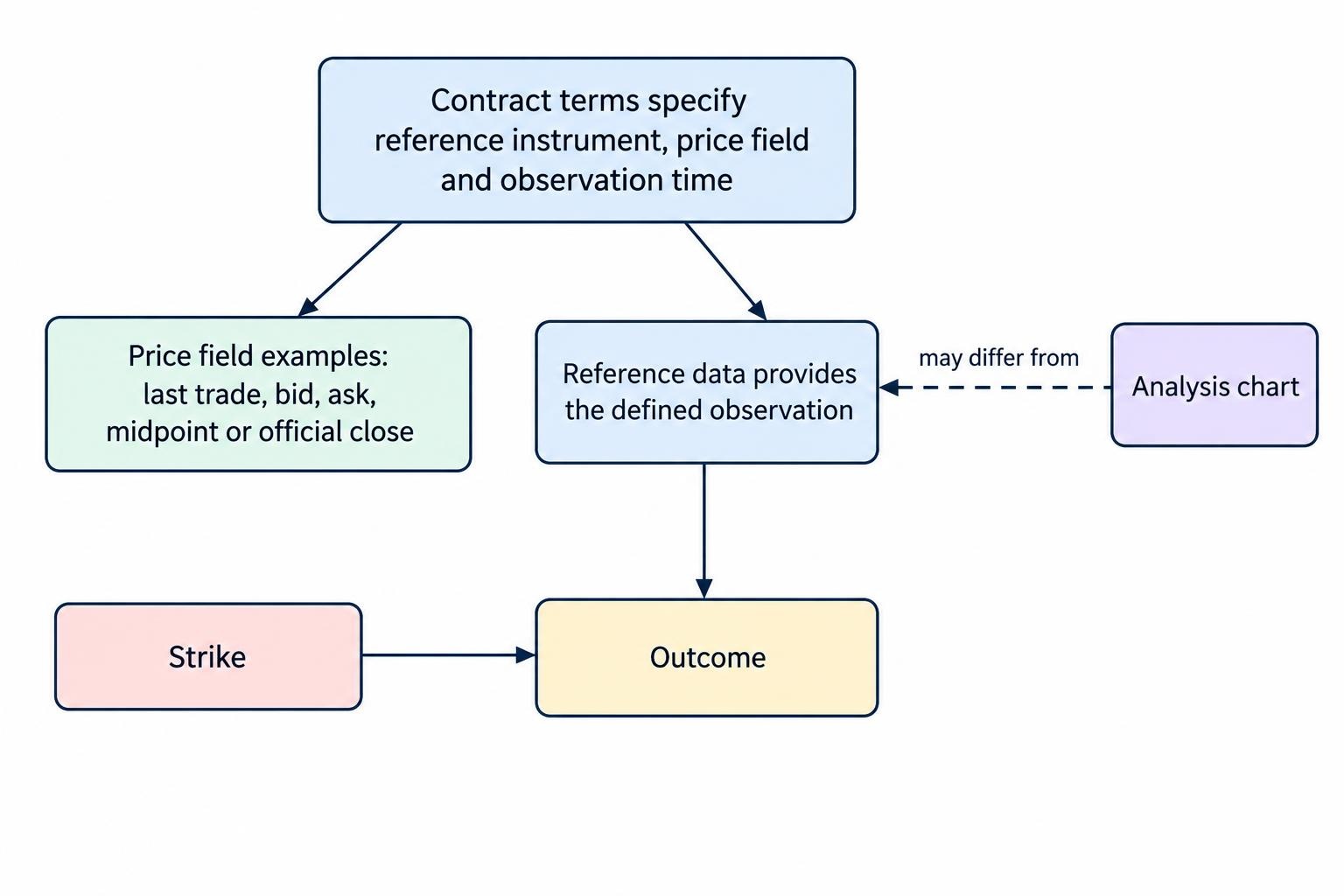
A chart labelled with a US company’s name is not a complete settlement specification. The terms should identify the reference instrument, the data provider or benchmark, the price field and the observation time. “Market price” leaves too much unanswered.
Check whether the contract uses a last transaction, bid, ask, midpoint, official closing price or an average over a defined interval. Also check timestamp precision and the treatment of missing updates. A one-minute candle cannot, on its own, establish which price applied at a particular second.
The chart used for analysis and the feed used for settlement need not be identical. Before comparing them, check whether either display is delayed, whether both include the same sessions and whether historical prices have been adjusted. The guide to price feeds and benchmarks explains these distinctions.
Consider a hypothetical discrepancy: an analysis chart shows US$150.02 at expiry, while the contract settles at US$149.99. That difference could decide the entire stake. Investigating it requires the contract’s recorded timestamp and reference price, not just a screenshot of a nearby candle.
For the same reason, rounded displays deserve attention. A screen showing US$150.00 may conceal extra decimal places. The tie rule should state whether equality is assessed using the full reference value or a rounded figure. Never assume that matching numbers on screen guarantee a refund.
Earnings announcements create a timing problem
Company research and binary settlement answer different questions. Research might support a view that a business will grow over several years. A binary contract might ask whether its share price is above a threshold in ten minutes. The first proposition does not establish the second.
For an earnings exercise, start with the company’s confirmed release date and intended publication window. Distinguish the results release from the conference call. Then compare both with the contract’s observation period. A contract that expires before the announcement cannot directly capture the price response to information that has not yet been published.
Suppose a hypothetical company reports rising profits but gives a weaker sales outlook than investors expected. A falling share price would not contradict the profit increase. Reading only the headline could miss the information that matters to the immediate reaction.
Even a correct initial interpretation may not match the expiry result. In a hypothetical sequence, the price could jump above the strike, reverse below it and recover after expiry. Only the defined settlement observation decides a standard expiry-based contract.
Keep this separate from a general news trading strategy. The immediate task is to establish what information arrived, when it became public and which price observation the contract uses. The guide to earnings reports and company news examines the announcement process in more detail.
Trading halts and corporate actions need written rules
A share can stop trading while a binary contract’s expiry approaches. Exchanges may halt trading when price-sensitive news is pending, giving participants time to assess it. The SEC’s explanation of trading halts and delays describes this mechanism.
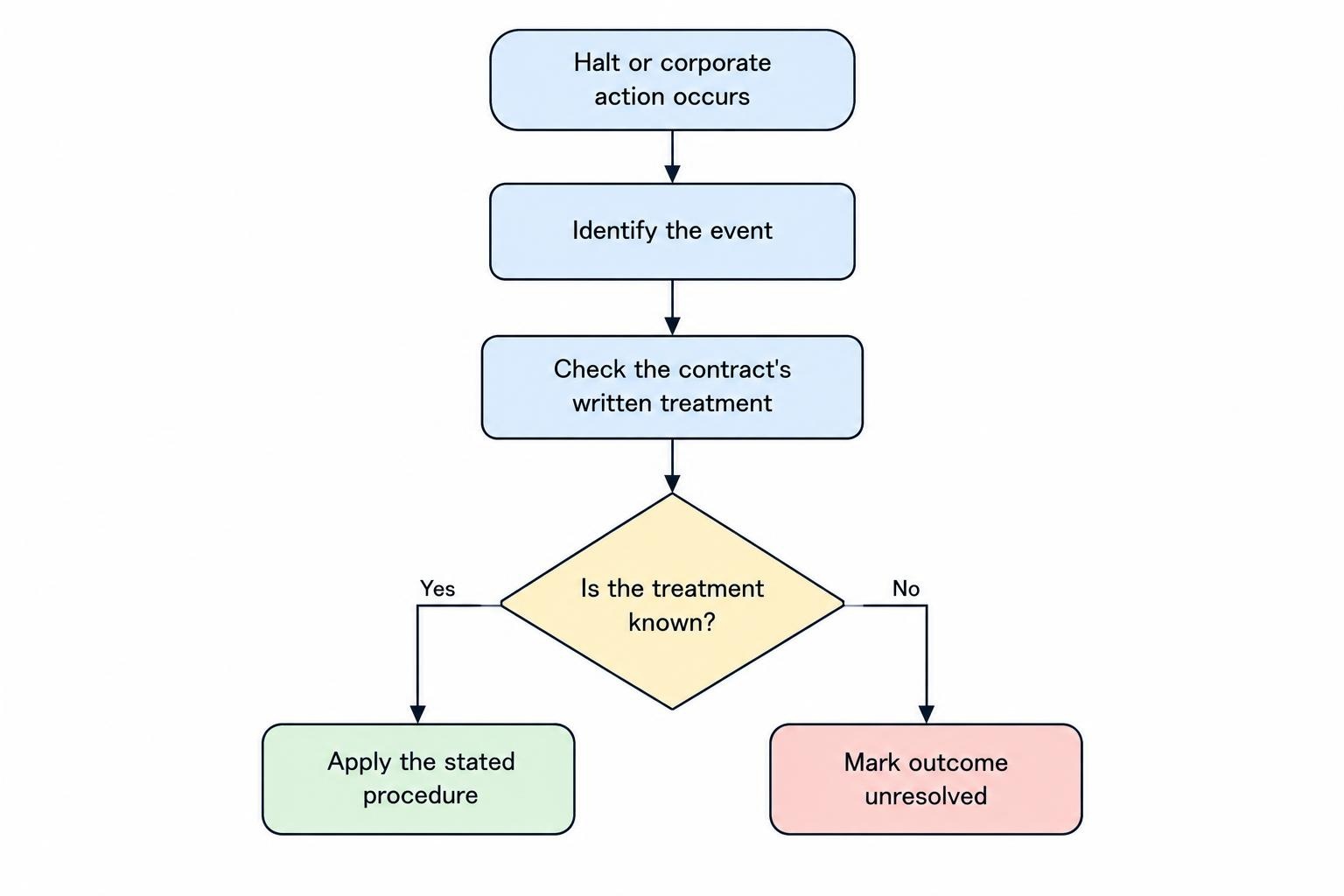
A halt in the underlying share does not, by itself, tell you how a separate binary contract settles. Its terms need to address that event. Does the issuer cancel the contract, postpone observation, use the last eligible price or apply another method? Do not assume the countdown pauses with the stock.
For paper analysis, mark the halt rather than filling the gap with a price from another session or instrument. If the settlement rule cannot be established, classify the outcome as unresolved. Forcing every observation into a win or loss makes the research look tidier, not better.
Splits are not ordinary price falls
Stock splits change the share count and per-share price without creating a matching change in a shareholder’s proportionate ownership. FINRA’s explanation of corporate actions distinguishes splits, dividends, mergers and other company events.
For a hypothetical four-for-one split, a theoretical US$200 share price becomes US$50, ignoring other price movements. Treating that mechanical change as an ordinary 75% market decline would wreck a historical test.
Ask whether a binary contract spanning the event adjusts its strike, terminates early or follows another stated procedure. Also check whether the historical chart and settlement records use the same adjustment basis. A beautifully smooth chart can still be the wrong dataset for the question.
The separate guide to dividends, stock splits and corporate actions covers these events. For US share binaries, the immediate requirement is simpler: identify the event and obtain its contractual treatment before assessing an outcome.
How to study US share contracts without confusing activity with evidence
A useful paper study begins with a defined question, not a watchlist of exciting company names. Choose a reference share, one session and one settlement method. Keep the hypothetical stake constant so that changing stake sizes do not disguise the result.
Record enough detail to reproduce each observation:
- Instrument: company, ticker, share class and reference market.
- Contract: direction, strike, expiry, payout and tie treatment.
- Data: provider, price field, timestamp and session.
- Events: scheduled announcements, halts and corporate actions.
- Result: settlement value, hypothetical cash outcome and any unresolved discrepancy.
Separate observations around announcements from those made during uneventful sessions. Otherwise, an apparent pattern may reflect a mixture of different conditions. Do not remove losing observations simply because the price movement looked unusual.
Keep the payout assumption visible throughout the study. A result calculated using an 80% net winning return cannot be transferred unchanged to a contract paying 65%. Likewise, a test using minute-end prices does not validate a contract settling at another timestamp.
A small sample can help expose recording mistakes and unclear rules. It does not establish a dependable forecasting advantage. The first useful result may be that the available data cannot reproduce settlement reliably.
Keep the stock, contract and legal position separate
US share binary options combine three questions: what the stock does, how the contract measures it and whether the product may lawfully be offered to the client. None can replace the others. A strong business does not guarantee a favourable expiry price, and an accurate chart does not establish the issuer’s regulatory status.
For Australian retail readers, the ban is the starting point, not a footnote beneath a broker’s asset list. The guide to binary options regulation in Australia covers that position in more detail.
When assessing an educational example, insist on a named reference instrument, a reproducible price observation and clear treatment of exceptional events. If those details are missing, the problem is not a shortage of trading signals. The contract itself cannot be evaluated properly.
This article was last updated on: October 22, 2026