The main economic drivers of forex markets are interest rate expectations, inflation, employment, economic growth, trade conditions and investors’ willingness to take risk. These forces affect demand for one currency relative to another. Their influence depends on what markets expected before the news arrived, not simply whether a headline looks positive or negative.
For Australian dollar analysis, the comparison often involves Australian and US monetary policy, commodity export prices and global financial conditions. The practical task is to identify what changed, which currency it favours and whether that change matters over the period being examined.
Australian regulatory context: ASIC’s prohibition on issuing and distributing binary options to retail clients remains in force until 1 October 2031. This article provides market education, not a recommendation to access these products. See ASIC’s binary options ban extension.
Exchange Rates Compare Two Economies
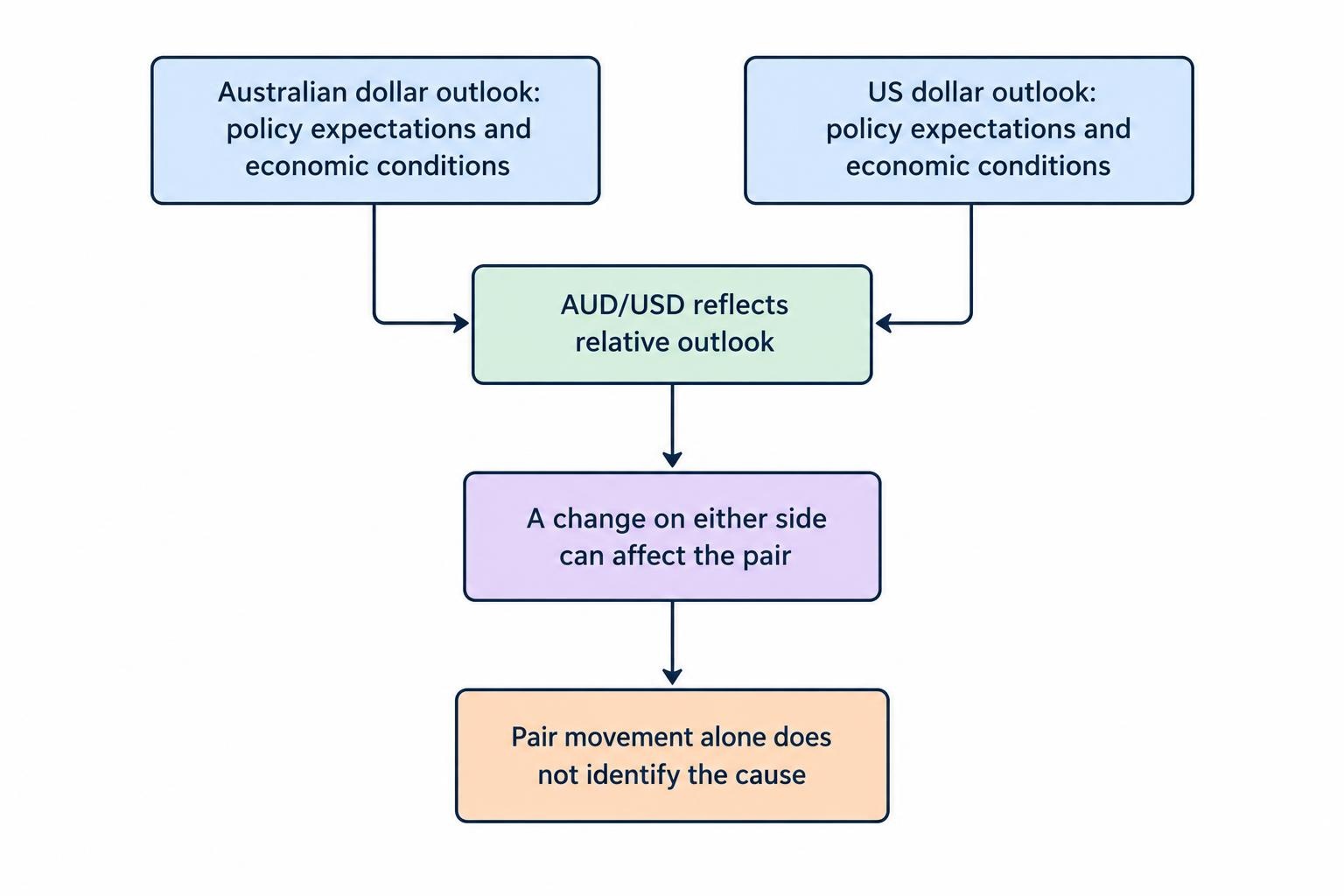
A currency pair expresses one currency’s value in another. AUD/USD rises when the Australian dollar strengthens against the US dollar, or equivalently when the US dollar weakens against the Australian dollar. A movement does not, by itself, reveal which side caused it.
This matters because domestic economic improvement does not guarantee currency appreciation. In a hypothetical example, Australian employment could improve while US inflation causes investors to expect much higher US interest rates. AUD/USD could fall despite the favourable Australian report.
Start with both sides of the pair. Identify the currencies, their central banks and the economic developments that could alter their relative appeal. The forex markets guide provides the broader context for analysing currency pairs rather than treating each currency in isolation.
A useful question is therefore not “Is the Australian economy doing well?” It is “Has the outlook for holding Australian dollars improved relative to holding US dollars?” Currencies do not award medals for good economic news.
Interest Rates and Central Bank Expectations
Relative interest rates affect currency demand
Higher interest rates can make assets denominated in a currency more attractive, other conditions unchanged. Buying those assets may require investors to buy the currency first. The Bank of England’s explanation of exchange rate influences connects higher UK interest rates with stronger demand for pounds, while also recognising the role of economic and financial stability.
The comparison matters more than the domestic rate alone. Suppose Australian rates remain at a hypothetical 4%, while US rates fall from 5% to 4.5%. The Australian rate has not increased, but its disadvantage against the US rate has narrowed.
That change could support AUD/USD. It would not make appreciation inevitable: investors must still consider risk, inflation and the outlook for both economies. A high advertised interest rate is not a promise that the associated currency will rise.
The expected path matters, not just the announcement
A central bank decision contains more than a number. Its statement, forecasts and subsequent communication can change expectations about the next several decisions.
An expected rate increase may deliver little new information. A decision to leave rates unchanged could matter more if investors had anticipated a cut. Research on monetary policy surprises and exchange rates distinguishes changes in the timing of policy from changes in its expected future path.
Consider a hypothetical central bank that raises rates by 0.25 percentage points. If investors already expected that increase but had also anticipated several more, a statement suggesting the tightening cycle has finished could weaken the currency. The immediate decision and the forward message would point in different directions.
For analysis, write down the expected decision before reading the announcement. Then separate the actual rate change from any change in the outlook. Otherwise, it is easy to explain the price move backwards after seeing the chart.
Inflation: Read the Surprise and Its Composition
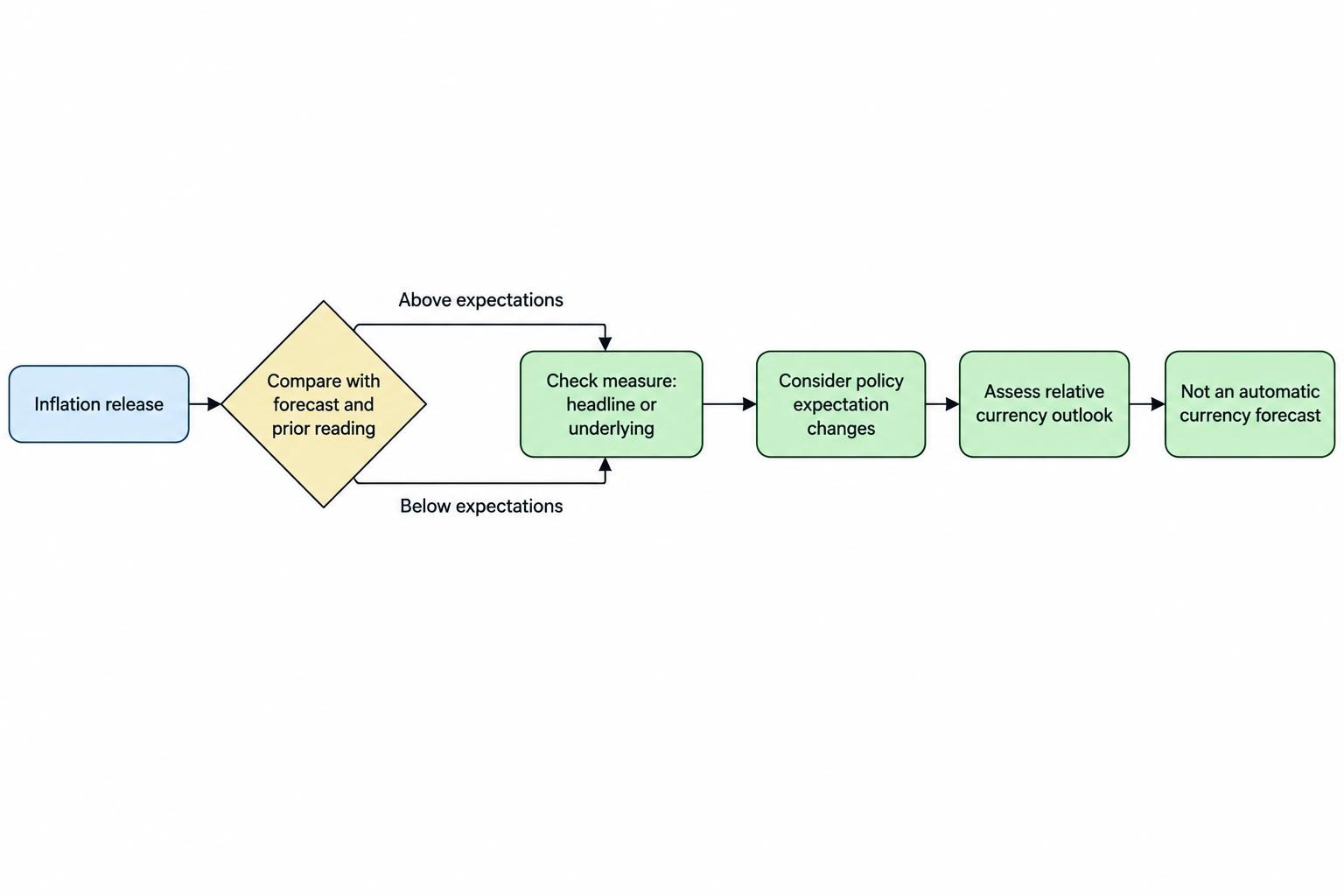
Inflation matters partly because it can change expectations about monetary policy. The analytical question is whether the new figures make tighter or easier policy more plausible, rather than whether inflation is simply “high” or “low”.
Headline inflation and underlying inflation can tell different stories. Australia’s trimmed mean measure reduces the influence of unusually large price changes, helping distinguish broader inflation pressure from temporary movements. The ABS explanation of underlying inflation measures sets out how the trimmed mean and weighted median work.
Suppose annual inflation previously measured 3.8%, the forecast is 3.2%, and the new result is 3.5%. Inflation has fallen, but by less than expected. Calling that release “lower inflation” is accurate yet incomplete. An interpretation based on reduced expectations of rate cuts would differ from one based only on the decline from the previous reading.
Check that the figures being compared measure the same thing. An annual change, a monthly change and a quarterly change are not interchangeable. Nor should a seasonally adjusted forecast be casually compared with an unadjusted result.
These checks do not produce a currency forecast automatically. They establish what the release actually says before any monetary policy argument is built on it.
Employment and Economic Growth
A jobs report contains several moving parts
Employment releases deserve more attention than their headline job count. For US analysis, payroll employment, unemployment, earnings and hours provide different information. Payroll figures estimate jobs, while the household survey supplies measures including unemployment. Earlier estimates can also change through revisions; the BLS guide to Employment Situation methods explains these distinctions.
Consider a hypothetical report showing more new jobs than forecast, slower wage growth and downward revisions to earlier payroll estimates. “Jobs beat expectations” would describe only part of the release. Before assigning a directional interpretation, ask whether the combined figures suggest stronger demand, weaker wage pressure or a less convincing employment trend.
This also prevents double counting. A lower unemployment rate and higher payroll employment are not two identical confirmations from the same measurement process. They come from different surveys and answer different questions.
Growth data need a policy connection
GDP, retail spending and business activity reports belong in the same analytical framework: what would the result change about the economic outlook, and why would that matter for the currency?
A hypothetical acceleration in spending could strengthen an argument that interest rates will stay elevated. Alternatively, if the release adds little to what investors already expected, its usefulness as new information may be small. The distinction is between describing economic conditions and identifying a change in expectations.
Build scenarios before the release. One might be stronger activity with persistent inflation pressure; another might be weaker activity with easing pressure. State how each scenario would affect the policy argument, then acknowledge what could contradict it. “Good growth means buy the currency” skips too many steps.
Trade, Commodity Prices and the Australian Dollar
Commodity export prices deserve attention in Australian dollar analysis. Australia’s terms of trade measure export prices relative to import prices. Higher commodity export prices can improve that ratio, raise export income and encourage investment. These channels help explain the relationship between commodity prices and the currency described in the RBA’s analysis of Australian dollar drivers.
Keep the mechanism separate from a mechanical trading rule. A rise in one commodity price is not proof that every force affecting the Australian dollar has turned positive. The currency comparison still includes overseas interest rates, investment demand and risk sentiment.
For a hypothetical assessment, suppose export commodity prices improve while expected US interest rates rise sharply. Those developments could pull AUD/USD in opposite directions. An analysis that mentions only commodities would miss the competing interest rate argument.
The same discipline applies when interpreting overseas demand news. Ask whether it changes the expected price or volume of Australian exports, rather than assuming every favourable foreign growth headline benefits Australia by the same amount. The AUD/USD market guide focuses on how these Australian and US influences interact within that pair.
Risk Sentiment and Cross-Border Capital Flows
Investors do not choose currencies solely by comparing interest rates. Their willingness to accept potential losses also matters.
Historical periods of market stress have often involved depreciation in higher yielding currencies against the US dollar. The yen and Swiss franc have sometimes strengthened even against the dollar. IMF research on currency behaviour during risk-off episodes documents these patterns while showing that responses differ across currencies and episodes.
This creates a competing explanation for currency movements. An apparently attractive interest rate advantage may not dominate when investors are reducing risk. Conversely, a currency’s historical reputation as a safe haven should not be treated as a guarantee about its next reaction.
For analysis, distinguish a domestic economic story from a broader change in risk appetite. If several currencies move together against the US dollar, investigate the shared influence before assigning a separate domestic explanation to each one.
Also avoid treating correlation as a permanent rule. An observed relationship between currencies, equities or commodities is a starting point for investigation. It is not a substitute for identifying the event, the proposed transmission channel and evidence that would weaken the explanation.
Why Economic News Does Not Provide an Easy Entry Signal
Recognising the likely importance of a release is different from obtaining a favourable price after it appears.
Economic surprises can enter exchange rates as abrupt jumps rather than smooth, easily followed trends. Federal Reserve research on macroeconomic announcements and forex prices documented rapid price adjustment in historical interdealer data. The study also highlights a measurement problem: a published survey forecast is an imperfect representation of market expectations.
The practical inference is straightforward. Reading a favourable headline does not establish that its information remains unreflected in the price available afterwards. A correct interpretation of the news can still arrive too late to support the decision being considered.
Separate three questions: did the result differ from expectations, did it change the economic outlook, and has the observed exchange rate already adjusted? These questions are related, but they are not interchangeable.
Avoid inventing explanations for every reversal. If a price rises and then falls, the chart alone does not prove whether traders reconsidered the release, reacted to another headline or adjusted existing positions. Where the evidence does not distinguish between explanations, leave the cause uncertain.
A Hypothetical AUD/USD Release Analysis
The following example illustrates a reasoning process, not an actual event or a forecast.
Assume Australian inflation falls from 3.8% to 3.5%, against a forecast of 3.2%. At the same time, suppose the latest central bank communication has stressed concern about persistent inflation. The result would challenge an argument based on inflation cooling as quickly as expected, even though the annual rate declined.
| Observation | Analytical implication | What remains unresolved |
|---|---|---|
| Inflation exceeds the forecast | Consider whether expectations of easier Australian policy should change | Does the detail show persistent or temporary pressure? |
| AUD/USD rises after the release | The movement is consistent with an Australian dollar supportive interpretation | How much information is already reflected in the new price? |
| US policy expectations also change | Reassess the relative outlook, not Australia alone | Which development has greater relevance over the period examined? |
The point is not to turn these observations into an automatic instruction. It is to keep the economic interpretation, the observed price response and the remaining uncertainty separate.
Build a Repeatable Economic Review
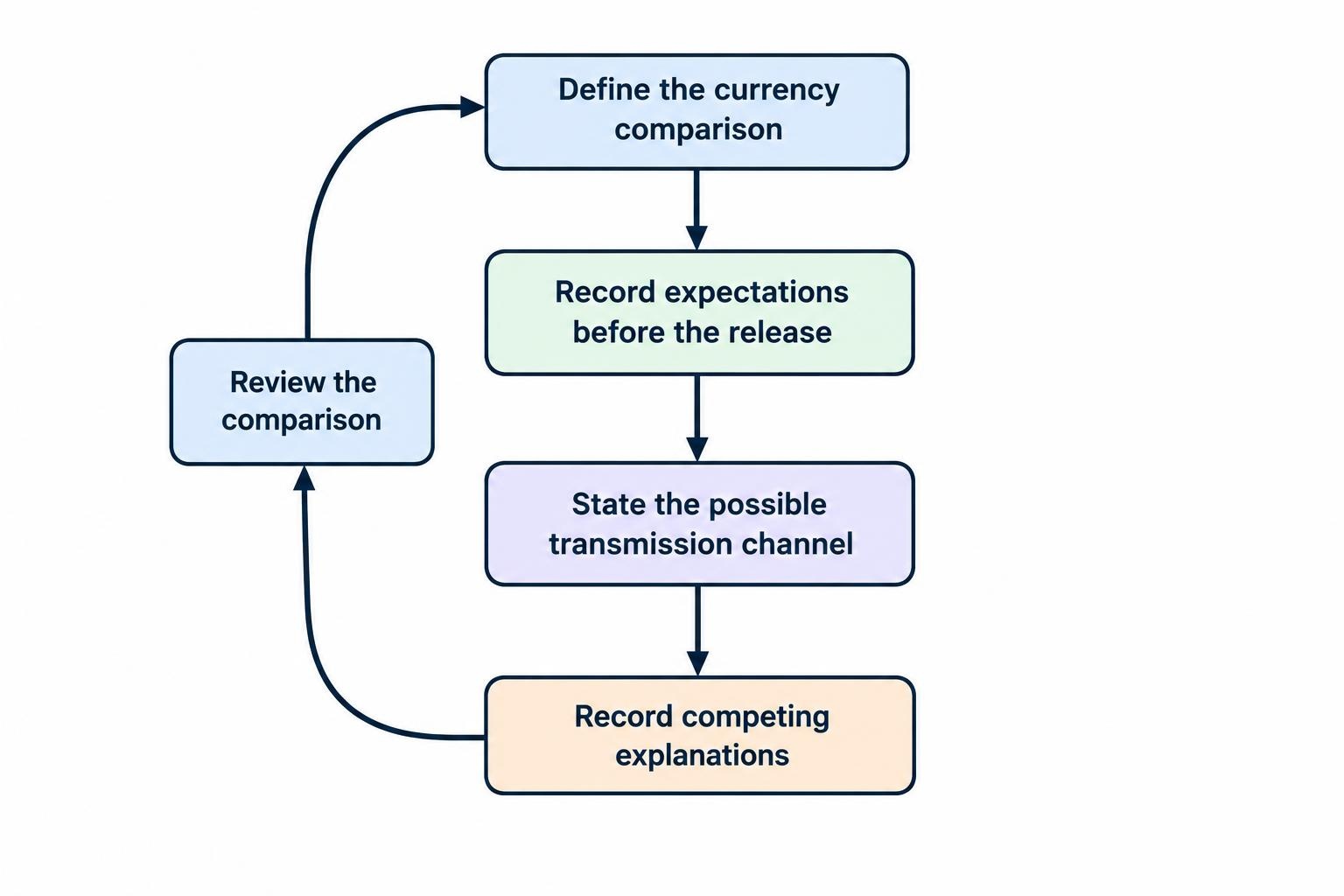
A useful review should be short enough to repeat and detailed enough to audit afterwards. Collecting more headlines is not necessarily better analysis.
- Define the comparison. Name both currencies and the policy or economic difference being examined.
- Record expectations. Save the forecast, previous reading and any relevant revisions before reviewing the outcome.
- State the transmission channel. Explain how the result could affect expected interest rates, export income, investment demand or risk appetite.
- Record competing explanations. Note what would weaken the argument, including developments affecting the other currency.
Use an economic calendar to organise scheduled releases, then verify the release time and figures with the issuing institution. Check the calendar’s time zone rather than assuming that the displayed time matches your location.
Afterwards, compare the original reasoning with what occurred. Preserve the forecast available before publication instead of replacing it with a later estimate. Note whether the release changed the economic argument, whether the exchange rate moved consistently with that argument and what remains unexplained.
This produces a more useful record than “inflation up, currency up”. It also makes weak reasoning easier to spot before it becomes a habit.
What This Means for Forex Binary Options Analysis
An economic view and a binary contract outcome answer different questions. The economic view concerns the forces that could affect an exchange rate. A conventional high-low binary contract concerns whether its settlement price satisfies a stated condition relative to a strike at expiry.
Consider a hypothetical AUD/USD contract with a strike of 0.6600. Suppose the pair reaches 0.6610 after favourable Australian news but settles at 0.6599. Under terms requiring settlement strictly above the strike, the higher-price condition would not be met. The earlier rise would not determine the outcome.
That distinction is why binary options expiry times cannot be treated as an afterthought. A view about economic conditions over several months does not establish where the settlement price will sit at a chosen moment. Nor does a plausible directional argument establish a reliable probability of meeting that condition.
Economic analysis is most useful here as a way to identify relevant information and challenge simplistic claims. It cannot remove uncertainty about price, timing or settlement. Start with the relative economic outlook, test the explanation against expectations and keep the contract question separate from the macroeconomic story.
This article was last updated on: October 22, 2026