Day trading means opening and closing a market position within the same trading session. A trade might last a few seconds, several minutes or most of the day. The defining feature is the intended holding period, rather than the number of trades, the chart interval or the use of borrowed money.
Australian residents can day trade through several markets, including shares, exchange-traded funds, futures, exchange-traded options and contracts for difference. These products have different ownership structures, settlement arrangements and loss exposures. Buying shares with available cash is materially different from taking a leveraged derivative position, even when both positions are closed before the market shuts.
The purpose is generally to profit from short-term price changes. That requires a price movement large enough to cover the costs of entering and leaving the position. Correctly predicting direction is therefore insufficient: the size and timing of the movement, execution prices and trading costs also determine the result.
Day trading also differs from holding investments for dividends or long-term business growth. An intraday share trader still owns the shares while holding them, but the trading decision usually depends on near-term price behaviour. A derivative trader may have price exposure without owning the underlying asset.
Read a more detailed guide on how to start day trading in Australia.
What the Australian loss figures show
ASIC reported in January 2026 that 68% of retail CFD investors lost money in the 2024 financial year. Their losses exceeded $458 million, including $73 million in fees. These figures appear in ASIC’s review of the CFD sector.
This is evidence about retail CFD outcomes. It is not a measured failure rate for every Australian day trader, and it does not describe unleveraged share trading separately. The distinction matters because holding periods, products and financing arrangements differ.
Nevertheless, the figures challenge the suggestion that accessible platforms and basic technical knowledge make trading a dependable income source. A trader needs a repeatable advantage after costs, and demonstrating that advantage requires more than a profitable week or a successful demonstration account.
A sound assessment starts with records. Net results, capital at risk, the size of losing periods and the time spent trading provide more useful evidence than screenshots of selected winning trades.
Markets available to Australian day traders
The market determines what the trader owns, how a position can be closed and what happens if an exit fails. Choosing a product purely because its minimum deposit is low overlooks these differences.
| Market or product | What the position represents | Main intraday considerations |
|---|---|---|
| Shares and ordinary ETFs bought with cash | Ownership of shares or fund units | Available capital, liquidity, brokerage, settlement and trading halts |
| Margin forex and CFDs | A derivative exposure under the provider’s contract | Leverage, spreads, counterparty risk, margin close-out and account protections |
| Exchange-traded futures | A standardised contract with a defined multiplier and expiry | Tick value, margin requirements, expiry arrangements and losses beyond initial margin |
| Purchased exchange-traded options | A contractual right acquired for a premium | Spread, time value, volatility, expiry and exercise arrangements |
| Written exchange-traded options | An obligation under the option contract | Margin, assignment and potentially substantial losses |
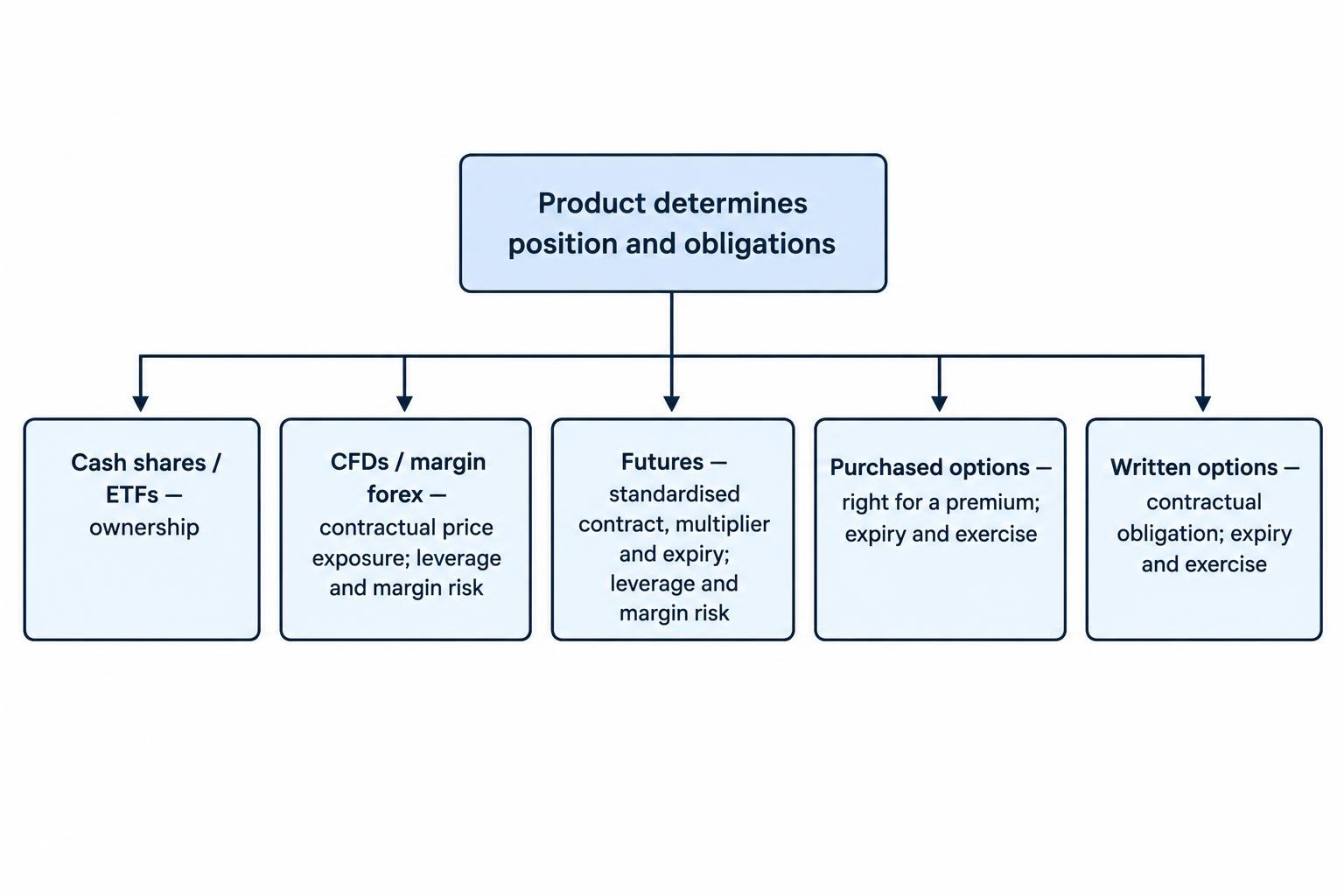
Shares and exchange-traded funds
A cash share account allows a trader to buy securities without borrowing. The purchase price still represents capital at risk, but an ordinary fully paid share position does not acquire leverage simply because it is held briefly.
For example, buying 1,000 shares at $10 commits $10,000 before brokerage. A sale at $10.05 produces a $50 gross trading gain. Whether that is worthwhile depends on transaction costs and the capital and time required to produce it.
ETFs can provide exposure to an index or other portfolio through a listed security. Their trading characteristics depend on the fund, the underlying market and available liquidity. A diversified ETF may reduce dependence on one company, but its price can still move against an intraday position. Leveraged or inverse products require separate analysis of their design.
Liquid securities generally make it easier to execute moderate orders near displayed prices. Liquidity can still deteriorate around announcements or market disruption. A familiar company name does not guarantee that the desired quantity will be available at the desired price.
Forex and CFDs
A contract for difference, or CFD, gives exposure to the change in a reference price under a contract with the issuer. A share CFD does not give ownership of the referenced shares. Margin forex similarly involves contractual currency exposure rather than necessarily purchasing currency for delivery.
These products commonly allow positions larger than the cash posted as margin. A 1% move against $20,000 of exposure creates a $200 trading loss before costs, regardless of whether the trader deposited $1,000 or $20,000 to support it.
ASIC’s Moneysmart explanation of CFDs describes their leverage and provider-related risks. Product terms determine pricing, financing, close-out and other contractual arrangements.
For forex, liquidity and trading activity change across the global day. An Australian afternoon trade and a trade during overlapping European and US hours may face different conditions. The guide to forex trading sessions explains that timing, while economic drivers of currencies provides context for scheduled announcements.
Futures and exchange-traded options
Futures have specified contract sizes, price increments and settlement arrangements. A small-looking price change can represent a substantial monetary change once the contract multiplier is applied. Initial margin is security supporting the obligation; it is not the purchase price or a maximum-loss limit.
As Moneysmart’s futures guide explains, losses can exceed initial margin. Anyone intending to close intraday still needs to understand expiry and settlement in case the position remains open.
Options introduce additional variables. Their prices respond to the underlying asset, remaining time and expected volatility. Buying a call is therefore different from buying the underlying shares, even when both express an expectation of a rising price.
For a purchased option that is closed or expires without exercise, the loss is limited to the premium and associated costs. Exercise can create a separate underlying position and funding requirement. Writing an option creates obligations rather than merely disposing of an existing purchased option; potential losses can be much larger. Moneysmart’s exchange-traded options guide explains these differences.
Australian regulation and retail protections
Licensing and the entity holding the account
An Australian financial services licence, or AFSL, authorises specified financial services. It does not certify that a strategy will make money, guarantee a platform’s performance or protect an account against ordinary market losses.
The relevant question is which legal entity provides the service and whether its authorisations cover that activity. A trading brand may operate through several companies in different jurisdictions. The entity named in the account agreement matters more than the group’s advertising.
Moneysmart’s guidance on checking an investment provider explains how to verify licensing and identify warning signs. A company registration or an overseas licence is not interchangeable with appropriate Australian authorisation.
Account location also affects dispute handling and practical recovery options. An offshore account offering higher leverage may operate under different protections. The apparent improvement in trading terms needs to be considered alongside those differences.
Retail CFD leverage limits
ASIC’s retail CFD intervention introduced leverage limits that vary by underlying asset. The limits are ceilings for providers, rather than recommended exposure levels for clients.
| CFD reference asset | Maximum retail leverage |
|---|---|
| Major currency pair | 30:1 |
| Minor currency pair, gold or major sharemarket index | 20:1 |
| Commodity other than gold, or minor sharemarket index | 10:1 |
| Shares or other assets | 5:1 |
| Crypto-assets | 2:1 |
ASIC’s explanation of the CFD measures also describes standardised margin close-out, negative balance protection and restrictions on certain inducements. Negative balance protection limits covered retail CFD losses to funds in the CFD trading account. It does not protect those funds from being lost.
A trader can therefore lose substantially more than the margin initially allocated to one position while still remaining within the account-level protection. Keeping several positions in one account also means their combined performance can affect margin availability and forced closure.
Current rules and proposed changes
The CFD intervention began on 29 March 2021. As at 22 October 2026, the existing order is due to expire on 23 May 2027. On 12 October 2026, ASIC opened consultation on a proposed further ten-year extension and amendments, subject to the necessary approval.
The October 2026 consultation is a proposal, not an enacted extension. Trading guides should distinguish the protections currently operating from changes still under consideration.
Retail protections also should not be assumed to apply to wholesale accounts. Classification affects the applicable safeguards. An invitation to obtain higher leverage by changing status deserves scrutiny rather than being treated as a routine platform upgrade.
Binary options are a separate case
Binary options should not be presented as another ordinary retail day-trading choice in Australia. ASIC prohibited their issue and distribution to retail clients from 3 May 2021, and extended that prohibition until 1 October 2031.
An offshore website accepting registrations does not establish that its offer complies with Australian requirements. The separate article on ASIC’s binary options regulations covers that restriction. Its existence also does not make CFDs a suitable substitute for every person previously interested in binary options.
Trading hours, settlement and execution
ASX sessions and Australian time zones
ASX cash-market hours are stated in Sydney time. Under the currently published trading timetable, the opening auction begins within a randomised window from 9:59 am. Continuous trading begins around 10 am, following the auction and buffer, and ends at 4 pm. The closing auction occurs around 4:10 pm.
The auction phases differ from continuous trading. Submitting an order during an auction does not mean it will execute immediately at the last price shown. Traders intending to be flat before the close need an exit process that accounts for the relevant market phase.
Sydney daylight saving changes the relationship between exchange hours and some other Australian states. International markets follow their own clocks and holiday calendars. A schedule that fits around employment in one month may shift when Australian or overseas daylight saving changes.
Forex and futures can offer access beyond the ASX share session, but longer availability does not mean constant liquidity. Trading late overseas sessions also creates a practical fatigue issue. Availability is useful only when the trader can monitor the position and respond adequately.
Same-day trading still creates settlement obligations
ASX cash equities currently settle on T+2, meaning two business days after the trade. ASX’s settlement-cycle information distinguishes the existing arrangement from potential transition to T+1.
Selling shares on the purchase day does not erase the underlying transactions. Broker rules determine whether purchase and sale obligations can be offset, when proceeds become available and how much prefunding is required.
A trader should establish those rules before relying on unsettled proceeds for another purchase. A visible account balance, buying-power figure and withdrawable cash balance may represent different things.
Orders, spreads and unavailable exits
The last traded price records an earlier transaction. It is not a promise that another order can execute there. The bid is the available buying price and the offer is the selling price; their difference is the spread.
A market order prioritises execution but leaves the eventual price exposed to available liquidity. A limit order controls the acceptable price but may remain unfilled. Partial fills can also leave a position smaller than intended or only partly closed.
A stop order triggers according to its specified conditions. An ordinary stop does not guarantee the exit price. A stop-limit order adds a price constraint, but that constraint can prevent execution altogether if the market moves through it.
Trading halts, technical problems and sudden gaps can defeat an intended intraday exit. This is why a planned stop distance and an actual maximum loss are different concepts. The same issue underlies broader counterparty and platform risk.
Short positions require separate arrangements
Selling shares already held differs from selling borrowed shares. In a covered short sale, securities lending arrangements support delivery; borrowing costs and recall terms can affect the trade.
ASIC describes the general prohibition on naked short selling and the requirements around covered transactions in its market integrity guidance. A retail account should not be assumed to support short selling simply because it supports ordinary share purchases.
Trading costs, position sizing and loss limits
Measuring the full cost of a trade
The relevant cost is the complete entry-and-exit transaction. Brokerage can apply on both sides. Spreads, slippage, exchange charges and currency conversion can add costs even when a platform advertises low or zero commission.
Slippage is the difference between the expected execution price and the price actually obtained. It can occur when liquidity changes or an order consumes several price levels. Using a backtest that assumes every trade executes at a chart’s displayed price can materially understate this cost.
Foreign-market trading can also require conversion between Australian dollars and the account or transaction currency. Conversion may occur when funding, trading or withdrawing, depending on the arrangement. The guide to currency conversion costs explains why the quoted exchange rate and the applied rate need separate attention.
Market-data subscriptions, charting software and signal services are recurring expenses. They should be allocated across actual activity rather than ignored because they do not appear on each contract note.
For derivatives, financing rules depend on the product and provider. Closing within a calendar day does not automatically avoid every financing charge: the relevant cut-off and contract terms determine the result.
Why small targets are sensitive to costs
Consider a hypothetical share trade with a $50 gross profit. If entry and exit brokerage totals $20, the remaining gain is $30 before any further execution costs. An additional $10 of adverse execution reduces it to $20.
The same costs worsen a losing trade. A $50 adverse price movement becomes a $70 loss after the assumed brokerage. A strategy cannot be assessed by comparing the size of favourable and unfavourable price moves while excluding the cost of participating.
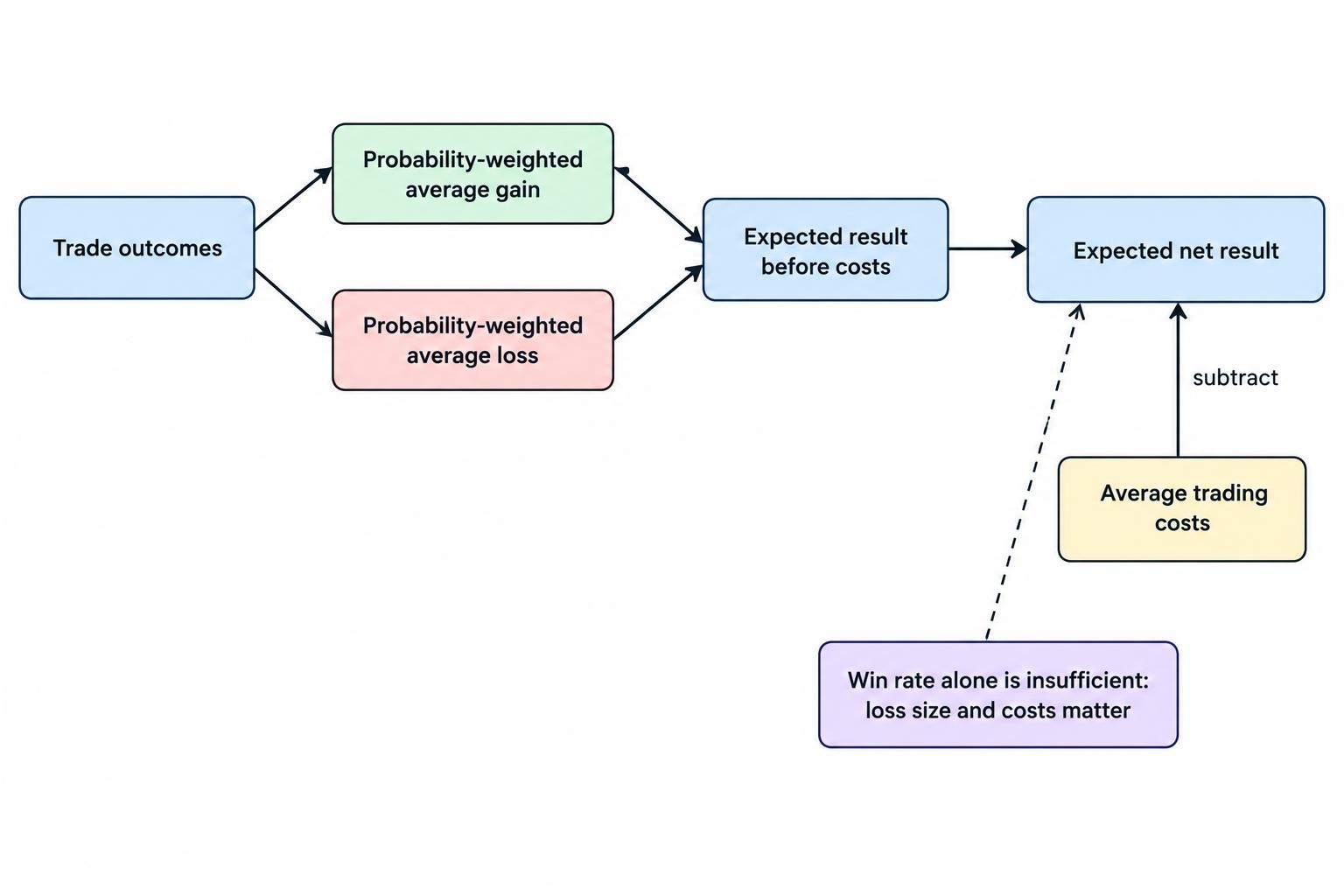
Trade frequency multiplies this effect. Making more trades increases the number of opportunities, but also the number of times the trader pays transaction costs. Frequency has value only when the additional trades retain a positive expectation after those costs.
A useful expression is that expected net result equals the probability-weighted average gain, less the probability-weighted average loss, less average trading costs. A high winning percentage can still produce a negative result if occasional losses are large.
Position size should follow the loss budget
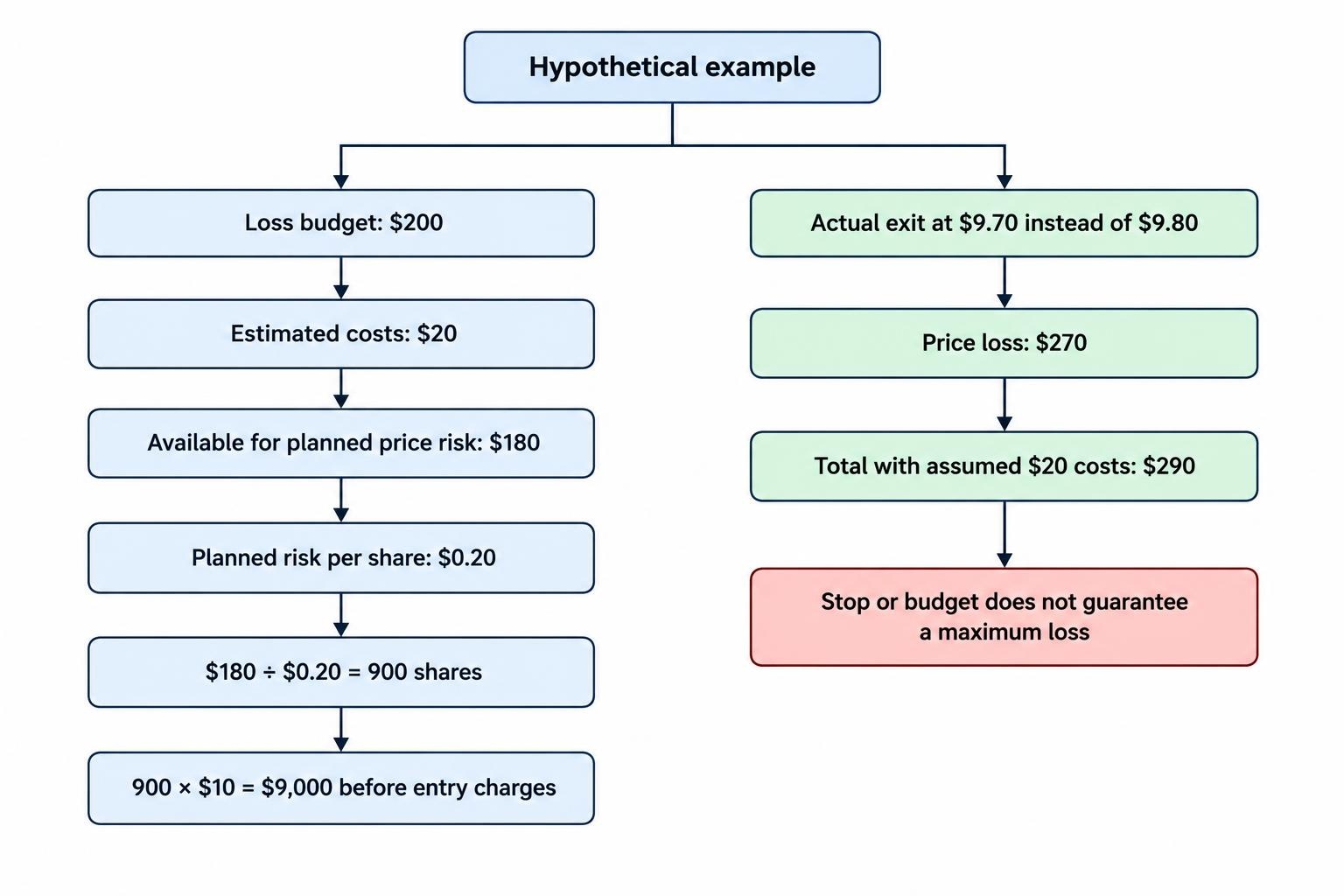
Suppose a trader has $20,000 of trading capital and chooses a hypothetical $200 loss budget for one trade. This is an illustration, not a suitable risk level for every account.
The intended share purchase is at $10, with an exit planned at $9.80 if the trade moves adversely. The planned price risk is 20 cents per share. Dividing $200 by $0.20 gives 1,000 shares, but that calculation leaves nothing for costs.
Allowing $20 for estimated transaction costs reduces the amount available for price movement to $180. At 20 cents per share, the resulting position is 900 shares, requiring $9,000 for the purchase before entry charges.
Even this revised calculation is conditional. If the actual exit occurs at $9.70, the price loss is $270, and the assumed $20 cost brings the total to $290. A loss budget governs planned exposure; it cannot guarantee the realised result.
For leveraged products, the same reasoning starts with the monetary exposure per price increment. The margin required to open the trade is a separate calculation. Sizing solely from available margin can create exposure far beyond the intended loss budget.
Account risk extends beyond individual trades
Several positions can respond to the same event. Holding multiple Australian bank shares, for example, may leave substantial common exposure to banking-sector news. Different trade tickets do not automatically create independent risks.
Correlation therefore matters when assessing the combined account. A daily loss limit should consider both realised losses and the exposure still open, rather than treating each new trade as a fresh start.
Drawdown measures the decline from an earlier capital peak. A 20% loss requires a 25% subsequent gain to recover, before withdrawals or further costs. This asymmetry makes preserving capital relevant even for a strategy with positive historical results.
Increasing position size to recover a poor session changes the risk precisely when execution and judgement may already be deteriorating. Predefined stopping conditions can limit that behaviour. They remain operating rules, however, rather than proof that the underlying strategy works.
Brokers, preparation and strategy testing
Comparing the service that will actually be used
Broker comparison should begin with the intended market and account arrangement. A platform suitable for occasional ASX share purchases may not support the required orders, market data or derivatives permissions.
The account documents should explain execution, custody or client-money arrangements, charges, withdrawal processing and the broker’s rights when margin or settlement obligations are unmet. Marketing descriptions rarely provide enough detail to resolve these questions.
Support also needs to be available when the relevant market is open. A trader using an overseas session may need assistance outside Australian office hours. The ability to contact a dealing or support desk during an outage is more relevant than the number of advertised communication channels.
Reliable internet access and a functioning device are basic requirements. A second connection or an alternative authorised way to manage positions can reduce operational disruption. Neither creates a trading advantage by itself.
Before placing an order, the trader needs to know where it resides and what happens if the local application disconnects. Some instructions may be held by the broker, while others can depend on software remaining active. These details must come from the actual platform documentation.
Turning a strategy into testable rules
“Buy momentum” is too vague to evaluate. A testable approach defines the market, qualifying conditions, entry method, exit conditions, position-size calculation and circumstances in which no trade is taken.
The rules also need to specify what happens around scheduled announcements. A setup tested during quiet sessions may behave differently when an economic release causes prices to jump.
Historical testing can help reject weak ideas, but it is vulnerable to hindsight. Repeatedly adjusting rules until they fit past data may capture accidental patterns. Testing on a separate period that was not used to develop the rules provides a more demanding check.
Results need realistic costs, spreads and execution assumptions. Illiquid securities create a particular problem: a historical chart may show a price without enough available quantity for the proposed position.
A demonstration account is useful for learning order entry and platform behaviour. Its fills, available liquidity and psychological demands may differ from live trading. Demonstration profits therefore establish less than a verified record of comparable live execution.
Records should reveal weaknesses
A trading journal is most useful when it captures why the order qualified, the intended exposure, actual entry and exit prices, costs and any departure from the rules. This makes it possible to separate a weak strategy from poor execution.
Performance should include losing days and abandoned approaches. Reporting only the surviving strategy after trying many alternatives creates a misleading impression of predictability.
Deposits and withdrawals must also be separated from trading returns. An account balance can rise because additional money was deposited, while a profitable account can shrink because funds were withdrawn.
Reviews should examine average net gains and losses, the distribution of outcomes and the largest drawdown. A small number of unusually profitable trades may explain most of the return. That is relevant when assessing whether the result is repeatable.
Signals and social trading groups
Paid signals transfer the entry decision without necessarily transferring knowledge of the risk. Published results may omit costs, losing recommendations or the delay between the provider’s trade and the subscriber’s execution.
Coordinated promotion of thinly traded shares creates a separate concern. ASIC has warned about social-media pump-and-dump activity in its market integrity publications. A group urging participants to buy together can expose later buyers to losses when earlier participants sell.
Australian tax and trading records
Tax treatment depends on the activity and the instrument. Calling an account a day-trading account does not, by itself, determine how its profits and losses are assessed.
For shares, the ATO distinguishes investing from carrying on a share-trading business. Investors generally deal with disposals under the capital gains tax rules, while a share-trading business generally treats shares as trading stock and its trading proceeds and expenses under the relevant income tax rules.
The ATO’s guidance on share investing versus share trading examines the activity’s circumstances. Profit intention alone is insufficient. Organisation, repetition, scale and the commercial character of the activity matter; no single self-selected label settles the issue.
Capital losses cannot be deducted from salary simply because the shares were held briefly. They generally reduce capital gains, with unused net capital losses carried forward. The ATO explains the distinction in its guidance on losses on shares and units.
Rules applying to share disposals should not automatically be transferred to CFDs, forex or other derivatives. Material uncertainty about classification or deductions warrants advice from a registered tax agent familiar with the instruments involved.
Records should identify transactions, dates, quantities, prices, brokerage, financing and currency conversions. Bank transfers and broker statements should reconcile with the trading ledger. The ATO’s share record-keeping guidance provides a starting point.
Exporting records regularly is prudent. A platform’s current screen may not preserve the detail needed years later, and changing brokers does not remove the need to substantiate earlier transactions.
Capital requirements and income expectations
A broker’s minimum deposit is an access threshold. It says little about whether the account can support a particular strategy after costs, losses and withdrawals.
A small account can be disproportionately affected by fixed brokerage and subscriptions. Increasing leverage to compensate for limited capital increases exposure; it does not improve the underlying strategy’s expected return.
Income expectations also need to account for variability. A hypothetical $2,000 monthly withdrawal from a $20,000 account equals 10% of starting capital each month, before allowing for tax, costs or losing periods. Describing that withdrawal as a modest wage does not make the required trading performance modest.
Money required for living costs creates additional pressure because expenses continue during a drawdown. Trading capital and household cash needs therefore require separate planning. A profitable period does not establish that future returns will arrive on the schedule needed to pay bills.
There is also an opportunity cost. Research, screen time, administration and tax records consume hours that could otherwise support employment or another activity. A fair assessment compares net results with both the capital exposed and the time committed.
Day trading is most accurately evaluated as a speculative activity with measurable operating costs and uncertain returns. Continued participation needs to rest on complete results after costs, acceptable losses and workable financial circumstances. Platform access, market knowledge and available leverage do not establish those conditions on their own.
This article was last updated on: October 22, 2026